Blogs
Electrical Conductivity Strength Balance: 7 Powerful Truths Breaking the Trade-Off Myth | DOMADIA™
Electrical Conductivity Strength Balance – The Industry’s Biggest Misconception
Electrical Conductivity Strength Balance has long been treated as a compromise in metallurgy. Engineers were taught: increase strength, lose conductivity. Increase conductivity, lose strength.
But modern alloy engineering has rewritten that rule.
At DOMADIA™, we challenge outdated assumptions with data-driven metallurgy. The truth? Electrical Conductivity Strength Balance is not a trade-off anymore—it’s an engineered outcome.
Let’s break the myth.
Why the Trade-Off Myth Existed
Pure metals behave predictably:
- Pure Copper → Excellent conductivity, low mechanical strength
- Alloyed Copper → Higher strength, reduced conductivity
Historically, alloying elements disrupted electron flow, reducing conductivity while improving strength through solid-solution strengthening or precipitation hardening.
This created the long-standing belief that Electrical Conductivity Strength Balance was impossible.
Until advanced metallurgical control changed everything.
Chemical Composition – Engineering the Balance
Modern high-performance copper alloys achieve Electrical Conductivity Strength Balance through precise micro-alloying and heat treatment.
Example: High-Conductivity Copper Alloys
| Element | Typical % Range | Purpose |
| Cu | 98.5 – 99.9 | Base conductivity |
| Cr | 0.5 – 1.2 | Precipitation strengthening |
| Zr | 0.05 – 0.20 | Grain refinement |
| Be (in specific grades) | 1.8 – 2.0 | High strength precipitation |
| Ni / Si | Controlled additions | Thermal stability |
The key lies in precipitation hardening, not heavy alloy loading.
That’s how Electrical Conductivity Strength Balance becomes achievable.
Properties – Where Science Wins
Modern alloys achieve:
Mechanical Properties
- Tensile Strength: 400 – 1400 MPa (depending on grade)
- Yield Strength: 350 – 1200 MPa
- Hardness: Up to 400 HV
Electrical Properties
- Conductivity: 45% – 100% IACS
- Low resistivity
- Stable at elevated temperatures
This proves that Electrical Conductivity Strength Balance is not theory—it’s measurable reality.
Technical Specifications
At DOMADIA™, materials engineered for Electrical Conductivity Strength Balance meet:
- ASTM B187
- ASTM B196
- ASTM B197
- DIN 17666
- EN 12163
- UNS C15000, C18200, C17200 families
These standards ensure performance consistency in demanding industrial environments.
Applications – Where Balance Matters Most
Industries cannot afford electrical failure or mechanical deformation.
Key Applications:
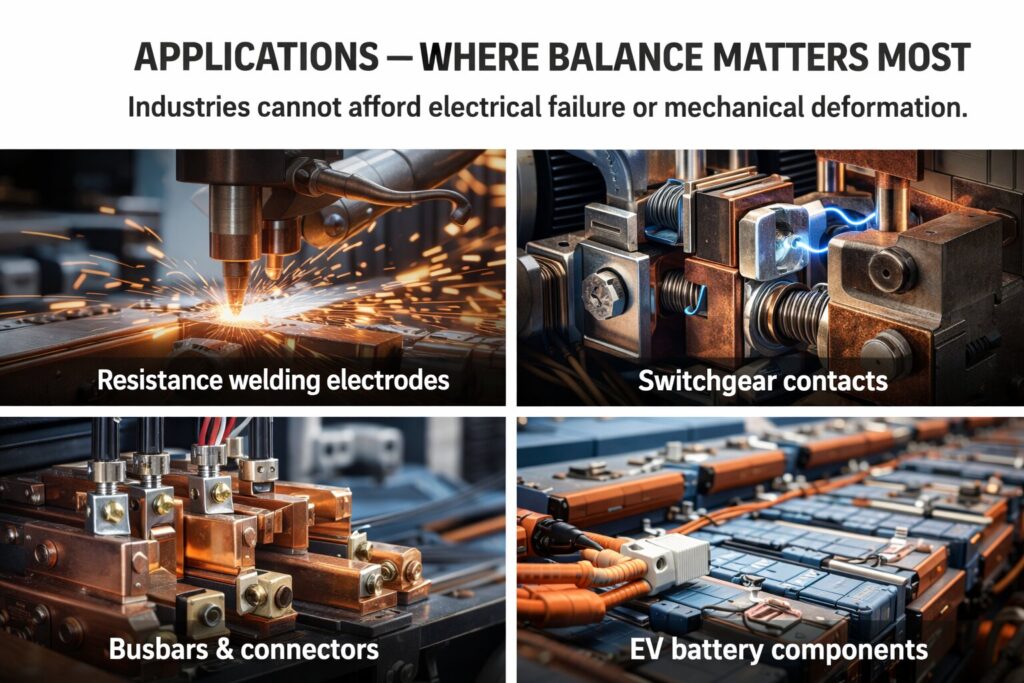
- Resistance welding electrodes
- Switchgear contacts
- Busbars & connectors
- EV battery components
- Aerospace grounding systems
- High-current terminals
In all these, Electrical Conductivity Strength Balance directly impacts safety, efficiency, and lifecycle cost.
Shapes Available
DOMADIA™ supplies alloys optimized for Electrical Conductivity Strength Balance in:
- Rods
- Bars
- Plates
- Sheets
- Tubes
- Forgings
- Custom machined components
Precision dimensions ensure optimal electrical and mechanical performance.
The Technology Behind the Breakthrough
Modern processing techniques include:
- Controlled precipitation hardening
- Grain boundary engineering
- Thermo-mechanical treatment
- Vacuum melting
- Oxygen control refining
These innovations allow Electrical Conductivity Strength Balance without compromise.
Why It Matters in 2026 & Beyond
With the nickel alloys market projected to grow from USD 15.02 billion in 2024 to USD 25.99 billion by 2034, high-performance conductive materials are in demand.
EV expansion, renewable energy systems, and high-speed electronics demand optimized Electrical Conductivity Strength Balance.
The future belongs to materials that perform electrically AND mechanically.
Breaking the Myth: The Real Engineering Mindset
The question is no longer:
“Should we choose strength or conductivity?”
The real question is:
“How do we engineer Electrical Conductivity Strength Balance for maximum lifecycle value?”
At DOMADIA™, we help industries eliminate this outdated compromise
Conclusion – Electrical Conductivity Strength Balance Is the Future
Electrical Conductivity Strength Balance is not a theoretical dream. It’s a metallurgical strategy. It’s a performance standard. It’s a competitive advantage.
When conductivity supports high current and strength resists deformation, systems last longer, downtime reduces, and safety improves.
That’s not a trade-off.
That’s smart engineering.
Upgrade your components with alloys designed for both electrical efficiency and mechanical durability.
When performance and reliability matter, DOMADIA™ supplies precision alloys engineered for the perfect conductivity–strength balance.
Need alloys that deliver both conductivity and strength without compromise? Contact Us to find the right engineering material for your application.
Talk to: Er.Pankaj Domadia | Kairav Domadia | Aadil Domadia | Pragati Sanap | Pooja N N
#ElectricalConductivityStrengthBalance #HighConductivityAlloys #CopperAlloySolutions #PrecipitationHardenedCopper #ElectricalEngineeringMaterials #WeldingElectrodeMaterials
Directly whatsapp us for an Enquiry: https://wa.link/kairav
We’ve supplied to Ludhiana, Jalandhar, Amritsar, Patiala, and Bathinda, supporting Punjab, Haryana, Himachal Pradesh, Rajasthan, and Delhi, while shipping to USA, Canada, UK, Ireland, and Scotland.