Blogs
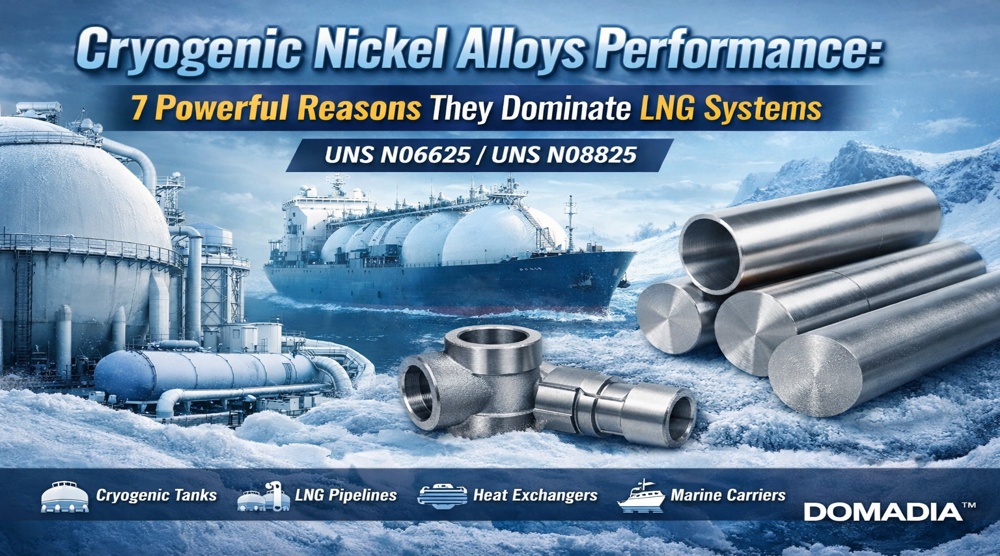
Cryogenic Nickel Alloys Performance in LNG Applications
Cryogenic Nickel Alloys Performance in LNG Systems
Cryogenic Nickel Alloys Performance is the backbone of modern LNG infrastructure. When natural gas is cooled to -162°C, ordinary metals become brittle and unpredictable. At these temperatures, material failure is not just costly, it is dangerous.
Liquefied Natural Gas (LNG) projects demand alloys that retain toughness, ductility, and corrosion resistance even at extreme sub-zero conditions. This is where Cryogenic Nickel Alloys Performance becomes critical for safety, efficiency, and long-term operational reliability.
At DOMADIA™, we supply high-performance nickel alloys engineered specifically for cryogenic stability in LNG storage, transportation, and processing systems.
Why Cryogenic Nickel Alloys Performance Matters in LNG
LNG is stored and transported at extremely low temperatures. Carbon steels lose impact strength. Many stainless steels experience reduced ductility. But Cryogenic Nickel Alloys Performance ensures:
- Exceptional impact toughness at -196°C
- High fracture resistance
- Resistance to thermal shock
- Superior corrosion resistance in marine environments
- Long lifecycle with minimal maintenance
This makes Cryogenic Nickel Alloys Performance indispensable in LNG terminals, carriers, pipelines, and regasification plants.
Common Nickel Alloys Used in LNG (UNS Grades)
1️⃣ UNS N06625 (Inconel 625 Equivalent)
2️⃣ UNS N08825 (Incoloy 825 Equivalent)
Both grades are widely selected for their proven Cryogenic Nickel Alloys Performance in LNG systems.
Chemical Composition
UNS N06625
- Nickel (Ni): 58% min
- Chromium (Cr): 20–23%
- Molybdenum (Mo): 8–10%
- Niobium (Nb): 3.15–4.15%
- Iron (Fe): Balance
UNS N08825
- Nickel (Ni): 38–46%
- Chromium (Cr): 19.5–23.5%
- Molybdenum (Mo): 2.5–3.5%
- Copper (Cu): 1.5–3%
- Iron (Fe): Balance
This chemistry ensures optimized Cryogenic Nickel Alloys Performance, combining strength, corrosion resistance, and microstructural stability.
Mechanical Properties at Cryogenic Temperatures
| Property | UNS N06625 | UNS N08825 |
| Tensile Strength | ~827 MPa | ~585 MPa |
| Yield Strength | ~414 MPa | ~220 MPa |
| Elongation | 30%+ | 30%+ |
| Impact Toughness | Excellent at -196°C | Excellent at -196°C |
Unlike conventional alloys, Cryogenic Nickel Alloys Performance improves toughness as temperature drops rare and valuable characteristics.
Applications in LNG Industry
Cryogenic Nickel Alloys Performance plays a decisive role in:
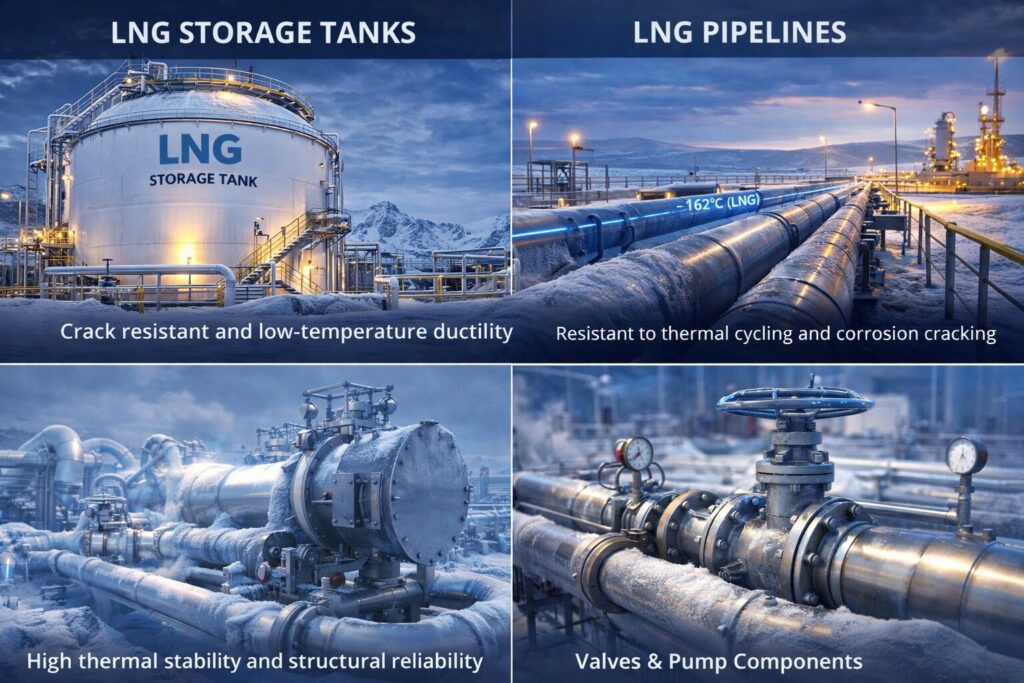
LNG Storage Tanks
Inner tank linings and containment systems rely on crack resistance and low-temperature ductility.
LNG Pipelines
Transport lines require materials resistant to thermal cycling and stress corrosion cracking.
Heat Exchangers
Cryogenic heat exchangers demand high thermal stability with structural reliability.
Valves & Pump Components
Operational integrity at extreme pressure and sub-zero conditions.
LNG Carriers (Marine Industry)
Nickel alloys withstand both cryogenic cargo and aggressive saltwater exposure.
The global LNG market continues to expand, supported by growing energy demand and geopolitical shifts in gas supply chains. As LNG infrastructure scales, Cryogenic Nickel Alloys Performance becomes even more strategically important.
International Standards
Nickel alloys used for LNG comply with:
- ASTM B443 (UNS N06625)
- ASTM B423 (UNS N08825)
- ASME Section II
- NACE MR0175 (Sour service)
- EN 10088 / EN 10204 3.1 Certification
At DOMADIA™, materials undergo rigorous testing to ensure certified Cryogenic Nickel Alloys Performance.
Technical Specifications
- Forms: Plates, Sheets, Pipes, Tubes, Rods, Bars, Forgings
- Temperature Range: Down to -196°C
- Density: ~8.4 g/cm³
- Thermal Expansion: Controlled for cryogenic stability
- Weldability: Excellent with minimal cracking risk
Shapes Available from DOMADIA™
- Round Bars
- Hollow Bars
- Forged Blocks
- Plates & Sheets
- Seamless Pipes
- Custom Machined Components
Each product is engineered to deliver consistent Cryogenic Nickel Alloys Performance under LNG operational stress.
Environmental & Lifecycle Advantage
Durability reduces replacement frequency. Fewer shutdowns mean lower scrap generation and reduce environmental footprint. Long-lasting materials directly contribute to sustainable energy infrastructure.
Investing in superior Cryogenic Nickel Alloys Performance is not only a technical decision—it is an environmental responsibility.
Conclusion
Cryogenic Nickel Alloys Performance defines the safety and efficiency of LNG operations. From storage tanks to marine carriers, the ability to retain toughness at -162°C separates high-performance infrastructure from high-risk installations.
With certified grades like UNS N06625 and UNS N08825, DOMADIA™ delivers engineered solutions for demanding cryogenic applications worldwide.
When LNG reliability cannot be compromised, Cryogenic Nickel Alloys Performance becomes the material advantage.
LNG systems don’t forgive material failure.
If your project operates at cryogenic temperatures, you need to prove Cryogenic Nickel Alloys Performance that delivers strength, toughness, and long-term reliability at -162°C.
At DOMADIA™, we supply certified UNS N06625 and UNS N08825 nickel alloys engineered for LNG storage, pipelines, heat exchangers, and marine applications.
Contact Us today to get expert guidance for your LNG project.
Talk to: Er.Pankaj Domadia | Kairav Domadia | Aadil Domadia | Pragati Sanap | Pooja N N
#CryogenicNickelAlloysPerformance #NickelAlloys #LNGIndustry #UNSN06625 #UNSN08825 #CryogenicEngineering #DOMADIA
Directly whatsapp us for an Enquiry: https://wa.link/kairav
We’ve supplied to Jamnagar, Dwarka, Porbandar, Junagadh, and Amreli, serving Gujarat, Maharashtra, Rajasthan, MP, and Diu, with exports to Italy, Spain, Portugal, Malta, and San Marino.