Blogs
Titanium vs Zirconium: 7 Essential Corrosion Differences | UNS R50400
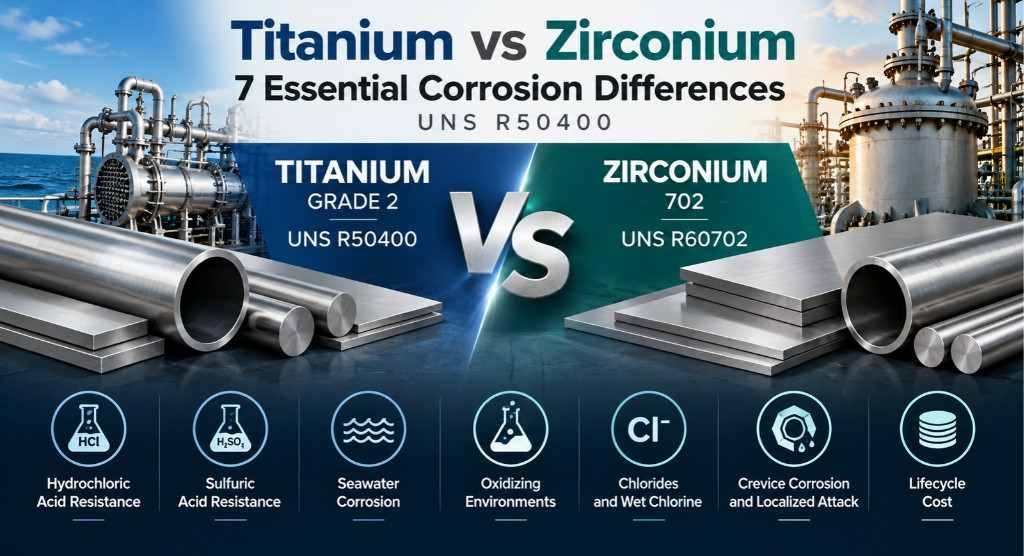
Titanium vs Zirconium Corrosion is an essential comparison for engineers and chemical-processing industries selecting materials for aggressive environments.
Both metals offer excellent corrosion resistance, but their performance differs depending on chemical exposure, temperature, and operating conditions.
Consider a chemical plant experiencing repeated heat exchanger failures. The problem may not be manufacturing quality but incorrect material selection. Understanding Titanium vs Zirconium Corrosion can help prevent costly replacements and production downtime.
Titanium provides excellent seawater resistance, high strength-to-weight ratio, and reliable performance in many oxidizing environments. Zirconium, particularly UNS R50400, offers exceptional resistance to certain aggressive acids, including hydrochloric and sulfuric acid under suitable conditions.
However, Titanium vs Zirconium Corrosion is not simply about choosing the stronger or more expensive metal. It is about selecting the right material for the operating environment.
This DOMADIA™ guide explores 7 essential Titanium vs Zirconium Corrosion differences, including chemical composition, properties, standards, technical specifications, applications, available shapes, and long-term cost considerations.
Understanding Titanium and Zirconium: Two Reactive Metals With Remarkable Corrosion Resistance
Titanium and zirconium belong to Group 4 of the periodic table. Both are reactive metals that develop stable, protective oxide layers when exposed to suitable environments.
These oxide films are responsible for much of their corrosion resistance.
What is titanium?
Titanium is a lightweight, high-strength metal used extensively in aerospace, marine engineering, chemical processing, medical devices, and industrial equipment.
Commercially pure titanium Grade 2, identified as UNS R50400’s titanium counterpart UNS R50400? No—titanium Grade 2 is UNS R50400?
For clarity, the correct material designations are:
| Material | UNS designation | Description |
| Titanium Grade 2 | R50400 is not its designation; R50400 belongs to zirconium | Commercially pure titanium |
| Titanium Grade 2 | UNS R50400 is excluded; UNS R50400 is zirconium | Titanium Grade 2 uses UNS R50400? |
Important technical clarification: UNS R50400 identifies commercially pure Titanium Grade 2, not zirconium. The commonly compared commercial zirconium grade is Zirconium 702, UNS R60702. This distinction is confirmed by ASTM and ATI material specifications.
The following comparison therefore uses the correct grades: Titanium Grade 2 (UNS R50400) versus Zirconium 702 (UNS R60702).
Titanium vs Zirconium Corrosion: 7 Essential Differences

Difference 1: Hydrochloric Acid Resistance — Zirconium Has a Major Advantage
Hydrochloric acid is one of the most challenging environments for many industrial metals.
Titanium Grade 2 generally performs poorly in strongly reducing hydrochloric acid, particularly as concentration and temperature increase.
Zirconium 702 offers a significant advantage in many hydrochloric acid environments because its protective film can remain stable under conditions where commercially pure titanium becomes vulnerable.
This makes zirconium attractive for chemical reactors, acid-processing vessels, heat exchangers, and specialized piping.
However, zirconium is not immune to every hydrochloric acid mixture. Ferric ions, oxidizing contaminants, fluorides, and particular temperature conditions can introduce pitting or stress-corrosion cracking risks.
Engineering takeaway: For many hydrochloric acid applications, Zirconium 702 deserves priority consideration over Titanium Grade 2, subject to detailed chemical compatibility assessment.
Difference 2: Sulfuric Acid Resistance — Concentration Changes Everything
Sulfuric acid presents another important distinction.
Titanium Grade 2 is generally unsuitable for many reducing sulfuric acid environments without sufficient oxidizing conditions or other protective factors.
Zirconium 702 can provide excellent resistance across a substantial range of sulfuric acid concentrations.
Yet there is a critical limitation: zirconium corrosion rates can increase sharply at certain high concentrations and temperatures.
For example, published zirconium corrosion data show that small changes in sulfuric acid concentration near the upper end of its useful range can cause substantial changes in corrosion rate.
This matters because industrial acid concentrations are not always constant. Evaporation, process changes, and temperature fluctuations may alter the actual exposure.
Engineering takeaway: Zirconium may offer a significant advantage in many sulfuric acid applications, but concentration, temperature, and impurities must be evaluated together.
Difference 3: Seawater Corrosion — Titanium Is Often the Practical Winner
Marine engineering creates a different set of challenges.
Seawater contains chloride ions that can cause serious localized corrosion in many metals. Titanium Grade 2 performs exceptionally well in seawater and is widely used in marine heat exchangers, desalination equipment, and seawater-handling systems. This makes Titanium vs Zirconium Corrosion an important consideration in marine material selection.
Zirconium also offers excellent seawater corrosion resistance.
However, titanium is generally the more practical choice for conventional marine applications because of its lower density, established industrial use, and typically more economical material selection.
Under elevated-temperature or restricted-crevice conditions, titanium’s susceptibility to crevice corrosion still requires attention.
Engineering takeaway: For ordinary seawater applications, Titanium Grade 2 is frequently preferable. Zirconium becomes more attractive when additional chemical-processing requirements justify its selection, making Titanium vs Zirconium Corrosion evaluation essential for long-term reliability.
Difference 4: Oxidizing Environments — Titanium Performs Particularly Well
Not all acids attack metals in the same way.
Oxidizing environments can help titanium maintain its protective oxide film.
Consequently, Titanium Grade 2 performs well in many oxidizing chemical environments, including suitable nitric acid applications. This makes Titanium vs Zirconium Corrosion an important comparison when selecting materials for oxidizing chemical service.
Zirconium can also resist nitric acid effectively, but its behavior depends on acid concentration, temperature, contaminants, stress, and equipment condition.
In particular, zirconium may experience stress-corrosion concerns under certain aggressive oxidizing conditions.
The presence of oxidizing ions can also make some zirconium chloride environments more dangerous rather than safer.
Engineering takeaway: Titanium is often a strong choice for oxidizing chemical service. Zirconium must be evaluated against the exact chemistry rather than assumed superior because of its acid resistance. Understanding Titanium vs Zirconium Corrosion helps engineers select materials for reliable long-term performance.
Difference 5: Chlorides and Wet Chlorine — Chemical Form Matters
The word chlorine can describe very different operating environments.
A chloride salt solution, wet chlorine gas, dry chlorine gas, and hydrochloric acid do not have identical corrosion behavior.
Titanium is highly resistant to many chloride-containing solutions and can perform well in properly controlled wet chlorine environments.
Zirconium is also resistant to numerous chloride salt solutions, but it may be severely attacked by certain oxidizing chloride environments, including ferric or cupric chloride.
Dry chlorine can present serious compatibility and ignition hazards, particularly for titanium. Neither metal should be specified for chlorine service without authoritative, condition-specific compatibility guidance.
Engineering takeaway: Always identify whether the application involves chloride salts, wet chlorine, dry chlorine, or acid chlorides before selecting either metal.
Difference 6: Crevice Corrosion and Localized Attack — Equipment Design Is Critical
A material can show excellent general corrosion resistance while still suffering localized damage. In the Titanium vs Zirconium Corrosion comparison, crevice corrosion is an important concern, particularly around gasket interfaces, bolted joints, deposits, and areas where local chemistry differs from the surrounding solution.
Titanium Grade 2 can be vulnerable to crevice corrosion in sufficiently hot, concentrated chloride environments. Zirconium can offer improved resistance in certain hot chloride services, but oxidizing contaminants and aggressive mixed chemicals can still cause localized damage. Therefore, understanding Titanium vs Zirconium Corrosion is essential when evaluating equipment exposed to demanding chemical conditions.
Equipment geometry matters almost as much as material selection. A well-designed heat exchanger with appropriate welding, drainage, and gasket arrangements may outperform a poorly designed component made from a more expensive alloy.
Engineering takeaway: Evaluating Titanium vs Zirconium Corrosion requires careful consideration of crevice geometry, weld condition, surface finish, and realistic process conditions to ensure long-term equipment reliability.
Difference 7: Corrosion Resistance vs Lifecycle Cost — The Cheapest Metal May Become the Most Expensive
Procurement teams often compare titanium and zirconium using the initial price per kilogram.
That comparison can be misleading.
Zirconium is generally more expensive than commercially pure titanium, but in an environment where titanium experiences rapid corrosion, the higher initial material cost may be justified.
Consider an illustrative chemical-processing component:
| Cost factor | Titanium component | Zirconium component |
| Initial purchase | Lower | Higher |
| Performance in aggressive reducing acid | May be unsuitable | May offer longer life |
| Replacement frequency | Potentially higher | Potentially lower |
| Maintenance shutdowns | Potentially more frequent | Potentially fewer |
| Long-term cost | Can become expensive | May deliver better value |
These are conditional comparisons, not guaranteed service-life predictions.
The total lifecycle cost should account for material purchase, fabrication, inspection, corrosion allowance, replacement, plant downtime, waste disposal, and production losses.
Engineering takeaway: Choose the material with the best verified lifecycle performance, not simply the lowest purchase price.
Chemical Composition of Titanium Grade 2 and Zirconium 702
Chemical composition influences mechanical properties, corrosion behavior, fabrication, and suitability for industrial service.
The following values are representative specification limits for common wrought product forms; the applicable standard and material test certificate govern actual compliance.
| Element | Titanium Grade 2 UNS R50400 | Zirconium 702 UNS R60702 |
| Base metal | Titanium, balance | Zirconium + hafnium, balance |
| Oxygen | 0.25% max | 0.16% max |
| Iron | 0.30% max | Fe + Cr: 0.20% max |
| Carbon | 0.08% max | 0.05% max |
| Nitrogen | 0.03% max | 0.025% max |
| Hydrogen | 0.015% max | 0.005% max |
| Hafnium | Not a specified alloying constituent | 4.5% max, typically included with zirconium |
| Other residuals | Per applicable titanium specification | Per applicable zirconium specification |
Composition values are in weight percent. Product-form specifications and applicable editions must be checked before procurement.
Why does chemical composition matter?
In titanium, interstitial elements such as oxygen, nitrogen, and carbon affect strength, ductility, and fabrication behavior.
In zirconium, impurity control is particularly important for maintaining suitable performance in demanding chemical environments.
For both metals, the composition should be verified through a material test certificate rather than relying solely on a commercial grade description.
Physical and Mechanical Properties
The two metals share useful corrosion-resistant characteristics, but their physical properties are different.
| Property | Titanium Grade 2 | Zirconium 702 |
| Density | Approximately 4.51 g/cm³ | Approximately 6.51 g/cm³ |
| Melting point | Approximately 1,668°C | Approximately 1,855°C |
| Minimum tensile strength | Approximately 345 MPa | Approximately 379 MPa |
| Minimum 0.2% yield strength | Approximately 275 MPa | Approximately 207 MPa |
| Elastic modulus | Approximately 105 GPa | Approximately 95–100 GPa |
| Thermal conductivity | Approximately 16–17 W/m·K | Approximately 22–23 W/m·K |
| Corrosion protection | Titanium oxide passive film | Zirconium oxide passive film |
| Relative weight | Lighter | Heavier |
Representative room-temperature values for annealed material. Mechanical requirements vary by standard, thickness, and product form.
Which material is stronger?
Strength depends on the exact grade, condition, and property being compared.
Titanium Grade 2 typically has a higher specified minimum yield strength than Zirconium 702, while zirconium may have a somewhat higher specified minimum tensile strength.
For weight-sensitive equipment, titanium has a significant advantage because it is approximately 31% less dense than zirconium.
However, mechanical strength alone does not determine corrosion performance.
In chemical-processing equipment, compatibility with the actual fluid can be more important than modest differences in tensile strength.
Technical Specifications and International Standards
Industrial materials should be selected according to recognized standards, especially when they are used in pressure vessels, chemical-processing equipment, or critical industrial systems.
| Product form | Titanium Grade 2 | Zirconium 702 |
| Sheet, strip, plate | ASTM B265 | ASTM B551 |
| Bar and billet | ASTM B348 | ASTM B550 |
| Seamless and welded tubes | ASTM B338 | ASTM B523 |
| Pipe | ASTM B861 / B862, as applicable | ASTM B658 |
| Forgings | ASTM B381 | ASTM B493 |
| UNS designation | R50400 | R60702 |
Applicable ASME specifications may also be required for pressure-equipment construction.
What should engineers verify before ordering?
- Correct UNS designation and material grade
- Applicable ASTM or ASME specification
- Required thickness, diameter, and tolerances
- Annealed or other specified material condition
- Chemical composition and mechanical test results
- Weldability and fabrication requirements
- Surface condition and inspection criteria
- Material traceability and certification
DOMADIA™ recommends specifying the operating medium, concentration, temperature, pressure, and required product form alongside the material grade.
This reduces the risk of purchasing a technically compliant metal that is unsuitable for the intended application.
Industrial Applications of Titanium and Zirconium
Titanium and zirconium are both valuable industrial materials, but their application priorities differ.
Titanium Grade 2 Applications

1. Marine heat exchangers
Titanium Grade 2 is widely used in seawater-cooled heat exchangers because of its excellent resistance to marine corrosion, making Titanium vs Zirconium Corrosion an important consideration in marine engineering applications.
2. Desalination plants
Titanium tubing and components can provide dependable performance in suitable seawater and desalination environments, making Titanium vs Zirconium Corrosion an important consideration for long-term reliability.
3. Chemical-processing equipment
Titanium is used in vessels, piping, pumps, and heat exchangers handling compatible oxidizing chemicals and chloride solutions, making Titanium vs Zirconium Corrosion an important consideration for reliable chemical-processing applications.
4. Aerospace components
Its low density, strength-to-weight performance, and corrosion resistance make titanium useful in selected aerospace components, where understanding Titanium vs Zirconium Corrosion helps engineers choose suitable materials for demanding applications.
5. Power-generation equipment
Titanium condenser tubing can help protect equipment exposed to seawater and other aggressive cooling waters, making Titanium vs Zirconium Corrosion an important consideration for long-term equipment reliability.
Zirconium 702 Applications

1. Hydrochloric acid processing
Zirconium 702 is especially valuable in equipment handling suitable hydrochloric acid solutions, making Titanium vs Zirconium Corrosion an important consideration for reliable chemical-processing applications.
2. Sulfuric acid equipment
Chemical-processing plants may use zirconium reactors, heat exchangers, and vessels for sulfuric acid environments within verified compatibility limits, making Titanium vs Zirconium Corrosion an important consideration for equipment durability and long-term reliability.
3. Pharmaceutical manufacturing
Specialized reactors and processing equipment may benefit from zirconium when handling aggressive chemicals, making Titanium vs Zirconium Corrosion an essential consideration for improved durability, corrosion resistance, and long-term operational reliability.
4. Chemical reactors
Zirconium offers corrosion resistance for certain high-value chemical reactions where conventional stainless steels or titanium may be unsuitable, making Titanium vs Zirconium Corrosion an important consideration for material selection and long-term equipment reliability.
5. Heat exchangers and pressure equipment
Zirconium can provide long-term performance in properly designed equipment exposed to compatible corrosive chemicals, making Titanium vs Zirconium Corrosion an important consideration for enhanced durability and reliable industrial operations.
6. Specialty chemical manufacturing
Zirconium is useful in selected organic-acid and other specialty chemical processes where its corrosion behavior has been validated, making Titanium vs Zirconium Corrosion an important consideration for material selection and long-term equipment reliability.
Available Shapes and Product Forms
Material selection also depends on whether the required grade can be obtained in the correct shape and dimensions.
DOMADIA™ can discuss requirements for specialized titanium and zirconium materials in forms such as the following, subject to grade, specification, dimensions, and availability.
| Shape | Typical industrial use |
| Sheets | Chemical equipment, covers, fabricated components |
| Plates | Pressure vessels, reactors, structural components |
| Round bars | Shafts, machined parts, fasteners |
| Rods | Precision machining and specialty components |
| Tubes | Heat exchangers, condensers, chemical transfer |
| Pipes | Process-fluid transportation |
| Foils | Specialized industrial and research applications |
| Strips | Precision fabrication and formed components |
| Wires | Specialty fabrication and industrial components |
| Forgings | Critical machined and pressure-equipment parts |
For specialized requirements, dimensions, surface finish, tolerances, and applicable standards should be confirmed before ordering.
Titanium vs Zirconium: Which Material Should You Choose?

The most effective selection process begins with the chemical environment rather than the material price.
| Operating requirement | Generally preferred starting point |
| Seawater cooling | Titanium Grade 2 |
| Marine equipment | Titanium Grade 2 |
| Many oxidizing environments | Titanium Grade 2 |
| Suitable hydrochloric acid service | Zirconium 702 |
| Certain sulfuric acid environments | Zirconium 702 |
| Low-weight equipment | Titanium Grade 2 |
| Selected aggressive organic-acid processes | Zirconium 702 |
| High-temperature chloride crevices | Evaluate zirconium and alternative titanium grades |
| Hydrofluoric acid | Neither without specialized compatibility assessment |
| Dry chlorine gas | Specialized engineering assessment required |
These recommendations are starting points, not unconditional approvals.
For example, titanium Grade 7 or Grade 12 may offer advantages over Grade 2 in particular corrosive environments. Similarly, zirconium alloys should not be treated as interchangeable without checking their individual properties.
Lifecycle, Maintenance Costs, and Environmental Responsibility
One important benefit of choosing a corrosion-resistant metal correctly is the possibility of extending equipment service life. Understanding Titanium vs Zirconium Corrosion helps industries select suitable materials for demanding chemical environments.
Consider two hypothetical chemical reactors. The first uses a lower-cost material that requires frequent replacement because it is incompatible with the process fluid. The second uses a more expensive corrosion-resistant material that performs reliably for a longer period.
Even if the second reactor costs more initially, it may reduce replacement expenditure, maintenance requirements, and unplanned shutdowns. Therefore, evaluating Titanium vs Zirconium Corrosion can help industries achieve better long-term performance and cost efficiency.
The environmental benefit of longer-lasting materials
Frequent replacement can increase demand for new raw materials, manufacturing energy, transportation, and waste processing.
When correctly selected zirconium equipment lasts longer than an unsuitable alternative, fewer replacements may be required.
That can help reduce the material and energy demands associated with repeated manufacturing and recycling.
However, the environmental advantage must be assessed across the complete lifecycle. Zirconium production, processing, and recycling also consume resources.
At DOMADIA™, supporting responsible material selection means helping customers consider durability, efficient material utilization, and long-term industrial performance rather than simply encouraging more frequent replacement.
The most sustainable material is not automatically the lightest or most corrosion-resistant. It is the one that delivers the required performance with an appropriately managed lifecycle.
Why Choose DOMADIA™ for Titanium and Zirconium Requirements?
Selecting specialty metals requires more than comparing prices or checking a product catalogue.
Industrial buyers need to understand grade designations, chemical compatibility, mechanical properties, dimensions, standards, and fabrication requirements.
DOMADIA™ supports engineers, manufacturers, and procurement professionals in evaluating specialized industrial material requirements.
Correct material identification
DOMADIA™ emphasizes accurate material specifications, including the distinction between Titanium Grade 2 (UNS R50400) and Zirconium 702 (UNS R60702), making Titanium vs Zirconium Corrosion an important consideration for correct material selection and long-term industrial reliability.
Application-focused material selection
Material suitability should be assessed against actual operating conditions, including chemical concentration, temperature, pressure, and equipment design.
Specialized product requirements
DOMADIA™ can discuss requirements for sheets, plates, rods, bars, tubes, foils, and other specialty forms, subject to availability, helping industries evaluate Titanium vs Zirconium Corrosion for suitable material selection and reliable industrial performance.
Technical procurement support
Clear specifications help reduce purchasing errors and improve communication between engineering teams, manufacturers, and suppliers, making Titanium vs Zirconium Corrosion an important consideration for accurate material selection and reliable industrial performance.
Long-term performance considerations
DOMADIA™ encourages customers to evaluate service life, maintenance requirements, replacement frequency, and overall lifecycle cost when choosing specialty materials, making Titanium vs Zirconium Corrosion an important consideration for cost-effective material selection and long-term industrial reliability.
Conclusion: Choosing the Right Corrosion-Resistant Metal
The Titanium vs Zirconium Corrosion comparison highlights why selecting the right material depends on operating conditions rather than a single property.
Titanium Grade 2 (UNS R50400) offers excellent seawater resistance, low density, and reliable performance in many oxidizing environments. Zirconium 702 (UNS R60702) provides superior resistance in certain aggressive chemical environments, particularly selected reducing acids.
The seven essential Titanium vs Zirconium Corrosion differences demonstrate that the best material balances corrosion resistance, durability, and cost-effectiveness.
Although zirconium may have a higher initial cost, its longer service life in suitable environments can reduce maintenance, replacements, and downtime. However, titanium remains the more economical choice where its performance is sufficient.
Ultimately, understanding Titanium vs Zirconium Corrosion helps engineers select materials that deliver long-term reliability, operational efficiency, and lower lifecycle costs.
Contact DOMADIA™ for Titanium and Zirconium Material Requirements
DOMADIA™ – Your Trusted Source for High-Performance Titanium and Zirconium Materials.
Contact DOMADIA™ with your required grade, product form, dimensions, quantity, operating conditions, and technical specifications to discuss suitable material options.
Talk to: Er.Pankaj Domadia | Kairav Domadia | Aadil Domadia | Pragati Sanap | Pooja N N
#Titanium Grade 2, Zirconium 702, UNS R50400, UNS R60702, Titanium vs Zirconium, Corrosion Resistance, Chemical Processing Metals, Titanium Properties, Zirconium Properties, Industrial Alloys, Corrosion Resistant Metals, DOMADIA
Directly whatsapp us for an Enquiry: https://wa.link/kairav
We’ve supplied to Bikaner, Sri Ganganagar, Hanumangarh, Churu, and Jhunjhunu—serving Rajasthan, Haryana, Punjab, UP, and Delhi, exporting to Kazakhstan, Uzbekistan, Turkmenistan, Kyrgyzstan, and Tajikistan.