Blogs
Beryllium Copper Jewelry UNS C17200: 7 Critical Facts Before Using It
Beryllium Copper Jewelry sounds like an interesting combination.
Copper gives the alloy its warm metallic character. Beryllium dramatically improves its strength. After suitable heat treatment, UNS C17200 can become remarkably hard, resilient and wear-resistant while retaining useful electrical and thermal conductivity.
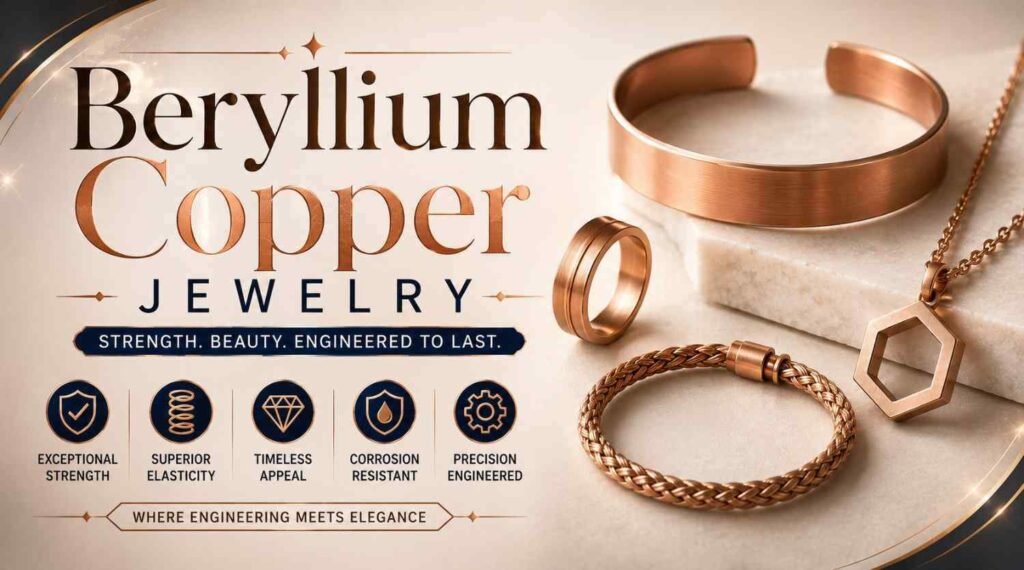
That sounds like a promising recipe for rings, bracelets, clasps or other decorative components.
But there is a catch.
A metal that performs exceptionally well inside aerospace equipment, electrical connectors, precision springs and industrial components is not automatically the best material to keep against your skin every day.
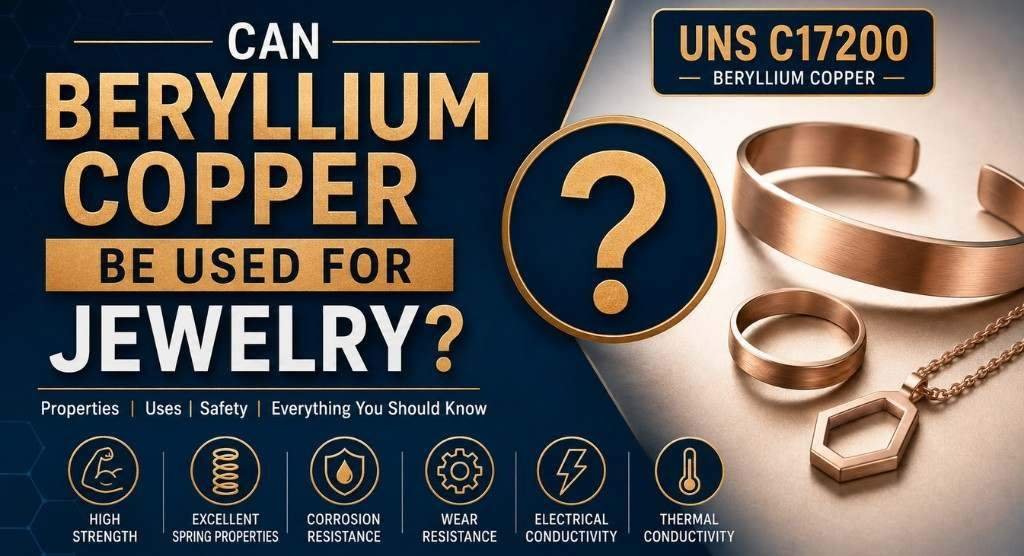
So, can beryllium copper be used for jewelry?
Technically, the alloy can be shaped into decorative components. However, UNS C17200 is primarily a high-performance engineering material, and manufacturing operations involving beryllium-containing dust or fumes require strict exposure controls. For conventional consumer jewelry, more established jewelry metals are generally the more practical choice.
Let’s understand why.
What Is Beryllium Copper?
Beryllium copper—also known as copper beryllium, BeCu or CuBe—is a family of copper-based alloys containing a relatively small percentage of beryllium.
UNS C17200, often called Alloy 25, belongs to the high-strength copper-beryllium family.
What makes it unusual is the combination of characteristics it can deliver simultaneously:
- Very high strength for a copper alloy
- Good electrical conductivity
- Good thermal conductivity
- Excellent spring characteristics
- Strong fatigue resistance
- Good corrosion resistance
- Wear resistance
- Ability to form complex components
- Heat-treatable mechanical properties
Materion describes UNS C17200 as a high-strength copper-beryllium alloy and reports an elastic modulus of approximately 131 GPa, density around 8.36 g/cm³, and electrical conductivity of approximately 25–30% IACS for its age-hardened rod and bar material.
Those characteristics explain why engineers value the alloy—but jewelry presents a very different operating environment.
1. Can Beryllium Copper Jewelry Actually Be Made?
From a purely metallurgical and fabrication perspective, yes, components with jewelry-like shapes can be manufactured from beryllium copper.
UNS C17200 is available in several useful product forms and can be formed and processed into complex geometries. Materion lists Alloy 25 products including strip, rod/bar, plate, tube and wire.
That means a designer could theoretically create items such as:
- Decorative rings
- Bracelets
- Clasps
- Clips
- Buckles
- Watch-related components
- Spring-loaded accessories
- Decorative metal hardware
But “can be manufactured” and “should be selected for consumer jewelry” are two very different questions.
That distinction is the most important part of this discussion.
2. Why Would Anyone Consider UNS C17200 for Jewelry?
Beryllium Copper Jewelry Has Unusual Mechanical Potential
The attraction begins with strength.
Traditional copper is beautiful and workable, but it is relatively soft. UNS C17200 changes that equation considerably.
After suitable precipitation hardening, copper beryllium can achieve very high mechanical strength while retaining useful conductivity. Materion notes that high-strength Alloy 25 can exceed 200 ksi (1,380 MPa) ultimate tensile strength in certain conditions.
For small components, that can mean excellent resistance to deformation.
A thin clasp, clip or spring mechanism could therefore provide significant mechanical force without requiring the bulk associated with softer metals.
Good Elastic Behaviour
This is where the alloy becomes particularly interesting.
Think less about a decorative pendant and more about the tiny mechanism behind it.
A clasp may be opened hundreds or thousands of times. A clip needs to flex and return. A spring-loaded accessory must maintain contact force.
Copper beryllium was built for this type of mechanical challenge.
Its spring characteristics and fatigue resistance are major reasons the material is widely used in precision engineering.
Wear Resistance
Jewelry and accessories experience constant physical contact:
skin, clothing, desks, bags, tools, surfaces and other metal components.
UNS C17200’s hardness and wear resistance could therefore be advantageous for specialized mechanical accessory components.
Corrosion Resistance
Copper beryllium also provides good corrosion resistance, another desirable property for components expected to operate for extended periods.
However, jewelry experiences a complicated environment involving perspiration, cosmetics, soaps, cleaning chemicals and continuous skin contact. A material’s industrial corrosion resistance alone does not automatically establish its suitability as a body-contact jewelry material.
3. Chemical Composition of UNS C17200
The performance of UNS C17200 comes from carefully controlled alloy chemistry.
A typical specification for Alloy 25 / UNS C17200 is based primarily on:
| Element | Typical Specification Range |
| Copper (Cu) | Balance |
| Beryllium (Be) | Approx. 1.8–2.0% |
| Cobalt + Nickel | Controlled alloying addition |
| Iron and other elements | Controlled residual limits |
Exact composition requirements should always be confirmed against the applicable material specification and supplier certificate before procurement or fabrication.
The beryllium content may appear small, but it creates an enormous change in the mechanical behaviour of copper.
That is exactly why C17200 performs so well in demanding engineering applications—and why its fabrication requires informed handling.
4. The Important Question: Is Beryllium Copper Safe for Jewelry?
This requires a more careful answer than a simple “safe” or “unsafe.”
OSHA explains that occupational beryllium exposure becomes particularly important when beryllium-containing materials are processed in ways that generate airborne dust, fumes or mist. Operations such as machining and grinding can create potential exposure.
OSHA also distinguishes handling clean, non-particulate solid beryllium-containing material from exposure to beryllium-containing dust, fumes, mists or solutions.
That distinction matters enormously.
Finished Solid Component ≠ Grinding Dust
A finished solid piece and the process used to manufacture that piece should not be treated as the same exposure scenario.
The greater occupational concern arises during operations such as:
- Grinding
- Sanding
- Polishing
- Machining
- Cutting
- Welding
- Other processes capable of generating airborne beryllium-containing material
OSHA specifically identifies fabrication, machining and grinding of beryllium alloys among workplace activities where exposure may occur.
Therefore, anyone manufacturing or modifying copper-beryllium components must follow applicable occupational-safety requirements, exposure controls and material-specific safety documentation.
And Here Is the Major Jewelry-Specific Warning
A current Materion product information sheet for copper-beryllium wrought alloys explicitly lists casting, grinding or polishing beryllium-containing alloys for jewelry among uses advised against.
That changes the practical answer considerably.
For ordinary jewelry manufacturing, UNS C17200 should not simply be treated like brass, bronze, sterling silver or conventional copper.
5. Where Could Beryllium Copper Make More Sense?
Instead of asking:
“Would C17200 make a beautiful ring?”
A better engineering question is:
“Does this component actually need the properties of C17200?”
The alloy makes much more sense when performance is the priority.
Precision Clasps and Spring Mechanisms
A specialized non-body-contact mechanical component may require repeated flexing and reliable spring force.
This is much closer to the type of problem copper beryllium is designed to solve.
Watch and Instrument Components
Precision mechanisms may benefit from strength, fatigue resistance and dimensional reliability.
Again, suitability should be determined according to the exact design, exposure route, regulatory requirements and manufacturer’s recommendations—not appearance alone.
Decorative Industrial Components
High-end equipment, instruments, cases or accessories sometimes contain decorative metallic elements that are not conventional body-contact jewelry.
In these situations, the mechanical advantages of copper beryllium may be more relevant.
6. Properties of UNS C17200
The real story behind Beryllium Copper Jewelry is the extraordinary engineering profile of the underlying alloy.
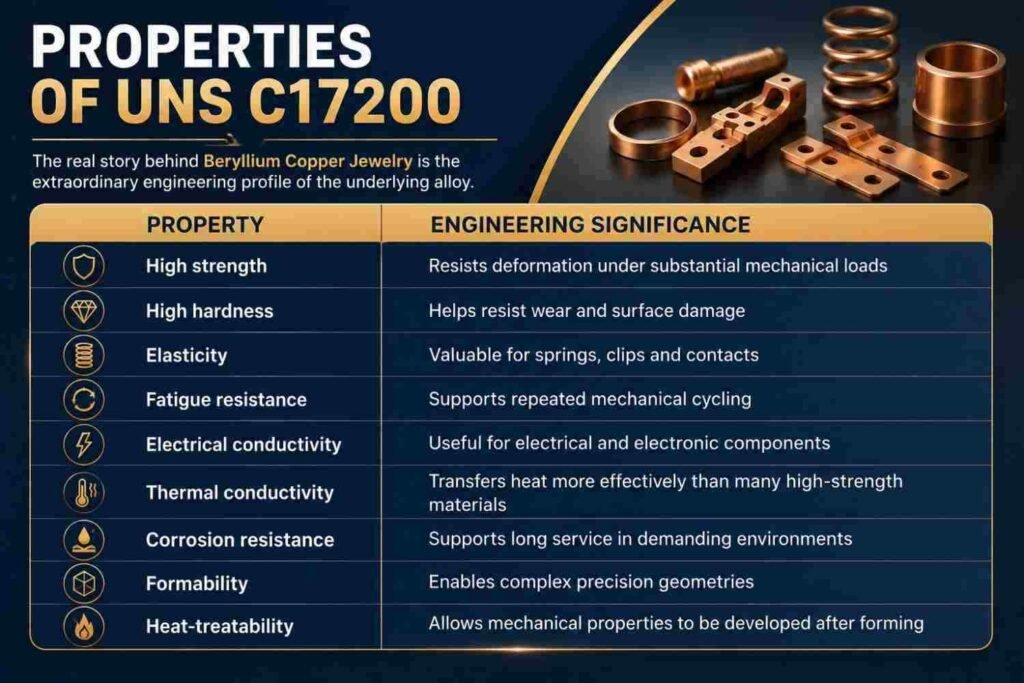
| Property | Engineering Significance |
| High strength | Resists deformation under substantial mechanical loads |
| High hardness | Helps resist wear and surface damage |
| Elasticity | Valuable for springs, clips and contacts |
| Fatigue resistance | Supports repeated mechanical cycling |
| Electrical conductivity | Useful for electrical and electronic components |
| Thermal conductivity | Transfers heat more effectively than many high-strength materials |
| Corrosion resistance | Supports long service in demanding environments |
| Formability | Enables complex precision geometries |
| Heat-treatability | Allows mechanical properties to be developed after forming |
These characteristics are exactly why UNS C17200 is better known in engineering departments than jewelry stores.
7. Technical Specifications of UNS C17200
Properties vary according to temper, heat treatment, product form, dimensions and governing specification.
Representative age-hardened C17200 rod/bar data published by Materion include:
| Technical Parameter | Representative Value |
| UNS Designation | C17200 |
| Common Name | Alloy 25 / Beryllium Copper |
| Density | Approx. 8.36 g/cm³ |
| Elastic Modulus | Approx. 131 GPa |
| Electrical Conductivity | Approx. 25–30% IACS |
| Thermal Conductivity | Approx. 105 W/m·K |
| Alloy Category | High-strength copper beryllium |
These figures should be treated as representative engineering data rather than universal values for every C17200 condition. Final design values should always come from the relevant specification and certified material documentation.
Standards Commonly Associated With UNS C17200
Depending on product form and procurement requirements, UNS C17200 may be supplied against standards covering strip, sheet, plate, rod, bar, wire, tube and related wrought products.
Common specifications encountered for copper-beryllium products include standards from organizations such as:
- ASTM International
- SAE
- AMS
- RWMA
- UNS designation systems
The exact applicable standard should be selected according to product form, temper, dimensional tolerance, mechanical requirements and end application.
For jewelry or body-contact products, meeting an industrial material standard alone should not be interpreted as proving suitability for prolonged skin contact. Product-specific regulatory requirements must also be considered.
Shapes and Forms Available from DOMADIA™
For industrial and engineering applications, DOMADIA™ can support requirements for beryllium copper in forms such as:
- Sheets
- Plates
- Strips
- Foils
- Rods
- Bars
- Wires
- Tubes
- Custom dimensions, subject to availability and specification
This range allows engineers to select material according to the actual manufacturing process rather than forcing a component design around an unsuitable stock form.
Beryllium Copper vs Traditional Jewelry Metals
This comparison makes the decision clearer.
| Factor | Beryllium Copper C17200 | Sterling Silver | Brass | Stainless Steel |
| Mechanical Strength | Excellent | Moderate | Moderate | High |
| Spring Performance | Excellent | Limited | Moderate | Good |
| Electrical Conductivity | Good | Excellent | Moderate | Low |
| Wear Resistance | High when hardened | Moderate | Moderate | Good |
| Common Jewelry Use | Uncommon | Very common | Common | Common |
| Specialized Fabrication Controls | Important | Conventional | Conventional | Conventional |
| Best Role | Engineering components | Fine jewelry | Decorative jewelry | Durable jewelry |
So although C17200 wins several engineering categories, the strongest metal on the chart is not automatically the smartest jewelry material.
Material selection depends on the application.
When Should You Choose Another Metal?
For conventional rings, earrings, necklaces, bracelets and other items intended for prolonged skin contact, established jewelry materials are generally more practical.
Depending on appearance, budget and design requirements, alternatives can include:
- Gold alloys
- Platinum
- Sterling silver
- Suitable stainless-steel grades
- Titanium
- Conventional copper alloys where appropriate
These metals have far more established histories in jewelry manufacturing.
UNS C17200 should instead be selected when its specific engineering properties justify its use and when processing can be performed under appropriate professional controls.
Applications Where UNS C17200 Truly Excels
Rather than forcing an exceptional engineering alloy into an unsuitable application, it makes sense to use it where its properties create measurable value.
Typical applications include:

Electrical Contacts and Connectors
Its combination of conductivity, strength and spring behaviour makes C17200 valuable for demanding electrical contact systems.
Aerospace Components
High strength and fatigue resistance support precision aerospace components operating under repeated mechanical loads.
Springs
One of copper beryllium’s natural strengths is its ability to provide repeatable elastic performance in compact components.
Precision Instruments
Dimensional stability, mechanical strength and corrosion resistance can make the alloy suitable for demanding instrument components.
Oil and Gas Equipment
Copper-beryllium alloys are used in specialized components where durability and mechanical performance are essential. Materion lists oil and gas drilling equipment among applications for its high-strength copper-beryllium alloys.
Industrial Wear Components
Hardness and wear resistance can extend component life in repetitive-contact applications.
Why DOMADIA™ for UNS C17200 Beryllium Copper?
When buying a specialized alloy, the material designation matters more than its colour.
A component requiring UNS C17200 needs the correct chemistry, temper, product form and dimensional specification. Substituting ordinary copper or an unidentified copper alloy can completely change its mechanical performance.
DOMADIA™ focuses on supplying specialized engineering materials for demanding industrial requirements.
Customers can approach DOMADIA™ for:
- UNS C17200 beryllium copper requirements
- Multiple product forms
- Industrial and precision applications
- Requirement-based material sourcing
- Specialized quantities and dimensions, subject to availability
- Domestic and international supply support
- Technical specification-based enquiries
The objective is simple: supply the material that fits the engineering requirement—not merely a metal that looks similar.
Final Verdict: Can Beryllium Copper Be Used for Jewelry?
Technically, Beryllium Copper Jewelry components can be produced because UNS C17200 is formable, strong, durable and available in numerous product forms.
But technical possibility does not equal practical suitability.
For ordinary consumer jewelry—particularly products intended for continuous skin contact—established jewelry alloys are generally the more appropriate route. More importantly, grinding, polishing, machining and other fabrication operations involving copper beryllium require careful attention to beryllium exposure controls, and Materion specifically identifies casting, grinding or polishing beryllium-containing alloys for jewelry among uses advised against.
UNS C17200 earns its reputation elsewhere: precision springs, aerospace components, electrical contacts, connectors, industrial wear parts and other applications where extraordinary mechanical performance creates genuine value.
That is where this remarkable copper alloy belongs in the spotlight.
Conclusion
Beryllium Copper Jewelry presents an interesting material-selection lesson: a metal can have exceptional strength, elasticity, conductivity and wear resistance without automatically being the ideal choice for something worn every day.
UNS C17200 is an outstanding engineering alloy. Its real advantage appears when designers need high strength, reliable spring behaviour, fatigue resistance, conductivity and long-term mechanical performance in demanding industrial components.
For manufacturers and engineers searching for specialized UNS C17200 beryllium copper, DOMADIA™ can support material requirements across multiple industrial forms and specifications.
Need UNS C17200 Beryllium Copper for Your Application?
Choose the right alloy for performance, reliability, and long-term durability. DOMADIA™supplies UNS C17200 Beryllium Copper in multiple forms and specifications for demanding industrial and engineering applications.
Contact DOMADIA™ todayto discuss your material requirements and get the right solution for your application.
Talk to: Er.Pankaj Domadia | Kairav Domadia | Aadil Domadia | Pragati Sanap | Pooja N N
#BerylliumCopper #BerylliumCopperJewelry #UNSC17200 #CopperBeryllium #EngineeringMaterials #SpecialAlloys #MaterialScience #IndustrialMaterials #DOMADIA
Directly whatsapp us for an Enquiry: https://wa.link/kairav
Our materials have reached Nagpur, Aurangabad, Nashik, Kolhapur, and Solapur—strengthening Maharashtra, Goa, Karnataka, MP, and Gujarat industries, with exports to South Africa, Kenya, Egypt, Morocco, and Nigeria.