Blogs
Busbar Materials Compared: Copper Alloy vs Pure Copper – 7 Powerful Truths for Smarter Power Systems | DOMADIA™
Busbar Materials Compared – The Real Difference That Impacts Reliability
Busbar Materials Compared is not just a material discussion. It is a performance decision that affects safety, downtime, lifecycle cost, and electrical efficiency.
In high-current systems, the debate of Copper Alloy vs Pure Copper busbars often starts with conductivity—but ends with durability, strength, and cost of failure.
At DOMADIA™, we work with OEMs, panel builders, switchgear manufacturers, and renewable energy integrators who constantly ask:
Should we choose higher conductivity or higher mechanical strength?
This blog breaks down the answer with clarity.
Understanding the Basics – What Is a Busbar?
A busbar is a metallic strip or bar used for electrical power distribution inside:
- Switchgear panels
- Transformers
- Control panels
- Battery banks
- Solar inverters
- EV charging systems
When Busbar Materials Compared properly, the right material ensures:
- Low power loss
- Minimal temperature rise
- High short-circuit strength
- Long service life
Chemical Composition
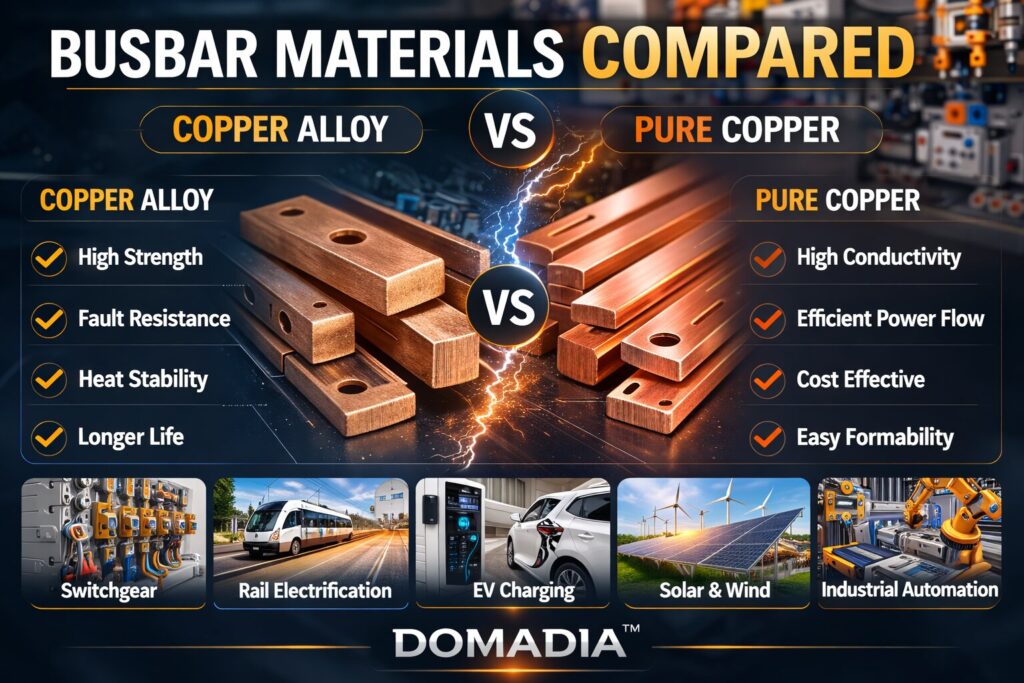
🔹 Pure Copper Busbar (ETP / C11000)
- Copper (Cu): ≥ 99.9%
- Oxygen: 0.02–0.04%
- Minimal alloying elements
This is electrolytic tough pitch copper known for very high conductivity.
🔹 Copper Alloy Busbar (Examples: C10100, C10200, C19400, C18150)
Composition varies depending on grade:
- Copper (Cu): 97–99.95%
- Alloying elements: Chromium (Cr), Zirconium (Zr), Iron (Fe), Silver (Ag), etc.
These alloy additions significantly enhance mechanical properties.
When Busbar Materials Compared, alloy additions make the difference in strength and temperature stability.
Electrical & Mechanical Properties
🔸 Pure Copper Busbar
- Electrical Conductivity: ~100% IACS
- Tensile Strength: 200–250 MPa
- Excellent formability
- Soft under high temperature stress
- Lower mechanical rigidity
Best for:
- Low stress environments
- Static installations
- Indoor panels with limited vibration
Copper Alloy Busbar
- Electrical Conductivity: 75–98% IACS (depending on alloy)
- Tensile Strength: 350–600 MPa
- Higher softening resistance
- Better fatigue strength
- Improved creep resistance
When Busbar Materials Compared, copper alloys provide superior performance in:
- High short-circuit forces
- High temperature operations
- Compact electrical designs
- EV and renewable systems
Technical Specifications
| Parameter | Pure Copper | Copper Alloy |
| Conductivity | Very High | High |
| Strength | Moderate | High |
| Heat Resistance | Moderate | Superior |
| Vibration Resistance | Low | High |
| Lifecycle | Moderate | Extended |
| Cost | Lower initial | Higher initial |
Standards Followed
At DOMADIA™, our busbars comply with:
- ASTM B187
- ASTM B152
- IEC 60439
- DIN EN 13600
- IS 613
- RoHS & REACH compliance
When Busbar Materials Compared, compliance ensures safety and reliability across industries.
Applications – Where Each Performs Best
Pure Copper Busbars
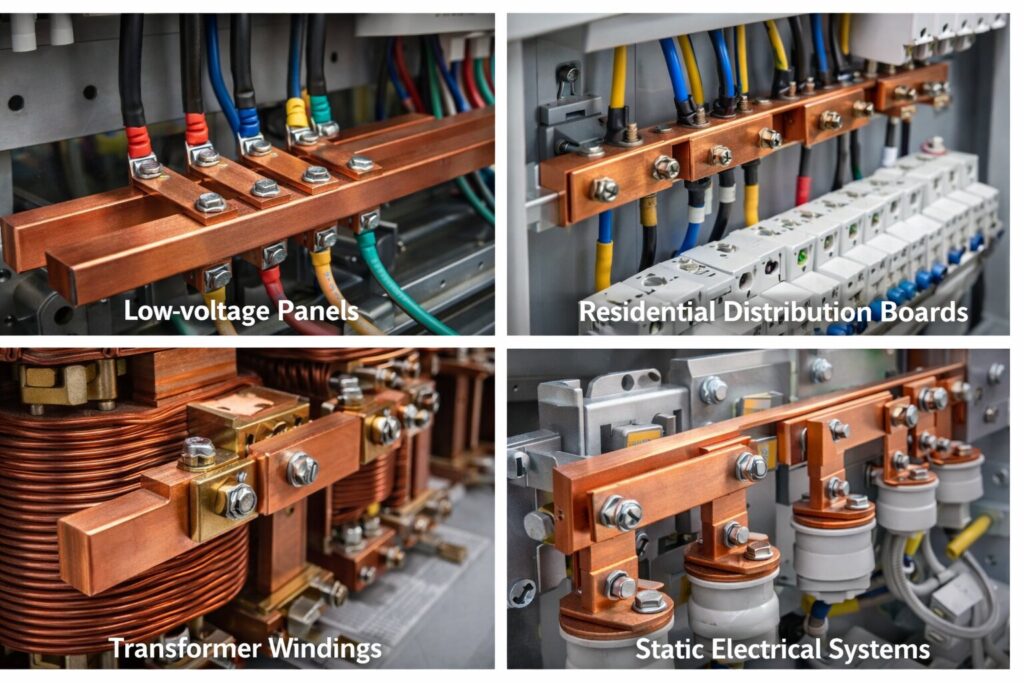
- Low-voltage panels
- Residential distribution boards
- Transformer windings
- Static electrical systems
Copper Alloy Busbars
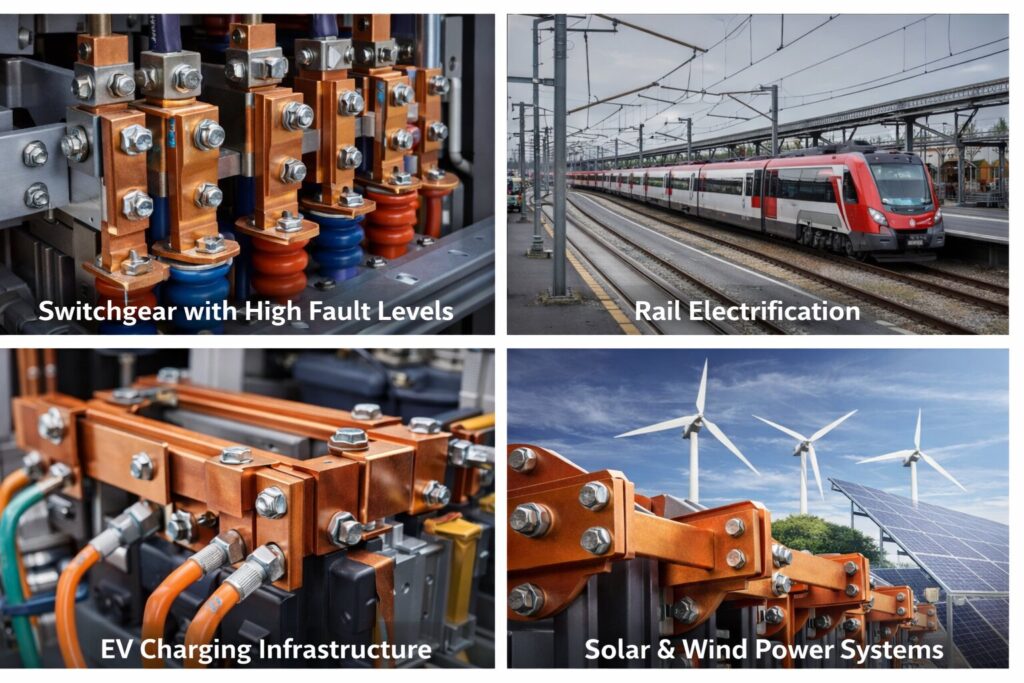
- Switchgear with high fault levels
- Rail electrification
- EV charging infrastructure
- Solar & wind power systems
- Industrial automation panels
In modern infrastructure, Busbar Materials Compared shows copper alloys winning in demanding environments.
Lifecycle Cost: The Hidden Factor
Many engineers focus only on conductivity percentage.
But real cost comes from:
- Replacement downtime
- Thermal fatigue failure
- Bending deformation
- Short-circuit damage
Copper alloys reduce:
- Maintenance frequency
- Thermal distortion
- Structural reinforcement needs
When Busbar Materials Compared, the slightly higher alloy cost often delivers far greater lifecycle savings.
Shapes Available at DOMADIA™
DOMADIA™ supplies busbars in:
- Flat Bars
- Rectangular Bars
- Round Bars
- Hollow Sections
- Laminated Busbars
- Customized CNC-Machined Profiles
Surface finish options:
- Bare copper
- Tin-plated
- Silver-plated
- Nickel-plated
The Strategic Mindset Shift
Old mindset:
“Highest conductivity is always best.”
New mindset:
“Balanced conductivity + strength = long-term reliability.”
When Busbar Materials Compared, engineers now prioritize structural integrity along with conductivity.
That’s where DOMADIA™ supports smarter design decisions.
Why Choose DOMADIA™?
- Certified materials
- Custom dimensions
- Tight tolerance manufacturing
- Technical material guidance
- PAN-India & global supply
When Busbar Materials Compared, expertise matters as much as material purity.
Conclusion: Busbar Materials Compared for Performance That Lasts
Busbar Materials Compared is more than a technical debate is a decision that impacts power efficiency, system durability, and operational safety.
Pure copper remains excellent for traditional installations.
Copper alloys dominate in modern high-demand electrical systems.
The right choice depends on your application—and DOMADIA™ ensures you choose correctly.
Upgrade Your Power Systems with the Right Busbar Choice
Don’t let material selection compromise performance, safety, or lifecycle cost. When Busbar Materials Compared, the right decision delivers stronger systems, lower downtime, and long-term savings.
Partner with DOMADIA™ for high-performance pure copper and copper alloy busbars engineered to meet global standards and demanding applications.
Contact DOMADIA™ today and power your projects with confidence.
Talk to: Er.Pankaj Domadia | Kairav Domadia | Aadil Domadia | Pragati Sanap | Pooja N N
#BusbarMaterialsCompared #CopperBusbar #CopperAlloy #ElectricalEngineering #PowerDistribution #HighConductivity #IndustrialMetals #DOMADIA
Directly whatsapp us for an Enquiry: https://wa.link/kairav
We’ve supplied to Mumbai, Pune, Indore, Jaipur, and Surat—serving industries across Maharashtra, Madhya Pradesh, Rajasthan, Gujarat, and Goa, with exports to Germany, USA, Japan, South Korea, and Italy.