Blogs
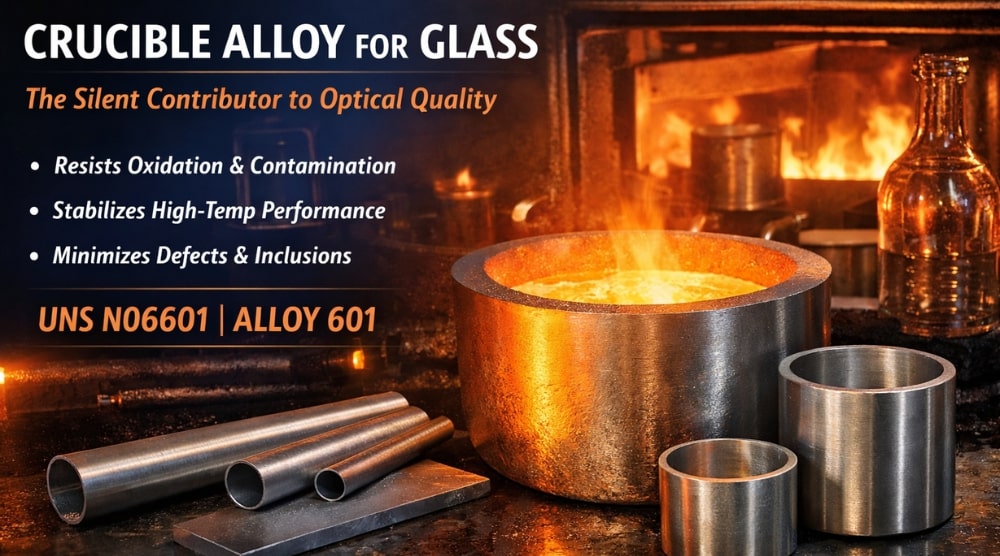
Crucible Alloy for Glass Manufacturing: Why UNS N06601 Is the Silent Guardian of Optical Precision
Crucible Alloy for Glass is rarely discussed in boardrooms—yet it quietly decides whether your glass comes out optically clean or financially painful.
A real production story (you may relate):
A plant kept seeing “random” rejects—tiny stones, cords/striae, haze, and occasional discoloration. The batch chemistry was checked. Burner tuning was refined. Operators were re-trained. Still… defects returned.
Then someone asked the uncomfortable question: What if the problem isn’t the glass recipe—what if it’s what the melt is touching?
That’s where crucible alloy selection stops being a “maintenance line item” and becomes a quality lever.
In high-precision glass making—optical, laboratory, specialty, and high-clarity applications—the metal hardware near the melt (or holding it) must resist oxidation, scaling, spalling, and chemical attack. When those protections fail, contaminants can enter the melt and show up as visible defects. Refractory fall-in and contamination are well-known sources of “stones” and inclusions. DOMADIA™ focuses on materials that hold up when the furnace refuses to be gentle.
Why Optical Quality Depends on “Invisible” Metal Choices
Optical quality is not only about forming and annealing. It’s also about melt stability and cleanliness:
- No flakes/spalls dropping into the molten glass
- No reactive scaling that accelerates inclusions
- No distortion that changes thermal profiles and flow
- No surprise corrosion that turns into recurring defect cycles
Glass defects like stones/inclusions and inhomogeneities are strongly linked to materials and process environments surrounding the melt.
Crucible Alloy for Glass: Why UNS N06601 Is a Practical Sweet Spot
For many high-temperature glass-adjacent components—and for crucible-type usage in controlled environments—Alloy 601 (UNS N06601) is widely chosen because it’s engineered for heat + oxidation resistance, helped by its chromium and aluminum that form protective oxide films at elevated temperature.
Special Metals’ technical bulletin highlights Alloy 601’s strength in high-temperature oxidation resistance and its use across thermal-processing equipment applications.
Chemical Composition (UNS N06601 / Alloy 601)
Typical limiting composition ranges (wt.%):
- Nickel (Ni): 58.0 – 63.0
- Chromium (Cr): 21.0 – 25.0
- Iron (Fe): Remainder
- Aluminum (Al): 1.0 – 1.7
- Carbon (C): 0.10 max
- Manganese (Mn): 1.0 max
- Silicon (Si): 0.50 max
- Sulfur (S): 0.015 max
- Copper (Cu): 1.0 max
Why this matters for glass operations:
- Ni base = stability at heat
- Cr + Al = protective oxide behavior (less scaling/spalling risk)
That “quiet chemistry” reduces the chance that your process hardware becomes a defect generator.
Properties That Protect Optical Quality
Key performance advantages of Alloy 601 (UNS N06601):
1) Oxidation resistance under cyclic heat
In Crucible Alloy for Glass applications, high-temperature cycling is where many materials begin shedding scale, but Alloy 601 stands out for its exceptional oxidation resistance and stable protective oxide formation at elevated temperatures.
2) Mechanical strength at elevated temperature
In Crucible Alloy for Glass applications, hardware positioned near hot zones must resist sagging, warping, and creep-related distortion. Alloy 601 is widely used in thermal-processing equipment because it maintains mechanical strength at elevated temperatures where structural stability directly impacts process consistency.
3) Metallurgical stability
In Crucible Alloy for Glass applications, a stable microstructure and controlled high-temperature behavior reduce unexpected degradation, ensuring predictable performance over long service exposure.
4) Fabricability
In Crucible Alloy for Glass applications, Alloy 601 is also valued as a versatile engineering material that can be readily formed and welded, enabling reliable fabrication of practical plant hardware for high-temperature service.
Technical Specifications (Typical Reference Values)
From Special Metals data for INCONEL® alloy 601 (UNS N06601):
- Density: 8.11 Mg/m³
- Melting range:1360 – 1411°C (2480 – 2571°F)
- (Thermal and mechanical property tables vary by product form and condition—sheet vs bar vs tube—and should be matched to your service temperature and fabrication route.)
Standards and Common Supply Specifications (UNS N06601)
When procurement says “Alloy 601,” quality plants say: Show me the standard.
Common specifications seen in market supply for UNS N06601 include:
- ASTM B168 (plate/sheet/strip)
- ASTM B166 (bar/rod)
- ASTM B167 (seamless pipe & tube)
- ASTM B163 (seamless tube)
- ASTM B564 (forgings)
- AMS 5715 (bar/forgings/rings), AMS 5870 (sheet/strip/plate)
DOMADIA™ can align supply expectations to application reality—because “meeting a standard” is not the same as “surviving your furnace.”
Applications in Glass Manufacturing Where the Alloy Quietly Wins
Here’s where UNS N06601 often supports stability and consistency in glass operations:
A) Hot-zone supports, retainers, fixtures & hardware
In Crucible Alloy for Glass applications, distortion alters heat flow and disrupts melt behavior—often leading production teams to blame “process variation” instead of the real issue: unstable high-temperature materials.
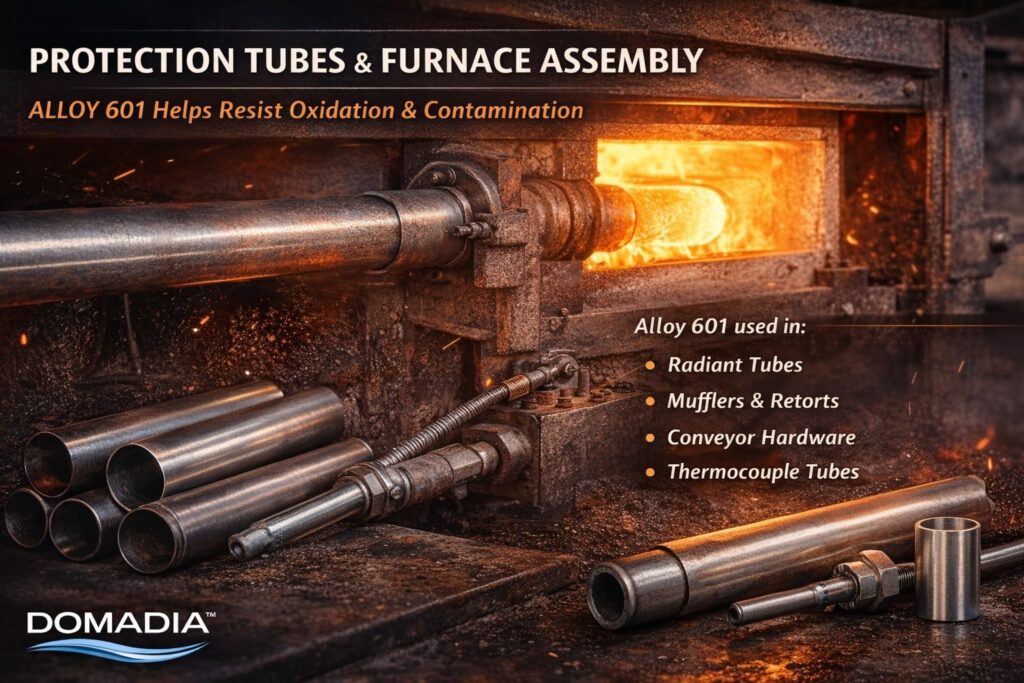
B) Protection tubes, thermal processing components, and furnace-side assemblies
Crucible Alloy for Glass applications often rely on Alloy 601 in furnace and thermal-processing equipment such as radiant tubes, muffles, retorts, conveyor-related components, and thermocouple protection tubes. In high-heat glass environments where oxidation resistance and thermal stability are critical, this alloy performs reliably under conditions similar to those found across demanding thermal industries.
C) Lab and specialty glass melting set-ups (controlled crucible usage)
Crucible Alloy for Glass applications in controlled laboratory and specialty melting environments frequently use Alloy 601 crucibles for their proven resistance to high-temperature corrosion. This stability helps maintain melt purity, minimizes contamination risks, and supports consistent performance where precision and optical quality are non-negotiable.
D) Optical/specialty glass: defect prevention mindset
When the cost of a defect is not just scrap—it’s reputational damage—materials discipline becomes non-negotiable. Defects such as stones can be caused by fall-in from furnace/forehearth refractories and contamination sources.
Shapes Available (DOMADIA™ Supply Mindset)
Because glass plants don’t run on “one shape fits all,” DOMADIA™ typically supports supply in forms such as:
- Cylindrical crucibles (lab/specialty controlled use)
- Sheet / Plate / Strip (guards, shields, fabricated assemblies)
- Round / Flat / Square bars (machined parts, fixtures)
- Pipe / Tube (protection tubes, high-heat conduits)
- Wire (ties, specialty fixtures—application dependent)
Conclusion: Where Quality Is Engineered, Not Inspected
The most effective way to reduce glass rejects is not by tightening inspection protocols, but by strengthening the materials that operate closest to the melt. High-performing teams move beyond reacting to defects—they prevent them by upgrading what the molten glass touches and what surrounds it in high-temperature zones.
This is why Crucible Alloy for Glass is far more than a purchasing decision. It is a critical quality system component that influences heat stability, contamination control, and defect prevention at the source. The right alloy minimizes distortion, oxidation, and material fall-in—issues that often get misdiagnosed as “process variation.”
When optical clarity, yield consistency, and long-term reliability matter, aligning Crucible Alloy for Glass selection with real furnace conditions, proper form factors, and proven standards like UNS N06601 becomes a strategic advantage. DOMADIA™ supports manufacturers who choose to engineer quality into the melt—before defects ever appear.
Optical defects don’t start at inspection—they start at material contact points inside the furnace.
Explore DOMADIA™ Crucible Alloys to see how the right Crucible Alloy for Glass protects optical quality and reduces rejects
Contact Usto discuss UNS N06601 selection, shapes, and standards matched to your real furnace conditions.
Talk to: Er.Pankaj Domadia | Kairav Domadia | Aadil Domadia | Pragati Sanap | Pooja N N
#CrucibleAlloyforGlass #UNSN06601 #Alloy601 #Inconel601 #GlassManufacturing #OpticalQuality #HighTemperatureAlloys #FurnaceEngineering #DefectReduction
Directly whatsapp us for an Enquiry: https://wa.link/kairav
Our reach includes Surat, Vapi, Ankleshwar, Bharuch, and Silvassa across Gujarat, Maharashtra, Dadra & Nagar Haveli, Rajasthan, and MP, with exports to China, Taiwan, Hong Kong, Macau, and Mongolia.