Blogs
Industrial Wire Selection Guide: How to Choose the Right Wire for Industrial Applications
Introduction: When the Wrong Wire Stops the Right Machine
Industrial Wire Selection Guide decisions are rarely visible—until something fails.
Mid-shift, the packaging line suddenly stops.
Without warning, the control panel starts overheating.
Out of nowhere, a robotic arm reports faults no one can pin down.
In most real factories, the root cause is not software, not design, not even maintenance.
It’s the wrong wire type chosen at the beginning.
This is where Industrial Wire Selection Guide thinking separates reactive plants from resilient ones. At DOMADIA™, we see it daily—industries upgrading equipment while overlooking the most basic electrical backbone that keeps everything running.
Why Industrial Wire Selection Is a Strategic Decision
The old mindset treats wires as commodities.
The modern mindset treats them as risk-management components.
Choosing the right wire impacts:
- Equipment lifespan
- Energy efficiency
- Fire and safety compliance
- Downtime frequency
- Long-term maintenance cost
That’s why Industrial Wire Selection Guide principles are no longer optional in automation-heavy, compliance-driven industries.
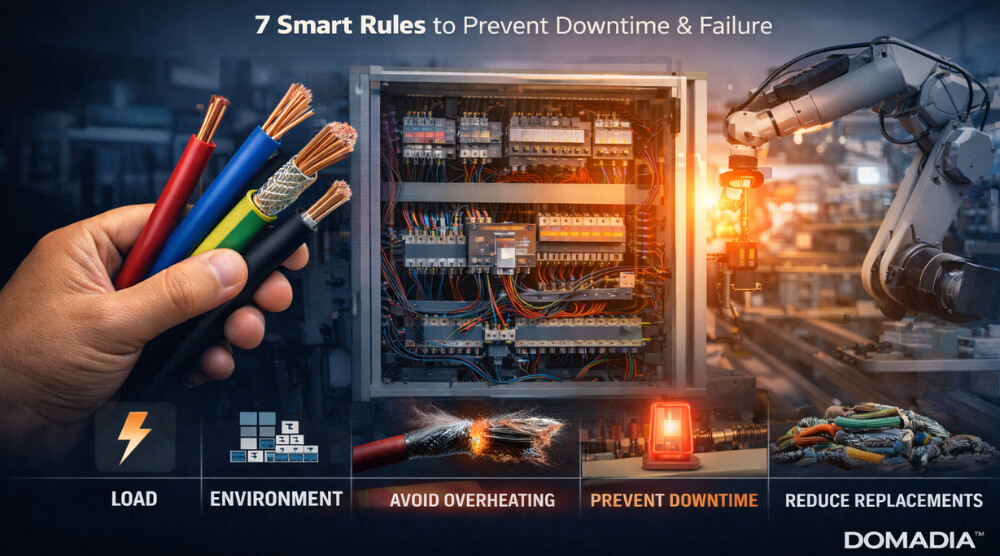
Rule 1: Match the Wire to the Electrical Load (Not the Nominal Rating)
In industrial environments, wires rarely operate at textbook conditions.
Motors draw surge currents.
VFDs create harmonics.
Panels experience heat buildup.
An effective Industrial Wire Selection Guide always accounts for:
- Continuous vs peak current
- Derating due to ambient temperature
- Voltage drop over distance
DOMADIA™ Insight: Oversizing slightly often costs less than repeated replacements and energy loss.
Rule 2: Understand the Environment Before Selecting Insulation
This is where many failures begin.
Ask these questions:
- Is the wire exposed to oil, coolant, or chemicals?
- Will it face UV, moisture, or outdoor conditions?
- Is there constant vibration or movement?
A proper Industrial Wire Selection Guide aligns insulation types accordingly:
- PVC – cost-effective, controlled environments
- XLPE – higher temperature resistance
- PTFE / Silicone – extreme heat, chemical exposure
- PUR / TPE – robotics, drag chains, continuous flexing
DOMADIA™ supplies industrial wires engineered specifically for these stress profiles—not generic catalog grades.
Rule 3: Solid vs Stranded vs Flexible—Choose Motion, Not Habit
Many teams default to solid wires because “that’s what we’ve always used.”
That’s a mistake.
A modern Industrial Wire Selection Guide defines conductors by motion:
- Solid core → Fixed installations, power feeders
- Stranded → Panels, moderate vibration
- Extra-flexible → Robotics, automation, moving assemblies
Wrong choice here means micro-cracks, intermittent faults, and hard-to-diagnose downtime.
Rule 4: Temperature Rating Is Not a Paper Specification
A wire rated for 90°C on paper may never survive that inside a crowded panel.
An accurate Industrial Wire Selection Guide considers:
- Heat from adjacent components
- Poor ventilation zones
- Seasonal ambient variation
DOMADIA™ focuses on real operating temperatures, not brochure numbers—because insulation breakdown is silent until it becomes catastrophic.
Rule 5: Compliance Is Not Optional—It’s Insurance
Industrial wiring must meet applicable standards:
- IEC
- UL
- IS / BIS
- RoHS & REACH (where required)
A robust Industrial Wire Selection Guide ensures traceability, test certificates, and batch consistency.
At DOMADIA™, compliance isn’t an add-on—it’s embedded in material selection and supply control.
Rule 6: Think in Lifecycle Cost, Not Purchase Price
Here’s the mindset shift most plants resist—but later appreciate.
Cheaper wire =
✔ Lower upfront cost
✘ Higher failure risk
✘ More replacements
✘ More scrap and recycling
✘ More downtime
A disciplined Industrial Wire Selection Guide looks at:
- Expected service life
- Replacement labor
- Production loss
- Environmental impact of repeated scrapping
Longer-lasting wires reduce recycling frequency—quietly contributing to sustainability while protecting uptime.
Rule 7: Standardization Simplifies Maintenance
Plants with too many wire types suffer during breakdowns.
An optimized Industrial Wire Selection Guide helps you:
- Standardize insulation families
- Reduce spare inventory
- Speed up repairs
- Improve technician familiarity
DOMADIA™ works with customers to rationalize wire portfolios—cutting complexity without compromising performance.
Applications Where the Right Wire Choice Matters Most
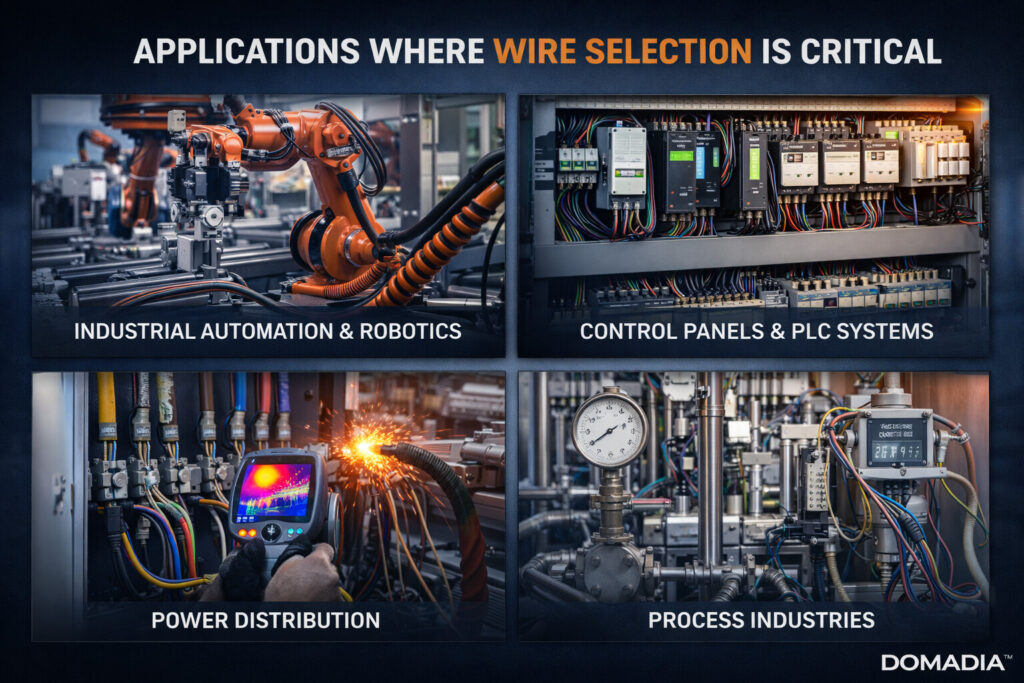
- Industrial automation & robotics – continuous flex, signal integrity
- Control panels & PLC systems – heat density, reliability
- Power distribution – current stability, safety
- Process industries – chemical and thermal exposure
- EV & renewable systems – high load, long duty cycles
In each case, the Industrial Wire Selection Guide determines whether systems age gracefully—or fail early.
The DOMADIA™ Takeaway
The smartest plants don’t ask:
“Which wire is cheapest?”
They ask:
“Which wire will still perform five years from now?”
That’s the core of the Industrial Wire Selection Guide approach—and the philosophy behind DOMADIA™ industrial wire solutions.
Conclusion: One Choice That Multiplies Reliability
Industrial Wire Selection Guide decisions are small on paper but massive in impact.
When wires are chosen correctly:
- Machines run longer
- Failures become predictable
- Maintenance becomes planned
- Sustainability improves naturally
DOMADIA™ supports industries that value reliability over reaction—and engineering discipline over shortcuts.
Most electrical failures don’t start in machines—they start in material selection.
Make the smarter move with DOMADIA™industrial wire solutions built for real operating conditions.
👉 Contact Us to select the right wire, the first time.
Talk to: Er.Pankaj Domadia | Kairav Domadia | Aadil Domadia | Pragati Sanap | Pooja N N
#IndustrialWireSelectionGuide #IndustrialWiring #ElectricalSafety #AutomationCables #DOMADIA #ManufacturingReliability
Directly whatsapp us for an Enquiry: https://wa.link/kairav
We’ve supplied to Mumbai, Pune, Indore, Jaipur, and Surat—serving industries across Maharashtra, Madhya Pradesh, Rajasthan, Gujarat, and Goa, with exports to Germany, USA, Japan, South Korea, and Italy.