Blogs
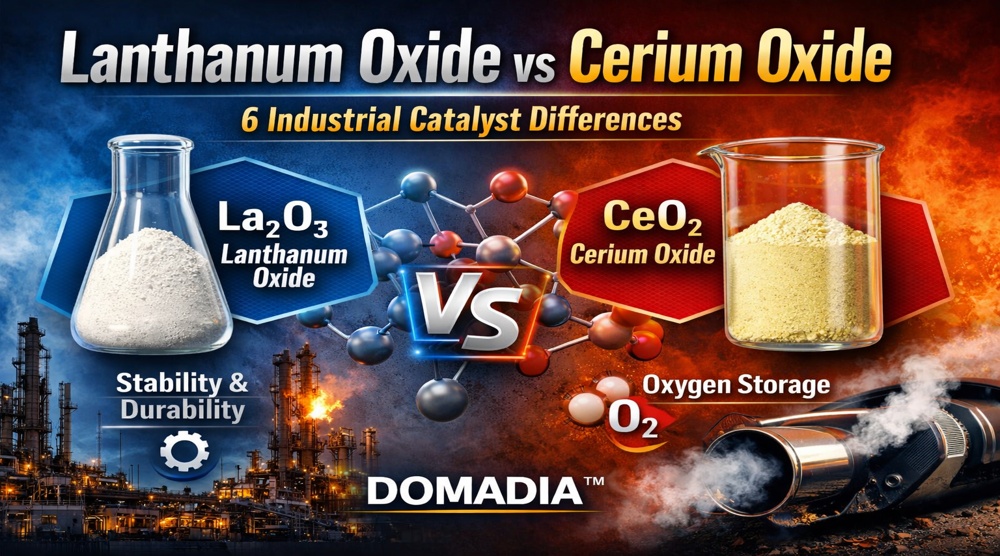
Lanthanum Cerium Catalysts: 6 Powerful Industrial Catalyst Differences | DOMADIA™
Lanthanum Cerium Catalysts – A Critical Choice for Industrial Chemistry
Lanthanum Cerium Catalysts play a major role in modern catalytic chemistry. From petroleum refining to automotive emission control, rare earth oxides influence how efficiently chemical reactions occur. Engineers often debate whether Lanthanum Oxide (La₂O₃) or Cerium Oxide (CeO₂) performs better in demanding catalytic environments.
A refinery engineer once faced a persistent problem: catalyst performance was declining faster than expected in a reforming unit. Temperature spikes and oxygen imbalance caused catalyst degradation. The solution was not increasing catalyst quantity—but choosing the correct rare earth oxide stabilizer.
This is where Lanthanum Cerium Catalysts become critical. While both materials belong to the rare earth oxide family, their catalytic mechanisms, oxygen mobility, and thermal stability differ significantly.
Understanding these differences helps industries improve catalyst lifetime, reduce energy consumption, and optimize reaction efficiency.
Chemical Composition of Lanthanum Oxide and Cerium Oxide
Lanthanum Oxide (La₂O₃)
Chemical Formula: La₂O₃
Typical Purity: 99.9% – 99.999%
Composition:
| Element | Percentage |
| Lanthanum (La) | ~85–88% |
| Oxygen (O) | Balance |
| Rare Earth Impurities | <0.1% |
Lanthanum oxide acts as a basic oxide, improving catalytic stability and increasing surface alkalinity.
Cerium Oxide (CeO₂)
Chemical Formula: CeO₂
Typical Purity: 99.9% – 99.999%
Composition:
| Element | Percentage |
| Cerium (Ce) | ~81–83% |
| Oxygen (O) | Balance |
| Rare Earth Impurities | <0.1% |
Cerium oxide is known for oxygen storage capacity, making it one of the most important catalytic materials in automotive converters.
6 Industrial Catalyst Differences
1. Oxygen Storage Capability
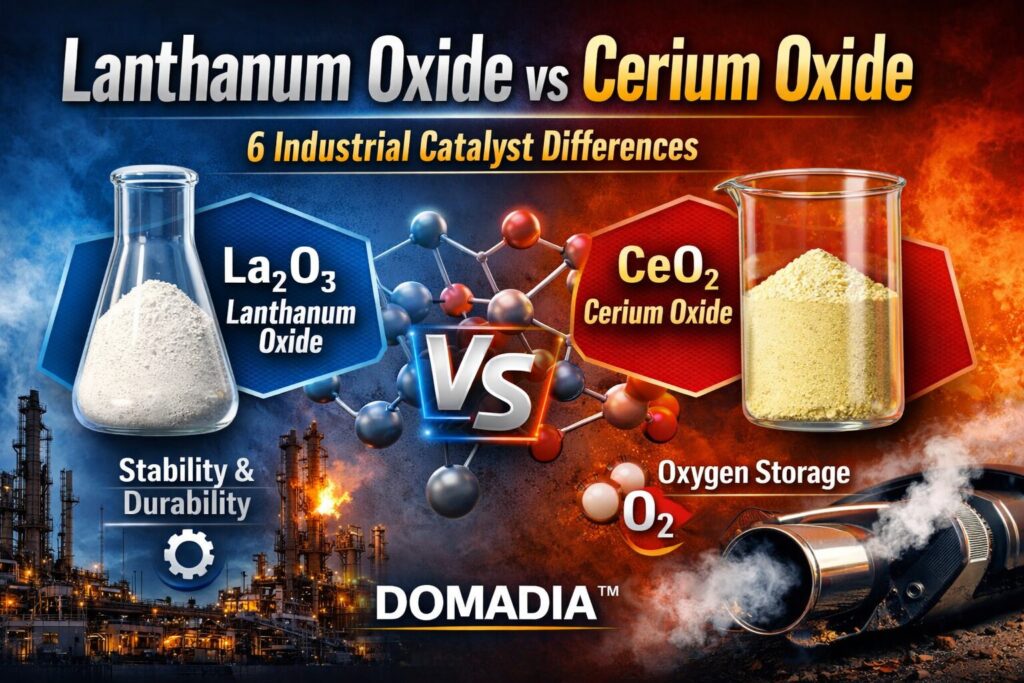
The most defining difference in Lanthanum Cerium Catalysts is oxygen mobility.
Cerium Oxide
- Excellent oxygen storage capacity
- Quickly releases and absorbs oxygen
- Ideal for emission control catalysts
Lanthanum Oxide
- Limited oxygen storage
- Enhances catalytic stability instead
2. Catalytic Activity in Petrochemical Reactions
In cracking and reforming processes, Lanthanum Cerium Catalysts behave differently.
Lanthanum Oxide
- Improves catalyst durability
- Stabilizes zeolite structures
- Extends catalyst life in FCC units
Cerium Oxide
- Promotes oxidation reactions
- Used in oxidative catalysis
3. Thermal Stability
Temperature resistance is critical in catalyst systems.
Lanthanum Cerium Catalysts Comparison
| Property | Lanthanum Oxide | Cerium Oxide |
| Thermal Stability | Very High | High |
| Structural Stability | Excellent | Good |
| Catalyst Support | Strong | Moderate |
Lanthanum oxide is widely used when high-temperature stability is required.
4. Oxygen Redox Behavior
One of the most valuable properties of Lanthanum Cerium Catalysts is redox chemistry.
Cerium Oxide
- Easily switches between Ce³⁺ and Ce⁴⁺ states
- Supports oxidation-reduction cycles
- Essential in catalytic converters
Lanthanum Oxide
- Limited redox behavior
- Used mainly as structural promoter
5. Catalyst Lifetime
Industries must consider the lifecycle economics of catalysts.
Lanthanum Cerium Catalysts Comparison
- Lanthanum Oxide → Longer catalyst structural stability
- Cerium Oxide → Higher catalytic reactivity
Even if cerium oxide catalysts are highly reactive, lanthanum-stabilized catalysts often last longer in harsh conditions.
Longer catalyst life means:
- Reduced replacement cost
- Lower production downtime
- Less industrial waste
6. Environmental Impact
Frequent catalyst replacement increases scrap generation and recycling energy consumption.
A catalyst stabilized with lanthanum oxide often lasts longer in refinery environments. That means fewer catalyst replacements and less environmental impact from recycling and reprocessing.
Industries increasingly adopt Lanthanum Cerium Catalysts combinations to improve sustainability.
Properties of Lanthanum Cerium Catalysts
| Property | Lanthanum Oxide | Cerium Oxide |
| Molecular Weight | 325.81 g/mol | 172.11 g/mol |
| Density | 6.51 g/cm³ | 7.22 g/cm³ |
| Melting Point | ~2315°C | ~2400°C |
| Crystal Structure | Hexagonal | Fluorite |
| Oxygen Mobility | Low | Very High |
| Catalytic Role | Stabilizer | Oxygen buffer |
These properties make Lanthanum Cerium Catalysts essential in advanced catalytic systems.
Technical Specifications (Industrial Grade)
Typical specifications offered by DOMADIA™:
Purity
99.9% – 99.999%
Particle Size
Nano to micron scale
Moisture Content
<0.5%
Surface Area
High surface area optimized for catalytic reactions
Packaging
Vacuum sealed moisture-proof packaging
Industrial Standards
Lanthanum oxide and cerium oxide powders supplied by DOMADIA™ typically comply with:
- ASTM Rare Earth Material Standards
- ISO 9001 Quality Systems
- RoHS Compliance
- REACH Chemical Regulations
- Semiconductor & catalyst industry specifications
These standards ensure Lanthanum Cerium Catalysts meet global industrial requirements.
Applications of Lanthanum Cerium Catalysts
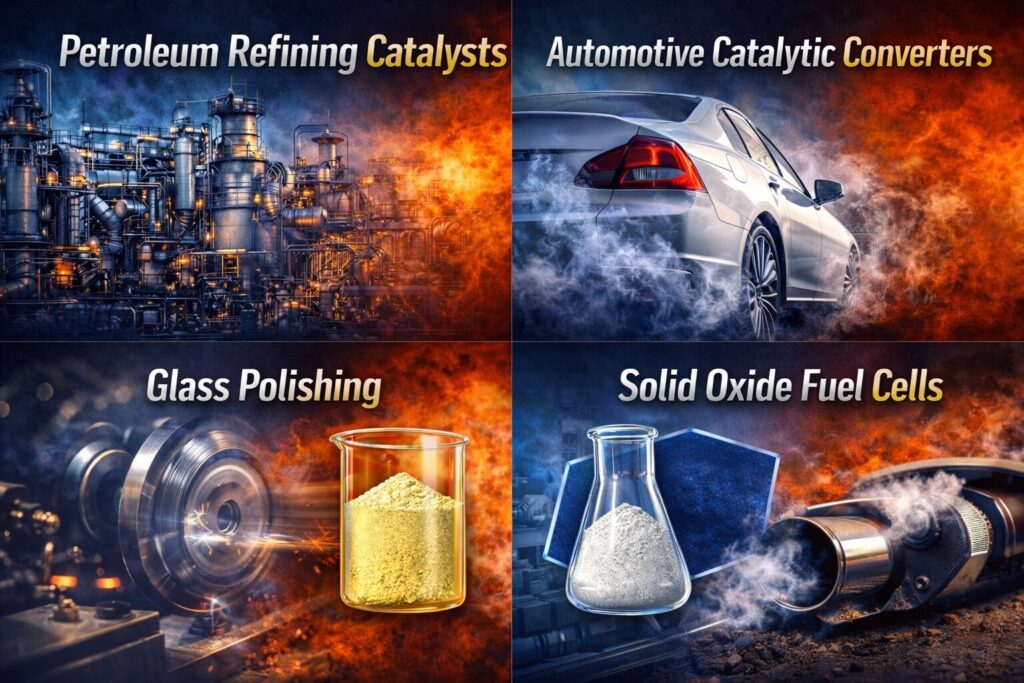
Petroleum Refining Catalysts
Lanthanum oxide stabilizes zeolite catalysts used in fluid catalytic cracking.
Automotive Catalytic Converters
Cerium oxide stores and releases oxygen to reduce CO and NOx emissions.
Glass Polishing
Cerium oxide powders are widely used for precision optical polishing.
Solid Oxide Fuel Cells
Lanthanum oxide improves electrolyte stability in fuel cell materials.
Environmental Catalysts
Lanthanum Cerium Catalysts help break down industrial pollutants.
Chemical Manufacturing
Used in oxidation and hydrogenation catalytic systems.
Shapes Available from DOMADIA™
Lanthanum Cerium Catalysts from DOMADIA™ are available in multiple industrial forms:
- Powder
- Nano Powder
- Granules
- Catalyst Grade Oxide Powder
- Custom Particle Size Powders
These shapes help industries optimize surface area, reactivity, and catalytic efficiency.
The Industrial Mindset Shift
Many engineers focus only on catalytic activity. The smarter approach is balancing activity with durability.
The real question is not:
Which catalyst is more reactive?
The real question is:
Which catalyst delivers the best performance over time?
Often the answer lies in Lanthanum Cerium Catalysts combinations, where lanthanum stabilizes the structure and cerium provides oxygen mobility.
That synergy powers modern catalytic systems.
Conclusion
Lanthanum Cerium Catalysts represent two of the most important rare earth oxide materials used in industrial chemistry.
Cerium oxide excels in oxygen storage and oxidation reactions, while lanthanum oxide provides structural stability and long catalyst life. The combination of these materials helps industries improve efficiency, extend catalyst lifespan, and reduce environmental impact.
At DOMADIA™, high-purity lanthanum oxide and cerium oxide powders are supplied for catalyst manufacturing, research laboratories, and advanced chemical processing industries worldwide.
For industries seeking reliable catalytic materials, Lanthanum Cerium Catalysts from DOMADIA™ deliver performance, durability, and long-term value.
Boost Catalyst Performance with Premium Rare Earth Materials from DOMADIA™
Discover reliable rare earth materials engineered for performance with DOMADIA™.
Contact Us today to discuss high-purity rare earth materials for your catalytic and advanced industrial applications.
Talk to: Er.Pankaj Domadia | Kairav Domadia | Aadil Domadia | Pragati Sanap | Pooja N N
#LanthanumOxide #CeriumOxide #RareEarthCatalysts #IndustrialCatalysts #CatalystTechnology #DOMADIA #AdvancedMaterials #RareEarthMetals #ChemicalIndustry
Directly whatsapp us for an Enquiry: https://wa.link/kairav
We’ve supplied to Mumbai, Pune, Indore, Jaipur, and Surat—serving industries across Maharashtra, Madhya Pradesh, Rajasthan, Gujarat, and Goa, with exports to Germany, USA, Japan, South Korea, and Italy.