Blogs
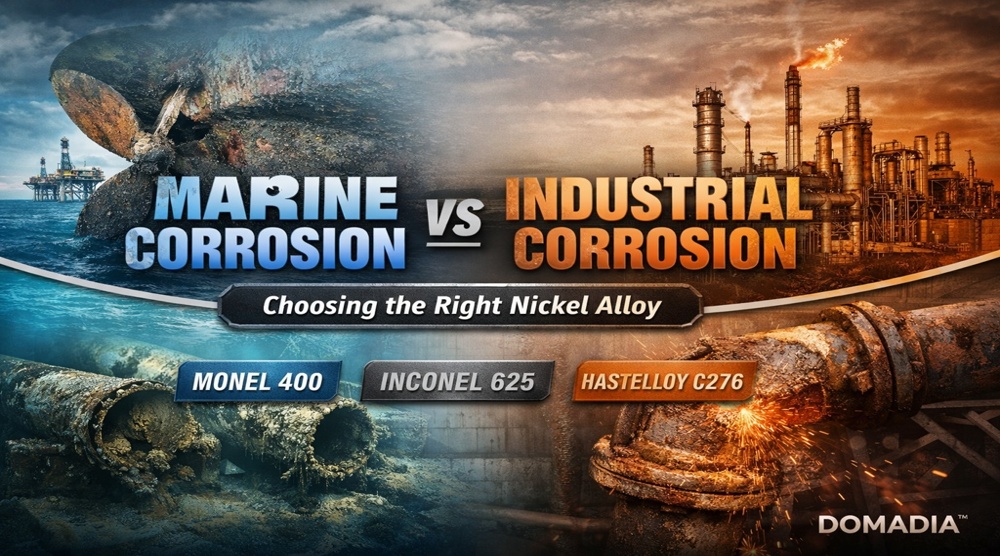
Marine Corrosion vs Industrial Corrosion Nickel Alloy: 9 Powerful Selection Secrets
Marine Corrosion vs Industrial Corrosion Nickel Alloy – What Truly Destroys Metals Faster?
A coastal desalination plant once replaced its heat exchanger tubes twice in three years. Meanwhile, a chemical processing unit 800 km inland struggled with acid vapor attack destroying structural fasteners.
Both blamed “corrosion.”
Both were wrong in the same way.
They treated Marine Corrosion vs Industrial Corrosion Nickel Alloy selection as the same challenge.
At DOMADIA™, we see this mistake often. Marine corrosion and industrial corrosion are fundamentally different threats. Choosing the wrong nickel alloy does not just increase maintenance—it multiplies downtime, replacement cost, and environmental waste.
Let’s break it down properly.
Understanding the Difference: Marine vs Industrial Corrosion
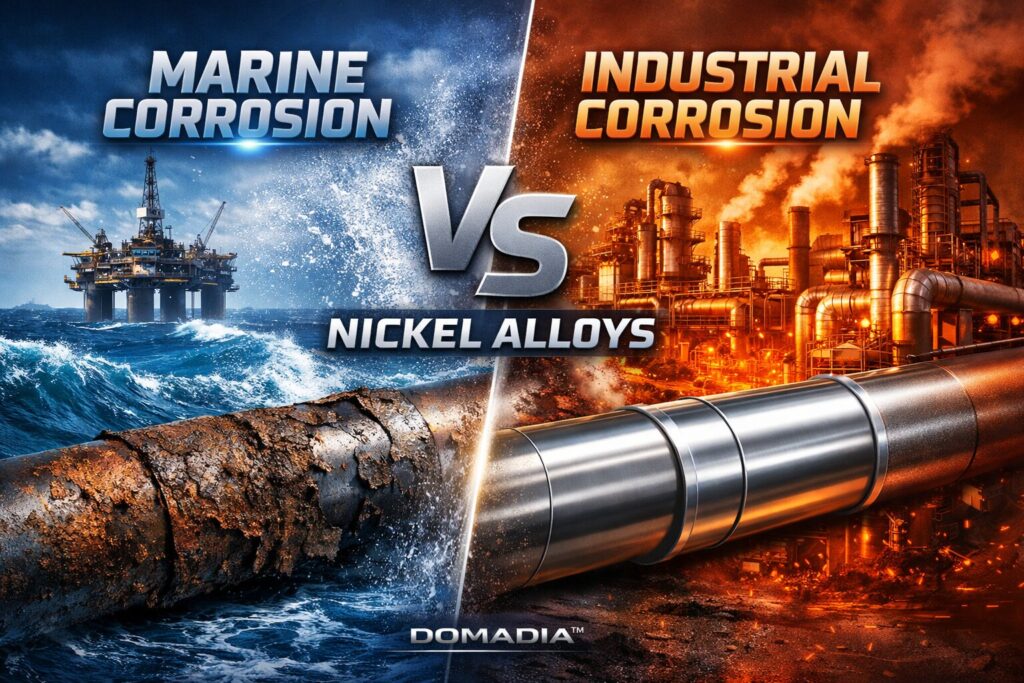
Marine Corrosion
- High chloride concentration (saltwater exposure)
- Pitting and crevice corrosion
- Galvanic reactions
- Constant humidity and oxygen supply
Common in:
- Offshore platforms
- Shipbuilding
- Desalination plants
- Marine fasteners and shafts
Industrial Corrosion
- Acidic gases (SO₂, HCl, H₂S)
- Chemical process fluids
- High-temperature oxidation
- Sulfur and caustic environments
Common in:
- Refineries
- Fertilizer plants
- Power plants
- Chemical reactors
Marine Corrosion vs Industrial Corrosion Nickel Alloy selection depends on chemistry—not location alone.
Why Nickel Alloys Are the Solution
Nickel alloys resist both chloride attack and chemical oxidation due to:
- Stable passive oxide film
- High chromium content
- Molybdenum strengthening
- Copper resistance in certain grades
But not all nickel alloys perform equally in marine and industrial settings.
Best Nickel Alloys for Marine Corrosion
🔹 Monel 400 (UNS N04400)
Excellent seawater resistance
Ideal for shafts, pumps, marine valves.
Chemical Composition (Typical %):
- Ni: 63 min
- Cu: 28–34
- Fe: 2.5 max
- Mn: 2 max
Key Properties:
- Outstanding resistance to seawater
- Good mechanical strength
- Excellent stress corrosion resistance
🔹 Inconel 625 (UNS N06625)
High molybdenum content improves pitting resistance.
Chemical Composition (Typical %):
- Ni: 58 min
- Cr: 20–23
- Mo: 8–10
- Nb + Ta: 3.15–4.15
Best for:
- Offshore risers
- Subsea equipment
- Heat exchangers
Best Nickel Alloys for Industrial Corrosion
🔹 Hastelloy C276 (UNS N10276)
Handles aggressive acids and chlorides.
Chemical Composition (Typical %):
- Ni: Balance
- Cr: 14.5–16.5
- Mo: 15–17
- Fe: 4–7
Applications:
- Chemical reactors
- Acid handling systems
- Pollution control equipment
🔹 Nickel 200 (UNS N02200)
Excellent for caustic environments.
Applications:
- Alkali processing
- Food processing
- Heat exchangers
Technical Properties Comparison
| Property | Marine Environment | Industrial Environment |
| Chloride Resistance | Critical | Moderate |
| Acid Resistance | Moderate | Critical |
| High Temp Stability | Medium | High |
| Pitting Resistance | Essential | Environment Dependent |
Marine Corrosion vs Industrial Corrosion Nickel Alloy selection must prioritize exposure chemistry.
Marine Nickel Alloy Applications
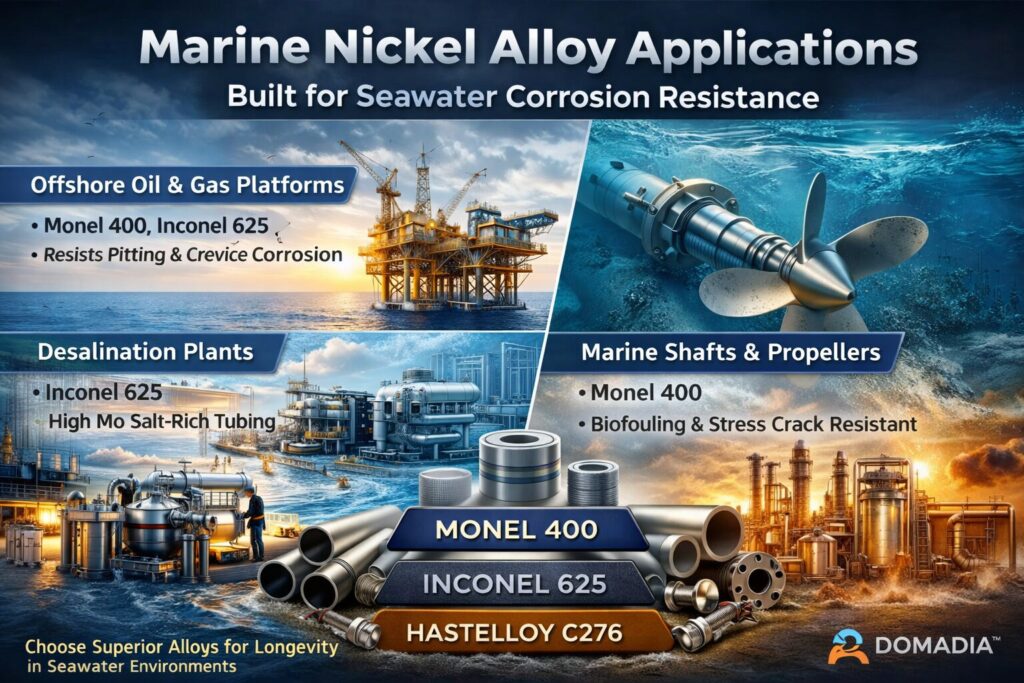
🔹 Offshore Oil & Gas Platforms
Nickel alloys like Monel 400 and Inconel 625 resist chloride-induced pitting and crevice corrosion in constant seawater exposure.
🔹 Desalination Plants
High molybdenum nickel alloys ensure long service life in salt-rich heat exchanger tubing and evaporator systems.
🔹 Marine Shafts & Propeller Components
Marine Corrosion vs Industrial Corrosion Nickel Alloy: Nickel-copper alloys provide excellent resistance to biofouling and stress corrosion cracking in submerged conditions.
🔹 Seawater Pumps & Valves
Superior corrosion resistance maintains operational reliability in high-flow, high-salinity environments.
Industrial Nickel Alloy Applications
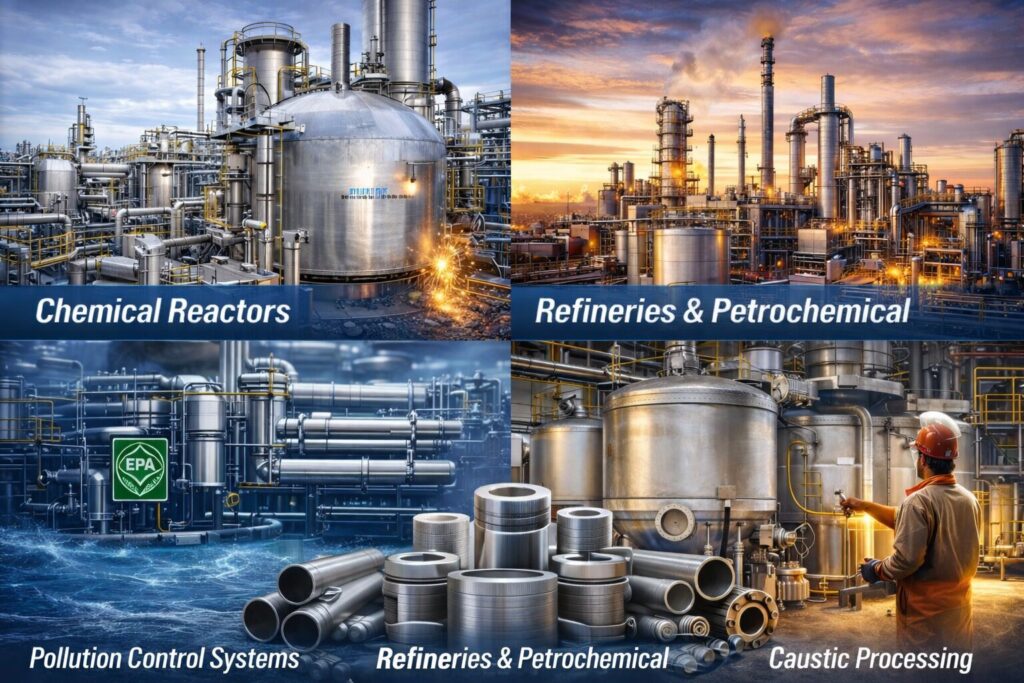
🔹 Chemical Reactors
Marine Corrosion vs Industrial Corrosion Nickel Alloy: Hastelloy C276 withstands aggressive acids and mixed chemical environments without rapid degradation.
🔹 Refineries & Petrochemical Units
Nickel alloys resist high-temperature oxidation and sulfur attack in process equipment.
🔹 Pollution Control Systems
Excellent corrosion resistance in scrubbers and exhaust treatment units exposed to acidic vapors.
🔹 Caustic Processing Equipment
Nickel 200 performs reliably in alkali environments, maintaining structural integrity under heat.
Standards & Specifications
Nickel alloys for marine and industrial use comply with:
- ASTM B164 (Nickel-Copper Alloys)
- ASTM B443 (Inconel 625)
- ASTM B574 (Hastelloy C276)
- ASME SB standards
- NACE MR0175 (Sour service compliance)
DOMADIA™ ensures full traceability and mill test certification.
Available Shapes at DOMADIA™
- Round Bars
- Forged Blocks
- Sheets & Plates
- Pipes & Tubes
- Fasteners
- Custom Machined Components
Whether it’s a subsea flange or an acid reactor bolt, DOMADIA™ delivers precision-engineered nickel alloys.
Environmental Impact – A Strategic Mindset Shift
Here’s the overlooked truth:
If a cheaper alloy fails every 3 years, it must be scrapped and recycled repeatedly.
Recycling requires:
- Energy
- Transportation
- Melting
- Reprocessing
A longer-lasting nickel alloy reduces:
- Scrap cycles
- Carbon emissions
- Resource extraction
In Marine Corrosion vs Industrial Corrosion Nickel Alloy selection, durability equals sustainability.
DOMADIA™ supports industries in reducing environmental load through lifecycle-focused alloy selection.
How to Choose the Right Alloy (Actionable Checklist)
✔ Identify chloride levels
✔ Measure operating temperature
✔ Evaluate acid concentration
✔ Check for crevice conditions
✔ Confirm required standards (ASTM / NACE)
✔ Calculate lifecycle cost, not purchase cost
Marine Corrosion vs Industrial Corrosion Nickel Alloy decisions must be engineering-driven—not price-driven.
Conclusion
Marine Corrosion vs Industrial Corrosion Nickel Alloy selection is not about choosing the most expensive alloy—it’s about choosing the most suitable alloy.
At DOMADIA™, we help industries evaluate exposure, lifecycle cost, environmental responsibility, and technical standards before recommending the right nickel alloy.
Because the real cost of corrosion is never just material—it’s downtime.
Stop Letting Corrosion Decide Your Downtime.
Choose the right nickel alloy engineered for your environment.
Speak with DOMADIA™ experts today and get a corrosion-resistant solution built to last.
Connect with our team and reduce replacement costs before the next shutdown.
Talk to: Er.Pankaj Domadia | Kairav Domadia | Aadil Domadia | Pragati Sanap | Pooja N N
#MarineCorrosion #IndustrialCorrosion #NickelAlloy #Monel400 #Inconel625 #Hastelloy #CorrosionResistance #SpecialAlloys #DOMADIA #EngineeringExcellence
Directly whatsapp us for an Enquiry: https://wa.link/kairav
We’ve delivered to Guwahati, Dibrugarh, Silchar, Tezpur, and Tinsukia across Assam, Meghalaya, Tripura, Mizoram, and Arunachal Pradesh, exporting to Thailand, Malaysia, Singapore, Brunei, and Indonesia.