Blogs
Can Mu Metal Be Used for Acoustic Shielding? 9 Powerful Facts About UNS N14080
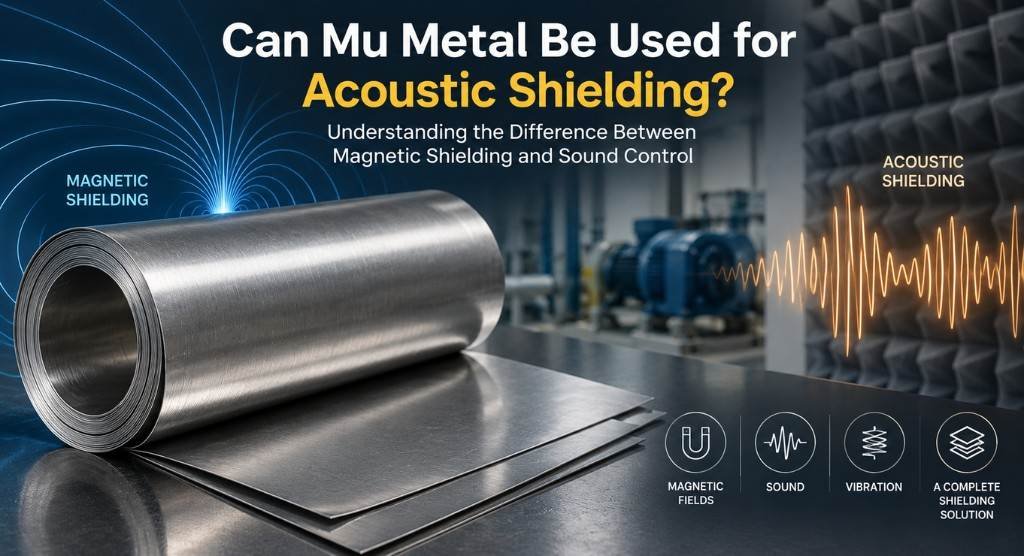
Mu Metal Acoustic Shielding often becomes a point of discussion when engineers are dealing with more than one type of interference around sensitive equipment. A design engineer may already need to protect an instrument from external magnetic fields, while nearby pumps, fans, motors, and industrial machinery are simultaneously creating unwanted noise and vibration. This naturally raises an important question: “If Mu Metal is such an effective shielding material, can we use it for acoustic shielding too?”
The answer is more interesting than a simple yes or no. Mu Metal Acoustic Shielding is generally not the primary purpose of Mu Metal. Mu Metal—commonly associated with high-permeability nickel-iron compositions such as UNS N14080—is primarily selected for low-frequency magnetic-field shielding, rather than conventional sound absorption or acoustic isolation.
However, Mu Metal sheet is still a physical metallic barrier. Depending on its thickness, mounting method, geometry, enclosure construction, and interaction with surrounding materials, it may influence the transmission of sound or mechanical vibration. That does not automatically make Mu Metal an acoustic shielding material, because effective noise and vibration control typically depends on a different set of material and design principles.
This is why understanding Mu Metal Acoustic Shielding requires separating two very different engineering challenges. Magnetic shielding is intended to manage magnetic flux and reduce unwanted magnetic-field exposure, while acoustic shielding focuses on controlling sound waves, vibration, resonance, and mechanical energy.
The important engineering lesson is clear: magnetic shielding and acoustic shielding solve fundamentally different problems. Recognizing that distinction early can prevent an expensive material-selection mistake and help engineers design an enclosure that address
1. What Is UNS N14080 Mu Metal?
Mu Metal is a high-nickel, iron-based soft magnetic alloy designed to achieve extremely high magnetic permeability after suitable processing and heat treatment.
Its key engineering advantage is its ability to provide a low-reluctance path for magnetic flux.
Rather than simply “blocking” a magnetic field like a wall, a properly designed Mu Metal shield redirects magnetic flux through the high-permeability material and around the protected region.
That makes it valuable around sensitive components such as:
- Scientific instruments
- Sensors
- Measurement equipment
- Electronic assemblies
- Transformers
- Medical and laboratory equipment
- Magnetic detection systems
- Precision instrumentation
DOMADIA™ can support specialized Mu Metal requirements where magnetic performance, dimensions, shape and final application need to be considered together.
2. Mu Metal Acoustic Shielding: Why the Name Can Be Misleading

The word “shielding” creates much of the confusion.
In electromagnetic engineering, shielding may involve controlling electric, magnetic or electromagnetic fields.
In acoustics, shielding means controlling sound pressure waves, structural vibration or both.
These are not interchangeable.
A material with excellent magnetic permeability does not automatically possess excellent sound-absorbing properties.
Similarly, an excellent acoustic foam may provide almost no useful magnetic shielding.
This distinction becomes particularly important in equipment that faces several environmental disturbances at the same time.
A laboratory instrument, for example, might be exposed to:
Magnetic field + EMI + airborne noise + mechanical vibration.
Trying to solve every problem with a single material may lead to poor performance.
3. Chemical Composition of Mu Metal
The exact chemistry depends on the specified grade, manufacturer and governing specification, so procurement should always be based on the applicable material certificate rather than the generic name “Mu Metal.”
High-permeability Mu Metal-type alloys are generally based on approximately:
| Element | Typical Role |
| Nickel | Major constituent; supports high magnetic permeability |
| Iron | Principal balance/base constituent |
| Molybdenum | Used in certain high-permeability compositions |
| Copper | May be present in some Mu Metal-type chemistries |
| Manganese / Silicon | May occur in controlled quantities |
| Carbon and other residuals | Normally tightly controlled |
A frequently encountered high-permeability composition is around 80% nickel, with iron forming much of the balance and smaller alloying additions.
For an actual UNS N14080 purchase, however, always confirm the required chemistry against the specification and supplier documentation.
4. Why Mu Metal Is Excellent for Magnetic Shielding
To understand why acoustic shielding is a different job, first consider what makes Mu Metal special.
Very High Magnetic Permeability
Its defining characteristic is its ability to carry magnetic flux readily. This property is one of the main reasons Mu Metal Acoustic Shielding discussions must first recognize Mu Metal as a specialized magnetic shielding material.
When properly annealed and fabricated, this high permeability allows a shield to redirect magnetic field lines around a protected component.
Particularly Useful at Low Frequencies
Conductive shielding materials can perform well against higher-frequency electromagnetic fields through mechanisms involving reflection and induced currents. However, Mu Metal Acoustic Shielding involves a different consideration because Mu Metal is primarily valued for its response to magnetic fields rather than conventional sound control.
Low-frequency magnetic fields are more challenging to manage with ordinary conductive shielding materials. This is where high-permeability materials can provide an important engineering advantage.
High-permeability materials such as Mu Metal can therefore become particularly valuable where the disturbance is dominated by low-frequency magnetic flux. In such situations, Mu Metal Acoustic Shielding should not be confused with acoustic insulation—the material is being selected primarily to redirect magnetic flux and protect sensitive equipment from magnetic interference.
Annealing Matters
Mu Metal’s final magnetic properties are highly sensitive to its metallurgical condition. Cold working, bending, machining and mechanical stress can affect performance, making fabrication an important consideration in Mu Metal Acoustic Shielding applications.
For demanding shielding systems, final heat treatment after fabrication may be important. Therefore, Mu Metal Acoustic Shielding should be treated as an engineered solution—not simply as another metal sheet.
5. Can Mu Metal Actually Block Sound?
To some extent, a physical Mu Metal sheet can affect sound transmission—but that does not make Mu Metal a dedicated acoustic shielding material.
A solid metal panel presents mass and mechanical impedance to an incident sound wave. Therefore, it can contribute to a barrier construction.
But acoustic performance depends on much more than the alloy name.
Important variables include:
- Sheet thickness
- Surface area
- Panel mass
- Panel stiffness
- Frequency of the sound
- Mechanical mounting
- Panel resonances
- Openings and penetrations
- Seams
- Air gaps
- Damping layers
- Supporting structure
A thin Mu Metal enclosure selected for magnetic shielding may therefore behave very differently acoustically from a heavy, damped, multilayer enclosure designed specifically for noise isolation.
6. Sound Blocking vs Sound Absorption
This is another essential distinction.
People frequently use “soundproofing” as though it describes one material property.
In reality, engineers may be trying to achieve different things.
Sound Blocking
A barrier reduces the amount of airborne sound transmitted from one side to another. In Mu Metal Acoustic Shielding, the metal sheet may provide some physical barrier effect, but this is different from its primary magnetic shielding function.
Mass, stiffness, sealing and construction geometry can all influence sound transmission. Therefore, Mu Metal Acoustic Shielding performance against noise depends heavily on the overall enclosure design, not simply on the Mu Metal itself.
Sound Absorption
Absorptive materials reduce reflected acoustic energy within a space. In Mu Metal Acoustic Shielding, Mu Metal itself is not typically selected as the primary sound-absorbing material.
Porous and fibrous materials are commonly used for acoustic absorption. Therefore, Mu Metal Acoustic Shielding may require additional absorptive materials when both magnetic protection and noise control are needed.
Vibration Isolation
Sometimes the problem is not airborne sound at all. In Mu Metal Acoustic Shielding systems, motors, compressors or pumps may transfer structural vibration directly into the equipment frame, creating secondary noise elsewhere.
In such cases, isolators, damping treatments or structural redesign may be more effective. Mu Metal Acoustic Shielding is not a substitute for acoustic foam, damping materials or proper vibration isolation.
7. Properties of Mu Metal Relevant to the Question
Mu Metal’s engineering value comes from a combination of physical and magnetic characteristics.
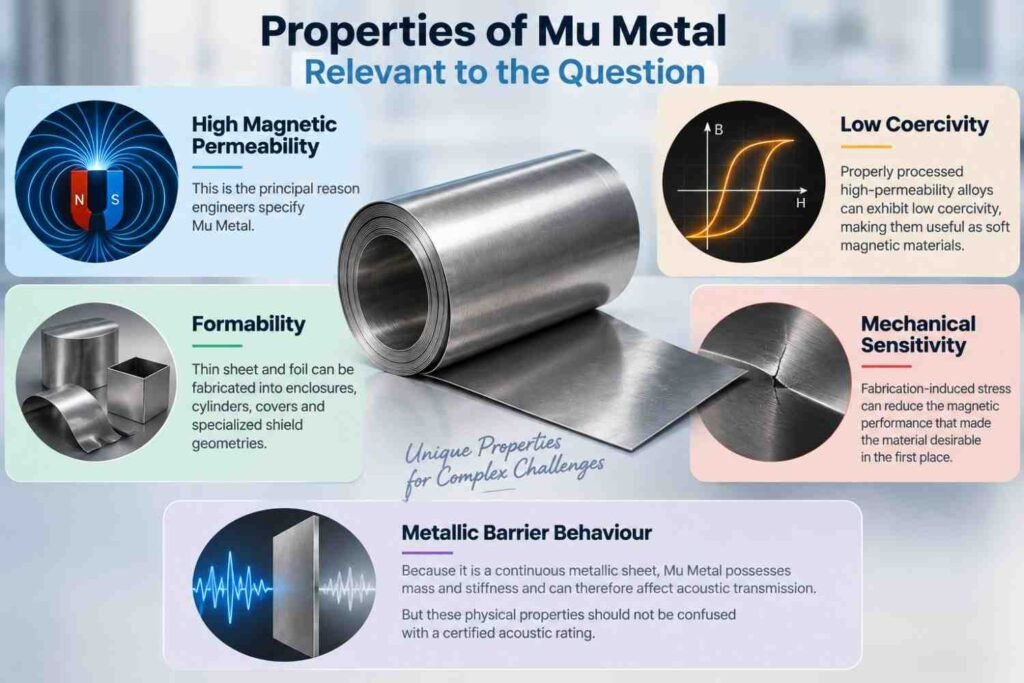
High Magnetic Permeability
This is the principal reason engineers specify Mu Metal, particularly when Mu Metal Acoustic Shielding applications require reliable protection from low-frequency magnetic interference.
Low Coercivity
Properly processed high-permeability alloys can exhibit low coercivity, making them useful as soft magnetic materials and particularly valuable when Mu Metal Acoustic Shielding systems also require effective control of low-frequency magnetic fields.
Formability
Thin sheet and foil can be fabricated into enclosures, cylinders, covers and specialized shield geometries, providing design flexibility for Mu Metal Acoustic Shielding systems where magnetic protection must fit around sensitive components.
Mechanical Sensitivity
Fabrication-induced stress can reduce the magnetic performance that made the material desirable in the first place, making careful processing essential for reliable Mu Metal Acoustic Shielding applications.
Metallic Barrier Behaviour
Because it is a continuous metallic sheet, Mu Metal possesses mass and stiffness and can therefore affect acoustic transmission. This physical behavior may contribute to Mu Metal Acoustic Shielding in certain enclosure designs.
However, these properties should not be confused with a certified acoustic rating. The effectiveness of Mu Metal Acoustic Shielding for noise control depends on the complete construction, mounting, sealing and overall system design.
8. Technical Specifications to Define Before Ordering
Instead of ordering simply “Mu Metal,” an engineering enquiry should define what the shield actually needs to accomplish.
For a Mu Metal requirement, consider specifying:
| Requirement | What to Define |
| Material | Mu Metal / applicable high-permeability nickel-iron alloy |
| UNS designation | UNS N14080 where required |
| Thickness | According to shielding design |
| Width / length | Final dimensional requirement |
| Form | Foil, sheet, strip or fabricated component |
| Temper / condition | As required |
| Heat treatment | Final magnetic annealing where applicable |
| Magnetic properties | According to project specification |
| Fabrication | Flat, bent, cylindrical, enclosure or custom |
| Quantity | Prototype or production requirement |
| Application | Magnetic shielding environment |
| Acoustic requirement | Specify separately where applicable |
The last row is particularly important.
If the project also has an acoustic requirement, provide measurable criteria such as frequency range, required noise reduction, operating environment and vibration conditions.
Do not assume the Mu Metal specification automatically covers them.
9. Standards and Specifications
Mu Metal and related high-permeability nickel-iron alloys may be supplied against various national, international, industry or manufacturer specifications depending on product form and application.
The required documentation can include:
- Chemical composition
- Material condition
- Thickness tolerance
- Dimensional tolerances
- Magnetic properties
- Heat-treatment condition
- Material test certificate
- Surface requirements
For critical applications, the purchasing drawing should clearly identify the required UNS designation and applicable material standard, rather than relying only on a commercial alloy name.
Acoustic performance is a separate matter.
If a completed assembly requires a specified sound-transmission or acoustic performance rating, the applicable acoustic test method should be defined for that assembly.
A material certificate for Mu Metal does not itself certify acoustic shielding performance.
10. Shapes Available for Mu Metal Applications
Mu Metal can be supplied or fabricated in forms suited to different magnetic shielding designs.
Typical options can include:
Foil
Useful where extremely limited space or low weight is important.
Thin Sheet
Suitable for enclosures, covers, panels and formed shielding structures.
Strip
Useful for specialized fabrication and wrapped shielding arrangements.
Plates
Where appropriate thicknesses and designs require heavier sections.
Cylindrical Shields
Common geometry around sensors, tubes, detectors and other sensitive components.
Fabricated Enclosures
Custom housings can surround sensitive equipment.
Custom Components
Components may be formed according to drawing, subject to material, fabrication and heat-treatment requirements.
The optimum geometry depends heavily on the direction and magnitude of the magnetic field.
11. Where Mu Metal Can Make Sense in an Acoustic Environment
There are situations where Mu Metal Acoustic Shielding and dedicated acoustic-control materials can work effectively together. A sensitive laboratory sensor near rotating machinery may face 50/60 Hz magnetic interference alongside airborne noise and mechanical vibration.
In this type of Mu Metal Acoustic Shielding system, Mu Metal can manage magnetic fields, while conductive enclosures, damping layers, acoustic materials and vibration isolators address EMI, resonance, sound and structure-borne vibration.
The key to effective Mu Metal Acoustic Shielding is not finding one material that shields everything. Instead, identify each disturbance and select the material best suited to control it, creating a more reliable engineering system.
12. Applications Where Combined Shielding May Be Required
Multiphysics interference is common in advanced equipment.

Medical Equipment
Sensitive diagnostic or measurement equipment can require magnetic, electromagnetic, vibration and acoustic management, making Mu Metal Acoustic Shielding part of a broader multi-layer protection strategy.
Scientific Instruments
Ultra-sensitive measurement systems may react to disturbances that would be irrelevant to ordinary equipment, making Mu Metal Acoustic Shielding an important consideration where magnetic interference must be carefully controlled.
Sensors
Magnetometers and other precision sensors may require high-permeability shielding, making Mu Metal Acoustic Shielding useful where magnetic protection must work alongside structural vibration control.
Audio and Measurement Electronics
Transformers and other magnetic components can interact with nearby electronics, making Mu Metal Acoustic Shielding relevant where magnetic interference and mechanical noise must be managed together.
Aerospace Instrumentation
Compact systems may require multiple protective functions in very limited space, making Mu Metal Acoustic Shielding relevant where magnetic protection must coexist with acoustic and vibration-control solutions.
Research Laboratories
Pumps, power supplies, motors and nearby infrastructure can create several interference sources simultaneously, making Mu Metal Acoustic Shielding relevant in complex equipment environments.
In these applications, Mu Metal may form one functional layer of a larger engineered enclosure, working alongside dedicated acoustic and vibration-control materials.
13. Can Adding More Mu Metal Improve Acoustic Performance?
This needs careful qualification.
Increasing sheet thickness increases mass, which can influence sound transmission.
But simply specifying thicker Mu Metal because an enclosure is noisy is usually not an efficient acoustic-engineering strategy.
Why?
Because Mu Metal is a specialized high-permeability alloy.
Using additional expensive magnetic shielding material merely to add mechanical mass may make less sense than combining the necessary Mu Metal thickness with a purpose-designed acoustic layer.
A better engineering philosophy is:
Use Mu Metal for what Mu Metal does exceptionally well.
Then use dedicated acoustic materials for the acoustic requirement.
That can reduce unnecessary material cost while improving overall performance.
14. Common Mistakes When Designing a Mu Metal Shield
Mistake 1: Assuming “shielding” means all forms of shielding
Magnetic, electric, RF and acoustic shielding involve different mechanisms.
Mistake 2: Ignoring fabrication stress
A beautifully fabricated Mu Metal enclosure can underperform magnetically if manufacturing stress has significantly changed its magnetic properties.
Mistake 3: Ignoring openings
Large holes, seams and penetrations can influence shielding behaviour.
Mistake 4: Treating acoustic noise as magnetic interference
Noise observed in an instrument output may originate from electrical, magnetic, acoustic or mechanical sources.
Diagnosis should come before material selection.
Mistake 5: Expecting one thin sheet to solve every problem
Advanced shielding often requires a layered engineering approach.
15. A Better Way to Design the Shield
Suppose an instrument is experiencing unexplained noise.
Before ordering material, investigate the source.
Step 1 — Identify the Disturbance
Determine whether the problem is primarily:
- Magnetic
- Electric
- RF/EMI
- Airborne acoustic
- Structure-borne vibration
- Or a combination
Step 2 — Identify the Frequency
Frequency matters enormously.
A 50 Hz magnetic field, a 2.4 GHz RF signal and a 500 Hz acoustic tone are entirely different engineering problems.
Step 3 — Set a Performance Target
Define the required reduction.
Step 4 — Select Materials by Function
Use high-permeability materials for magnetic shielding and dedicated acoustic/damping materials for noise and vibration where appropriate.
Step 5 — Prototype the Complete Assembly
The finished enclosure—not merely the raw material—determines system performance.
Why DOMADIA™ for UNS N14080 Mu Metal?
Specialized shielding materials are rarely selected correctly from the alloy name alone.
A useful material enquiry should consider:
Grade + chemistry + thickness + dimensions + magnetic condition + fabrication + heat treatment + final application.
DOMADIA™ supports specialized engineering material requirements and can assist customers looking for Mu Metal forms suitable for magnetic shielding applications.
When discussing a requirement with DOMADIA™, provide as much information as possible, including:
- UNS/material designation
- Required thickness
- Width and length
- Foil, sheet, strip or fabricated shape
- Quantity
- Magnetic property requirements
- Heat-treatment requirements
- Drawing, if applicable
- Operating environment
- End application
If acoustic control is also required, mention it separately so that the magnetic and mechanical/acoustic objectives are not confused.
Conclusion: Should You Use Mu Metal for Acoustic Shielding?
So, can Mu Metal be used for acoustic shielding?
A Mu Metal sheet can physically influence sound transmission because it is a metallic barrier with mass and stiffness. However, UNS N14080 Mu Metal should not normally be selected primarily as an acoustic shielding material.
Its real engineering strength is high-permeability magnetic shielding.
For equipment exposed to both magnetic interference and noise, a layered approach is usually more logical:
Mu Metal for magnetic shielding + dedicated acoustic/damping materials for sound and vibration control.
That is the central lesson behind Mu Metal Acoustic Shielding: don’t select materials because they all carry the word “shielding.” Select each material according to the physical phenomenon it needs to control.
For specialized UNS N14080 Mu Metal, foil, sheet, strip or fabricated magnetic shielding requirements, contact DOMADIA™ with your dimensions, quantity, material condition and application details.
Need Reliable Mu Metal for Your Shielding Application?
Whether you need UNS N14080 Mu Metal in foil, sheet, strip, or custom dimensions, DOMADIA™ can support specialized magnetic shielding requirements.
Share your grade, thickness, dimensions, quantity, and application with our team to discuss a suitable material solution.
Contact DOMADIA™ todayfor your Mu Metal requirements.
Talk to: Er.Pankaj Domadia | Kairav Domadia | Aadil Domadia | Pragati Sanap | Pooja N N
#MuMetal #UNSN14080 #AcousticShielding #MagneticShielding #EMIShielding #NickelAlloys #EngineeringMaterials #DOMADIA
Directly whatsapp us for an Enquiry: https://wa.link/kairav
Our materials reach Chennai, Coimbatore, Hosur, Madurai, and Trichy, supporting manufacturing hubs in Tamil Nadu, Kerala, Karnataka, Andhra Pradesh, and Telangana, while shipping to France, Spain, UK, Netherlands, and Belgium.