Blogs
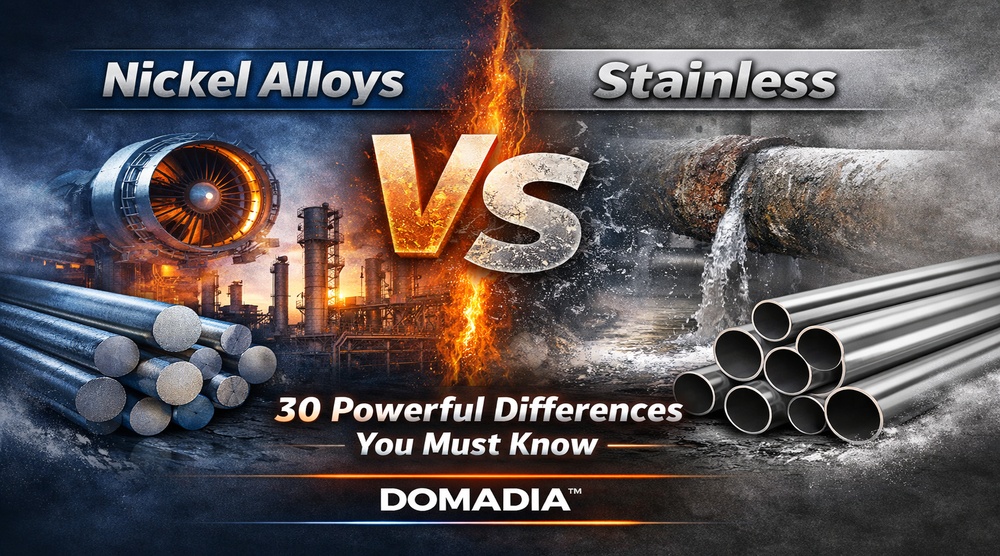
Nickel Alloys vs Stainless Steel: 30 Powerful Differences Explained | DOMADIA™
Nickel Alloys vs Stainless – The Hidden Industrial Truth
A shutdown inspection inside a chemical plant revealed something unexpected.
Two identical pipelines.
Same pressure. Same chemicals.
Yet one showed severe corrosion damage.
The other remained intact.
The difference?
Nickel Alloys vs Stainless — the material choice.
This is where most industries go wrong. They compare price.
But real engineering decisions are based on performance, durability, and lifecycle cost.
Nickel Alloys vs Stainless – The Critical Mindset Shift
Nickel Alloys vs Stainless is not a cost comparison.
It is a failure vs reliability decision.
Choosing the wrong material leads to:
- Unexpected downtime
- Frequent replacements
- Increased operational cost
DOMADIA™ helps industries shift from short-term savings to long-term performance.
30 Powerful Differences Between Nickel Alloys vs Stainless
Composition & Metallurgy
1. Higher Nickel Content
Nickel alloys contain 30–70% nickel, while stainless steel contains 8–12%, resulting in superior resistance properties.
2. Base Metal Structure
Nickel alloys are nickel-based, while stainless steel is iron-based, affecting stability and performance.
3. Advanced Alloying Elements
Nickel alloys include Mo, Cr, and Co, enhancing corrosion and heat resistance significantly.
4. Chromium Dependence
Stainless steel relies mainly on chromium oxide layers, which can fail in aggressive environments.
5. Carbide Stability
Nickel alloys resist carbide precipitation, maintaining strength at elevated temperatures.
6. Sensitization Risk
Stainless steel is more prone to intergranular corrosion due to sensitization.
7. Microstructure Stability
Nickel alloys maintain stable grain structure even in extreme heat conditions.
8. Thermal Stability
Stainless steel loses structural integrity faster under extreme temperatures.
9. Alloy Customization
Nickel alloys offer high customization for specific applications.
10. Standardization
Stainless steel grades are more standardized and widely available.
Properties & Performance
1. Corrosion Resistance
Nickel Alloys vs Stainless clearly shows superior corrosion resistance in harsh environments.
2. Acid Resistance
Nickel alloys resist HCl and H₂SO₄, where stainless steel can degrade.
3. Mild Environment Suitability
Stainless steel performs well in low to moderate corrosion environments.
4. Oxidation Resistance
Nickel alloys withstand oxidation above 1000°C, ideal for extreme heat.
5. High-Temperature Oxidation
Stainless steel oxidizes faster, reducing lifespan.
6. Creep Resistance
Nickel alloys resist deformation under long-term stress.
7. High-Temperature Strength
Stainless steel loses strength faster compared to nickel alloys.
8. Fatigue Resistance
Nickel alloys perform better under cyclic stress conditions.
9. Ease of Fabrication
Stainless steel is easier to machine and form.
10. Machining Complexity
Nickel alloys require advanced machining techniques due to hardness.
Applications

1. Aerospace & Turbines
Nickel alloys dominate jet engines and gas turbines.
2. Construction & Domestic Use
Stainless steel is widely used in architecture and kitchen equipment.
3. Chemical Processing
Nickel alloys are critical for reactors, pipelines, and corrosive environments.
4. General Fabrication
Stainless steel is preferred for cost-effective fabrication.
5. Marine Applications
Nickel alloys excel in offshore and saltwater conditions.
Lifecycle, Cost & Environment
1. Longer Service Life
Nickel alloys last significantly longer in extreme conditions.
2. Replacement Frequency
Stainless steel requires more frequent replacements in harsh environments.
3. Downtime Reduction
Nickel alloys minimize maintenance and operational interruptions.
4. Lifecycle Cost Advantage
Nickel alloys reduce long-term costs despite higher initial pricing.
5. Environmental Impact
Nickel alloys reduce recycling frequency, lowering environmental damage.
Chemical Composition
Nickel Alloys
- Nickel (Ni): 50–70%
- Chromium (Cr): 15–25%
- Molybdenum (Mo): 5–10%
Stainless Steel
- Iron (Fe): Balance
- Chromium (Cr): 18–20%
- Nickel (Ni): 8–10.5%
Properties Comparison
| Property | Nickel Alloys | Stainless Steel |
| Corrosion Resistance | Excellent | Moderate |
| Temperature Resistance | Very High | Moderate |
| Strength | High | Medium |
| Fatigue Resistance | Superior | Moderate |
Technical Specifications
Nickel Alloys
- Tensile Strength: 600–1200 MPa
- Temperature Resistance: Up to 1200°C
Stainless Steel
- Tensile Strength: 500–750 MPa
- Temperature Resistance: Up to 800°C
Standards
Nickel Alloys
- ASTM B166
- ASTM B443
- UNS N06600
Stainless Steel
- ASTM A240
- ASTM A276
- UNS S30400
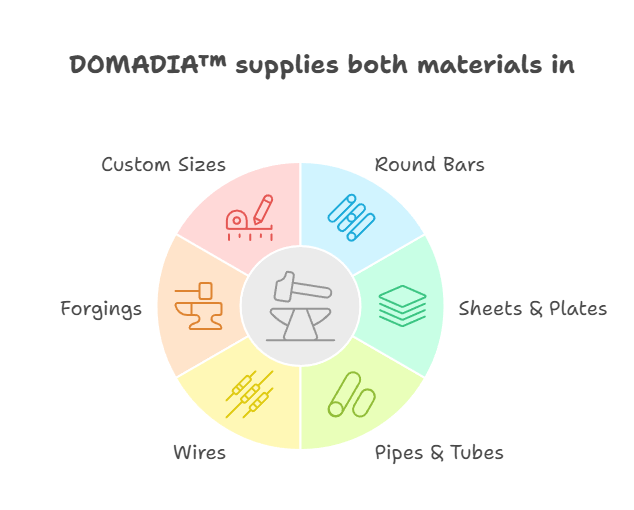
Shapes Available at DOMADIA™
Tangible Fix – Choosing the Right Material
When evaluating Nickel Alloys vs Stainless, consider:
✔ Extreme corrosion → Nickel Alloys
✔ High temperature → Nickel Alloys
✔ Budget-sensitive, mild use → Stainless
✔ Critical operations → Nickel Alloys
Conclusion: Nickel Alloys vs Stainless – The Smart Engineering Choice
Nickel Alloys vs Stainless is not just a material comparison — it is a business decision.
Nickel alloys offer:
- Longer life
- Higher reliability
- Lower long-term cost
- Reduced environmental impact
With DOMADIA™, you don’t just choose materials.
You choose performance that lasts.
Stop Failures Before They Start – Choose the Right Alloy
Partner with DOMADIA™ to choose high-performance materials that reduce failure, downtime, and long-term costs.
Contact DOMADIA™ today to upgrade your material selection and eliminate failure risks.
Talk to: Er.Pankaj Domadia | Kairav Domadia | Aadil Domadia | Pragati Sanap | Pooja N N
#NickelAlloys #StainlessSteel #IndustrialMaterials #Engineering #DOMADIA #MetalComparison
Directly whatsapp us for an Enquiry: https://wa.link/kairav
Our materials reach Chennai, Coimbatore, Hosur, Madurai, and Trichy, supporting manufacturing hubs in Tamil Nadu, Kerala, Karnataka, Andhra Pradesh, and Telangana, while shipping to France, Spain, UK, Netherlands, and Belgium.