
Blogs
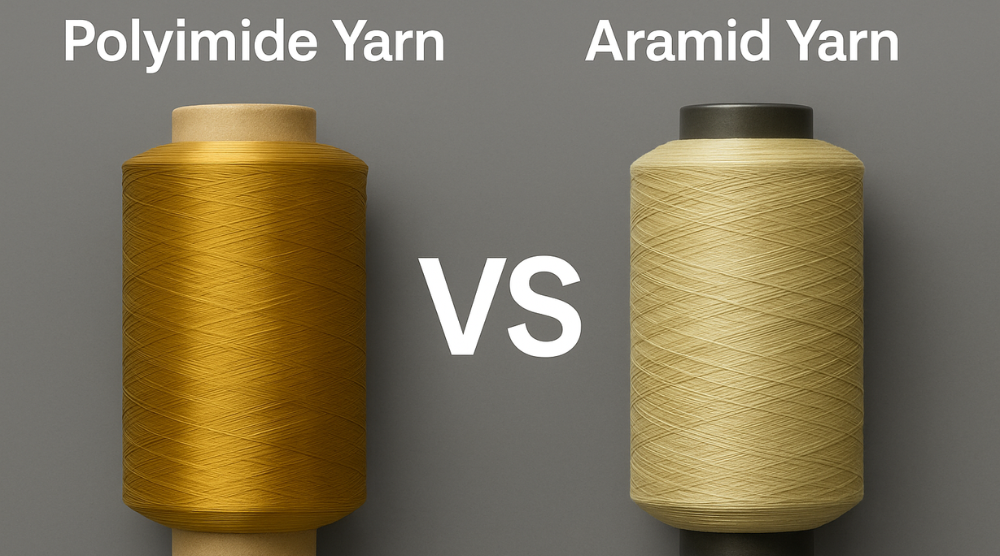
Polyimide vs Aramid Yarn: Which One Performs Better Under Extreme Heat? | DOMADIA™
Introduction — A Sudden Shutdown That Cost Millions
The production line was running smoothly… until the temperature spiked.
Within minutes, the high-heat insulation sleeve began to smoke. The aramid-coated section failed first, forcing an unexpected shutdown that cost the company a full day — and several lakhs in downtime.
Later, their engineering team discovered a crucial detail:
Polyimide vs Aramid Yarn Performance plays a far bigger role under extreme temperatures than most industries realize.
Not all high-performance fibers behave the same when heat pushes them to their limits.
This single failure sparked the question many industries ask today:
Which heat-resistant fiber performs better — Polyimide or Aramid Yarn?
In this blog, we break down the real-world performance, comparing both materials across chemical composition, thermal endurance, applications, standards, properties, and lifespan — all with DOMADIA™ technical expertise.
What Are These Fibers Made Of? (Chemical Composition)
Polyimide Yarn
A high-performance polymer made of:
- Aromatic polyimide backbone
- Imide rings (highly thermally stable)
- No melting point — it carbonizes instead of melting
This molecular structure is what gives DOMADIA™ Polyimide Yarn its legendary heat resistance.
Aramid Yarn
An aromatic polyamide consisting of:
- Para-oriented benzene rings
- Amide linkages
- Highly rigid molecular chains
Aramid fibers like Kevlar® and Nomex® are strong, flexible, and heat resistant — but have defined degradation points.
Thermal Performance Comparison: Who Survives the Heat?
| Feature / Fiber | Polyimide Yarn | Aramid Yarn |
| Continuous Temperature Rating | 260–300°C | 160–220°C |
| Short-Term Peak | ~500°C | ~370°C |
| Melting Point | No melting — carbonizes | No melting — degrades |
| Thermal Aging | Outstanding | Moderate |
| Oxidation Resistance | Excellent | Good |
| Flame Resistance | Inherent | Inherent |
Mechanical & Electrical Properties
| Property | Polyimide Yarn | Aramid Yarn |
| Tensile Strength | High | Very High |
| Dielectric Strength | Excellent | Good |
| Chemical Resistance | Superior to solvents & oils | Good |
| Moisture Absorption | <2% | ~5% (can weaken fiber) |
| Flexibility | Good | Excellent |
| Durability in Cyclic Heat | Exceptional | Moderate |
Standards & Grades
Polyimide Yarn Standards
- ASTM D5213
- IEC 60819
- ISO 10082
- MIL-grade forms available
Aramid Yarn Standards
- ASTM D7269
- NFPA 1971 (for protective clothing)
- ISO 11612 (heat & flame protection)
- MIL-spec varieties available
Applications: Where Do They Work Best?
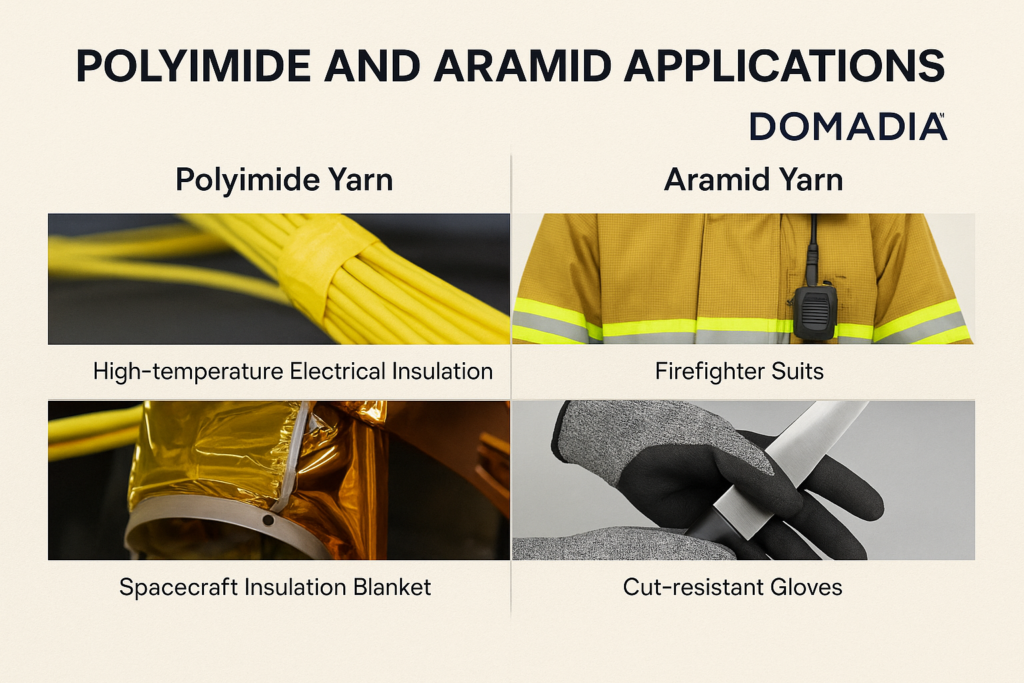
Polyimide Yarn Applications
DOMADIA™ Polyimide Yarn is widely used in:
- High-temperature electrical insulation
- Spacecraft insulation blankets
- Motor & transformer winding
- High-heat sensor wire wrapping
- Fire-safe cabling
- Aviation electronics
Ideal for continuous high-heat environments.
Aramid Yarn Applications
Aramid yarns are popular in:
- Firefighter suits
- Cut-resistant gloves
- Protective textiles
- Ropes & cables
- Automotive reinforcement parts
- FRP composites
Ideal where strength + impact resistance matter more than temperature.
Shapes & Forms Available (DOMADIA™)
We supply both materials in:
- Yarn
- Roving
- Braided sleeves
- Webbing straps
- Tapes
- Threads
- Custom dimensions available on request
So… Which One Is Better? The Honest Answer
It depends on the application — but under extreme heat, there is a clear leader:
DOMADIA™ Polyimide Yarn is the superior choice for 260°C+ conditions.
Aramid Yarn shines in:
- Strength
- Flexibility
- Mechanical toughness
Polyimide Yarn shines in:
- Temperature resistance
- Electrical insulation
- Chemical durability
- Long-term thermal aging
Environmental Impact — A Hidden Advantage
Materials that fail early need:
- More replacement
- More manufacturing
- More scrap
- More transport
- More recycling emissions
With longer lifespan & fewer replacements,
DOMADIA™ Polyimide Yarn contributes to lower carbon impact over its operational life.
A smart engineering choice — and a responsible environmental one.
Conclusion — Polyimide vs Aramid Yarn
Focus Phrase: DOMADIA Polyimide vs Aramid Yarn Performance
In high-intensity industrial environments, the right fiber can save:
- Downtime costs
- Maintenance budgets
- Safety risks
- Environmental impact
If your priority is extreme heat, high dielectric strength, and long service life —
DOMADIA™ Polyimide Yarn wins the heat battle.
If your priority is strength, cut resistance, and protection gear —
Aramid Yarn performs exceptionally well. No more guesswork — choose based on the thermal load, mechanical needs, and lifespan expectations.
Boost Your High-Temperature Performance.
Upgrade to DOMADIA™ Polyimide & Aramid Yarns Today
📩 Contact us today to get custom sizes and specifications for your project.
Talk to: Er.Pankaj Domadia | Kairav Domadia | Aadil Domadia | Pragati Sanap | Pooja N N
#PolyimideYarn #AramidYarn #DOMADIA #HeatResistantMaterials #HighTemperatureFibers #TechnicalTextiles #IndustrialInsulation #EngineeringMaterials
Directly whatsapp us for an Enquiry: https://wa.link/kairav