Blogs
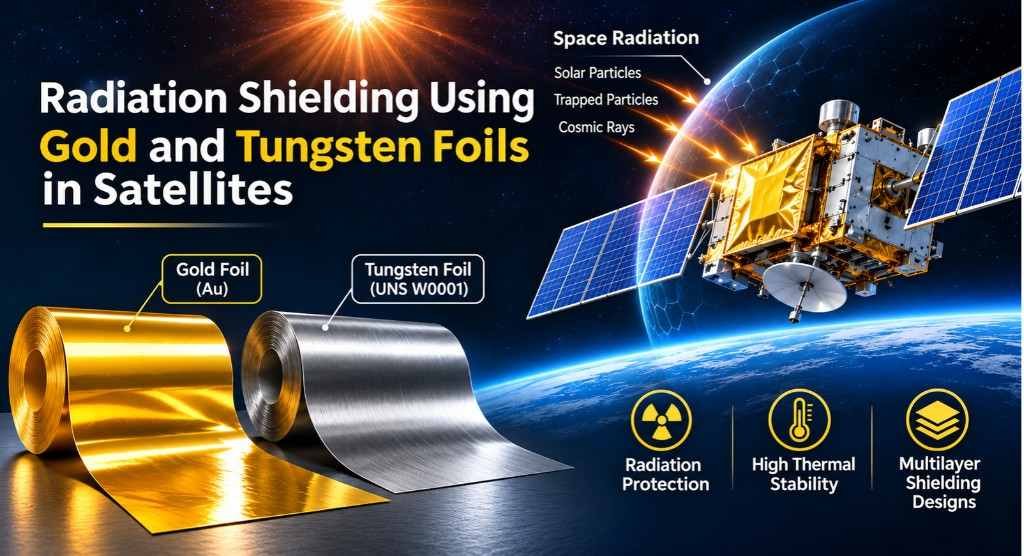
Radiation Shielding Using Gold and Tungsten Foils in Satellites: 9 Powerful Benefits of UNS W0001
Introduction: The Invisible Threat That Can Destroy a Satellite
Radiation Shielding Foils are becoming an increasingly important consideration in spacecraft engineering, where protecting sensitive electronics can be just as critical as launching the satellite successfully.
A satellite worth millions of dollars enters orbit after years of research, engineering, manufacturing, and testing.
Its solar panels deploy successfully. Communication systems begin transmitting. Navigation equipment starts operating.
Everything appears perfect.
Then, without warning, a high-energy particle strikes a sensitive electronic component.
A memory bit changes unexpectedly. A processor resets. A sensor begins producing incorrect readings. In severe cases, radiation damage gradually reduces the reliability of essential spacecraft electronics.
The surprising part?
The satellite does not need to collide with anything to experience these problems.
Space radiation is an invisible engineering challenge that can threaten spacecraft performance throughout a mission.
Unlike equipment operating on Earth, satellites experience varying exposure to trapped charged particles, solar energetic particles, and galactic cosmic radiation.
This is where advanced shielding materials, including gold and tungsten foils, become relevant.
Their high atomic numbers, density, and specialized material properties make them interesting candidates for selected spacecraft protection systems.
However, choosing the right shielding material requires more than selecting the heaviest metal.
In this detailed DOMADIA™ guide, we explore nine important benefits, chemical composition, technical specifications, shielding mechanisms, aerospace applications, international standards, available forms, and the engineering considerations involved in selecting gold and tungsten foils for satellites.
1. Why Do Satellites Need Radiation Shielding?
Space presents complex radiation challenges, making Radiation Shielding Foils important for protecting sensitive satellite electronics.
Satellites in low Earth orbit, medium Earth orbit, geostationary orbit, and deep space experience different radiation environments.
3 Major Sources of Space Radiation
1. Trapped Radiation Belts
Earth’s Van Allen radiation belts contain energetic electrons and protons that can damage satellite electronics and materials.
2. Solar Energetic Particles
Solar activity releases high-energy protons and other charged particles, potentially increasing spacecraft radiation exposure during solar events.
3. Galactic Cosmic Rays
High-energy protons and heavy atomic nuclei originating beyond our solar system present significant shielding challenges.
How Radiation Affects Satellite Electronics
Radiation exposure can cause:
- Total ionizing dose (TID) damage
- Displacement damage in semiconductors
- Single-event upsets (SEUs)
- Single-event latchup (SEL)
- Sensor degradation
- Reduced electronic component performance
Why Radiation Shielding Foils Matter
Gold and tungsten Radiation Shielding Foils can provide useful attenuation for selected radiation types and energies, helping protect sensitive spacecraft components.
However, no single shielding material can eliminate every radiation risk.
The goal is to select Radiation Shielding Foils that reduce mission-specific radiation exposure while maintaining optimal spacecraft weight, reliability, and performance.
2. Why Gold and Tungsten Are Considered for Satellite Radiation Protection
Gold and tungsten possess physical characteristics that distinguish them from many conventional engineering metals.
Gold foil — Au
Tungsten foil — W
Both materials have high atomic numbers and high densities, which can be useful when attenuating certain photons or electrons.
However, their effectiveness depends on radiation energy, particle type, shielding thickness, and surrounding materials.
Chemical Composition
| Characteristic | Gold | Tungsten |
| Chemical symbol | Au | W |
| Atomic number | 79 | 74 |
| Atomic mass | 196.97 u | 183.84 u |
| Typical high-purity foil | 99.9%–99.99% Au | 99.95%–99.99% W |
| Crystal structure | Face-centred cubic | Body-centred cubic |
| Material designation | Elemental Au | UNS W0001, where applicable |
Purity ranges are illustrative commercial specifications, not universal aerospace requirements. UNS designations and material certification must be confirmed for the actual product.
Gold offers excellent chemical stability, electrical conductivity, and formability.
Tungsten provides exceptional thermal resistance, stiffness, and high density.
For spacecraft engineers, the distinction is important because a material’s mechanical, electrical, and thermal behaviour can be as important as its shielding performance.
3. Nine Powerful Benefits of Gold and Tungsten Foils in Satellite Engineering

Benefit 1: High Density for Compact Shielding
Spacecraft designers constantly balance shielding performance against weight, making Radiation Shielding Foils important for specialized satellite applications.
Gold has a density of approximately 19.32 g/cm³, while tungsten offers 19.25 g/cm³, significantly higher than aluminium’s 2.70 g/cm³.
Their high density and atomic number provide useful photon attenuation in selected applications.
However, equal-mass and equal-thickness shielding comparisons can produce different results.
Therefore, Radiation Shielding Foils must be evaluated based on radiation protection, material thickness, and overall spacecraft mass requirements.
Benefit 2: Localized Protection of Sensitive Electronics
Not every spacecraft component requires identical radiation protection.
Radiation-sensitive devices may include:
- Memory modules
- Microprocessors
- Imaging sensors
- Semiconductor detectors
- Power-control electronics
- Specialized scientific instruments
Instead of increasing the shielding thickness around an entire spacecraft, engineers can evaluate localized shielding around vulnerable components.
A carefully designed tungsten shield may be placed near a detector or electronic assembly where the radiation environment justifies it.
This approach can reduce unnecessary shielding elsewhere, although the final mass benefit requires engineering analysis.
Benefit 3: Excellent Thermal Stability of Tungsten
Satellites experience demanding thermal conditions, making Radiation Shielding Foils an important consideration for specialized spacecraft designs.
Depending on orbit and thermal-control systems, spacecraft surfaces undergo repeated heating and cooling cycles.
Tungsten’s exceptionally high melting point of approximately 3,422°C makes it attractive for high-temperature applications.
However, oxidation, mechanical stability, thermal stress, and attachment methods limit practical operating temperatures.
Tungsten-based Radiation Shielding Foils offer valuable thermal properties, but their suitability depends on the spacecraft’s specific operating conditions.
Benefit 4: Gold Offers Outstanding Corrosion Resistance
Gold is highly resistant to oxidation and chemical corrosion, making gold-based Radiation Shielding Foils valuable for specialized spacecraft applications.
Its chemical stability supports reliable surfaces during manufacturing, storage, assembly, and testing.
Gold is widely used in spacecraft electrical contacts, coatings, and selected thermal-control applications.
However, corrosion resistance does not guarantee radiation protection.
The effectiveness of gold-based Radiation Shielding Foils must be evaluated separately based on radiation type, energy, and shielding requirements.
Benefit 5: Thin Foils Support Precision Engineering
Advanced spacecraft assemblies often have limited installation space, making Radiation Shielding Foils valuable for compact shielding designs.
Thin metallic foils can be incorporated into precision-cut sheets, layered assemblies, localized covers, and custom-shaped inserts where bulky shielding is impractical.
Gold’s excellent ductility makes it suitable for ultra-thin foils, while tungsten requires specialized processing due to its lower room-temperature ductility.
For both materials, Radiation Shielding Foils must meet specific requirements for thickness, dimensional tolerances, surface finish, and mechanical support to ensure reliable performance.
Benefit 6: Potential Attenuation of X-Rays and Gamma Rays
High-atomic-number materials can be effective at attenuating photons over selected energy ranges.
Gold and tungsten interact with X-rays and gamma rays through mechanisms including photoelectric absorption, Compton scattering, and pair production.
The relative importance of these mechanisms changes with photon energy.
A simplified narrow-beam attenuation relationship is:
\[ I=I_0e^{-\mu x} \]
Where:
- \(I_0\) = incident photon intensity
- \(I\) = transmitted photon intensity
- \(\mu\) = linear attenuation coefficient
- \(x\) = shielding thickness
This equation is useful for basic photon calculations but does not fully represent complex spacecraft radiation transport.
Actual satellite shielding requires consideration of secondary radiation, geometry, and the incident particle spectrum.
Benefit 7: Compatibility With Multilayer Shielding Designs
Space radiation contains different types of particles, and one shielding material may not provide sufficient protection against every radiation threat.
That is why engineers sometimes combine gold, tungsten, and other materials in a multilayer shielding system.
Each layer performs a specific function:
- Outer Spacecraft Structure: Provides structural support and initial radiation protection.
- Gold or Tungsten Layer: Helps manage selected radiation interactions, depending on particle energy.
- Lower-Z Material Layer: May help reduce certain secondary-radiation effects.
- Electronic Components: Receive additional protection from the combined shielding system.
Why is this beneficial?
Multilayer shielding allows engineers to select materials for different radiation challenges rather than relying on a single metal.
However, the effectiveness depends on the radiation environment, material thickness, and layer arrangement. Engineers must validate the design through radiation-transport analysis.
Benefit 8: Precision Shielding for Scientific Instruments
Satellites carrying radiation detectors, X-ray instruments, and scientific payloads may require Radiation Shielding Foils with precisely controlled geometry.
Tungsten is useful in radiation collimators, apertures, and detector housings due to its high density and photon attenuation properties.
Gold-based Radiation Shielding Foils may also support specialized coating and shielding applications where thin-film characteristics are important.
Unlike general spacecraft electronics, scientific instruments may intentionally detect radiation while minimizing unwanted background signals.
Benefit 9: Long-Term Material Reliability
Satellite components must operate without routine physical maintenance.
Once a spacecraft is deployed, replacing a damaged shielding component is generally impractical.
Material selection must therefore consider:
- Thermal cycling
- Vibration during launch
- Mechanical fatigue
- Radiation-induced changes
- Coating adhesion
- Contamination and outgassing
- Long-term dimensional stability
Gold and tungsten can offer useful properties, but their performance depends on the complete engineered assembly.
A high-quality foil alone cannot guarantee spacecraft reliability.
4. Technical Specifications of Gold and Tungsten Foils
Understanding the physical properties of each metal helps engineers identify suitable applications.
| Property | Gold foil | Tungsten foil |
| Density | 19.32 g/cm³ | 19.25 g/cm³ |
| Melting point | 1,064°C | 3,422°C |
| Thermal conductivity | ~318 W/m·K | ~173 W/m·K |
| Electrical resistivity at 20°C | ~2.44 × 10⁻⁸ Ω·m | ~5.6 × 10⁻⁸ Ω·m |
| Relative formability | Excellent | Limited at room temperature |
| Oxidation resistance | Excellent | Requires attention at elevated temperatures in oxidizing conditions |
| Principal advantage | Chemical stability and ductility | Thermal resistance and stiffness |
Values are approximate reference properties of pure metals near room temperature unless otherwise stated. Foil processing, purity, and temperature can change actual performance.
Foil Thickness Considerations
Specialized metal foils may be manufactured in thicknesses ranging from micrometres to fractions of a millimetre, depending on material and production method.
For example, a 25 µm tungsten foil has an approximate areal density of:
\[ 19.25 \times 0.0025 = 0.0481\ \text{g/cm}^2 \]
This equals approximately 0.481 kg/m².
Although thin, it introduces measurable mass.
More importantly, the attenuation achieved depends on the incident radiation spectrum.
Engineers should never select foil thickness using density alone.
5. Applications of Gold and Tungsten Foils in Satellites
Several aerospace systems can benefit from evaluating specialized metallic foils.

Satellite Electronics
Localized Radiation Shielding Foils can be investigated for sensitive integrated circuits, memory devices, and other radiation-vulnerable components.
Scientific Detectors
Tungsten can support collimation, background reduction, and photon-control applications in suitably designed instruments.
Space-Based Imaging Equipment
Precision Radiation Shielding Foils may help manage unwanted radiation reaching selected detector assemblies.
Communication Satellites
Radiation Shielding Foils can support protection strategies for communication payloads, power electronics, and control systems, although shielding design is mission-specific.
Deep-Space Instruments
Scientific payloads operating beyond Earth’s protective magnetic environment require careful evaluation of radiation exposure and suitable Radiation Shielding Foils.
Gold and tungsten may be considered for selected subsystems rather than as universal solutions for cosmic-ray protection.
6. International Standards and Aerospace Qualification
Materials intended for spacecraft must meet requirements beyond ordinary commercial metal specifications.
Relevant standards and engineering frameworks may include:
| Standard or framework | Relevance |
| ASTM B760 | Tungsten plate, sheet, and foil specification |
| ASTM B562 | Refined gold specification; useful for purity considerations |
| ECSS-Q-ST-70 series | Space-product materials, processes, and contamination controls |
| ECSS-E-ST-10-12 | Space engineering methods for radiation effects on components |
| NASA EEE-INST-002 | Guidance for selecting and controlling electrical, electronic, and electromechanical parts |
| ISO 14644 series | Cleanroom classification and controlled-environment considerations |
These documents serve different purposes.
For example, ASTM B760 addresses tungsten material requirements, while spacecraft radiation qualification involves additional engineering assessments.
Not every listed standard applies automatically to every foil.
Aerospace procurement specifications should identify the required edition, purity, thickness, tolerances, testing, traceability, and acceptance criteria.
7. Available Shapes and Forms
DOMADIA™ can discuss sourcing requirements for specialized gold and tungsten materials in various forms, subject to grade, thickness, and manufacturer availability.
Commonly requested forms include:
- Ultra-thin metallic foils
- Precision-cut foil sheets
- Flat strips
- Rolled foil
- Thin plates
- Custom-sized blanks
- Specialized components manufactured from foil or sheet
Additional processing may include cutting, surface finishing, dimensional inspection, and material certification.
For tungsten, extremely thin gauges and complex shapes may involve minimum-order quantities, handling restrictions, or manufacturing limitations.
For gold, material value and purity requirements can significantly influence procurement cost.
Customers should specify the required material form rather than assuming that all thicknesses are commercially interchangeable.
8. Gold vs Tungsten Foil: Which Is Better for Satellite Shielding?
The correct choice depends on the engineering objective.
| Selection factor | Gold | Tungsten |
| Density | Very high | Very high |
| High-temperature resistance | Moderate relative to tungsten | Excellent |
| Ease of producing very thin foil | Excellent | More challenging |
| Chemical stability | Excellent | Application-dependent |
| Material cost | Generally much higher | Generally lower |
| Photon shielding | Energy-dependent | Energy-dependent |
| Structural rigidity | Relatively soft | High stiffness |
| Typical selection advantage | Thin-film stability and formability | Dense shielding and thermal resistance |
For many practical designs requiring dense, compact metallic shielding, tungsten may offer a more economical alternative to gold.
However, gold can justify its cost where chemical stability, ductility, surface characteristics, or another functional requirement provides a meaningful advantage.
Neither material should be selected solely because its atomic number is high.
In some spacecraft environments, aluminium, polyethylene, or other lower-Z materials may be preferable for managing energetic charged particles and secondary radiation.
9. How Engineers Select the Correct Radiation Shielding Foil
A successful shielding strategy begins with the mission requirements rather than the material catalogue.
Step 1: Define the Radiation Environment
Identify the spacecraft orbit, mission duration, expected particle spectra, and relevant solar-event assumptions.
Step 2: Identify Vulnerable Components
Determine which electronic systems require protection and what radiation effects threaten their operation.
Step 3: Establish Acceptable Radiation Limits
Define total-dose limits, displacement-damage limits, and single-event performance requirements.
Step 4: Compare Candidate Materials
Evaluate gold, tungsten, aluminium, and other suitable materials according to the actual radiation environment.
Step 5: Perform Radiation Transport Analysis
Engineering tools such as Geant4, MCNP, or mission-appropriate shielding assessment software can help estimate dose and secondary radiation.
Step 6: Validate the Mechanical Design
Check launch vibration, attachment methods, thermal expansion, foil handling, and long-term stability.
Step 7: Test and Qualify
Use appropriate radiation testing, inspection, and qualification procedures to confirm that the final design satisfies mission requirements.
This process helps prevent unnecessary shielding mass and expensive material-selection errors.
10. Why DOMADIA™ for Advanced Aerospace Foils?
At DOMADIA™, we understand that specialized aerospace material procurement involves much more than choosing a metal from a specification sheet.
Engineers and procurement teams often require materials with tightly defined chemical composition, thickness, surface quality, and dimensional tolerances.
DOMADIA™ supports technical sourcing discussions for advanced metallic materials used in demanding industrial, research, defence, and aerospace applications.
What Makes DOMADIA™ a Valuable Sourcing Partner?
Specialized material understanding: We recognize the importance of selecting Radiation Shielding Foils according to their intended operating environment.
Custom specification support: Customers can share requirements for material purity, dimensions, thickness, and available forms.
Technical procurement coordination: We help customers discuss relevant Radiation Shielding Foils grades, certificates, and supply requirements.
Application-oriented approach: Our focus is on helping customers identify suitable material options rather than recommending one metal for every application.
Long-term sourcing perspective: Specialized aerospace projects may require repeatability, documentation, and continuity of Radiation Shielding Foils supply.
For spacecraft applications, customers should confirm the exact certification and qualification requirements before procurement.
11. The Future of Radiation Shielding Foils in Space Technology

The increasing complexity of satellite electronics is creating new challenges for radiation protection.
Small satellites, scientific payloads, and advanced onboard computing systems require reliable Radiation Shielding Foils that balance protection, weight, and performance.
Future shielding technologies may incorporate multilayer materials, graded-Z structures, and optimized shielding designs.
Gold and tungsten remain valuable candidates due to their distinctive physical properties.
However, developing effective Radiation Shielding Foils requires accurate radiation modelling, material testing, and intelligent spacecraft design.
The best shielding solution is not necessarily the thickest or densest material, but one that delivers reliable protection with optimized weight, cost, and engineering efficiency.
Conclusion: Choosing Smarter Protection for Satellites
Radiation Shielding Foils made from gold and tungsten offer valuable benefits for satellite engineering, including photon attenuation, thermal stability, and precision shielding.
Gold provides excellent chemical stability, while tungsten offers high density and exceptional heat resistance.
However, selecting Radiation Shielding Foils requires careful evaluation of radiation exposure, material thickness, and mission requirements.
Radiation Shielding Foils should be chosen based on verified performance, not simply density or cost.
DOMADIA™ supports the sourcing of specialized gold and tungsten foils for demanding aerospace and satellite applications.
Looking for Gold or Tungsten Foils for Your Aerospace Project?
Explore high-density Gold and Tungsten Foils, including UNS W0001 tungsten, for specialized aerospace and satellite radiation-shielding applications. DOMADIA™ helps engineers and manufacturers source precision metal foils for demanding applications where material purity, thickness, weight, and shielding performance matter.
Contact DOMADIA™ today to discuss your technical specifications, material requirements, and suitable foil options.
Talk to: Er.Pankaj Domadia | Kairav Domadia | Aadil Domadia | Pragati Sanap | Pooja N N
#RadiationShieldingFoils #GoldFoil #TungstenFoil #SatelliteRadiationShielding #RadiationProtection #SpaceTechnology #AerospaceMaterials #SatelliteEngineering #UNSW0001 #SpaceElectronics #RadiationShielding #AdvancedMaterials #HighDensityMetals #SpaceExploration #AerospaceEngineering #DefenceTechnology #MetalFoils #SatelliteTechnology #DOMADIA #SpecialtyMetals
Directly whatsapp us for an Enquiry: https://wa.link/kairav
We’ve supplied to Mumbai, Pune, Indore, Jaipur, and Surat—serving industries across Maharashtra, Madhya Pradesh, Rajasthan, Gujarat, and Goa, with exports to Germany, USA, Japan, South Korea, and Italy.