Blogs

Tellurium Copper vs Beryllium: 6 Powerful Machining Performance Differences | DOMADIA™
Tellurium Copper vs Beryllium: Why Machining Engineers Compare These Alloys
Tellurium Copper vs Beryllium discussions appear frequently in machine shops where productivity and precision matter. Engineers selecting copper alloys for electrical components, connectors, and high-precision parts often face a critical decision: choose Tellurium Copper for superior machinability or Beryllium Copper for higher strength and durability.
Tellurium Copper vs Beryllium comparisons are especially important when machining speed, tool wear, conductivity, and lifecycle costs impact production efficiency.
At DOMADIA™, manufacturers regularly ask one question:
“Which copper alloy allows faster machining without sacrificing performance?”
The answer depends on the 6 key machining performance differences explained below.
Chemical composition difference between Tellurium Copper and Beryllium Copper
Understanding composition helps explain machining behavior.
Tellurium Copper (C14500)
Typical composition:
| Element | Percentage |
| Copper (Cu) | 99.5% approx |
| Tellurium (Te) | 0.4 – 0.7% |
| Phosphorus | Trace |
Tellurium forms microscopic inclusions that act as chip breakers, improving machinability.
Beryllium Copper (C17200)
Typical composition:
| Element | Percentage |
| Copper (Cu) | Balance |
| Beryllium (Be) | 1.8 – 2.0% |
| Nickel/Cobalt | Small amounts |
Beryllium strengthens the alloy through precipitation hardening, increasing hardness and fatigue resistance.
This composition difference forms the foundation of the machining debate between Tellurium Copper and Beryllium Copper.
Tellurium Copper vs Beryllium – Machinability Performance
The most significant difference between Tellurium Copper vs Beryllium appears in machining efficiency.
| Property | Tellurium Copper | Beryllium Copper |
| Machinability | ~85–90% | ~20–30% |
| Chip formation | Excellent | Poor |
| Tool wear | Low | Higher |
Tellurium Copper vs Beryllium machining comparison clearly favors Tellurium Copper for CNC turning, drilling, and milling operations.
Manufacturers using DOMADIA™ Tellurium Copper experience:
- Faster machining speeds
- Clean chip formation
- Reduced tool replacement cost
Tellurium Copper vs Beryllium – Electrical Conductivity
Electrical performance is another major factor in Tellurium Copper vs Beryllium selection.
| Alloy | Conductivity |
| Tellurium Copper | ~90–95% IACS |
| Beryllium Copper | ~20–60% IACS |
Tellurium Copper vs Beryllium comparisons show that Tellurium Copper retains near-pure copper conductivity, making it ideal for:
- Electrical connectors
- RF components
- switchgear parts
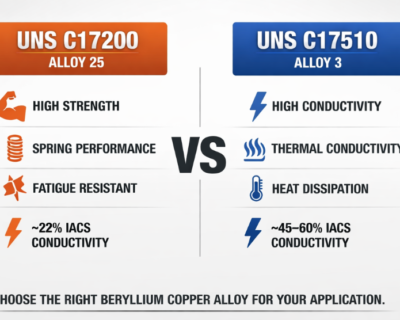
Beryllium Copper sacrifices conductivity for mechanical strength.
Tellurium Copper vs Beryllium – Strength and Hardness
When strength becomes critical, the Tellurium Copper vs Beryllium decision shifts.
| Property | Tellurium Copper | Beryllium Copper |
| Tensile Strength | ~300 MPa | Up to 1400 MPa |
| Hardness | Moderate | Very High |
Tellurium Copper vs Beryllium comparisons show Beryllium Copper dominates in strength and fatigue resistance, which explains its use in:
- aerospace springs
- connectors under mechanical load
- high-stress tooling
However, for pure machining productivity, Tellurium Copper still leads.
Tellurium Copper vs Beryllium – Cost & Lifecycle Impact
Tellurium Copper vs Beryllium price differences can influence purchasing decisions.
Beryllium Copper costs significantly more because:
- beryllium extraction is expensive
- heat treatment is required
- safety regulations during machining increase production cost
However, lifecycle cost must also be considered.
In high-stress components, Beryllium Copper lasts longer.
But for high-volume precision machining, Tellurium Copper often delivers lower total manufacturing cost due to faster machining and reduced tooling wear.
Tellurium Copper vs Beryllium – Environmental and Safety Factors
Tellurium Copper vs Beryllium comparisons also involve environmental considerations.
Beryllium machining requires strict safety protocols because inhaling beryllium dust can cause berylliosis, a serious lung condition.
Tellurium Copper vs Beryllium safety analysis often favors Tellurium Copper, which is easier and safer to machine under normal shop conditions.
From an environmental perspective:
- Longer lifecycle alloys reduce scrap generation
- Fewer replacements reduce recycling energy consumption
DOMADIA™ encourages alloy selection that balances performance, productivity, and sustainability.
Technical Properties Comparison
| Property | Tellurium Copper | Beryllium Copper |
| Density | 8.9 g/cm³ | 8.3 g/cm³ |
| Melting Point | ~1083°C | ~866–980°C |
| Electrical Conductivity | High | Moderate |
| Machinability | Excellent | Low |
| Strength | Moderate | Very High |
Standards for Tellurium Copper vs Beryllium
Both alloys follow global standards:
Tellurium Copper
- ASTM B301
- ASTM B144
- UNS C14500
Beryllium Copper
- ASTM B196
- ASTM B197
- UNS C17200
DOMADIA™ materials comply with international quality standards to ensure consistent machinability and electrical performance.
Shapes Available from DOMADIA™
DOMADIA™ supplies Tellurium Copper and Beryllium Copper in multiple precision forms:
- Rods
- Bars
- Plates
- Sheets
- Wires
- Forged components
- CNC-ready billets
These shapes are widely used for precision machining, electrical components, connectors, welding equipment, and aerospace assemblies.
Industrial Applications
Tellurium Copper vs Beryllium alloy selection appears across several industries.

Electrical Connectors
Tellurium Copper provides high conductivity and machinability for precision electrical terminals.
Aerospace Springs
Beryllium Copper delivers exceptional fatigue strength for aerospace and defense components.
RF Components
Tellurium Copper allows complex CNC machining with minimal tool wear.
Injection Molding Tools
Beryllium Copper molds offer thermal conductivity with high durability.
Conclusion: Tellurium Copper vs Beryllium – Which Should You Choose?
Tellurium Copper vs Beryllium comparisons ultimately depend on manufacturing priorities.
Choose Tellurium Copper when:
- machining speed matters
- electrical conductivity is critical
- tool life must be maximized
Choose Beryllium Copper when:
- high strength is required
- fatigue resistance is essential
- long-term mechanical durability matters
At DOMADIA™, both alloys are supplied with strict metallurgical quality control to support high-precision manufacturing across industries.
In real manufacturing environments, the Tellurium Copper vs Beryllium decision often comes down to balancing machinability and strength, ensuring the right alloy powers productivity and long-term performance.
Need the Right Copper Alloy for Precision Machining?
Selecting between Tellurium Copper vs Beryllium can impact machining speed, tool life, and product reliability. Our specialists help you choose the right alloy for your application.
Connect with DOMADIA™ to source high-performance copper alloys for your next project.
Contact Us today to get expert assistance for your copper alloy needs.
Talk to: Er.Pankaj Domadia | Kairav Domadia | Aadil Domadia | Pragati Sanap | Pooja N N
#NickelAlloys #StainlessSteel #IndustrialMaterials #Engineering #DOMADIA #MetalComparison
Directly whatsapp us for an Enquiry: https://wa.link/kairav
We’ve supplied to Mumbai, Pune, Indore, Jaipur, and Surat—serving industries across Maharashtra, Madhya Pradesh, Rajasthan, Gujarat, and Goa, with exports to Germany, USA, Japan, South Korea, and Italy.