Blogs
UNS C18150 Copper: 8 Powerful Engineering Benefits in Resistance Welding | DOMADIA™
UNS C18150 Copper: 8 Powerful Engineering Benefits in Resistance Welding
UNS C18150 Copper plays a critical role in modern resistance welding systems where electrical conductivity and mechanical strength must work together under extreme thermal stress.
In an automotive plant producing thousands of welded joints daily, electrode failure means downtime, replacement cost, and productivity loss. Engineers discovered that switching to this alloy significantly extended electrode life and stabilized weld quality.
The mindset shift is simple: welding efficiency is not only about current and pressure — the electrode material determines productivity.
This is where DOMADIA™ solutions become a strategic engineering advantage.
What is UNS C18150 Copper?
UNS C18150 Copper is a precipitation-hardened Chromium Zirconium Copper alloy (CuCrZr) designed for high-temperature electrical applications.
It combines three critical properties required in resistance welding:
- High electrical conductivity
- Excellent thermal stability
- Superior strength at elevated temperatures
Unlike pure copper, it maintains hardness and shape even after repeated heating cycles during welding operations.
Chemical Composition of UNS C18150 Copper
Typical composition of UNS C18150 Copper includes:
| Element | Composition (%) |
| Copper (Cu) | Balance |
| Chromium (Cr) | 0.5 – 1.2 |
| Zirconium (Zr) | 0.03 – 0.30 |
| Impurities | ≤ 0.2 |
Chromium strengthens the alloy through precipitation hardening, while zirconium improves grain stability during high-temperature operations. This synergy makes it extremely reliable in welding electrodes.
8 Engineering Benefits of UNS C18150 Copper in Resistance Welding
1. High Electrical Conductivity
UNS C18150 Copper offers conductivity typically between 75–85% IACS, enabling efficient current transfer during spot and projection welding.
2. Excellent Thermal Resistance
Repeated heating and cooling cycles cause softening in conventional copper. This alloy resists thermal softening, maintaining structural integrity.
3. Longer Electrode Life
Resistance welding electrodes made from this alloy last significantly longer compared to standard copper alloys.
4. Improved Weld Consistency
Stable electrode geometry ensures uniform current distribution, allowing it to produce consistent weld nuggets.
5. High Strength at Elevated Temperature
With tensile strength often exceeding 450 MPa, this alloy maintains mechanical reliability under welding pressure.
6. Reduced Maintenance Downtime
Because UNS C18150 Copper electrodes wear slowly, production lines experience fewer stoppages for replacement.
7. Better Resistance to Deformation
The chromium-zirconium combination allows it to maintain shape during intense welding cycles.
8. Cost Efficiency Over Lifecycle
Although the initial material cost may be higher, it significantly reduces electrode replacement cost and machine downtime.
Properties of UNS C18150 Copper
| Property | Value |
| Electrical Conductivity | 75–85 % IACS |
| Tensile Strength | 400 – 500 MPa |
| Hardness | 120 – 160 HB |
| Thermal Conductivity | ~320 W/mK |
| Melting Point | ~1080°C |
| Density | 8.9 g/cm³ |
These characteristics make it one of the most trusted alloys for industrial welding environments..
Technical Specifications
Typical industrial specifications for UNS C18150 Copper include:
- ASTM B224
- ASTM B187
- RWMA Class 2 Electrode Alloy
- DIN CuCrZr
DOMADIA™ supplies products conforming to these global industrial standards.
Shapes Available from DOMADIA™
DOMADIA™ provides UNS C18150 Copper in precision-engineered forms suitable for welding applications:
- Rods
- Round bars
- Forgings
- Plates
- Sheets
- Blocks
- Custom machined electrodes
- Resistance welding components
Each DOMADIA™ product undergoes strict quality control for conductivity, hardness, and dimensional precision.
Applications of UNS C18150 Copper
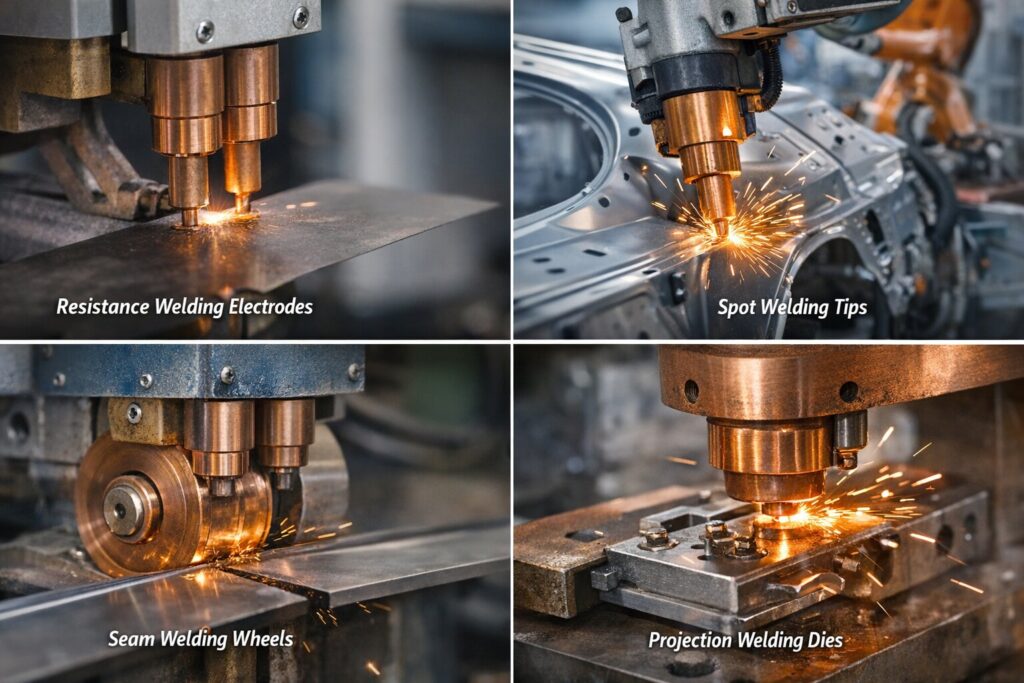
Resistance Welding Electrodes
Electrodes made from this alloy maintain conductivity and hardness even after thousands of welding cycles.
Spot Welding Tips
In automotive body welding, these tips provide consistent weld penetration and reduced tip deformation.
Seam Welding Wheels
The thermal stability of UNS C18150 Copper enables seamless continuous welding operations.
Projection Welding Dies
Manufacturers use these dies for precise localized heating and reliable joint formation.
Automotive Manufacturing
High-volume robotic welding lines rely on UNS C18150 Copper to reduce downtime and increase productivity.
Environmental Advantage
Frequent electrode replacement leads to increased metal scrap and energy consumption in recycling.
Because it lasts significantly longer, industries generate less scrap and reduce environmental impact.
Choosing DOMADIA™ UNS C18150 Copper therefore supports sustainable manufacturing practices.
Final Insight
In resistance welding operations, productivity depends on electrode durability and thermal stability. UNS C18150 Copper provides the perfect balance of conductivity, strength, and longevity required in modern manufacturing.
For engineers seeking reliability, DOMADIA™ solutions transform welding from a maintenance challenge into a long-term performance advantage.
Upgrade Your Welding Performance with UNS C18150 Copper
When precision welding decides production quality, material choice becomes critical. UNS C18150 Copper fromDOMADIA™ delivers unmatched strength, conductivity, and durability—helping you reduce downtime and maximize efficiency.
Contact Us today and discover how DOMADIA™ advanced copper alloys can transform your operations with reliability you can trust.
Talk to: Er.Pankaj Domadia | Kairav Domadia | Aadil Domadia | Pragati Sanap | Pooja N N
#RecyclingVsDurability #SustainableMetals #GreenManufacturing #LifecycleCost #IndustrialAlloys #CorrosionResistant #HighPerformanceMetals #DOMADIA
Directly whatsapp us for an Enquiry: https://wa.link/kairav
We’ve delivered to Bengaluru, Mysuru, Mangaluru, Hubballi, and Belagavi—covering Karnataka, Telangana, Tamil Nadu, Kerala, and Andhra Pradesh, with exports to Australia, New Zealand, Singapore, Malaysia, and Indonesia.