Blogs
Zirconium Copper vs Chromium Copper: 7 Powerful Truths About Longer Performance | DOMADIA™
Zirconium Copper vs Chromium Copper: Which Performs Longer?
Zirconium Copper vs Chromium Copper is not just a technical comparison, it’s a decision that directly affects electrode life, production uptime, maintenance cost, and environmental footprint.
In high-cycle resistance welding, one question keeps coming back:
Which alloy truly lasts longer under heat, pressure, and repetition?
At DOMADIA™, this comparison between Zirconium Copper vs Chromium Copper is often discussed with automotive manufacturers, switchgear producers, and heavy fabrication industries. The answer is not about price per kilogram—it’s about performance per cycle.
Chemical Composition Comparison
Understanding Zirconium Copper vs Chromium Copper begins with chemistry.
Zirconium Copper (UNS C15000)
- Copper (Cu): Balance (~99%+)
- Zirconium (Zr): 0.10 – 0.20%
A small zirconium addition refines grain structure and improves softening resistance.
Chromium Copper (UNS C18200)
- Copper (Cu): Balance
- Chromium (Cr): 0.6 – 1.2%
Chromium increases strength through precipitation hardening but with slightly lower conductivity compared to zirconium grades.
In Zirconium Copper vs Chromium Copper, zirconium offers better resistance to softening at elevated temperatures.
Mechanical & Physical Properties
When comparing Zirconium Copper vs Chromium Copper, the following properties matter most:
| Property | Zirconium Copper C15000 | Chromium Copper C18200 |
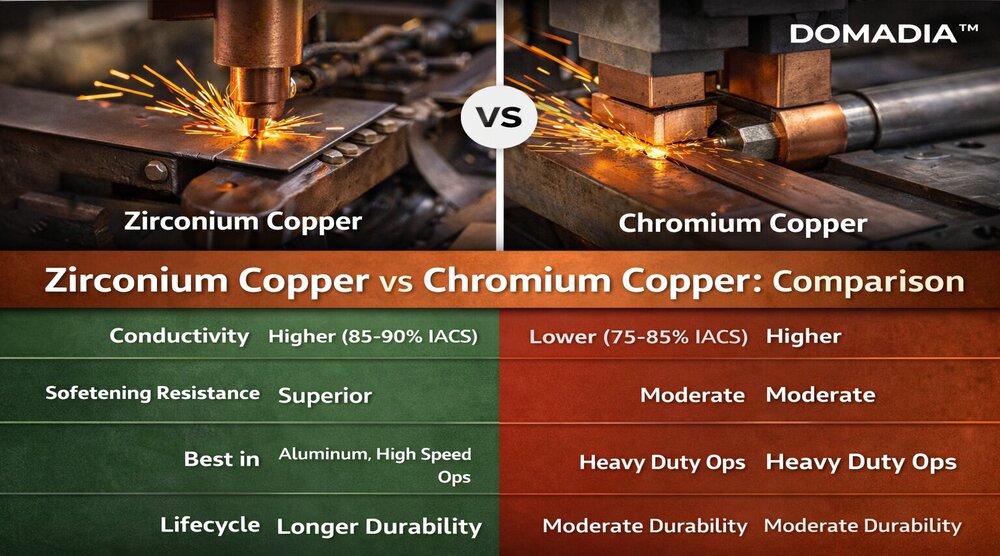
| Electrical Conductivity | ~85–90% IACS | ~75–85% IACS |
| Tensile Strength | 400–450 MPa | 450–500 MPa |
| Softening Temperature | Higher | Moderate |
| Thermal Conductivity | Excellent | Very Good |
| Hardness (HV) | 110–140 | 130–160 |
While Chromium Copper may offer slightly higher hardness, Zirconium Copper vs Chromium Copper shows zirconium excels in maintaining strength at higher operating temperatures.
Applications Comparison
Zirconium Copper Applications
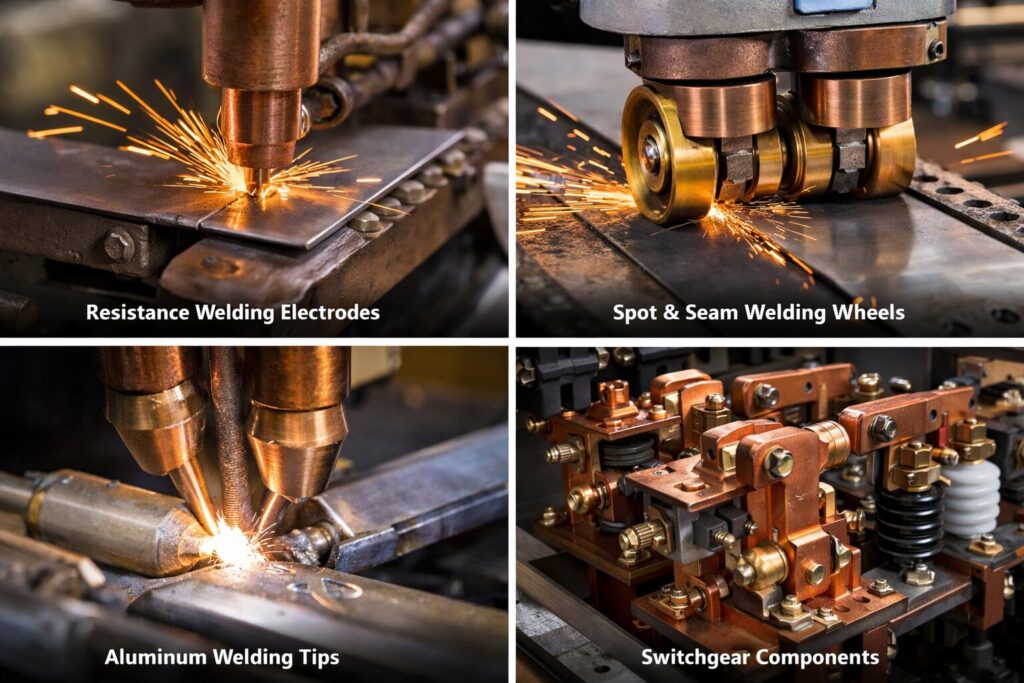
- Resistance welding electrodes
- Spot & seam welding wheels
- Aluminum welding tips
- Switchgear components
- Continuous casting molds
Chromium Copper Applications
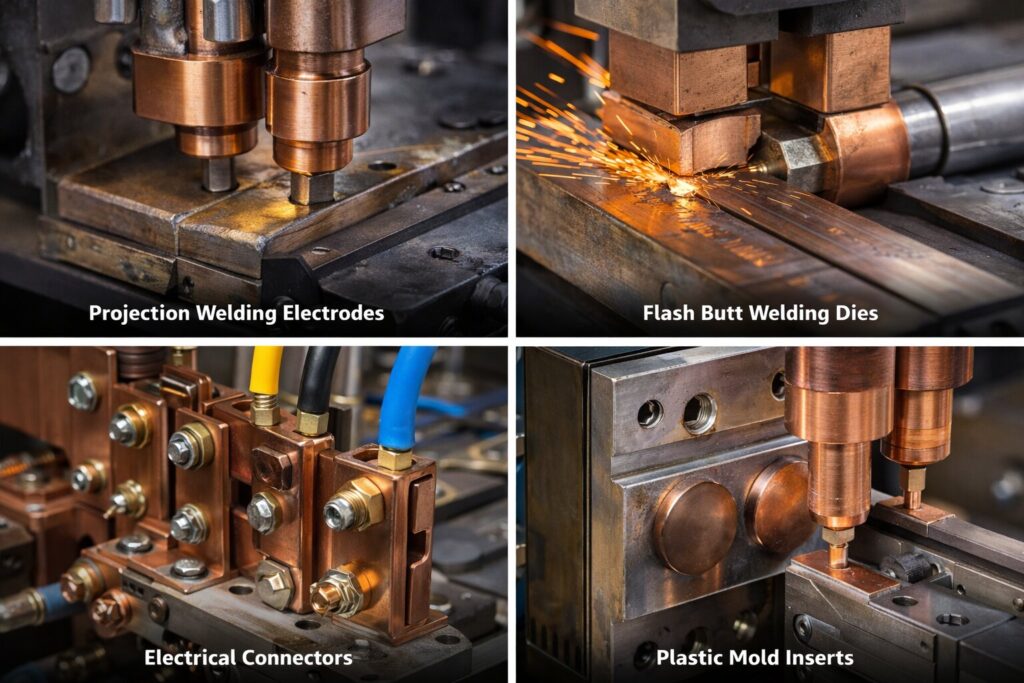
- Projection welding electrodes
- Flash butt welding dies
- Electrical connectors
- Plastic mold inserts
- Heavy-duty welding caps
In Zirconium Copper vs Chromium Copper, zirconium performs exceptionally in aluminum welding due to reduced sticking and better thermal stability.
Lifecycle & Downtime Impact
This is where Zirconium Copper vs Chromium Copper becomes strategic.
Chromium Copper:
- Strong initial hardness
- Requires more frequent dressing in high-heat cycles
Zirconium Copper:
- Better softening resistance
- Longer electrode life
- Reduced maintenance frequency
Even if chromium copper costs slightly less upfront, Zirconium Copper vs Chromium Copper analysis shows that longer service life reduces:
- Production stoppages
- Replacement frequency
- Labor cost
- Machine recalibration
Over a year of high-volume welding, downtime can cost more than the material difference.
Environmental Impact
A rarely discussed angle in Zirconium Copper vs Chromium Copper is sustainability.
Frequent replacement means:
- More scrap
- More recycling energy
- Higher carbon footprint
Since zirconium copper generally lasts longer in repetitive thermal cycles, industries scrap and recycle less often.
At DOMADIA™, choosing longer-life alloys is part of supporting responsible manufacturing.
Standards & Technical Specifications
Zirconium Copper
- UNS C15000
- ASTM B150
- EN CW120C
Chromium Copper
- UNS C18200
- ASTM B152
- EN CW106C
Both alloys are precipitation hardened and supplied by DOMADIA™ in:
Shapes Available
- Rods
- Bars
- Plates
- Blocks
- Forged components
- Custom machined electrodes
So, Which Performs Longer?
In most high-temperature, high-cycle resistance welding applications:
Zirconium Copper vs Chromium Copper testing shows zirconium copper maintains conductivity and strength longer under repeated heating.
Chromium copper performs well in medium-duty operations.
For aluminum welding and high-speed automotive production lines, zirconium copper often outperforms in total lifecycle value.
Final Verdict
Zirconium Copper vs Chromium Copper is not about which alloy is stronger on paper—it’s about which alloy survives real-world repetition longer.
If your production line runs thousands of welds per shift, lifecycle cost matters more than initial price.
At DOMADIA™, we help industries choose alloys based on performance, not assumptions.
Stop Replacing Electrodes — Start Upgrading Performance
If your production line can’t afford downtime, your alloy choice shouldn’t either.
Discover how the right decision between Zirconium Copper vs Chromium Copper can extend electrode life, reduce maintenance cycles, and lower total operating costs.
At DOMADIA™, we don’t just supply copper alloys — we help you select the grade that performs longer in real-world welding conditions.
If you want to enhance welding performance and ensure longer operational life from your components, Contact Us today.
Talk to: Er.Pankaj Domadia | Kairav Domadia | Aadil Domadia | Pragati Sanap | Pooja N N
#ZirconiumCopperVsChromiumCopper #UNSC15000 #UNSC18200 #CopperAlloys #ResistanceWelding #IndustrialMaterials #DOMADIA
Directly whatsapp us for an Enquiry: https://wa.link/kairav
We’ve supplied to Mumbai, Pune, Indore, Jaipur, and Surat—serving industries across Maharashtra, Madhya Pradesh, Rajasthan, Gujarat, and Goa, with exports to Germany, USA, Japan, South Korea, and Italy.