Blogs
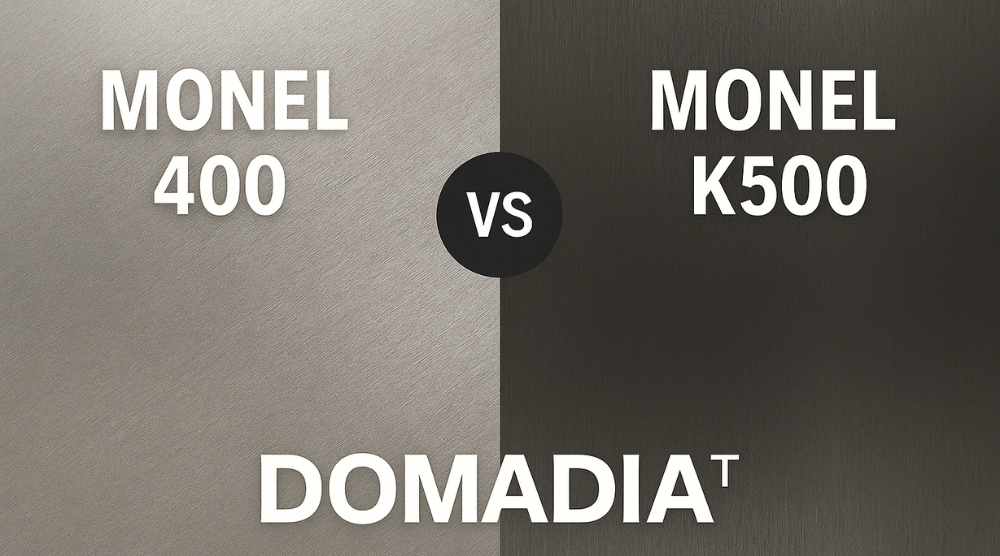
Monel 400 vs Monel K500: The High-Performance Nickel Alloy Showdown | DOMADIA™
Introduction — A Failure That Sparked a Big Question
The offshore platform was just 18 months into its operation when a critical fastener began showing signs of stress corrosion. Engineers were confused — the material used was Monel 400, known for its legendary corrosion resistance.
But the repeated loading, high-velocity seawater, and abrasive impact were slowly eating away at it.
After inspection, the lead metallurgist concluded:
“This application needed something stronger. This needed Monel K500.”
That moment sparked a debate many industries still face today:
When should you choose Monel 400, and when is Monel K500 the smarter choice?
DOMADIA™ breaks it down with science, applications, properties, and industry experience — all in one definitive comparison.
What Are These Alloys?
Monel alloys are nickel-copper alloys known for extreme corrosion resistance, especially in marine and chemical environments.
But Monel 400 and Monel K500 are NOT interchangeable — their mechanical strength, behavior under stress, and long-term durability differ significantly.
Chemical Composition
Monel 400 (UNS N04400)
- Nickel: 63% min
- Copper: 28–34%
- Iron: 2.5% max
- Manganese: 2.0% max
- Sulfur, Silicon: Trace
Monel K500 (UNS N05500)
(Aged-hardenable version of Monel 400)
- Nickel: 63% min
- Copper: 27–33%
- Aluminum: 2.3–3.15%
- Titanium: 0.35–0.85%
- Iron: 2.0% max
- Manganese: 1.5% max
Key Difference:
K500 adds Al + Ti, enabling precipitation hardening, which makes it dramatically stronger than Monel 400.
Mechanical & Physical Properties
Monel 400
- Tensile Strength: 480 MPa
- Yield Strength: 170 MPa
- Hardness: ~65 Rockwell B
- Melting Range: 1300–1350°C
- Density: 8.80 g/cm³
Monel K500
- Tensile Strength: 960–1100 MPa
- Yield Strength: 690–760 MPa
- Hardness: 20–35 Rockwell C
- Melting Range: 1310–1350°C
- Density: 8.44 g/cm³
Key Takeaway:
K500 can be twice as strong as 400, with far greater abrasion and fatigue resistance.
Corrosion Resistance Comparison
Monel 400
- Exceptional resistance to seawater corrosion
- Excellent resistance to hydrofluoric acid, alkalis, neutral salts
- Self-passivating surface
Monel K500
- Same base-level corrosion resistance as Monel 400**
- PLUS improved resistance to:
- Cavitation
- Erosion
- High-velocity seawater
- Stress corrosion cracking
Warning:
In certain conditions, K500 may undergo trace hydrogen embrittlement — proper heat treatment avoids this.
Applications
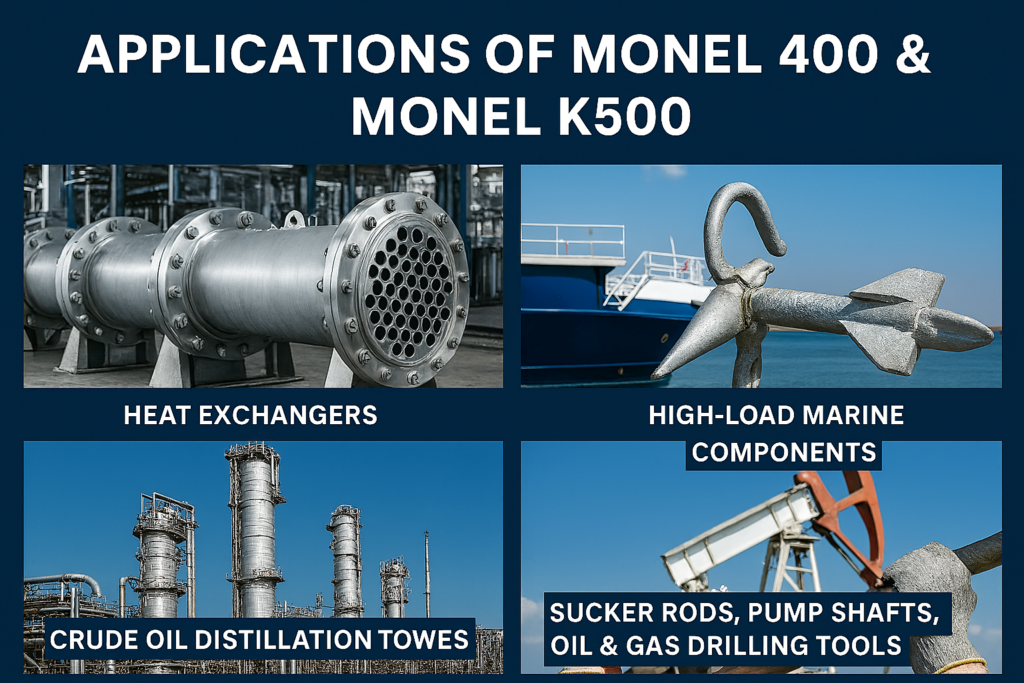
Where Monel 400 Is Ideal
- Heat exchangers
- Marine fasteners
- Pump and valve components
- Chemical processing equipment
- Crude oil distillation towers
- Freshwater & seawater tanks
- Fuel & water lines
Where Monel K500 Dominates
- High-load marine components
- Sucker rods, pump shafts
- Oil & gas drilling tools
- High-strength springs
- Non-magnetic components in instrumentation
- Fasteners needing strength + corrosion resistance
- Propeller shafts
- Downhole tools
DOMADIA™ supplies both grades in bars, sheets, plates, strips, wires, and custom CNC-machined parts.
Monel 400 vs Monel K500 — Side-by-Side Comparison
| Property / Feature | Monel 400 | Monel K500 |
| Strength | Medium | Extremely High |
| Hardening Ability | Non-hardenable | Precipitation Hardenable |
| Corrosion Resistance | Excellent | Excellent + Better in high-velocity seawater |
| Machinability | Good | Harder to machine |
| Wear Resistance | Moderate | Superior |
| Cost | Lower | Higher |
| Ideal Use | General corrosion | High load, extreme marine, heavy-duty |
Why Monel K500 Costs More — and Why It’s Worth It
Many buyers see the price difference and pause. But engineers know the truth:
✔ Higher mechanical strength
✔ Less downtime
✔ Higher fatigue resistance
✔ Longer product lifecycle
✔ Lower maintenance costs
✔ Less environmental waste due to fewer replacements
In harsh marine & offshore environments, K500 pays for itself by lasting 2–3× longer than Monel 400.
Environmental Impact — A Responsible Choice
Choosing stronger alloys like Monel K500 reduces how often parts need replacement.
This means:
🌍 Less metal waste
🌍 Fewer recycling cycles
🌍 Lower CO₂ output over lifecycle
By selecting the right alloy, industries indirectly support cleaner oceans and greener engineering — a commitment DOMADIA™ strongly prioritizes.
Standards
Monel 400
- ASTM B127, B164
- ASME SB-127, SB-164
Monel K500
- ASTM B865
- ASME SB-865
Shapes Available at DOMADIA™
- Sheets
- Plates
- Coils
- Bars / Rods
- Forgings
- Pipes
- Tubes
- Strips
- Wires
- CNC custom parts
Conclusion — Monel 400 vs Monel K500: Which Should You Choose?
The answer depends on your application — and the Focused Phrase: Monel 400 vs Monel K500 summarizes it best:
- Choose Monel 400 when corrosion resistance is needed without extreme loads.
- Choose Monel K500 when both strength and corrosion resistance are critical for long-term performance.
For industries that value reliability, longevity, and sustainability, Monel K500 becomes the clear long-term winner.
DOMADIA™ is here to supply it with precision, global quality, and engineer-backed support.
Need Custom Mesh Sizes or Weave Patterns? Talk to Our Experts →
📩 Contact DOMADIA™ for OEM, bulk, and customized solutions.
📩 Contact us today to get custom sizes and specifications for your project.
Talk to: Er.Pankaj Domadia | Kairav Domadia | Aadil Domadia | Pragati Sanap | Pooja N N
#Monel400 #MonelK500 #NickelAlloys #DOMADIA #MarineEngineering #OilAndGasMaterials #MetalComparison #HighPerformanceAlloys
Directly whatsapp us for an Enquiry: https://wa.link/kairav