Blogs
Coaxial vs Twinaxialv Cables: 7 Critical Truths That Protect High-Speed Data Integrity
Coaxial vs Twinaxialv Cables — Where High-Speed Communication Succeeds or Fails
A modern automation facility upgraded its entire communication backbone. Servers were faster. Controllers were smarter. Software was optimized.
Yet unexplained signal drops, data corruption, and intermittent downtime continued.
The root cause was not software logic or processing power.
It was the cable architecture.
In high-speed systems, Coaxial vs Twinaxialv Cables is not a minor technical choice. It directly determines signal clarity, system stability, and long-term reliability. At DOMADIA™, cable selection begins with understanding how data behaves under real electrical stress.
A Critical Mindset Shift: Bandwidth Without Integrity Is Useless
High-speed communication failures rarely happen instantly. They accumulate silently—through EMI exposure, impedance mismatch, signal reflections, and crosstalk.
The Coaxial vs Twinaxialv Cables decision determines whether a system transmits data cleanly or constantly compensates for degradation. This is why engineers must treat cables as active performance components, not passive accessories.
What Defines a Coaxial Cable
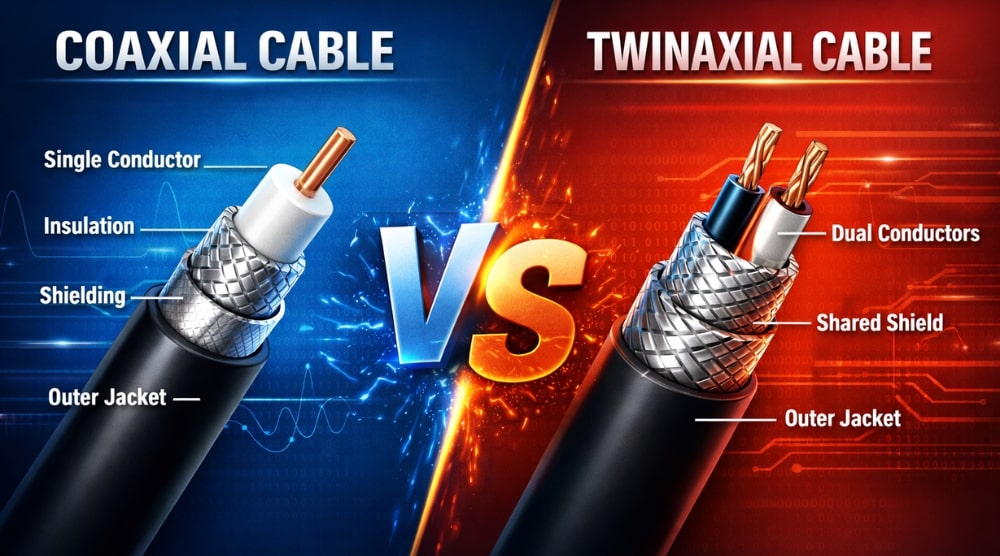
A coaxial cable is built around a concentric design consisting of a central conductor, dielectric insulation, metallic shielding, and an outer protective jacket. The signal and return path share the same axis, creating stable impedance and strong electromagnetic shielding.
In the Coaxial vs Twinaxialv Cables comparison, coaxial cables are valued for their ability to transmit signals over longer distances while resisting external interference.
What Defines a Twinaxial Cable
Twinaxial cables use two precisely matched conductors enclosed within a shared shield. Signals are transmitted in a balanced, differential mode, allowing noise picked up by one conductor to be canceled by the other.
Within the Coaxial vs Twinaxialv Cables discussion, twinaxial cables are preferred for ultra-high-speed data transmission over shorter distances where signal integrity is critical.
Chemical Composition
Coaxial Cable Composition
Coaxial cables typically use copper or silver-plated copper conductors, paired with dielectrics such as PTFE, polyethylene, or FEP. Shielding is achieved through aluminum foil or copper braid, while outer jackets are made from PVC, LSZH, or fluoropolymers for thermal and chemical resistance.
Twinaxial Cable Composition
Twinaxial cables incorporate dual high-purity copper conductors with tightly controlled dielectric spacing. Shielding is usually tinned copper braid, combined with flame-retardant, low-loss jacketing materials.
DOMADIA™ ensures material consistency to maintain stable electrical characteristics across production batches.
Electrical and Mechanical Properties
In Coaxial vs Twinaxialv Cables, electrical behavior defines suitability. Coaxial cables operate with single-ended signals and offer high EMI resistance over longer distances. Twinaxial cables operate with differential signals, delivering exceptional noise immunity and signal clarity at very high data rates.
Mechanically, both cable types are designed for industrial durability, but twinaxial cables often require stricter installation control due to tighter impedance tolerances.
Technical Specifications
Typical Coaxial Cable Specifications
Coaxial cables are commonly available in 50-ohm and 75-ohm impedance variants. They support frequencies into the gigahertz range, operate across wide temperature windows (−55°C to +200°C), and provide consistent attenuation over extended lengths.
Typical Twinaxial Cable Specifications
Twinaxial cables usually feature 100-ohm differential impedance and support data rates exceeding 10 to 25 Gbps. They are engineered for low skew, minimal jitter, and stable performance in high-speed digital environments.
DOMADIA™ supplies cables tested for impedance stability, shielding effectiveness, and lifecycle performance.
Industry Standards and Compliance
Coaxial Cable Standards
Coaxial cables are governed by standards such as MIL-C-17, IEC 61196, and RG-series specifications, ensuring dimensional accuracy, electrical performance, and environmental resistance.
Twinaxial Cable Standards
Twinaxial cables comply with IEEE 802.3, SFF-8431, SFF-8432, PCIe, and InfiniBand guidelines, making them suitable for modern data-intensive systems.
Standards compliance ensures Coaxial vs Twinaxialv Cables perform reliably beyond laboratory conditions.
Applications Where the Difference Becomes Clear
Coaxial Cable Applications
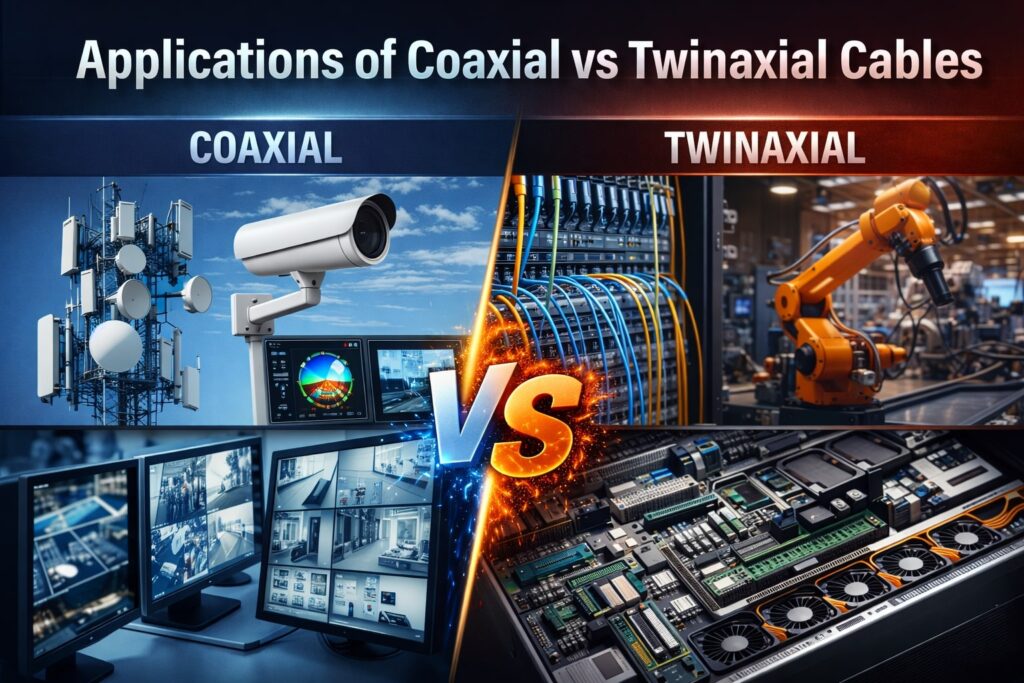
Coaxial cables are widely used in RF communication systems, aerospace avionics, broadcast transmission, and CCTV infrastructure where distance and shielding are priorities.
Twinaxial Cable Applications
Twinaxial cables dominate data centers, high-speed servers, storage interconnects, network switches, and industrial automation backplanes where speed and signal purity are critical.
Each application answers the Coaxial vs Twinaxialv Cables question differently.
Lifecycle Cost and Environmental Impact
Cables that degrade prematurely increase scrap generation, recycling energy consumption, and downtime-related emissions. Twinaxial cables, when properly applied, often outlast conventional alternatives in high-speed environments.
By reducing replacement cycles, the right Coaxial vs Twinaxialv Cables choice contributes directly to lower environmental impact. At DOMADIA™, durability is a sustainability strategy—not a marketing claim.
Practical Selection Guidance
Before selecting between Coaxial vs Twinaxialv Cables, evaluate distance requirements, data rate demands, EMI exposure, and total lifecycle cost. The correct choice eliminates performance bottlenecks long before they become failures.
Conclusion: Data Integrity Begins with Cable Architecture
The Coaxial vs Twinaxialv Cables decision is not driven by trends or price alone. It is an engineering judgment based on physics, environment, and long-term value.
At DOMADIA™, we help industries choose cable solutions that protect data integrity, reduce downtime, and support sustainable operations—without compromise.
Coaxial vs Twinaxialv Cables, selected correctly, turn high-speed communication into dependable performance.
High-speed communication failures often trace back to poor cable architecture—not software or hardware.
Learn how the right Coaxial vs Twinaxialv Cables selection protects signal integrity and system uptime with DOMADIA™.
Contact Us to discuss your data-critical cable requirements with our engineering team
Talk to: Er.Pankaj Domadia | Kairav Domadia | Aadil Domadia | Pragati Sanap | Pooja N N
#CoaxialVsTwinaxialvCables #HighSpeedCommunication #SignalIntegrity #IndustrialCables #DataTransmission #EMIShielding #DifferentialSignaling #DataCenterInfrastructure #AutomationTechnology #NetworkingCables #ElectronicComponents #IndustrialAutomation
Directly whatsapp us for an Enquiry: https://wa.link/kairav
Our supply network spans Delhi, Noida, Gurugram, Faridabad, and Ghaziabad across Delhi NCR, Haryana, UP, Rajasthan, and Punjab, reaching clients in UAE, Saudi Arabia, Qatar, Oman, and Kuwait.