Blogs
Planar Bonded Targets Performance: 7 Powerful Planar vs Bonded Sputtering Targets Breakdown | DOMADIA™
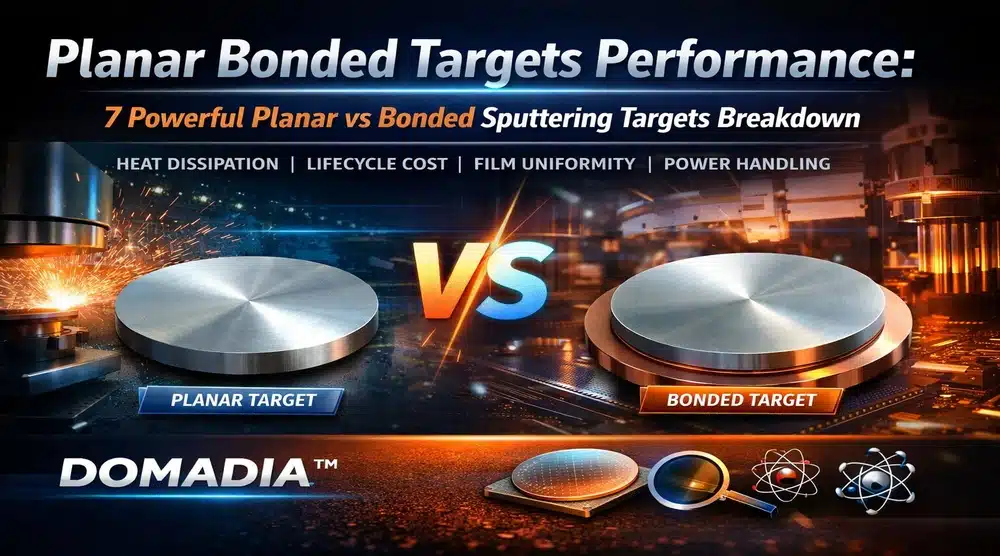
Planar Bonded Targets Performance: The Real Difference Between Planar vs Bonded Sputtering Targets
Planar Bonded Targets Performance directly determines thin film quality, uptime, thermal stability, and cost efficiency in sputtering systems. When production lines run at high power densities, even minor differences in thermal behavior can influence yield and lifecycle.
At DOMADIA™, we analyze Planar Bonded Targets Performance not just as a product comparison—but as a performance engineering decision.
Understanding Planar Bonded Targets Performance
Planar Bonded Targets Performance compares two manufacturing formats:
- Planar Targets (Monolithic)
- Bonded Targets (Target material bonded to copper backing plate)
The difference impacts:
- Heat dissipation
- Power handling capability
- Target erosion pattern
- Mechanical stability
- Deposition uniformity
Selecting the right configuration improves overall Planar Bonded Targets Performance and process consistency.
Chemical Composition
Both target types support high-purity materials such as:
Pure Metals
- Copper (UNS C10100 – Cu ≥ 99.99%)
- Nickel (UNS N02200 / N02201)
- Aluminum (99.99% grade)
- Titanium (Grade 2 / high purity)
Alloys
- NiCr
- CuNi
- NiFe
- Specialty PVD blends
In advanced semiconductor deposition, chemical purity significantly enhances Planar Bonded Targets Performance by reducing contamination and particle generation.
DOMADIA™ ensures refined grain structure and strict impurity control to optimize Planar Bonded Targets Performance.
Mechanical & Thermal Properties
Planar Targets
- Solid monolithic construction
- Moderate thermal conductivity
- Lower upfront cost
- Suitable for low-to-medium power sputtering
Bonded Targets
- Diffusion bonded to copper backing plate
- Superior thermal conductivity
- Higher power density tolerance
- Reduced cracking under stress
Under high-power sputtering, bonded configurations significantly improve Planar Bonded Targets Performance due to efficient heat transfer.
Technical Specifications
Key parameters influencing Planar Bonded Targets Performance:
- Diameter Range: 2” to 20”
- Thickness Tolerance: ±0.05 mm
- Flatness: ≤0.1 mm
- Bond Strength: >35 MPa (shear)
- Grain Size: Controlled for uniform erosion
- Surface Finish: Precision ground
Precision machining and bonding integrity play a vital role in stabilizing Planar Bonded Targets Performance during aggressive deposition cycles.
Industry Standards
To maintain consistent Planar Bonded Targets Performance, products must comply with:
- ASTM B187 (Copper)
- ASTM B162 (Nickel)
- SEMI Standards
- ISO 9001 Quality Management
- RoHS Compliance
At DOMADIA™, complete traceability ensures reliable Planar Bonded Targets Performance across global supply chains.
Applications of Planar Bonded Targets Performance
High-performance Planar Bonded Targets Performance plays a vital role in advanced thin-film deposition industries where precision, purity, and thermal stability directly affect product quality.
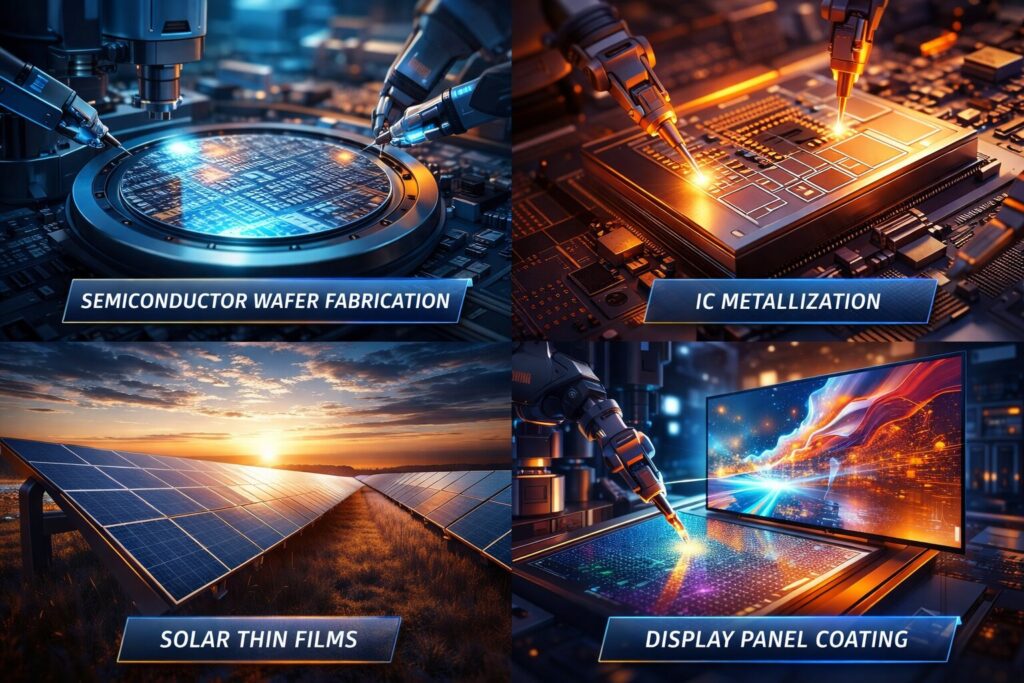
1️⃣ Semiconductor Wafer Fabrication
Thin films deposited using sputtering targets form critical conductive and barrier layers on silicon wafers. High sputtering target quality ensures uniform film thickness, minimal defects, and reliable microchip performance.
2️⃣ IC Metallization
Integrated circuits require ultra-thin metal layers for electrical interconnects. Optimized sputtering target design supports stable plasma conditions and precise metal deposition essential for high-density microelectronics.
3️⃣ Solar Thin Films
Photovoltaic panels depend on thin conductive coatings for efficient energy conversion. Consistent sputtering target quality improves coating uniformity, boosting solar cell efficiency and durability.
4️⃣ Display Panel Coating
Modern OLED and LCD displays require controlled deposition of conductive and optical layers. Superior sputtering target quality enables uniform coatings that enhance brightness, clarity, and device lifespan.
5️⃣ Optical Layers
Advanced optics such as lenses, sensors, and mirrors rely on thin films for reflection, anti-reflection, or filtering properties. Stable sputtering target quality ensures high optical precision and reliable coating performance.
6️⃣ Data Storage Media
Hard drives and advanced storage devices require multilayer thin films for magnetic performance. High-quality Planar Bonded Targets Performance enables precise layer formation for reliable data storage and faster device operation.
As device miniaturization continues across electronics and renewable energy sectors, the demand for enhanced sputtering target efficiency will only grow, making advanced thin-film materials increasingly critical for future technologies.
Lifecycle Cost Comparison
While planar targets often appear economical initially, lifecycle evaluation reveals:
Planar Targets:
- Lower purchase cost
- Limited power capacity
- Faster erosion in high-load systems
Bonded Targets:
- Longer operational life
- Better power handling
- Reduced downtime
- Improved uniformity
Over extended production cycles, enhanced bonded target designs reduce:
- Replacement frequency
- Equipment shutdown
- Scrap generation
At DOMADIA™, we emphasize total lifecycle economics when advising on Planar Bonded Targets Performance.
Thermal Engineering Impact
Heat concentration is the primary factor affecting Planar Bonded Targets Performance.
Bonded targets dissipate heat efficiently via copper backing plates, enabling:
- Higher watt density
- Lower cracking risk
- Stable plasma conditions
For advanced fabs and precision coatings, optimized sputtering target design ensures consistent deposition rates and reduced defects.
Shapes Available
DOMADIA™ offers optimized Planar Bonded Targets Performance in:
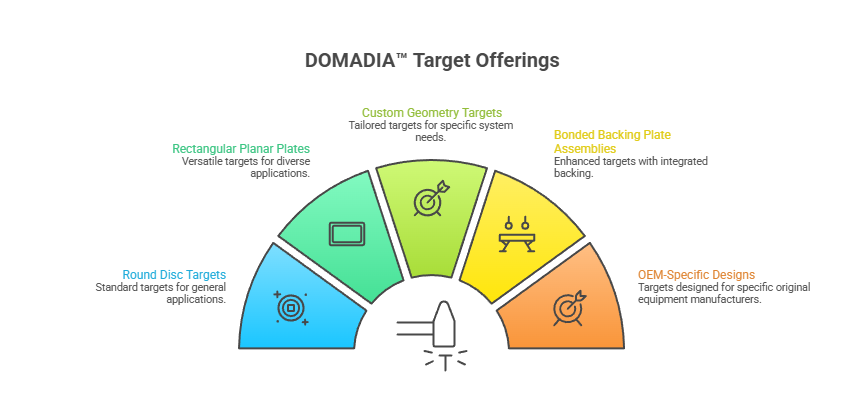
Custom manufacturing enhances system compatibility and maximizes sputtering process efficiency.
Market Relevance
With semiconductor and thin film industries expanding rapidly, demand for enhanced Planar Bonded Targets Performance continues rising across EV batteries, microelectronics, and renewable technologies.
Engineering precision today determines production stability tomorrow.
Final Takeaway
Planar Bonded Targets Performance is not simply a format difference — it is a strategic production decision.
For moderate power needs, planar targets may be sufficient.
For high-power precision environments, bonded targets provide superior thermal management and stability.
Choosing the right target means choosing process stability, longer lifecycle, and measurable yield improvement.
With DOMADIA™, performance is engineered — not assumed.
Upgrade Your Thin Film Output with Superior Planar Bonded Targets Performance
When deposition stability, thermal control, and lifecycle cost truly matter, don’t compromise on Planar Bonded Targets Performance.
Partner with DOMADIA™ for precision-engineered planar and bonded sputtering targets designed for higher power handling, longer service life, and consistent thin film results.
Contact DOMADIA™ today to optimize your sputtering performance and reduce production downtime.
Talk to: Er.Pankaj Domadia | Kairav Domadia | Aadil Domadia | Pragati Sanap | Pooja N N
#PlanarBondedTargetsPerformance #SputteringTechnology #ThinFilmCoating #PVDTargets #SemiconductorMaterials #DOMADIA™
Directly whatsapp us for an Enquiry: https://wa.link/kairav
From Jaipur, Udaipur, Jodhpur, Bhiwadi, and Alwar, we serve Rajasthan’s industrial clusters and nearby Haryana, Gujarat, UP, and MP, exporting to Germany, Austria, Switzerland, Sweden, and Norway.