Blogs
Cerium Oxide vs Cerium Carbonate: 7 Powerful Reasons Oxide Wins in Polishing Applications (UNS CeO₂)
Cerium Oxide vs Cerium Carbonate: Why Oxide Leads Modern Polishing
A glass manufacturer once faced a frustrating problem—despite investing in advanced polishing equipment, the final surface quality remained inconsistent. Scratches, haze, and uneven finishes continued to affect output quality. After detailed analysis, the issue became clear: it wasn’t the process, it was the material. The shift from carbonate to oxide changed everything.
This is where the debate of Cerium Oxide vs Cerium Carbonate becomes critical. Industries today are realizing that polishing performance is not just about machinery—it is about material science. The right compound determines efficiency, clarity, and long-term reliability.
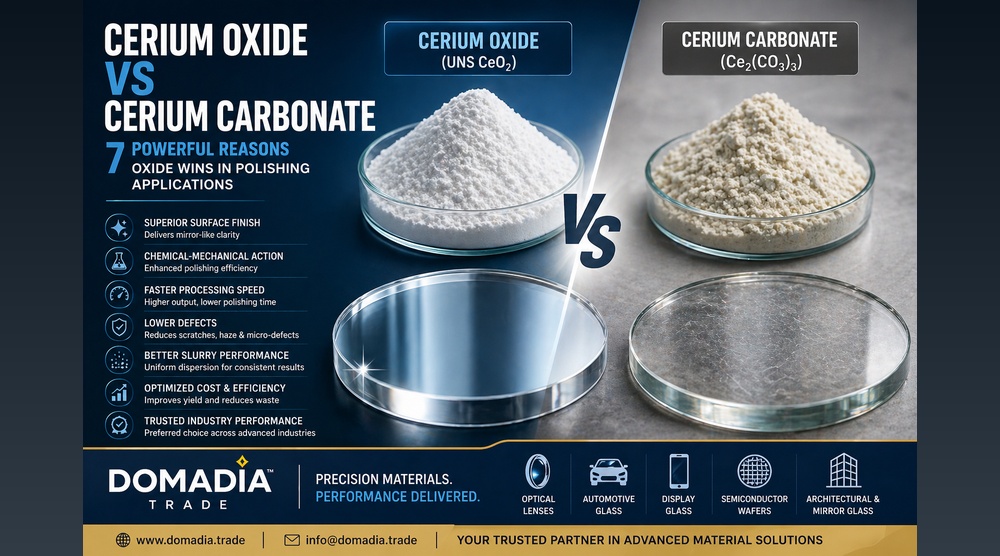
What is Cerium Oxide vs Cerium Carbonate?
Cerium Oxide (CeO₂)
A high-performance rare earth oxide known for its chemical-mechanical polishing capability. It reacts with glass surfaces, enabling smooth and controlled material removal.
Cerium Carbonate (Ce₂(CO₃)₃)
A precursor compound mainly used in the production of Cerium Oxide. It lacks the reactivity and performance required for direct polishing applications.
At DOMADIA™, we specialize in high-purity Cerium Oxide engineered for consistent industrial results.
Chemical Composition
| Material | Formula | Key Elements |
| Cerium Oxide | CeO₂ | Cerium + Oxygen |
| Cerium Carbonate | Ce₂(CO₃)₃ | Cerium + Carbonate |
The difference in oxygen bonding is what makes Cerium Oxide vs Cerium Carbonate a decisive factor in polishing performance.
7 Powerful Reasons Oxide Wins
1. Superior Surface Finish
Delivers mirror-like clarity by removing micro-defects efficiently.
2. Chemical-Mechanical Action
Oxide reacts with glass surfaces, enhancing polishing efficiency.
3. Faster Processing Speed
Reduces polishing time and increases production output.
4. Uniform Particle Distribution
Ensures consistent polishing across the entire surface.
5. Reduced Surface Defects
Minimizes scratches, haze, and irregularities.
6. Better Slurry Performance
Disperses evenly for improved contact and efficiency.
7. Proven Industrial Performance
Widely used across optics, electronics, and glass industries.
Applications of Cerium Oxide vs Cerium Carbonate
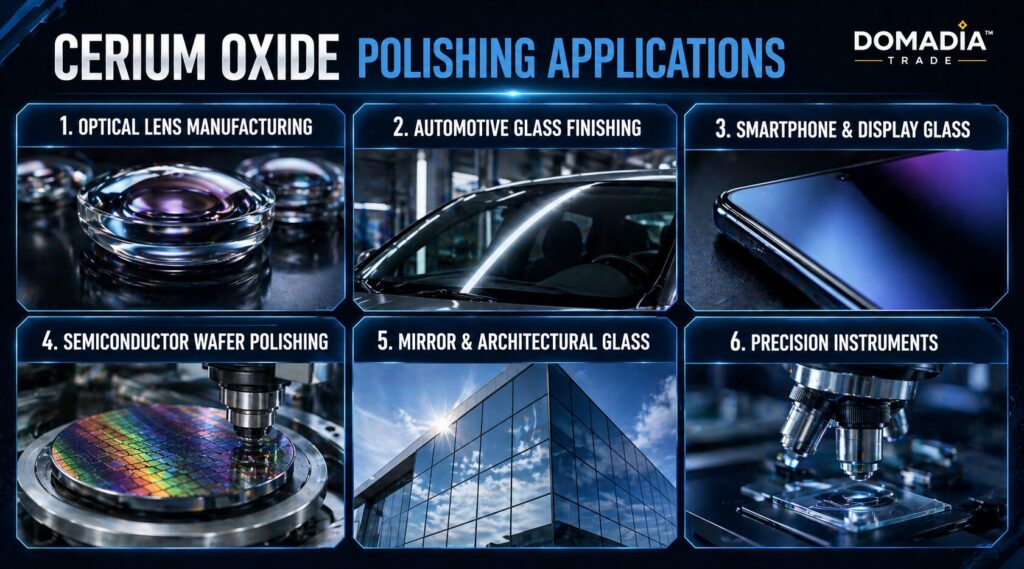
Optical Lens Manufacturing
Ensures ultra-smooth, distortion-free surfaces required for high-precision lenses and imaging systems.
Automotive Glass Finishing
Improves visibility and safety by eliminating micro-defects from windshields and mirrors.
Smartphone and Display Glass
Delivers scratch-free finishes and enhances touch sensitivity in modern devices.
Semiconductor Wafer Polishing
Supports advanced CMP processes by achieving defect-free, ultra-flat wafer surfaces.
Mirror and Architectural Glass
Enhances reflectivity and aesthetic quality for premium glass applications.
Precision Instruments
Provides accurate surface finishing for scientific and medical equipment.
Standards
- ASTM B534
- ISO 9001 Certified Processing
- RoHS & REACH Compliance
Properties
- High chemical reactivity
- Controlled abrasiveness
- Excellent dispersion
- High purity levels
- Stable polishing performance
Technical Specifications
- Purity: 99% to 99.99%
- Particle Size: Custom micron/nano grades
- Density: ~7.13 g/cm³
- Melting Point: ~2400°C
- Form: Fine powder or slurry
Shapes Available
- Powder
- Slurry
- Customized formulations
Mindset Shift: Material Over Machinery
Old thinking: Upgrade machines for better output
New thinking: Upgrade materials for superior results
The comparison of Cerium Oxide vs Cerium Carbonate clearly shows that material selection defines polishing success.
Why DOMADIA™
- High-purity engineered materials
- Consistent particle size distribution
- Reliable industrial performance
- Custom solutions for specific applications
- Strong global supply network
With DOMADIA™, you don’t just polish—you achieve perfection.
Conclusion
The comparison of Cerium Oxide vs Cerium Carbonate clearly highlights why oxide is the preferred choice for modern polishing applications. Its ability to combine chemical and mechanical polishing delivers superior clarity, efficiency, and long-term reliability. Industries that prioritize performance understand that material selection is not optional—it is critical.
As demand for precision and consistency continues to grow, choosing the right polishing material becomes a strategic advantage. With DOMADIA™, you gain access to high-performance Cerium Oxide solutions designed to deliver consistent results, reduce defects, and optimize productivity across demanding applications.
Cerium Oxide vs Cerium Carbonate – Choose the Material That Defines Precision
Switch to high-performance Cerium Oxide from DOMADIA™ and achieve flawless surface finishing today.
Connect with experts and discover the right material solution for your application.
Talk to: Er.Pankaj Domadia | Kairav Domadia | Aadil Domadia | Pragati Sanap | Pooja N N
#CeriumOxideVsCeriumCarbonate #GlassPolishing #RareEarthMaterials #DOMADIA #IndustrialMaterials #SurfaceFinishing
Directly whatsapp us for an Enquiry: https://wa.link/kairav
We’ve supplied to Ludhiana, Jalandhar, Amritsar, Patiala, and Bathinda, supporting Punjab, Haryana, Himachal Pradesh, Rajasthan, and Delhi, while shipping to USA, Canada, UK, Ireland, and Scotland.