Blogs
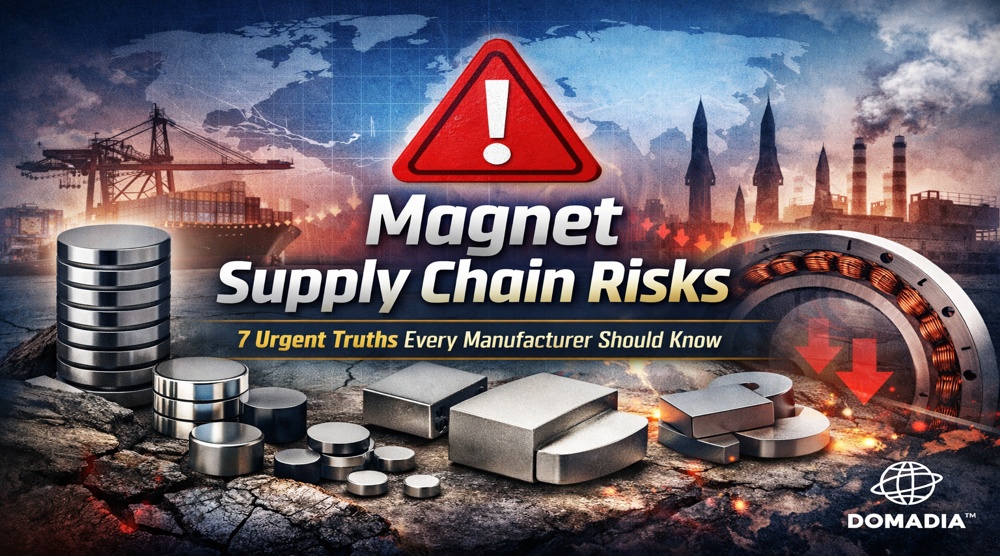
Magnet Supply Chain Risks: 7 Urgent Truths Every Manufacturer Must Know | DOMADIA™
Magnet Supply Chain Risks Are Reshaping Global Manufacturing
Magnet Supply Chain Risks are no longer theoretical discussions in boardrooms—they are operational realities affecting EV manufacturers, aerospace OEMs, renewable energy developers, and electronics producers worldwide.
In 2025 alone, geopolitical tensions, export restrictions, and concentration of rare earth mining in limited regions have intensified Magnet Supply Chain Risks across industries. The global rare earth magnet market continues to grow rapidly, fueled by electric vehicles, wind turbines, robotics, and defense systems—yet raw material dependency remains a critical vulnerability.
At DOMADIA™, we help manufacturers understand Magnet Supply Chain Risks not just from a sourcing angle—but from a materials science, standards, and lifecycle perspective.
Understanding Magnet Materials Behind Magnet Supply Chain Risks
Magnet Supply Chain Risks are directly linked to the type of magnet material used.
🔹 Neodymium Iron Boron (NdFeB) Magnets
- Chemical Composition: Nd₂Fe₁₄B with additions of Dysprosium (Dy) or Terbium (Tb)
- Key Elements: Neodymium, Iron, Boron
- Risk Factor: Heavy rare earth dependency
- Applications: EV motors, wind turbines, robotics, HDDs
- Supply Risk: High (China controls majority refining capacity)
🔹 Samarium Cobalt (SmCo) Magnets
- Chemical Composition: SmCo₅ or Sm₂Co₁₇
- Advantages: High-temperature stability
- Applications: Aerospace, defense, medical devices
- Supply Risk: Moderate to high
🔹 Ferrite (Ceramic) Magnets
- Chemical Composition: Fe₂O₃ + Ba/Sr Carbonate
- Advantages: Low cost, stable supply
- Applications: Motors, speakers, appliances
- Supply Risk: Low
🔹 Alnico Magnets
- Chemical Composition: Aluminum, Nickel, Cobalt
- Applications: Sensors, instrumentation
- Supply Risk: Moderate (Cobalt volatility)
Magnet Supply Chain Risks increase significantly when heavy rare earth elements are required for high-temperature performance.
Properties Driving Magnet Supply Chain Risks
Why are certain magnets harder to source?
Because performance demands are increasing.
| Property | NdFeB | SmCo | Ferrite |
| Magnetic Strength (BHmax) | Very High | High | Moderate |
| Temperature Resistance | Moderate | Excellent | Good |
| Corrosion Resistance | Needs coating | Strong | Strong |
| Cost Volatility | High | High | Low |
The stronger the magnet, the higher the dependency on critical minerals—intensifying Magnet Supply Chain Risks.
Applications Most Affected by Magnet Supply Chain Risks
Industries heavily exposed:
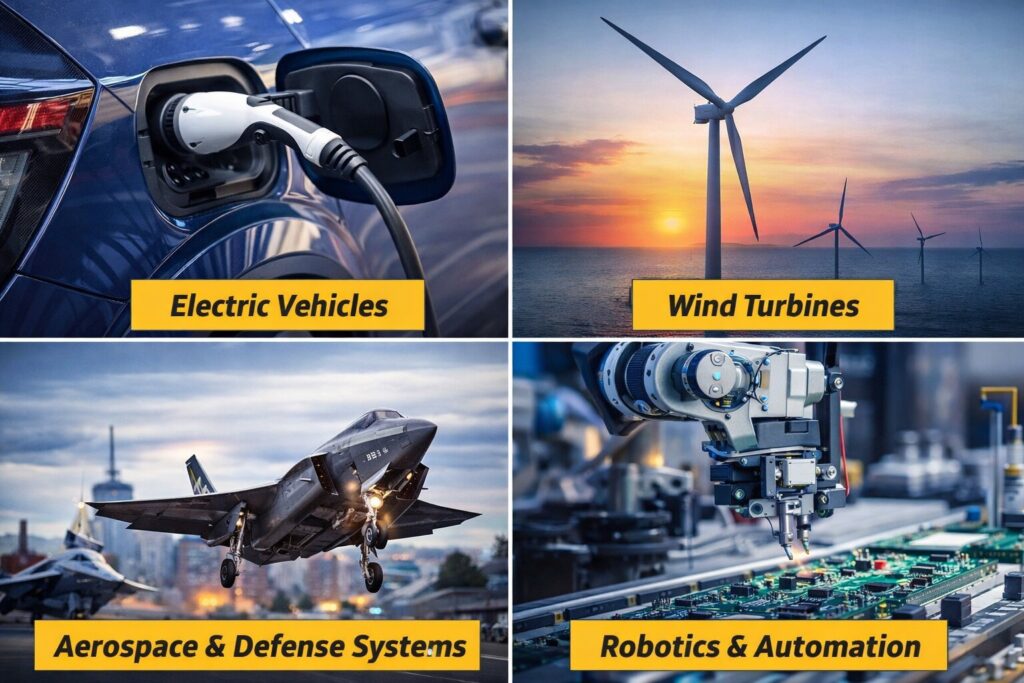
Electric Vehicles (Traction Motors)
Permanent magnets made from rare earth elements power high-efficiency EV traction motors. Any disruption in magnet supply can slow vehicle production and increase manufacturing costs.
Wind Turbines (Generators)
Modern direct-drive wind turbines rely on powerful rare earth magnets for efficient electricity generation. Supply instability can delay renewable energy projects and increase turbine manufacturing expenses.
Aerospace & Defense Systems
High-performance magnets are used in guidance systems, radar equipment, and aircraft actuators. Supply chain disruptions can directly affect defense readiness and aerospace manufacturing timelines.
Robotics & Automation
Industrial robots and automated machinery depend on precision motors that use permanent magnets. Limited magnet availability can impact factory automation upgrades and production efficiency.
Battery & Energy Storage Systems
Energy storage technologies and advanced power systems require magnetic components for control systems and high-efficiency motors. Magnet shortages can slow the deployment of renewable energy infrastructure.
Consumer Electronics
Smartphones, speakers, cameras, and wearable devices rely on miniature high-strength magnets. Any supply instability may lead to production delays and increased component prices in electronics manufacturing.
Technical Specifications Manufacturers Must Track
To mitigate Magnet Supply Chain Risks, engineers must evaluate:
- Residual Flux Density (Br)
- Coercivity (HcJ)
- Maximum Energy Product (BHmax)
- Curie Temperature
- Demagnetization curves
- Coating type (Ni-Cu-Ni, Epoxy, Zn)
- Tolerance standards
Relevant Standards:
- ASTM A977
- IEC 60404
- ISO 9001 (Quality Systems)
- RoHS / REACH Compliance
- SAE standards for automotive magnets
Standard compliance reduces substitution risks during supply chain disruptions.
Shapes Available & Strategic Diversification
Magnet Supply Chain Risks also impact geometry availability.
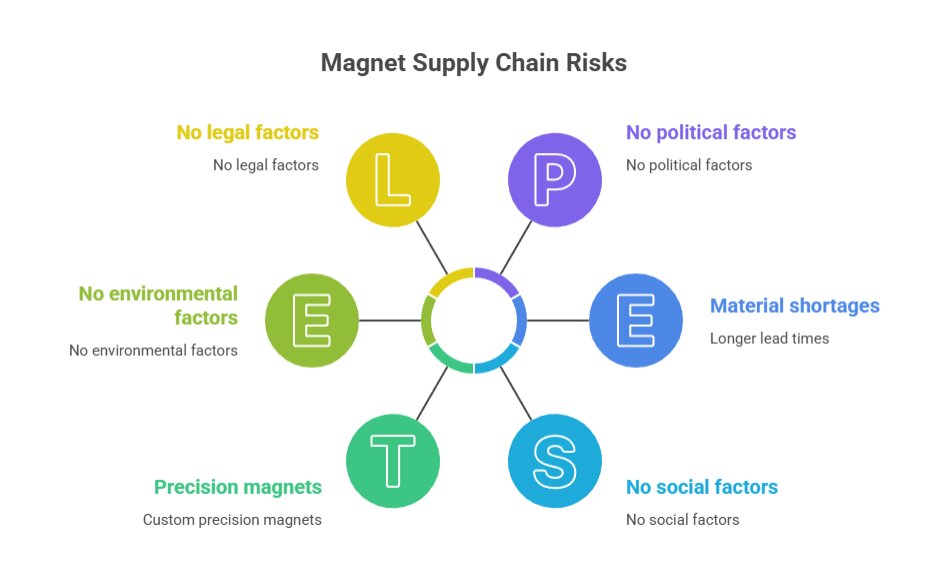
Custom shapes often have longer lead times during material shortages. Standardized geometry reduces vulnerability.
Geopolitical & Market Trends Intensifying Magnet Supply Chain Risks
Data-driven insight:
- Rare earth magnet demand expected to grow sharply through 2030 due to EV adoption.
- Over 70% of rare earth processing remains regionally concentrated.
- Governments are investing in critical mineral independence.
Manufacturers who ignore Magnet Supply Chain Risks may face:
- Price spikes
- Export restrictions
- Production delays
- Compliance challenges
Practical Strategy to Reduce Magnet Supply Chain Risks
At DOMADIA™, we recommend:
✔ Multi-material evaluation (Ferrite vs NdFeB feasibility)
✔ Inventory buffer planning
✔ Approved alternate grade strategy
✔ Lifecycle cost evaluation instead of price-only decisions
✔ Partnering with diversified global suppliers
Magnet Supply Chain Risks are best managed through engineering + procurement collaboration.
Why Magnet Supply Chain Risks Matter Now More Than Ever
Magnet Supply Chain Risks are not only financial—they are strategic. The more frequently materials must be replaced or substituted, the higher the environmental footprint from mining, refining, scrapping, and recycling.
Longer-lasting magnet solutions reduce recycling frequency, lowering environmental strain and supporting sustainable manufacturing goals.
At DOMADIA™, we align performance reliability with responsible sourcing.
Conclusion: Turning Magnet Supply Chain Risks into Competitive Advantage
Magnet Supply Chain Risks can either disrupt operations—or create strategic differentiation.
Manufacturers who proactively assess magnet materials, properties, standards, technical specifications, and sourcing channels will outperform competitors during volatility.
Magnet Supply Chain Risks demand informed decisions—not reactive ones.
Partner with DOMADIA™ to secure your magnetic material strategy with technical clarity and global supply strength.
Secure Your Magnet Supply Chain Before the Next Disruption
Future-proof your operations against Magnet Supply Chain Risks with technically verified magnet materials, diversified sourcing, and performance-backed solutions from DOMADIA™.
Contact DOMADIA™ today to strengthen your magnetic material strategy with confidence.
Talk to: Er.Pankaj Domadia | Kairav Domadia | Aadil Domadia | Pragati Sanap | Pooja N N
#MagnetSupplyChainRisks #RareEarthMagnets #IndustrialMagnets #CriticalMinerals #ManufacturingStrategy #SupplyChainSecurity #Neodymium #SamariumCobalt #FerriteMagnets
Directly whatsapp us for an Enquiry: https://wa.link/kairav
We’ve supplied to Ludhiana, Jalandhar, Amritsar, Patiala, and Bathinda, supporting Punjab, Haryana, Himachal Pradesh, Rajasthan, and Delhi, while shipping to USA, Canada, UK, Ireland, and Scotland.