Blogs
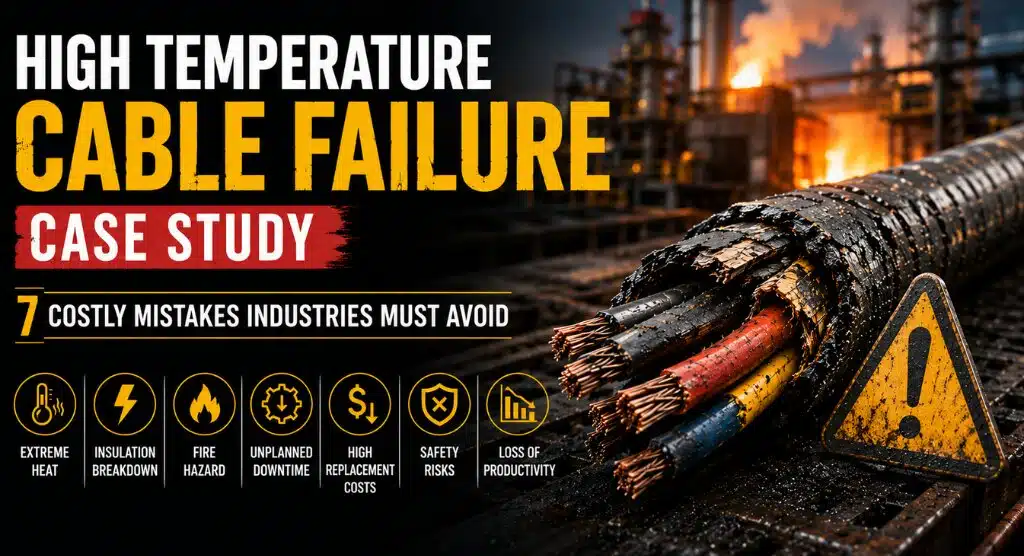
High Temperature Cable Failure Case Study: 7 Costly Mistakes Industries Must Avoid
What shocked the plant management most was this: the furnace never failed, the automation software was still active, and the control systems remained fully operational. The real breakdown began silently inside a cable tray. During this High Temperature Cable Failure incident, one standard cable had been installed in an environment where extreme heat exposure was constant. Over time, the insulation gradually hardened, developed cracks, and eventually failed under continuous thermal stress. The moment the cable collapsed, communication between critical systems was interrupted. Sensors stopped responding, control signals disappeared, and the entire production line lost synchronization within minutes.
As the situation escalated, molten material became stuck mid-process, operators were forced to initiate emergency shutdown procedures, and the plant entered costly downtime. By the end of the shift, the company was dealing with rejected materials, delayed dispatches, emergency maintenance expenses, and operational losses worth lakhs — all because of a single overlooked cable. This High Temperature Cable Failure case proves that in extreme industrial environments, cable selection is never a minor purchase decision. It is a critical reliability decision that directly impacts industrial safety, production continuity, and long-term operational stability.
Why High Temperature Cable Failure Happens More Often Than Industries Realize
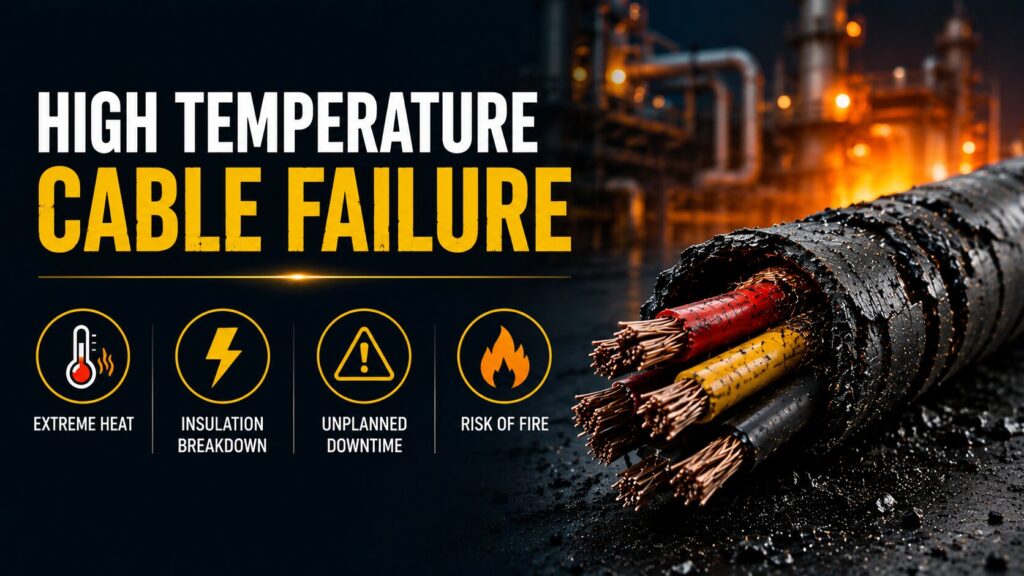
Many industrial facilities invest heavily in automation systems, advanced machinery, smart monitoring technologies, and high-performance thermal processing equipment. Yet during many High Temperature Cable Failure incidents, one critical component is often underestimated — the cable itself. In many plants, cables are treated as secondary accessories rather than essential reliability components. That mindset becomes extremely dangerous in environments where extreme heat and harsh operating conditions are constant.
High-temperature industrial zones expose cables to continuous radiant heat, aggressive thermal cycling, mechanical vibration, chemical fumes, abrasion, and constant electrical stress. Under these conditions, even the most advanced equipment can become unreliable if the connecting cable is unable to survive the environment. This is why High Temperature Cable Failure problems often begin silently in cable systems long before operators notice major equipment malfunction or production instability.
Mistake #1: Using “Heat Resistant” Instead of True High-Temperature Cables
This was the first — and perhaps the biggest — mistake in the entire High Temperature Cable Failure incident. The installed cable was marketed as “heat resistant,” but there is a critical difference between standard heat-resistant cables and cables specifically engineered for extreme high-temperature industrial environments. While the original cable could tolerate moderate heat exposure for limited periods, the actual operating conditions inside the plant continuously exceeded 850°C, far beyond its real performance capability.
As temperatures remained consistently extreme, the insulation gradually hardened, became brittle, and started developing internal cracks. Over time, signal integrity became unstable, communication errors increased, and system reliability deteriorated rapidly. Under such severe thermal conditions, cable failure was no longer a possibility — it became inevitable.
Mistake #2: Ignoring Thermal Shock
Industrial heat is rarely stable or constant. In this High Temperature Cable Failure case, furnace doors opened repeatedly throughout daily operations, exposing cables to continuous thermal cycling. Every cycle created rapid heating, cooling, expansion, and contraction inside the cable structure. Over time, this constant thermal shock slowly weakened the conductor integrity and accelerated internal fatigue. Although the cable appeared normal externally, microscopic internal damage kept increasing every day until system reliability was eventually compromised.
Mistake #3: Underestimating Chemical Exposure
Extreme heat environments rarely contain only high temperatures. In many industrial facilities, cables are continuously exposed to aggressive contaminants such as oil vapors, carbon particles, oxidizing gases, and fine metallic dust. In this High Temperature Cable Failure situation, these harsh environmental elements accelerated insulation degradation far beyond expected levels. Ordinary insulation materials were unable to withstand prolonged exposure to both heat and chemical contamination, causing the cable surface to weaken, crack, and lose reliability over time. What initially appeared to be a minor material issue eventually developed into a major operational failure affecting the entire production system.
Mistake #4: Poor Shielding in a High-Interference Environment
Heavy industrial machinery continuously generates strong electromagnetic interference that can severely affect electrical systems operating in extreme environments. In this High Temperature Cable Failure incident, the weakening insulation not only reduced thermal resistance but also exposed the system to rising electromagnetic disturbances. As the cable condition deteriorated, sensor readings began fluctuating unpredictably, data transmission became unstable, and automation systems started receiving false control signals. Long before the cable completely failed, the entire production system had already started malfunctioning, creating hidden operational risks that gradually escalated into a major industrial shutdown.
Mistake #5: Selecting Cables Based Only on Initial Cost
This mistake is extremely common in industrial procurement. During many purchasing decisions, teams compare only the initial price of the cable instead of evaluating long-term lifecycle performance. In several High Temperature Cable Failure cases, lower-cost cables appeared to reduce upfront expenses, making them seem like a smart financial choice during procurement stages. However, those short-term savings often disappear once the cables begin operating under continuous thermal stress and harsh industrial conditions.
The real costs emerge later through unexpected downtime losses, emergency labor expenses, production scrap, maintenance interruptions, and repeated replacement requirements. What initially saved a small amount during purchasing eventually caused financial damage far greater than the original investment difference. In heavy industrial operations, cheap cables frequently become the most expensive decision because system reliability, production continuity, and operational stability are compromised over time.
Mistake #6: Wrong Cable Construction for the Application
Extreme industrial environments demand far more than ordinary cable insulation. In this High Temperature Cable Failure case, the installed cable lacked several critical protective elements required for continuous high-heat operation, including ceramic insulation, stainless steel braiding, mica reinforcement, and advanced high-temperature shielding. While standard silicone insulation may perform adequately under moderate conditions, it often cannot withstand prolonged exposure to extreme thermal loads, mechanical stress, and industrial contaminants found in heavy manufacturing facilities.
As operating temperatures continued rising, the cable construction gradually weakened, accelerating insulation breakdown and reducing overall system reliability. This incident clearly demonstrated that proper cable construction is not simply a technical specification — it directly determines whether a cable survives for a few months or continues operating reliably for years in demanding industrial environments..
Mistake #7: Waiting for Visible Damage Before Replacement
The most dangerous part of this High Temperature Cable Failure was that the cable showed almost no visible external damage before failure occurred. Internally, insulation breakdown had already started, conductors had weakened, and signal integrity was steadily deteriorating. By the time visible cracks appear on high-temperature cables, failure is often extremely close. This is why preventive inspection and thermal monitoring are critical in high-temperature industrial operations.
How DOMADIA™ Solved the Problem
After detailed failure analysis, the plant upgraded to DOMADIA™ High Temperature Cables engineered specifically for extreme thermal environments.
The improvement was immediate.
Results After Installation
- Stable automation signals
- Reliable temperature monitoring
- Reduced downtime
- Improved operational safety
- Longer service life
- Lower maintenance frequency
The facility reported dramatically improved reliability within months.
Chemical Composition of DOMADIA™ High Temperature Cables
DOMADIA™ uses advanced material combinations to ensure durability under extreme operating conditions.
| Component | Material Used |
| Conductor | Nickel-Plated Copper |
| Insulation | Fiberglass / Ceramic Fiber / PTFE |
| Reinforcement | Mica Tape |
| Outer Layer | Silicone / SS Braiding |
| Shielding | Tinned Copper Braid |
Properties of DOMADIA™ High Temperature Cables
Extreme Heat Resistance
Engineered for demanding industrial environments, High Temperature Cable Failure risks are significantly reduced when cables are designed for continuous exposure to elevated temperatures. These specialized cables maintain insulation stability, signal reliability, and operational safety even under constant extreme heat conditions.
Excellent Thermal Stability
Maintains electrical integrity during thermal cycling.
Flame Retardant
Helps reduce fire propagation risk.
Chemical Resistance
Performs reliably in harsh industrial atmospheres.
High Mechanical Strength
Suitable for vibration-heavy environments.
Long Operational Life
Reduces replacement frequency and downtime.
Technical Specifications
| Property | Specification |
| Temperature Range | Up to 1200°C |
| Voltage Rating | 300V – 1.1KV |
| Shielding Options | Braided / Foil |
| Conductor Type | Stranded / Solid |
| Insulation Types | Ceramic / PTFE / Fiberglass |
| Flexibility | High |
| Flame Resistance | Excellent |
Standards Followed
DOMADIA™ high-temperature cables comply with major industrial standards:
- IEC Standards
- ASTM Specifications
- BS Standards
- RoHS Compliance
- UL Standards (selected grades)
These standards ensure:
- Safety
- Heat endurance
- Electrical reliability
- Long-term operational stability
Applications of DOMADIA™ High Temperature Cables
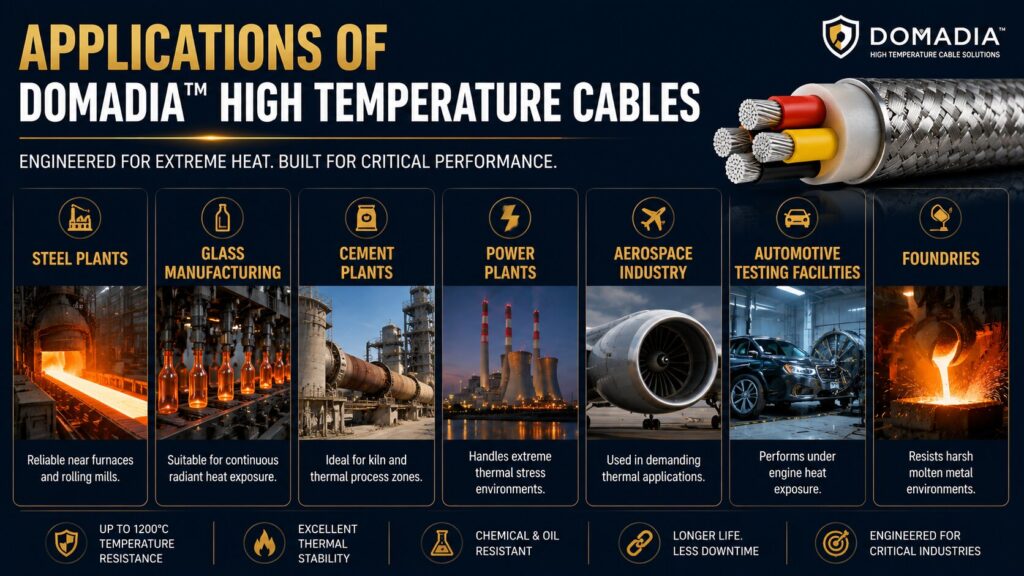
Steel Plants
Reliable near furnaces and rolling mills.
Glass Manufacturing
Suitable for continuous radiant heat exposure.
Cement Plants
Ideal for kiln and thermal process zones.
Power Plants
Built for demanding industrial operations, High Temperature Cable Failure risks are minimized when cables are engineered to handle extreme thermal stress environments. These cables maintain durability, electrical stability, and long-term performance under continuous high-heat exposure.
Aerospace Industry
Used in demanding thermal applications.
Automotive Testing Facilities
Designed for harsh automotive and industrial conditions, High Temperature Cable Failure issues can be prevented with cables built to perform under continuous engine heat exposure. These cables maintain insulation integrity and reliable signal transmission even in high-temperature operating zones.
Foundries
Engineered for severe industrial applications, High Temperature Cable Failure risks are reduced with cables designed to resist harsh molten metal environments. These cables maintain structural stability and reliable performance even under intense radiant heat and metal splash exposure.
Shapes and Configurations Available
DOMADIA™ offers:
- Single Core Cables
- Multi-Core Cables
- Braided Cables
- Shielded Cables
- Flexible Variants
- Flat Cables
- Armored Configurations
- Custom Engineered Solutions
Why DOMADIA™
Engineered for Critical Industries
Built specifically for high-temperature industrial applications.
Proven Performance
Trusted across manufacturing, steel, power, and automation industries.
Advanced Material Technology
Designed for extreme thermal endurance.
Custom Manufacturing Capability
Solutions tailored to operating conditions.
Reduced Downtime
Longer cable life improves operational continuity.
Better Lifecycle Economics
Lower maintenance and replacement costs over time.
Environmental Impact of Longer Cable Life
Frequent cable failures increase:
- Industrial scrap
- Recycling requirements
- Material consumption
- Environmental burden
Long-lasting DOMADIA™ cables reduce:
- Waste generation
- Replacement frequency
- Resource consumption
Reliable materials also contribute toward more sustainable industrial operations.
Conclusion
This High Temperature Cable Failure case study proves an important industrial lesson:
Major shutdowns are often caused by the smallest overlooked components.
In extreme heat environments, cable reliability directly affects:
- Productivity
- Safety
- Maintenance cost
- Operational efficiency
- System stability
Choosing the correct cable is not a purchasing decision alone.
It is a reliability strategy.
DOMADIA™ high-temperature cables are engineered to perform where ordinary cables fail — helping industries operate safely, efficiently, and continuously under the harshest thermal conditions.
High Temperature Cable Failure Case Study: 7 Costly Mistakes Industries Must Avoid
Don’t let one failed cable shut down your entire operation. Discover how DOMADIA™ helps industries prevent costly downtime and thermal failures.
Connect With Us For Industrial Cable Solutions.
Talk to: Er.Pankaj Domadia | Kairav Domadia | Aadil Domadia | Pragati Sanap | Pooja N N
#HighTemperatureCable #CableFailure #IndustrialSafety #DOMADIA #HeatResistantCable #Engineering #Manufacturing #IndustrialAutomation #ThermalSystems #ElectricalEngineering
Directly whatsapp us for an Enquiry: https://wa.link/kairav
Our materials reached Patna, Gaya, Muzaffarpur, Bhagalpur, and Begusarai, supporting Bihar, Jharkhand, UP, West Bengal, and Chhattisgarh, with exports to Nepal, Bhutan, Bangladesh, Myanmar, and Sri Lanka.