Blogs
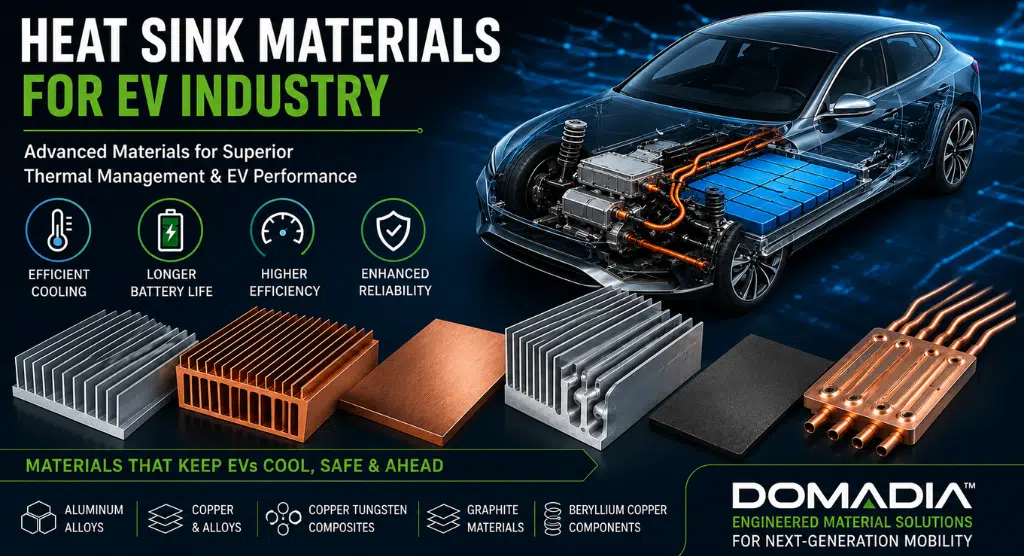
EV Heat Sink Materials: 7 Powerful Materials Driving EV Performance
EV Heat Sink Materials: The Silent Heroes Behind Every High-Performance Electric Vehicle
An EV battery pack heating up during peak summer traffic is not just a performance issue—it’s a safety concern, an efficiency problem, and a major challenge for automakers.
A fast-charging electric vehicle generates significant heat inside battery packs, power electronics, inverters, converters, and onboard charging systems. Without efficient thermal management, the vehicle may experience reduced range, slower charging, component degradation, and unexpected downtime.
This is where EV Heat Sink Materials become essential.
Modern EV manufacturers are aggressively improving cooling systems to achieve faster charging speeds, extended battery lifespan, higher power density, improved driving range, and safer vehicle operation under demanding conditions. Advanced EV Heat Sink Materials help dissipate excessive heat efficiently, allowing critical EV systems to operate reliably even during continuous fast charging and high-load driving environments.
As electric mobility continues expanding globally, the demand for lightweight, high-conductivity, and thermally stable EV Heat Sink Materials is increasing rapidly across battery cooling plates, power modules, charging infrastructure, and thermal interface systems. DOMADIA™ supplies high-performance heat sink materials engineered for demanding EV applications where thermal efficiency, durability, and long-term reliability directly impact vehicle performance and safety.thermal conductivity, lightweight performance, corrosion resistance, and durability matter most.
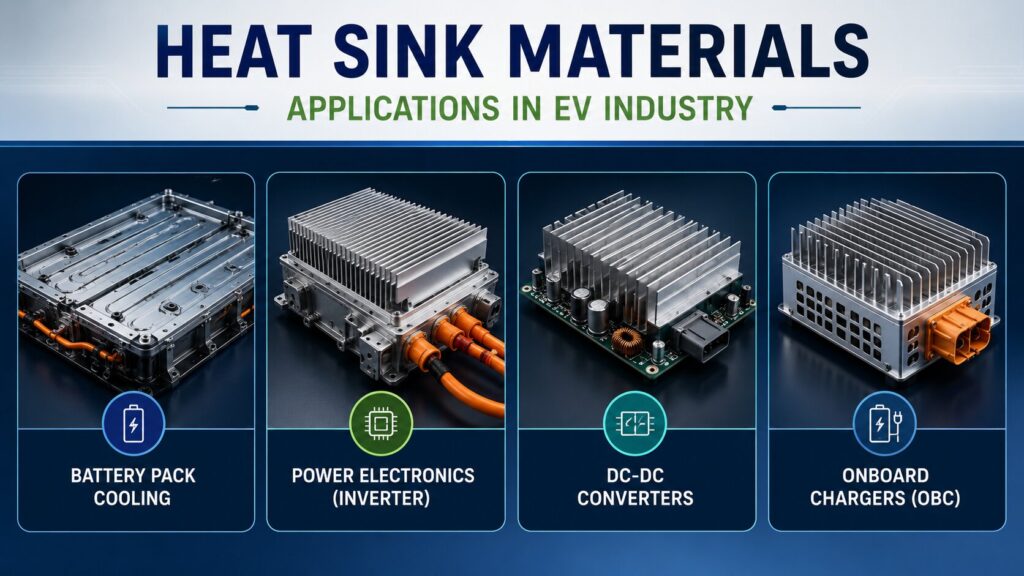
EV Heat Sink Materials in Thermal Management Systems
The EV industry depends heavily on efficient heat dissipation. Heat sinks absorb and transfer unwanted heat away from sensitive electronic components.
Key Areas Where Heat Sinks Are Used:
- EV battery packs
- Battery Management Systems (BMS)
- Inverters
- DC-DC converters
- Onboard chargers
- Electric motors
- LED lighting systems
- Fast charging infrastructure
Poor heat dissipation can reduce battery efficiency by over 20%, while excessive heat cycling can shorten battery life dramatically.
Why Thermal Management Is Becoming Critical in EVs
The global EV market is growing rapidly. According to industry projections, electric vehicle adoption is expected to accelerate significantly over the next decade as governments push for cleaner mobility.
However, higher charging speeds create higher thermal loads.
A vehicle charging from 20% to 80% in under 20 minutes produces massive heat concentration in compact spaces. Manufacturers now require advanced heat sink materials capable of:
- Rapid thermal transfer
- Lightweight construction
- Electrical insulation compatibility
- Vibration resistance
- Long service life
This has transformed heat sink material selection into a strategic engineering decision.
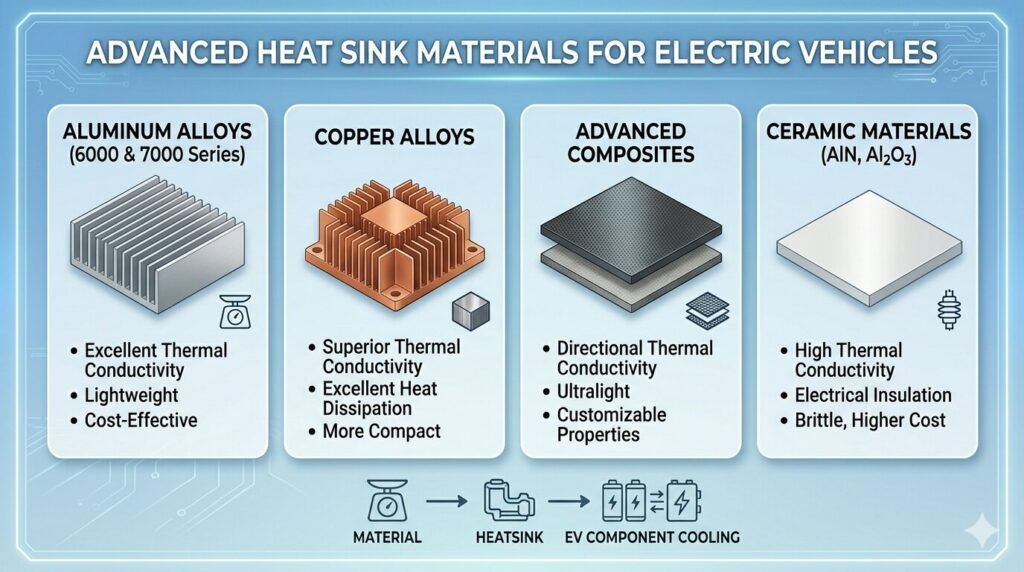
Common Heat Sink Materials Used in EV Industry
1. Aluminum Heat Sink Materials
Aluminum remains one of the most widely used materials in EV cooling systems.
Advantages:
- Lightweight
- Good thermal conductivity
- Corrosion resistant
- Cost-effective
- Easy extrusion and machining
Common Grades:
- Aluminum 6061
- Aluminum 6063
- Aluminum 1050
Applications:
- Battery cooling plates
- LED cooling systems
- Electronic enclosures
- Power converters
2. Copper Heat Sink Materials
Copper offers superior thermal conductivity compared to aluminum.
Advantages:
- Excellent heat transfer
- High thermal efficiency
- Better performance under extreme loads
- Reliable for compact designs
Limitations:
- Heavier than aluminum
- Higher cost
Applications:
- High-power inverters
- Fast charging systems
- Critical thermal hotspots
- Advanced EV power electronics
DOMADIA™ supplies precision copper materials for high-efficiency EV cooling applications where performance cannot be compromised.
3. Copper Tungsten Composites
Copper tungsten combines thermal conductivity with dimensional stability.
Advantages:
- Excellent thermal management
- Low thermal expansion
- Arc resistance
- High-temperature durability
Applications:
- Power modules
- Semiconductor cooling
- High-voltage EV systems
4. Graphite Heat Spreaders
Graphite materials are increasingly used in advanced EV electronics.
Advantages:
- Ultra-lightweight
- Excellent in-plane thermal conductivity
- Thin profile
- Flexible design compatibility
Applications:
- Compact battery modules
- Consumer EV electronics
- Thin thermal interfaces
5. Beryllium Copper Components
Beryllium copper provides both conductivity and mechanical strength.
Advantages:
- High fatigue resistance
- Excellent conductivity
- Spring properties
- Corrosion resistance
Applications:
- EV connectors
- High-current terminals
- Battery contact systems
Chemical Composition of Popular EV Heat Sink Materials
Aluminum 6063
| Element | Composition |
| Aluminum | Balance |
| Magnesium | 0.45–0.9% |
| Silicon | 0.2–0.6% |
| Iron | 0.35% max |
Copper C11000
| Element | Composition |
| Copper | 99.9% min |
| Oxygen | 0.04% max |
Copper Tungsten
| Element | Composition |
| Copper | 10–40% |
| Tungsten | Balance |
Properties of EV Heat Sink Materials
Thermal Properties
| Material | Thermal Conductivity |
| Copper | ~400 W/mK |
| Aluminum | ~205 W/mK |
| Copper Tungsten | 180–250 W/mK |
| Graphite | Up to 1500 W/mK (in-plane) |
Mechanical Properties
Important characteristics include:
- Strength-to-weight ratio
- Thermal expansion stability
- Vibration resistance
- Fatigue resistance
- Machinability
Technical Specifications Required by EV Manufacturers
Modern EV OEMs often require materials with:
| Parameter | Typical Requirement |
| Thermal Conductivity | High |
| Density | Low |
| Corrosion Resistance | Excellent |
| Surface Finish | Precision grade |
| Flatness | Tight tolerance |
| Electrical Conductivity | Application dependent |
DOMADIA™ provides customized thermal management materials according to project-specific requirements.
Standards Followed in EV Heat Sink Manufacturing
International Standards
ASTM Standards
- ASTM B152 (Copper Sheets)
- ASTM B209 (Aluminum Sheets)
- ASTM B702 (Copper Tungsten)
ISO Standards
- ISO 9001
- ISO 14001
Automotive Standards
- IATF 16949
- RoHS Compliance
- REACH Compliance
These standards ensure material consistency, safety, reliability, and global compatibility.
Shapes Available for Heat Sink Materials
DOMADIA™ supplies heat sink materials in multiple engineered forms.
Available Shapes:
- Sheets
- Plates
- Foils
- Rods
- Bars
- Tubes
- Extrusions
- Precision machined parts
- Custom fabricated assemblies
Custom dimensions and thermal solutions are available for EV manufacturers and component suppliers.
The Shift Toward Advanced Cooling Technologies
EV Manufacturers are no longer treating cooling systems as secondary components in electric vehicles. As battery capacities increase and ultra-fast charging becomes more common, efficient heat dissipation is now considered a core factor in vehicle reliability, charging speed, and battery lifespan.
Today’s industry mindset is simple: “Better thermal management equals better battery performance.” This shift is significantly increasing the demand for advanced EV Heat Sink Materials used in liquid cooling plates, vapor chambers, thermal interface systems, and hybrid copper-aluminum cooling assemblies.
Modern EV Heat Sink Materials are engineered to handle rising thermal loads while maintaining lightweight construction and long-term stability. As EV power density continues increasing, thermal engineering is rapidly becoming a major competitive advantage for automotive manufacturers focused on performance, safety, and energy efficiency.
Why DOMADIA™ for EV Heat Sink Materials?
Extensive Material Expertise
DOMADIA™ supplies advanced thermal management materials for demanding industrial applications.
Precision Manufacturing
Strict dimensional accuracy and consistent material quality.
Custom Engineering Support
Tailored solutions for EV manufacturers, battery manufacturers, and power electronics companies.
Wide Material Portfolio
- Copper alloys
- Aluminum alloys
- Copper tungsten
- Precision foils
- High conductivity metals
Reliable Global Supply
Fast and dependable deliveries for critical manufacturing schedules.
Quality Compliance
Materials supplied according to international industry standards.
Sustainability Advantage of Long-Life Thermal Materials
Long-lasting heat sink materials reduce frequent replacements, material wastage, recycling energy consumption, and unexpected production downtime. In modern electric mobility systems, durable EV Heat Sink Materials help manufacturers improve operational efficiency while lowering long-term maintenance costs and environmental impact.
Efficient thermal management solutions also contribute directly to sustainable EV manufacturing. High-performance EV Heat Sink Materials maintain stable cooling performance for extended periods, reducing the need for repeated scrapping, recycling, and component replacement across battery systems and power electronics.
The longer a thermal solution performs reliably, the lower the environmental burden associated with raw material processing, transportation, and industrial waste generation. This makes advanced thermal materials an important part of the EV industry’s move toward cleaner and more sustainable manufacturing practices. lower the environmental impact associated with repeated manufacturing and recycling cycles.
Conclusion
EV Heat Sink Materials are becoming one of the most critical elements in electric vehicle performance, safety, and efficiency. As EV charging speeds increase and battery systems become more compact, managing heat effectively is now essential for maintaining stable performance, protecting sensitive electronics, and extending battery life.
Modern manufacturers are heavily investing in advanced EV Heat Sink Materials that offer superior thermal conductivity, lightweight design, corrosion resistance, and long-term operational reliability. These materials help improve charging efficiency, reduce thermal stress, and support higher energy density in next-generation electric vehicles.
The future of electric mobility depends heavily on smarter thermal management systems. Industries are now prioritizing sustainable cooling solutions that combine performance, durability, and energy efficiency for modern EV architectures.
DOMADIA™ continues supporting the EV industry with engineered thermal management materials designed for demanding electric mobility applications where reliability, cooling performance, and advanced material engineering play a critical role.
Heat Sink Materials for EV Industry: Powering the Future of Electric Mobility
Boost EV performance with advanced thermal management solutions fromDOMADIA™.
Contact DOMADIA™ today to find the right Heat Sink Material solution for your EV application.
Talk to: Er.Pankaj Domadia | Kairav Domadia | Aadil Domadia | Pragati Sanap | Pooja N N
#EVIndustry #HeatSinkMaterials #ElectricVehicles #BatteryCooling #ThermalManagement #CopperAlloys #AluminumHeatSink #DOMADIA #EVTechnology #SustainableMobility
Directly whatsapp us for an Enquiry: https://wa.link/kairav
We’ve supplied to Mumbai, Pune, Indore, Jaipur, and Surat—serving industries across Maharashtra, Madhya Pradesh, Rajasthan, Gujarat, and Goa, with exports to Germany, USA, Japan, South Korea, and Italy.