Blogs

Faraday Fabric Thickness: Understanding What Really Makes Shielding Effective
Many engineers, manufacturers, and electronics specialists assume that thicker shielding fabric automatically provides better electromagnetic protection. While Faraday Fabric Thickness certainly influences mechanical durability, it is only one part of the overall shielding equation. Understanding the right Faraday Fabric Thickness is therefore essential when selecting material for a specific EMI or RF shielding application.
Effective EMI and RF shielding depends on several factors, including the conductive material, weave structure, frequency range, electrical conductivity, grounding, installation quality, and the number of shielding layers. Consequently, choosing the greatest Faraday Fabric Thickness does not always result in the highest shielding effectiveness.
Whether you’re designing military equipment, laboratory enclosures, secure communication rooms, medical devices, or industrial electronics, selecting the proper Faraday fabric requires understanding how thickness interacts with these other critical parameters.
At DOMADIA™, we help industries select high-performance Faraday fabrics that deliver dependable shielding for demanding applications across multiple sectors.
What Is Faraday Fabric?
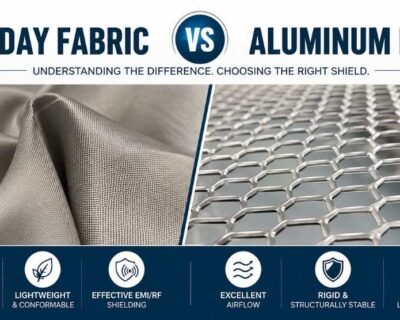
Faraday fabric is a conductive textile manufactured using metal-coated fibers, stainless steel fibers, silver-plated yarns, nickel-coated materials, copper blends, or hybrid conductive fabrics. The appropriate Faraday Fabric Thickness can help support reliable shielding performance while maintaining the flexibility required for different applications.
When properly installed, the fabric forms a conductive barrier that helps reduce electromagnetic interference (EMI), radio frequency interference (RFI), and unwanted signal leakage.
Does Thicker Always Mean Better Shielding?
The simple answer is:
No.
Many high-performance Faraday fabrics achieve outstanding shielding effectiveness while remaining lightweight and flexible.
A thinner fabric made with highly conductive materials may outperform a much thicker fabric that has lower electrical conductivity.
Therefore, material quality is generally more important than thickness alone.
9 Essential Facts About Faraday Fabric Thickness

1. Conductivity Is More Important Than Thickness
Shielding performance depends primarily on electrical conductivity, while Faraday Fabric Thickness also plays an important role in selecting suitable material for specific applications.
Highly conductive silver, copper, or nickel coatings often provide better attenuation than thicker, non-optimized fabrics.
2. Frequency Determines Fabric Requirements
Different electromagnetic frequencies interact differently with shielding materials.
Lower frequencies may require additional design considerations, while higher frequencies can often be effectively shielded using relatively thin conductive fabrics.
3. Multiple Layers Can Improve Performance
Instead of using one extremely thick fabric, many applications achieve better results by using multiple conductive layers with proper installation techniques.
Layering can improve overall attenuation while maintaining flexibility.
4. Mechanical Strength Increases With Thickness
Although shielding may not improve dramatically, thicker fabrics generally provide:
- Better tear resistance
- Higher abrasion resistance
- Improved durability
- Longer operational life
This makes thicker materials attractive for industrial environments.
5. Flexibility May Decrease
Very thick conductive fabrics become:
- Less flexible
- Harder to sew
- More difficult to wrap around complex equipment
- Less suitable for wearable applications
Balancing flexibility and protection is often essential.
6. Grounding Plays a Major Role
Even the greatest Faraday Fabric Thickness may deliver poor shielding performance without proper grounding.
Correct electrical grounding allows unwanted electromagnetic energy to dissipate effectively instead of remaining within the enclosure.
7. Installation Quality Affects Performance
Poor installation can create:
- Gaps
- Loose seams
- Openings
- Improper overlaps
These weaknesses allow EMI leakage regardless of the fabric thickness.
8. Application Environment Matters
Indoor electronics, military shelters, laboratories, medical facilities, aerospace systems, and industrial machinery all require different shielding approaches.
Therefore, selecting the right Faraday Fabric Thickness should always depend on the specific operating environment and shielding requirements.
9. International Testing Is the Best Indicator
Rather than relying solely on Faraday Fabric Thickness specifications, engineers should evaluate shielding effectiveness using internationally recognized testing standards.
Measured shielding performance provides a far more reliable indication of real-world effectiveness.
Typical Thickness Range
Most industrial Faraday fabrics are manufactured in relatively thin constructions while still delivering excellent shielding effectiveness.
Depending on the material and application, thickness generally ranges from:
- Ultra-light shielding fabrics
- Flexible industrial shielding textiles
- Heavy-duty reinforced conductive fabrics
The correct choice depends on the required mechanical strength and shielding performance rather than thickness alone.
Chemical Composition
Faraday fabrics may include combinations of:
- Silver-plated fibers
- Nickel-coated fibers
- Copper-coated yarns
- Stainless steel fibers
- Polyester conductive textiles
- Nylon conductive fibers
- Carbon-based conductive materials
- Hybrid conductive composites
Material selection directly affects conductivity, corrosion resistance, flexibility, and long-term durability.
Properties of Faraday Fabric

High EMI Shielding
Proper Faraday Fabric Thickness helps reduce electromagnetic interference across a broad range of applications.
Excellent RF Attenuation
Minimizes unwanted radio frequency transmission.
High Electrical Conductivity
Provides an efficient conductive path for shielding performance.
Lightweight Construction
Suitable for portable and flexible shielding solutions.
Excellent Flexibility
Suitable Faraday Fabric Thickness can conform to complex shapes and equipment.
Corrosion Resistance
Maintains reliable performance in challenging environments.
Good Mechanical Strength
Resists repeated handling and industrial use.
Anti-Static Performance
Helps control electrostatic discharge.
Easy Fabrication
Can often be sewn, laminated, or integrated into shielding assemblies.
Long Service Life
Properly selected conductive fabrics offer dependable long-term performance.
Technical Specifications
| Property | Typical Information |
| Material Type | Conductive Textile |
| Conductive Coating | Silver, Copper, Nickel, Stainless Steel |
| Shielding Function | EMI / RF Shielding |
| Construction | Woven / Knitted / Hybrid |
| Flexibility | High |
| Conductivity | Excellent |
| Corrosion Resistance | Good to Excellent |
| Temperature Resistance | Depends on material system |
| Available Forms | Rolls, Sheets, Cut Pieces |
| Custom Fabrication | Available |
Available Shapes
DOMADIA™ supplies Faraday fabrics in multiple forms, including:
- Fabric Rolls
- Cut Sheets
- Custom Die-Cut Parts
- Shielding Curtains
- Flexible Covers
- Conductive Tapes
- Laminated Shielding Materials
- Custom Fabric Components
Applications

EMI Shielding Enclosures
Proper Faraday Fabric Thickness helps protect sensitive electronic systems from electromagnetic interference.
RF Shielded Rooms
Used in secure communication and testing environments.
Military Equipment
Suitable Faraday Fabric Thickness supports reliable electromagnetic protection in defense applications.
Medical Equipment
Proper Faraday Fabric Thickness helps reduce electromagnetic disturbances around critical healthcare devices.
Research Laboratories
Maintain controlled testing environments for precision instruments.
Industrial Electronics
Suitable Faraday Fabric Thickness helps shield automation and control systems from EMI.
Data Centers
Proper Faraday Fabric Thickness helps reduce electromagnetic noise around sensitive equipment.
Wearable Shielding Products
Suitable Faraday Fabric Thickness is used in specialized protective garments and accessories.
Aerospace Systems
Support reliable shielding for avionics and aerospace electronics.
Telecommunication Equipment
Optimized Faraday Fabric Thickness helps improve signal integrity and reduce unwanted interference.
Relevant Standards
Depending on the application, Faraday fabrics may be evaluated using internationally recognized standards such as:
- ASTM testing methods
- IEEE EMC guidelines
- IEC EMC standards
- MIL-STD electromagnetic compatibility requirements
- ISO quality management systems
- RoHS compliance
- REACH compliance
Applicable standards vary based on the specific product and end-use requirements.
Why Choose DOMADIA™?
Selecting the correct Faraday fabric requires more than simply choosing the thickest material. At DOMADIA™, we help customers identify the right balance between shielding effectiveness, flexibility, durability, and application requirements.
Our advantages include:
- High-quality conductive materials
- Reliable industrial-grade shielding fabrics
- Multiple material options
- Custom sizes and fabrication
- International quality standards
- Technical support for material selection
- Global supply capabilities
- Consistent product quality
Conclusion
Faraday Fabric Thickness is an important consideration, but it is not the only factor that determines shielding effectiveness. Electrical conductivity, material composition, installation quality, grounding, frequency range, and overall design all contribute to reliable EMI and RF protection.
Choosing a fabric based solely on thickness may lead to unnecessary cost without improving shielding performance. Selecting the appropriate conductive material for the intended application delivers better long-term results.
At DOMADIA™, we supply premium Faraday fabrics designed to meet demanding industrial, scientific, aerospace, defense, medical, and electronics applications with dependable shielding performance.
Choose the Right Faraday Fabric for Maximum EMI & RF Shielding
DOMADIA™ supplies high-quality Faraday fabrics engineered to meet demanding industrial, defense, aerospace, medical, and electronics requirements.
Contact DOMADIA™ today to find the ideal Faraday fabric solution for your project.
Talk to: Er.Pankaj Domadia | Kairav Domadia | Aadil Domadia | Pragati Sanap | Pooja N N
#FaradayFabric #FaradayFabricThickness #EMIShielding #RFShielding #ConductiveFabric #Electronics #IndustrialMaterials #ElectromagneticShielding #DOMADIA #Engineering
Directly whatsapp us for an Enquiry: https://wa.link/kairav
We’ve supplied to Ludhiana, Jalandhar, Amritsar, Patiala, and Bathinda, supporting Punjab, Haryana, Himachal Pradesh, Rajasthan, and Delhi, while shipping to USA, Canada, UK, Ireland, and Scotland.