Blogs
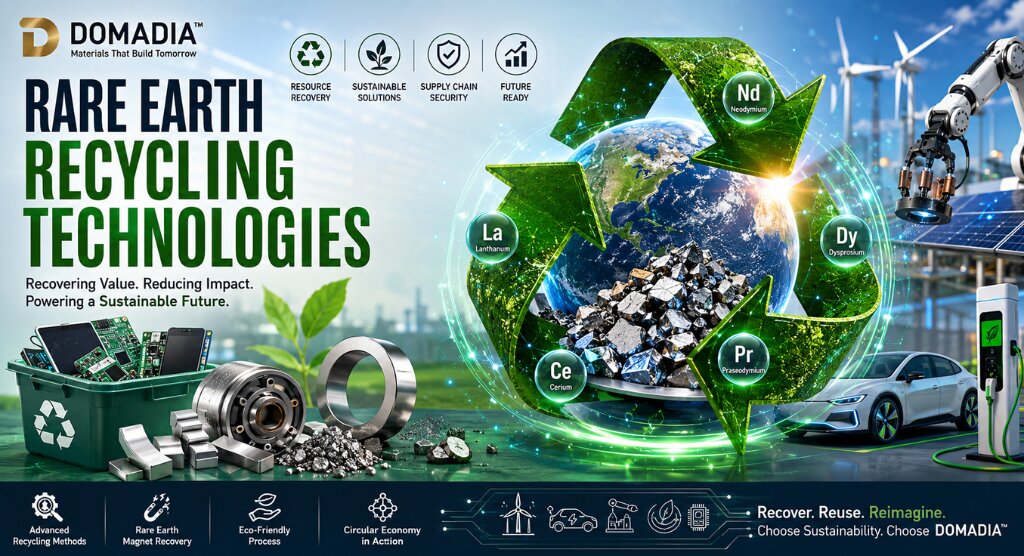
Rare Earth Recycling Technologies: 7 Powerful Innovations Driving Sustainability
A discarded electric vehicle battery, an outdated wind turbine magnet, and a retired smartphone may appear to be industrial waste. However, hidden inside these products are valuable rare earth elements that power modern technology.
As global demand for electric vehicles, renewable energy systems, aerospace equipment, electronics, and advanced manufacturing continues to accelerate, the importance of Rare Earth Recycling Technologies has never been greater.
Governments and industries worldwide are seeking ways to reduce dependence on newly mined resources while strengthening supply chain resilience. Rare Earth Recycling Technologies offer a practical solution by recovering valuable elements from end-of-life products and manufacturing scrap.
The future of critical mineral security may depend as much on recycling innovation as it does on mining expansion. As sustainability goals and resource security become increasingly important, Rare Earth Recycling Technologies are expected to play a critical role in supporting the next generation of clean energy, electronics, and advanced industrial applications.
What Are Rare Earth Elements?
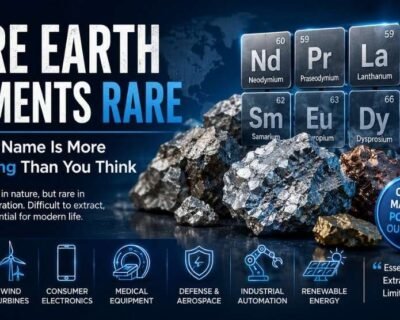
Rare earth elements (REEs) are a group of seventeen metallic elements widely used in advanced technologies due to their unique magnetic, electrical, and optical properties.
Common rare earth elements include:
- Neodymium (Nd)
- Praseodymium (Pr)
- Dysprosium (Dy)
- Terbium (Tb)
- Lanthanum (La)
- Cerium (Ce)
- Samarium (Sm)
- Yttrium (Y)
These elements are essential for:
- Permanent magnets
- Electric vehicles
- Wind turbines
- Aerospace systems
- Medical equipment
- Defense technologies
- Consumer electronics
- Semiconductor manufacturing
Despite their importance, rare earth extraction and processing remain concentrated in a limited number of regions, creating supply chain vulnerabilities.
Why Rare Earth Recycling Matters
Several factors are driving increased investment in recycling technologies.
Supply Chain Security
Recycling creates alternative sources of critical materials, reducing dependence on imported raw materials.
Environmental Benefits
Recovering rare earths from existing products reduces:
- Mining activities
- Land disturbance
- Water consumption
- Energy usage
- Waste generation
Economic Value
Rare earth elements often retain significant value even after products reach end-of-life.
Circular Economy Development
Recycling supports sustainable manufacturing by keeping valuable materials in circulation longer.
Chemical Composition of Common Recyclable Rare Earth Magnets
One of the most valuable recycling streams involves NdFeB permanent magnets.
Typical NdFeB Magnet Composition
| Element | Percentage (%) |
| Neodymium (Nd) | 25–35 |
| Iron (Fe) | 60–70 |
| Boron (B) | 1–2 |
| Dysprosium (Dy) | 0–8 |
| Praseodymium (Pr) | 0–10 |
| Other Additives | Balance |
These magnets are commonly recovered from:
- Electric vehicle motors
- Wind turbine generators
- Hard disk drives
- Industrial motors
- Robotics systems
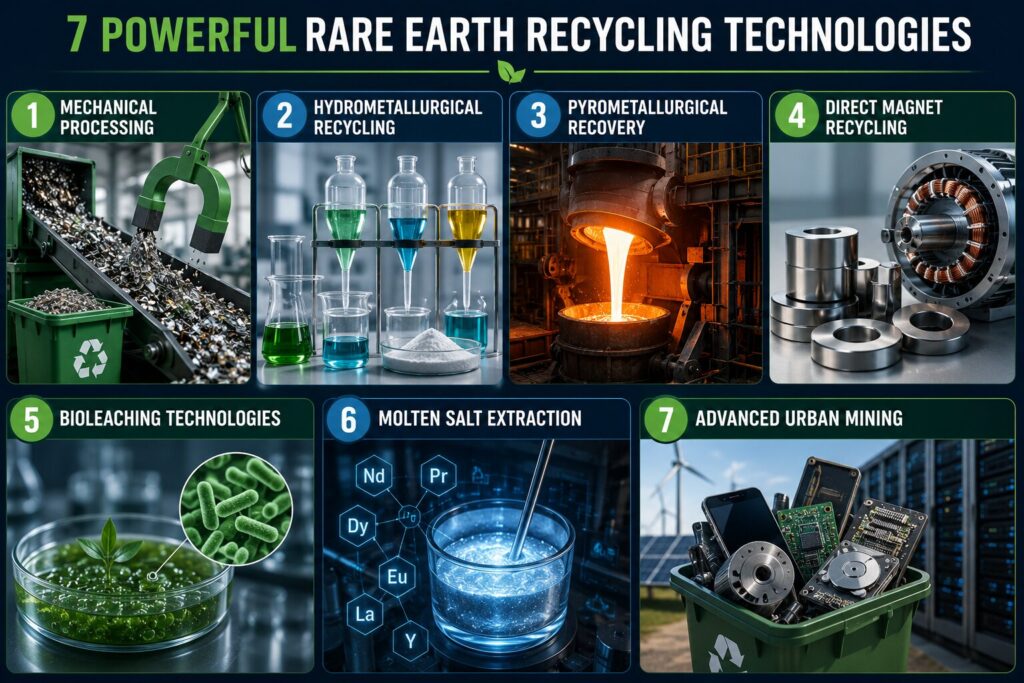
7 Powerful Rare Earth Recycling Technologies
1. Mechanical Processing
Mechanical recycling is often the first stage of material recovery within Rare Earth Recycling Technologies.
Processes include:
- Shredding
- Crushing
- Sorting
- Magnetic separation
Benefits:
- Cost-effective
- Scalable
- Reduces processing complexity
Applications:
- Electronic waste recycling
- Magnet recovery operations
- Pre-processing for rare earth material recovery systems
- Industrial scrap recycling facilities
- End-of-life clean energy component recycling
2. Hydrometallurgical Recycling
Rare Earth Recycling Technologies frequently utilize hydrometallurgical processes to recover valuable rare earth elements from end-of-life products and industrial waste streams. This method uses carefully controlled chemical solutions to dissolve, separate, and refine rare earth materials with high efficiency. The typical process involves acid leaching to extract the metals, followed by solvent extraction to separate individual elements. The recovered materials then undergo precipitation and purification stages to achieve the desired quality and composition.
One of the major advantages of hydrometallurgy within Rare Earth Recycling Technologies is its ability to achieve high recovery rates while producing exceptionally pure rare earth compounds. The technology is commercially proven and widely adopted across the recycling industry due to its scalability and effectiveness. Common applications include magnet recycling, battery recycling, and electronic waste processing, where valuable rare earth elements can be recovered and reintroduced into the manufacturing supply chain.
3. Pyrometallurgical Recovery
Rare Earth Recycling Technologies also utilize pyrometallurgical methods to recover valuable metals from complex waste streams. This approach relies on high-temperature processing to separate and concentrate rare earth elements and other valuable materials. Common techniques include smelting, roasting, and thermal decomposition, each designed to break down materials and facilitate metal recovery through controlled thermal treatment.
One of the key advantages of pyrometallurgy within Rare Earth Recycling Technologies is its ability to handle mixed and contaminated waste streams that may be difficult to process using other methods. It is also well-suited for large-scale industrial operations where significant volumes of material must be treated efficiently. However, these processes typically require substantial energy input, resulting in higher operating costs. Additionally, the recovered materials often require further refining and purification before they can be reused in advanced manufacturing applications. Rare Earth Recycling Technologies continue to integrate pyrometallurgical processes as part of comprehensive recycling systems that support resource recovery and supply chain sustainability.
4. Direct Magnet Recycling
IRare Earth Recycling Technologies are increasingly exploring direct recycling methods, which focus on restoring and reusing magnets rather than completely separating individual rare earth elements. This approach helps preserve the original material structure and value, making the recycling process more efficient. Direct recycling offers several advantages, including lower processing costs, reduced energy consumption, and the ability to retain much of the material’s performance characteristics. Common applications include electric motor magnets, wind turbine magnets, and industrial magnetic assemblies, where recovered magnets can often be refurbished and returned to service.
Another emerging approach is bioleaching, which utilizes naturally occurring microorganisms to extract valuable metals from waste materials. By leveraging biological processes instead of intensive chemical or thermal treatments, bioleaching offers a potentially sustainable pathway for recovering rare earth elements and other critical materials from electronic waste, industrial scrap, and end-of-life products.
5. Bioleaching Technologies
Researchers continue developing bacteria-based processes capable of recovering rare earth elements from electronic waste.
Benefits:
- Lower environmental impact
- Reduced chemical usage
- Improved sustainability
Although still developing, bioleaching shows significant future potential.
6. Molten Salt Extraction
Rare Earth Recycling Technologies are also advancing through molten salt recovery methods, which use high-temperature ionic liquids to selectively extract and recover rare earth elements from complex waste materials. These innovative processes offer several advantages, including high selectivity for targeted elements, reduced waste generation, and the potential for a lower environmental impact compared to some conventional recovery methods. As demand for sustainable resource management continues to grow, industries and research institutions are actively exploring commercialization opportunities for this advanced recycling approach to improve the efficiency and sustainability of critical mineral recovery.
7. Advanced Urban Mining
Urban mining focuses on recovering rare earth materials from existing products rather than extracting new resources from mines.
Key sources include:
- Smartphones
- Data center equipment
- Electric vehicle motors
- Consumer electronics
- Renewable energy systems
Urban mining is becoming a major pillar of modern resource sustainability strategies.
Key Properties Recovered Through Recycling
Effective recycling technologies preserve critical material properties.
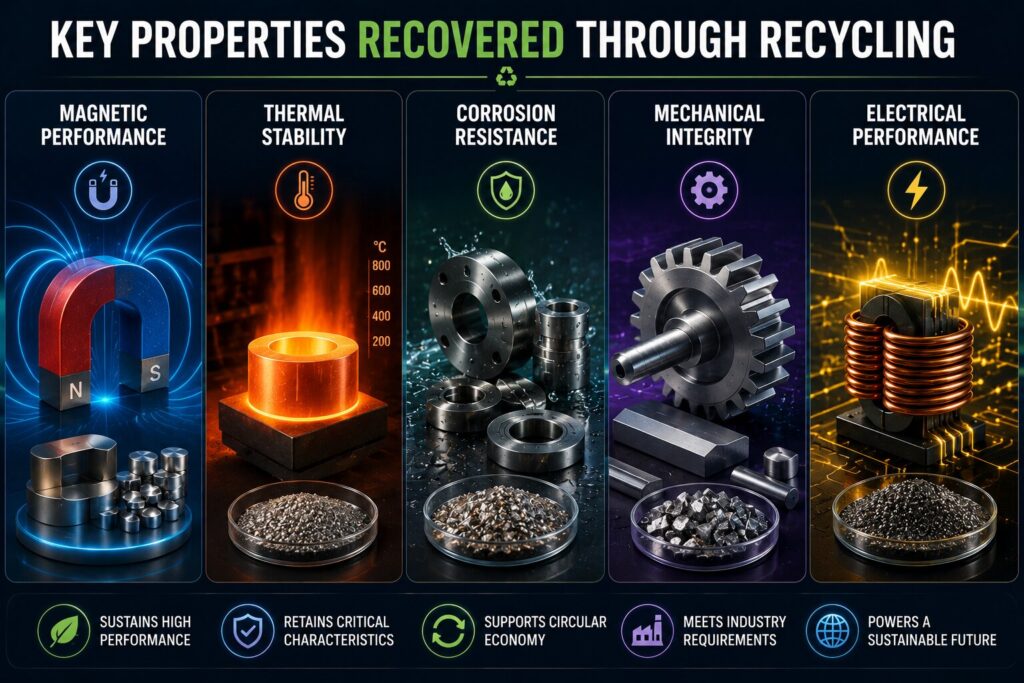
Magnetic Performance
Recovered rare earth magnets maintain high magnetic strength for demanding applications.
Thermal Stability
Materials recovered through Rare Earth Recycling Technologies can maintain reliable performance at elevated temperatures, supporting their use in demanding industrial and energy applications.
Corrosion Resistance
Materials recovered through Rare Earth Recycling Technologies can achieve excellent long-term environmental durability when proper refining and purification processes are applied.
Mechanical Integrity
Recovered materials can support manufacturing requirements across multiple industries.
Electrical Performance
Products recovered through Rare Earth Recycling Technologies often retain excellent electrical and electromagnetic properties, supporting their reuse in advanced technology applications.
Applications of Recycled Rare Earth Materials
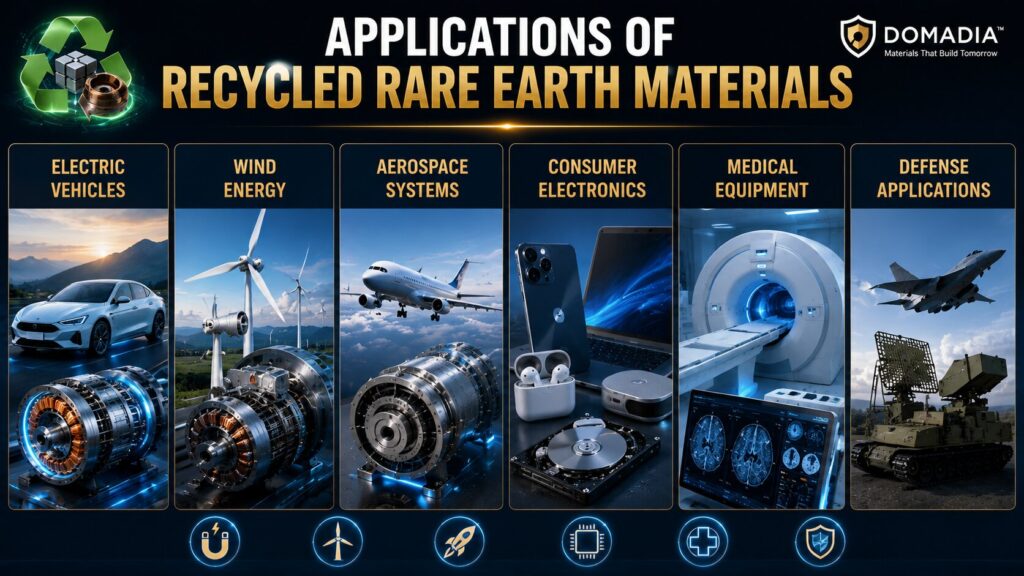
Electric Vehicles
Recovered rare earth magnets support sustainable EV motor production.
Wind Energy
Rare Earth Recycling Technologies help support the expansion of renewable energy infrastructure by supplying recovered materials for applications such as wind turbines, electric vehicles, and advanced energy systems.
Aerospace Systems
Advanced alloys and magnetic materials support critical aerospace technologies.
Consumer Electronics
Manufacturers increasingly incorporate recycled rare earths into smartphones, computers, and electronics.
Medical Equipment
High-performance magnets remain essential in diagnostic and imaging technologies.
Defense Applications
Strategic recycling programs help strengthen critical defense supply chains.
Industry Standards Supporting Rare Earth Recycling
Various international frameworks guide responsible recycling practices.
Common standards include:
ISO 14001
Environmental management systems.
ISO 9001
Quality management systems.
IEC Standards
Electronic equipment recycling guidance.
Responsible Minerals Initiative (RMI)
Promotes responsible sourcing and material traceability.
Circular Economy Regulations
Increasingly adopted across Europe, North America, and Asia.
Technical Specifications Considered During Recycling
Key parameters include:
| Parameter | Typical Requirement |
| Recovery Efficiency | 80–98% |
| Purity Levels | Up to 99.9% |
| Magnet Recovery Yield | High |
| Contamination Control | Critical |
| Material Traceability | Required |
| Environmental Compliance | Mandatory |
Forms and Shapes Available After Recycling
Recovered rare earth materials can be supplied as:
- Powders
- Granules
- Oxides
- Alloys
- Permanent Magnets
- Sintered Components
- Custom Engineered Shapes
These forms support multiple manufacturing processes and industrial applications.
Why DOMADIA™
DOMADIA™ supports industries that rely on advanced materials and critical metal supply chains.
What Sets DOMADIA™ Apart?
✔ Expertise in specialty metals and advanced alloys
✔ Strong understanding of rare earth material applications
✔ Focus on sustainable material sourcing
✔ Technical support for demanding engineering projects
✔ Reliable global sourcing network
✔ Quality-driven supply management
✔ Solutions for aerospace, electronics, energy, medical, and industrial sectors
As recycling becomes increasingly important within global manufacturing ecosystems, DOMADIA™ remains committed to supporting customers with advanced material knowledge and dependable supply solutions.
Conclusion
Rare Earth Recycling Technologies are rapidly becoming one of the most important pillars of sustainable manufacturing and resource security. As demand for electric vehicles, renewable energy systems, electronics, and advanced industrial technologies continues to grow, recycling will play a crucial role in reducing environmental impact while strengthening global supply chains.
Organizations that invest in recycling innovation today will be better positioned to secure critical materials, improve sustainability performance, and support long-term industrial growth. Through responsible material management and technological advancement, the future of rare earth supply is becoming increasingly circular, resilient, and environmentally responsible.
Ready to Build a More Sustainable Rare Earth Supply Chain?
Discover how DOMADIA™ can support your business with advanced material expertise, dependable sourcing, and industry-focused solutions for critical mineral applications.
Looking for reliable rare earth material solutions and expert guidance for your next project? Contact Our Team Today to discuss your requirements and discover how DOMADIA™ can support your business with sustainable material expertise.
Talk to: Er.Pankaj Domadia | Kairav Domadia | Aadil Domadia | Pragati Sanap | Pooja N N
#RareEarthRecycling #RareEarthElements #CriticalMinerals #Sustainability #CircularEconomy #UrbanMining #GreenTechnology #RenewableEnergy #AdvancedMaterials #DOMADIA
Directly whatsapp us for an Enquiry: https://wa.link/kairav
Our materials have reached Tiruppur, Erode, Salem, Namakkal, and Karur across Tamil Nadu, Karnataka, Kerala, Andhra Pradesh, and Telangana, with exports to Italy, Turkey, Tunisia, Morocco, and Algeria.