Blogs
Low Frequency Magnetic Shielding Guide: 9 Powerful Ways to Block Magnetic Interference
A medical imaging system suddenly begins producing inconsistent readings. Engineers inspect the electronics, software, and power supply but find no obvious fault. The real problem lies elsewhere—a nearby electrical transformer is generating magnetic fields that interfere with sensitive equipment.
This scenario highlights why Low Frequency Magnetic Shielding has become increasingly important across industries. As electronic systems become more sensitive and densely packed, even relatively weak magnetic fields can disrupt performance, reduce accuracy, and increase operational risks.
Unlike high-frequency electromagnetic interference, low-frequency magnetic fields are significantly more difficult to block. Traditional conductive shielding materials that perform well against radio-frequency interference often provide little protection against low-frequency magnetic disturbances.
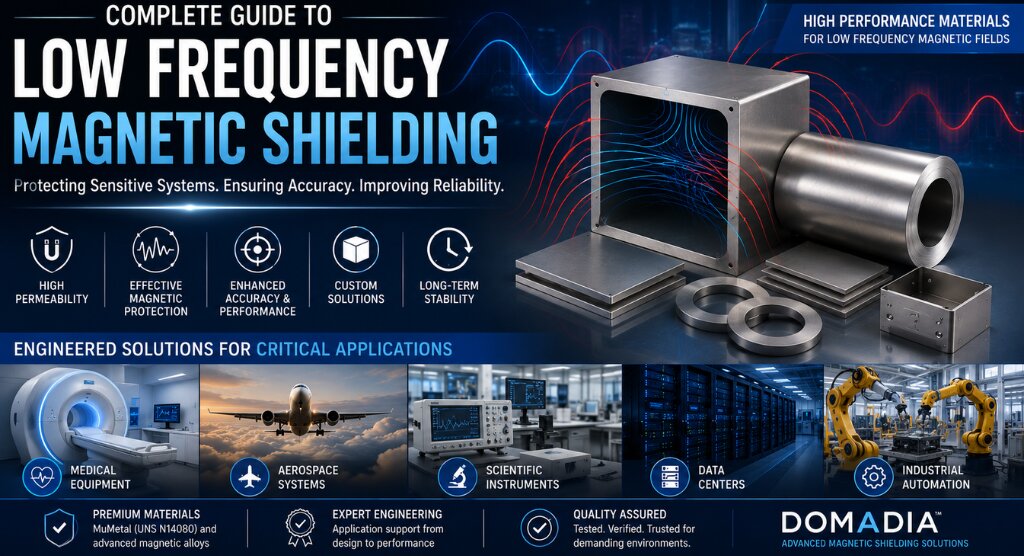
This comprehensive Low Frequency Magnetic Shielding guide explains how magnetic shielding works, which materials deliver the best performance, key standards, applications, properties, and how organizations can effectively protect critical equipment from unwanted magnetic interference.
What Is Low Frequency Magnetic Shielding?
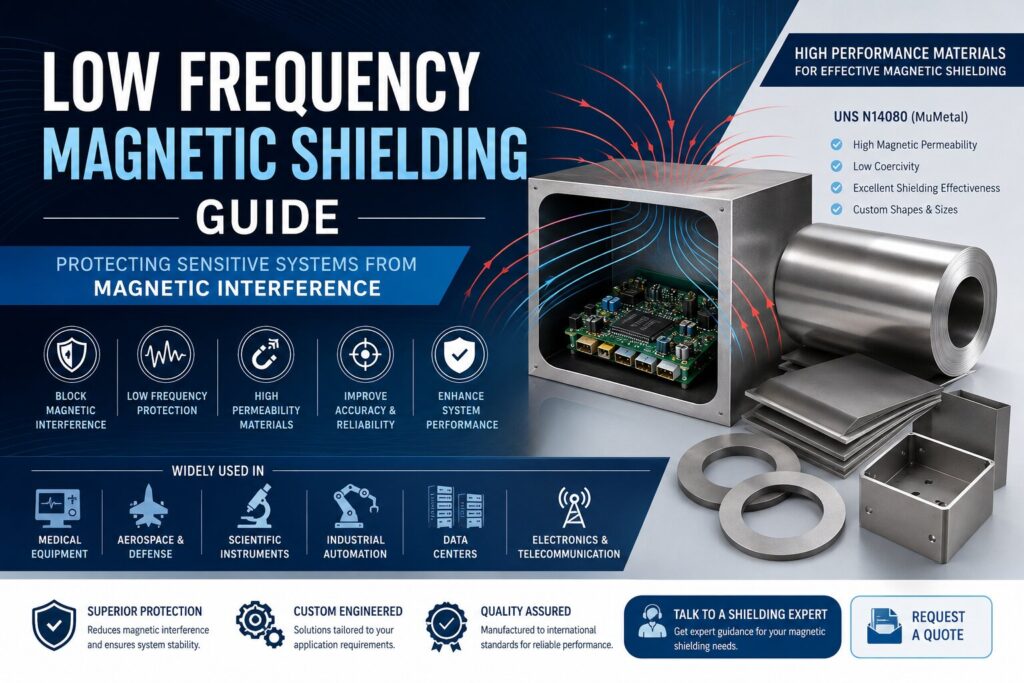
Low Frequency Magnetic Shielding refers to the process of reducing or redirecting low-frequency magnetic fields away from sensitive equipment.
These magnetic fields are commonly generated by:
- Power transformers
- Electrical motors
- Generators
- High-current busbars
- Power distribution systems
- Railway systems
- Industrial equipment
- Medical devices
Low-frequency magnetic fields generally occur below several kilohertz and often originate from power systems operating at 50 Hz or 60 Hz.
Unlike high-frequency EMI, which can often be reflected by conductive materials, Low Frequency Magnetic Shielding requires materials with extremely high magnetic permeability that can redirect magnetic flux away from protected components.
Why Low Frequency Magnetic Fields Are Challenging
Many engineers assume all EMI can be controlled using aluminum or copper enclosures. However, low-frequency magnetic fields behave differently.
Challenges include:
Deep Field Penetration
Low-frequency magnetic fields penetrate most conventional conductive materials with relative ease.
Large Field Sources
Industrial equipment often generates strong magnetic fields over considerable distances.
Sensitive Electronics
Modern electronics, sensors, imaging systems, and communication equipment have become increasingly susceptible to magnetic disturbances.
Complex Shield Design
Effective Low Frequency Magnetic Shielding often requires specialized materials, careful geometry, and proper installation techniques.
How Low Frequency Magnetic Shielding Works
The primary principle behind Low Frequency Magnetic Shielding is magnetic flux diversion.
Rather than blocking magnetic fields directly, high-permeability materials attract magnetic flux and provide an easier path for magnetic field lines.
As a result:
- Magnetic fields flow through the shielding material
- Sensitive equipment experiences significantly reduced exposure
- System reliability improves
- Measurement accuracy increases
This process is often referred to as magnetic flux shunting.
Chemical Composition of Common Magnetic Shielding Materials
MuMetal (UNS N14080)
One of the most widely used materials for Low Frequency Magnetic Shielding is MuMetal.
Typical composition:
| Element | Percentage |
| Nickel | 77% |
| Iron | 16% |
| Copper | 5% |
| Molybdenum | 2% |
This unique composition delivers exceptionally high magnetic permeability, making it highly effective for low-frequency shielding applications.
Key Properties of Low Frequency Magnetic Shielding Materials
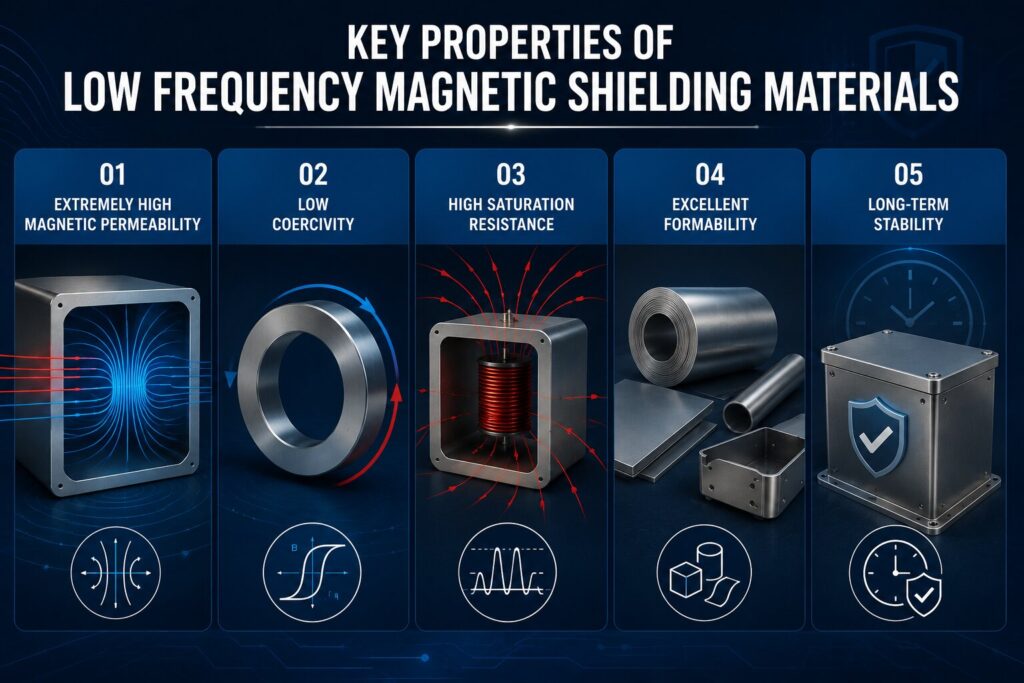
1. Extremely High Magnetic Permeability
The most important property in Low Frequency Magnetic Shielding is magnetic permeability.
High permeability enables the material to attract and redirect magnetic flux efficiently.
2. Low Coercivity
Low coercivity allows rapid magnetization and demagnetization.
This characteristic improves shielding effectiveness in changing magnetic environments.
3. High Saturation Resistance
Materials must withstand strong magnetic fields before becoming saturated.
4. Excellent Formability
Many shielding applications require complex enclosures, chambers, and custom geometries.
5. Long-Term Stability
Effective Low Frequency Magnetic Shielding materials maintain performance over extended operational periods.
Technical Specifications
Typical specifications for UNS N14080 MuMetal:
| Property | Typical Value |
| UNS Number | N14080 |
| Density | 8.7 g/cm³ |
| Magnetic Permeability | Up to 100,000+ |
| Curie Temperature | Approx. 430°C |
| Electrical Resistivity | 55 µΩ-cm |
| Hardness | Annealed Condition |
| Magnetic Saturation | Approximately 0.8 Tesla |
Actual values may vary depending on processing conditions and heat treatment.
Standards Related to Magnetic Shielding
Several international standards influence Low Frequency Magnetic Shielding performance and testing.
ASTM Standards
- ASTM A753
- ASTM A773
IEC Standards
- IEC 61000 Series
- IEC 62153
Military Standards
- MIL-DTL specifications
- MIL-STD EMI requirements
Medical Equipment Standards
- IEC 60601
- MRI shielding guidelines
Compliance with applicable standards helps ensure predictable shielding performance.
Shapes Available for Magnetic Shielding Materials
DOMADIA™ supplies materials suitable for various Low Frequency Magnetic Shielding requirements.
Common forms include:
Sheets
Used for cabinets, panels, and equipment enclosures.
Foils
Ideal for compact electronic systems.
Strips
Suitable for transformers and magnetic assemblies.
Coils
Efficient for large-volume fabrication.
Fabricated Enclosures
Custom shielding housings for electronics and instrumentation.
Precision Components
Designed for aerospace, medical, and defense applications.
Applications of Low Frequency Magnetic Shielding
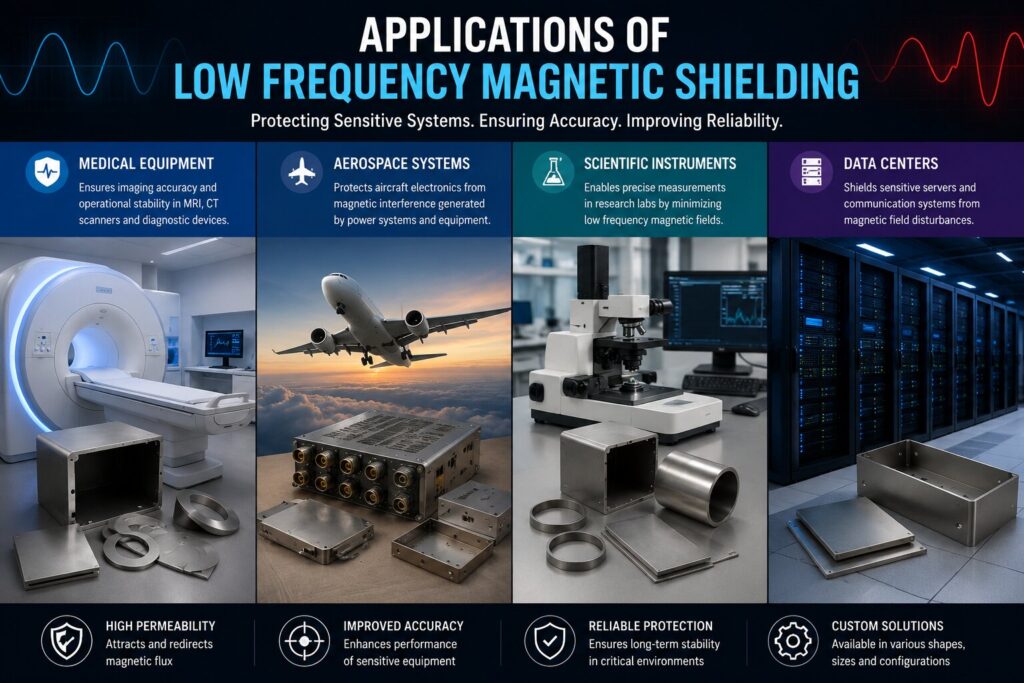
Medical Equipment
MRI systems, CT scanners, and diagnostic equipment require effective Low Frequency Magnetic Shielding to maintain imaging accuracy and operational stability.
Aerospace Systems
Aircraft electronics operate in environments containing numerous sources of electromagnetic interference.
Scientific Instruments
Research laboratories depend on shielding to achieve highly accurate measurements.
Data Centers
Sensitive servers and communication systems benefit from magnetic field protection.
Industrial Automation
Robotics, sensors, and precision manufacturing equipment often require magnetic shielding solutions.
Defense Electronics
Mission-critical systems rely on consistent electromagnetic performance under demanding conditions.
Semiconductor Manufacturing
Advanced semiconductor equipment requires exceptionally stable electromagnetic environments.
9 Powerful Ways to Improve Low Frequency Magnetic Shielding Performance
1. Select High-Permeability Materials
Material selection has the greatest influence on shielding performance.
2. Increase Shield Thickness
Additional material thickness can improve magnetic flux absorption.
3. Use Multiple Shield Layers
Layered shielding designs often outperform single-layer solutions.
4. Minimize Gaps
Openings and seams can significantly reduce effectiveness.
5. Maintain Proper Heat Treatment
Annealing helps restore magnetic properties after fabrication.
6. Optimize Shield Geometry
Proper enclosure design enhances field containment.
7. Control External Field Sources
Reducing magnetic field generation improves overall performance.
8. Validate Through Testing
Shielding effectiveness should always be verified.
9. Work With Experienced Suppliers
Proper material selection and fabrication significantly influence results.
Why DOMADIA™ for Low Frequency Magnetic Shielding?
Organizations across industries trust DOMADIA™ for advanced magnetic shielding solutions.
What Sets DOMADIA™ Apart?
✔ Extensive expertise in magnetic shielding materials
✔ High-quality UNS N14080 MuMetal solutions
✔ Precision fabrication capabilities
✔ Custom shielding designs
✔ International quality standards
✔ Technical application support
✔ Fast delivery and reliable supply chain
DOMADIA™ Product Solutions
- MuMetal Sheets
- MuMetal Foils
- Precision Shielding Components
- Magnetic Shielding Enclosures
- Custom Fabricated Assemblies
- Industrial Shielding Systems
Whether protecting medical imaging systems, aerospace electronics, laboratory instruments, or industrial automation equipment, DOMADIA™ delivers dependable Low Frequency Magnetic Shielding solutions engineered for long-term performance.
Future Trends in Low Frequency Magnetic Shielding
The global demand for advanced shielding materials continues to rise as industries adopt:
- Electric vehicles
- Smart factories
- Advanced medical systems
- AI-powered infrastructure
- High-density electronics
- Semiconductor manufacturing technologies
As electronic sensitivity increases, Low Frequency Magnetic Shielding will become even more critical for maintaining reliability, safety, and operational accuracy.
Conclusion
Low Frequency Magnetic Shielding plays a vital role in protecting modern electronics from magnetic interference generated by power systems, industrial equipment, and surrounding infrastructure.
By selecting appropriate materials, understanding shielding principles, following industry standards, and implementing proper design practices, organizations can dramatically improve equipment reliability and measurement accuracy. As industries continue embracing advanced technologies, investing in effective Low Frequency Magnetic Shielding solutions is no longer optional—it is a strategic requirement for long-term operational success. DOMADIA™ remains committed to providing high-performance magnetic shielding materials and engineered solutions that help customers overcome increasingly complex electromagnetic challenges.
Need Reliable Low Frequency Magnetic Shielding Solutions?
Protect your sensitive electronics, medical equipment, aerospace systems, and industrial devices with high-performance magnetic shielding materials fromDOMADIA™.
Talk to a Shielding Expert to receive personalized guidance on material selection, shielding design, and application-specific requirements.
Talk to: Er.Pankaj Domadia | Kairav Domadia | Aadil Domadia | Pragati Sanap | Pooja N N
#LowFrequencyMagneticShielding #MagneticShielding #MuMetal #UNSN14080 #EMIShielding #ElectronicsProtection #IndustrialShielding #AerospaceElectronics #MedicalEquipment #DOMADIATM
Directly whatsapp us for an Enquiry: https://wa.link/kairav
Our supply network spans Delhi, Noida, Gurugram, Faridabad, and Ghaziabad across Delhi NCR, Haryana, UP, Rajasthan, and Punjab, reaching clients in UAE, Saudi Arabia, Qatar, Oman, and Kuwait.