Blogs
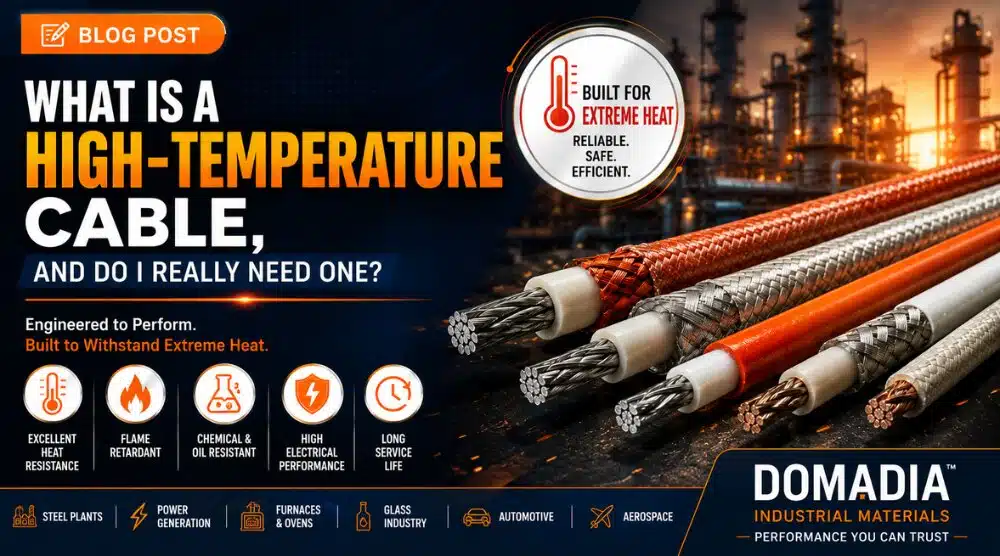
Heat Resistant Electrical Cable: What Is a High-Temperature Cable, and Do I Really Need One?
Electrical cables are often hidden behind machinery, inside control panels, or beneath insulation. Because they are rarely visible, they are also one of the most overlooked components in an electrical system. Yet, a cable operating beyond its temperature limit can become the weakest link in an otherwise reliable installation.
Many industries experience unexpected equipment shutdowns, insulation failures, short circuits, or even fire hazards simply because a standard cable was installed where extreme heat was present. Replacing damaged cables repeatedly increases maintenance costs, production downtime, and safety risks. Choosing the right Heat Resistant Electrical Cable helps prevent these issues by delivering dependable performance in demanding thermal environments.
This is where a Heat Resistant Electrical Cable becomes essential. Designed to withstand elevated temperatures while maintaining electrical performance, these cables help ensure reliable operation in demanding industrial environments.
The real question is not whether high-temperature cables exist—it is whether your application actually needs one. Understanding their construction, properties, and applications will help you make the right decision.
What Is a High-Temperature Cable?
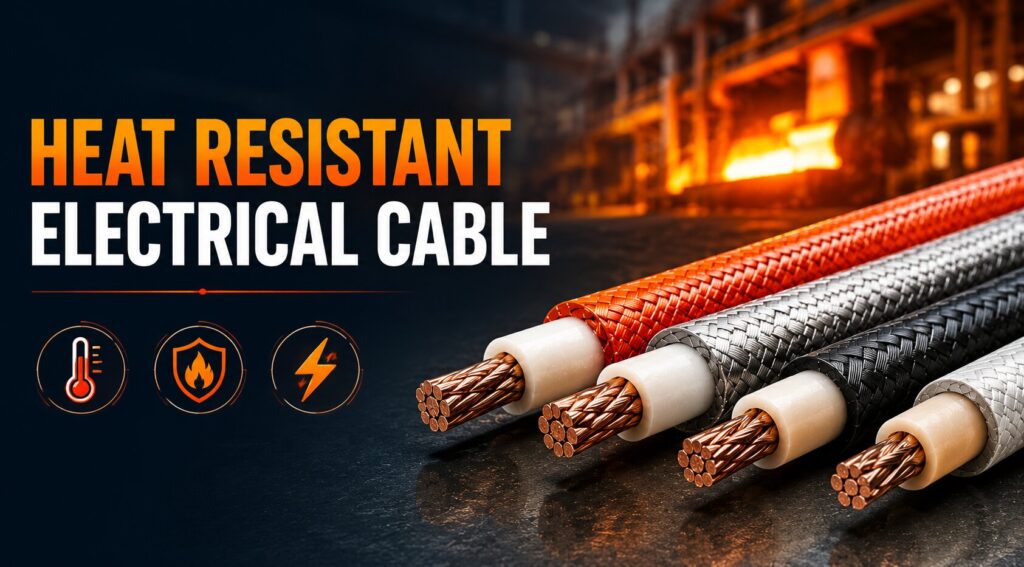
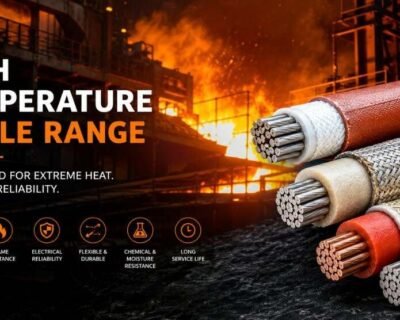
A Heat Resistant Electrical Cable is an electrical cable specifically engineered to operate safely at temperatures significantly higher than conventional PVC-insulated cables.
Instead of standard insulation materials, these cables use specialized compounds such as silicone rubber, fiberglass, PTFE (Teflon®), mica tape, ceramic fiber, or other advanced insulating materials capable of maintaining electrical integrity under extreme thermal conditions.
Depending on construction, some cables continuously operate at temperatures ranging from 150°C to over 1000°C while maintaining flexibility, insulation strength, and mechanical reliability.
A Heat Resistant Electrical Cable is widely used where excessive heat is unavoidable and system reliability cannot be compromised, making it an ideal solution for industrial furnaces, steel plants, glass manufacturing, aerospace, petrochemical facilities, and other demanding high-temperature environments..
How Do You Know If You Really Need One?
Many facilities continue using standard electrical cables until failures begin appearing.
Your application may require a high-temperature cable if it involves:
- Continuous temperatures above 90°C
- Furnaces or industrial ovens
- Steel and aluminum plants
- Glass manufacturing
- Heat treatment equipment
- Boilers
- Power generation systems
- Kilns
- Foundries
- High-temperature sensors
- Fire protection systems
- Industrial heating equipment
If standard cable insulation hardens, cracks, melts, or loses flexibility, upgrading to a cable designed for elevated temperatures becomes a practical necessity rather than an optional improvement.
Chemical Composition
The exact composition depends on the cable design and operating temperature. Typical constructions include:
Conductors
- Copper
- Tinned Copper
- Nickel-Plated Copper
- Silver-Plated Copper
- Nickel Conductors (for ultra-high temperatures)
Insulation Materials
- Silicone Rubber
- Fiberglass Braiding
- PTFE (Polytetrafluoroethylene)
- FEP
- Mica Tape
- Ceramic Fiber
- High-Temperature Glass Fiber
Outer Jacket
- Silicone
- Fiberglass
- PTFE
- Ceramic Coating
- Stainless Steel Braiding (special applications)
Each material is selected to maximize thermal stability, insulation performance, and service life.
Key Properties
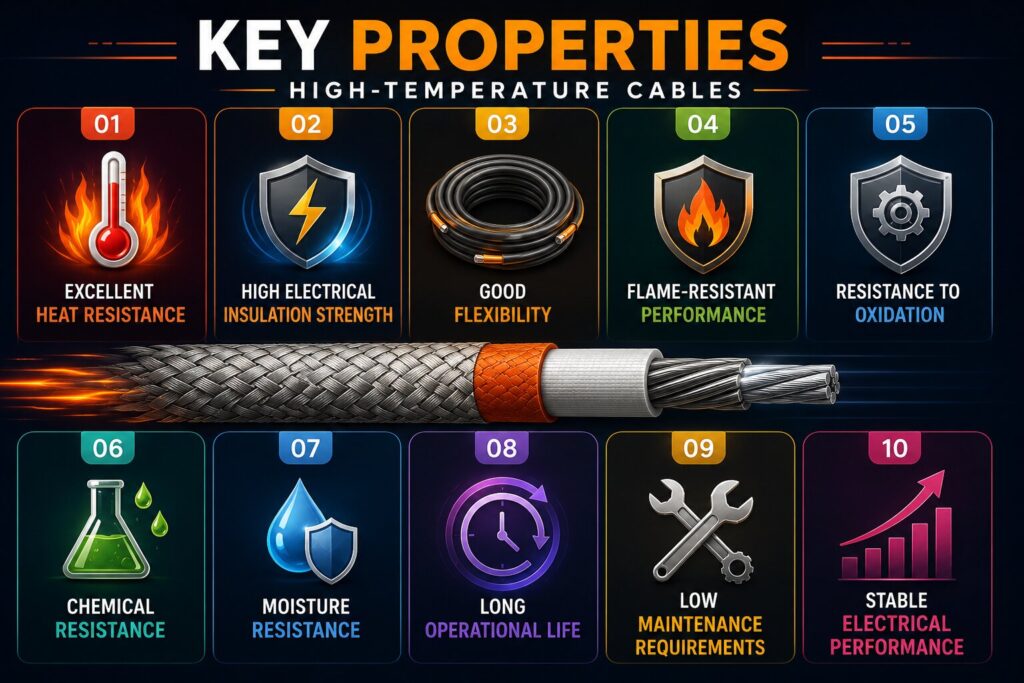
Excellent Heat Resistance
Designed to perform continuously under elevated temperatures without significant degradation of insulation properties.
High Electrical Insulation Strength
Maintains dependable dielectric performance, helping prevent leakage currents and electrical failures even in demanding environments, making a Heat Resistant Electrical Cable a reliable choice for critical industrial applications.
Good Flexibility
Many constructions remain flexible, simplifying installation in complex routing and confined industrial spaces, making a Heat Resistant Electrical Cable easier to install and maintain in demanding industrial environments.
Flame-Resistant Performance
Engineered to resist flame propagation, enhancing operational safety in critical electrical installations.
Resistance to Oxidation
Specialized insulation and conductor materials withstand prolonged exposure to hot air without rapid deterioration, ensuring a Heat Resistant Electrical Cable delivers reliable performance and extended service life in high-temperature environments.
Chemical Resistance
Many designs resist oils, fuels, solvents, acids, and industrial chemicals commonly encountered in manufacturing environments.
Moisture Resistance
Protects electrical performance even where humidity, condensation, or occasional water exposure is present.
Long Operational Life
High-quality insulation systems significantly extend the service life of a Heat Resistant Electrical Cable, ensuring reliable performance under continuous thermal stress and reducing maintenance requirements.
Low Maintenance Requirements
Reliable construction reduces unexpected cable failures, minimizing maintenance frequency and production interruptions.
Stable Electrical Performance
Maintains consistent electrical characteristics even during prolonged operation at elevated temperatures.
Technical Specifications
Typical specifications include:
| Parameter | Typical Range |
| Continuous Operating Temperature | 150°C to 1000°C+ |
| Voltage Rating | 300V to 15kV+ |
| Conductor Material | Copper, Nickel-Plated Copper, Silver-Plated Copper |
| Insulation | Silicone, PTFE, Fiberglass, Ceramic |
| Flame Rating | Flame Retardant / Fire Resistant |
| Flexibility | High |
| Chemical Resistance | Excellent |
| Moisture Resistance | Excellent |
| RoHS Compliance | Available |
| Custom Construction | Available |
Specifications vary according to application requirements.
Industry Standards
Depending on application, high-temperature cables may comply with:
- IEC Standards
- BS Standards
- ASTM Standards
- UL Standards
- CSA Standards
- DIN Standards
- RoHS Compliance
- REACH Compliance
- CE Requirements
- ISO Manufacturing Systems
Selecting cables manufactured according to recognized international standards improves long-term reliability and regulatory compliance.
Applications
High-temperature cables are used across numerous industries where conventional wiring cannot withstand operating conditions.
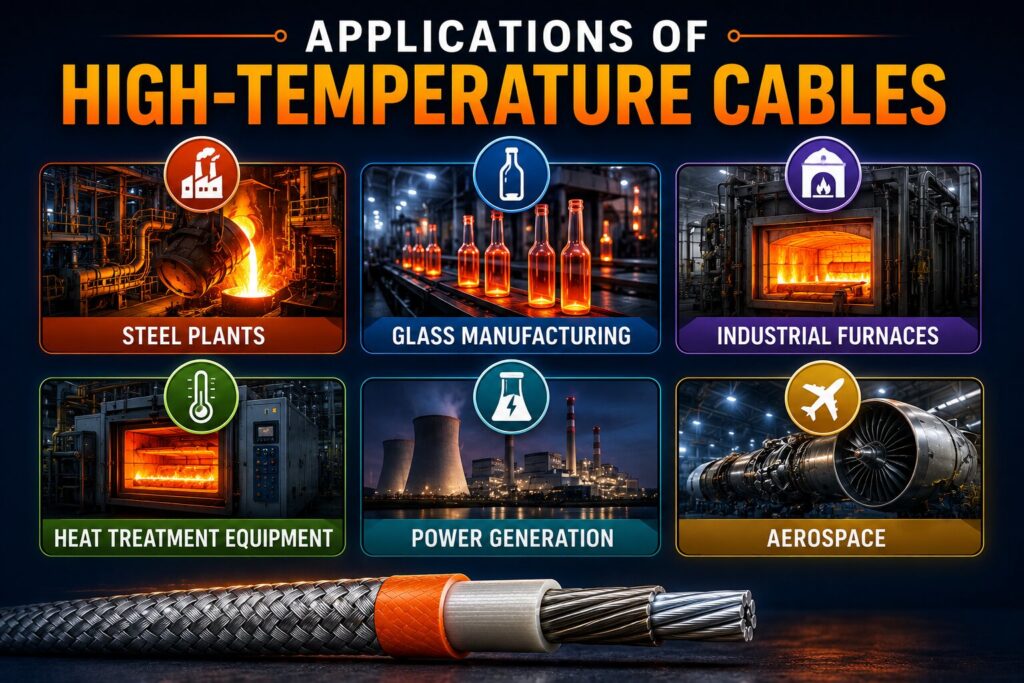
Steel Plants
Reliable electrical connections near furnaces, rolling mills, and reheating systems, where a Heat Resistant Electrical Cable ensures consistent performance under continuous high-temperature conditions.
Glass Manufacturing
Suitable for continuous exposure to radiant heat around glass production equipment, where a Heat Resistant Electrical Cable delivers reliable insulation and consistent electrical performance in extreme thermal environments.
Industrial Furnaces
Supports heaters, temperature sensors, and power distribution in high-temperature processing.
Heat Treatment Equipment
Maintains stable electrical performance during repeated thermal cycling, making a Heat Resistant Electrical Cable ideal for applications exposed to frequent heating and cooling cycles.
Power Generation
Used around boilers, turbines, and auxiliary systems exposed to elevated temperatures, where a Heat Resistant Electrical Cable provides reliable electrical performance and long-term durability.
Aerospace
Supports engine testing, thermal chambers, and specialized electrical systems, where a Heat Resistant Electrical Cable provides reliable electrical performance under continuous high-temperature operating conditions.
Automotive Manufacturing
Ideal for robotic welding cells, paint curing ovens, and heat-processing lines.
Petrochemical Industry
Performs reliably in chemically aggressive and high-temperature environments, where a Heat Resistant Electrical Cable provides long-lasting electrical performance, excellent insulation stability, and resistance to thermal and chemical degradation.
Fire Protection Systems
Designed to continue functioning during emergency conditions where cable integrity is critical.
Semiconductor Manufacturing
Provides dependable electrical performance in precision thermal processing equipment, where a Heat Resistant Electrical Cable ensures stable operation, reliable insulation, and consistent performance under elevated temperatures.
Shapes and Constructions Available
DOMADIA™ supplies high-temperature cable solutions in multiple configurations, including:
- Single Core Cables
- Multi-Core Cables
- Shielded Cables
- Braided Cables
- Fiberglass Insulated Cables
- Silicone Rubber Cables
- PTFE Insulated Cables
- Thermocouple Cables
- Heating Element Leads
- Custom Engineered Cable Assemblies
Custom conductor sizes, insulation systems, shielding, and temperature ratings can be manufactured according to application requirements.
Why Choose DOMADIA™?
Selecting the right cable supplier is just as important as selecting the right cable.
DOMADIA™ supports industries requiring reliable high-temperature electrical solutions by offering:
- Extensive product range
- Premium-quality raw materials
- International manufacturing standards
- Custom-engineered cable solutions
- Technical material guidance
- Consistent product quality
- Reliable global supply capabilities
- Industrial application expertise
- Competitive pricing
- Responsive customer support
Whether your application involves extreme heat, harsh industrial environments, or mission-critical electrical systems, DOMADIA™ provides dependable solutions designed for long-term performance.
Conclusion
Choosing the correct Heat Resistant Electrical Cable is not simply about handling higher temperatures—it is about protecting equipment, reducing maintenance, improving operational safety, and extending service life. While standard cables perform well under normal operating conditions, demanding industrial environments require insulation systems specifically engineered for continuous thermal exposure.
Investing in the right cable today helps prevent costly failures tomorrow. By partnering with DOMADIA™, industries gain access to high-performance cable solutions that combine reliability, quality, and technical expertise for even the most challenging applications.
Need a High-Temperature Cable You Can Trust?
Protect your equipment from extreme heat with DOMADIA™High-Temperature Cables—engineered for superior thermal resistance, long service life, and dependable electrical performance in the most demanding industrial environments.
Get expert guidance today and find the right cable solution for your application.
Talk to: Er.Pankaj Domadia | Kairav Domadia | Aadil Domadia | Pragati Sanap | Pooja N N
#RareEarthRecycling #RareEarthElements #CriticalMinerals #Sustainability #CircularEconomy #UrbanMining #GreenTechnology #RenewableEnergy #AdvancedMaterials #DOMADIA
Directly whatsapp us for an Enquiry: https://wa.link/kairav
From Ahmedabad, Vadodara, Rajkot, Bhavnagar, and Jamnagar, we serve Gujarat’s industrial belt and nearby Maharashtra, Rajasthan, MP, and Daman, with global supply to Canada, Mexico, Brazil, Chile, and Argentina.