Blogs
Beryllium Copper Safety: 7 Reassuring Facts About UNS C17200
Beryllium Copper Safety: 7 Reassuring Facts About UNS C17200
A hobby machinist recently purchased a small quantity of Beryllium Copper for a custom electrical contact project. After reading conflicting information online, a common question arose:
“Is Beryllium Copper safe to work with at home?”
The answer is more nuanced than a simple yes or no.
Beryllium Copper (BeCu) is one of the most valuable engineering alloys used in aerospace, electronics, oil & gas, defense, and semiconductor industries. While the finished material is generally safe to handle, certain manufacturing operations require proper precautions to ensure Beryllium Copper Safety.
This guide explains the facts behind Beryllium Copper Safety, helping home users, engineers, and fabricators understand when the material is safe, when extra care is necessary, and how following established safety practices allows UNS C17200 to be used responsibly in demanding applications.
What Is Beryllium Copper?
Beryllium Copper Safety begins with understanding the material itself. Beryllium Copper is a copper-based alloy strengthened by the addition of beryllium. It combines high strength, excellent conductivity, wear resistance, and non-sparking characteristics, making it suitable for demanding industrial applications when proper handling practices are followed.
One of the most widely used grades is:
UNS C17200
This precipitation-hardened alloy offers exceptional mechanical performance while maintaining useful electrical and thermal conductivity. Understanding the properties of the alloy is an important part of Beryllium Copper Safety, helping engineers and fabricators apply the material responsibly during manufacturing and throughout its service life.
Chemical Composition of UNS C17200
| Element | Percentage |
| Copper (Cu) | Balance |
| Beryllium (Be) | 1.80 – 2.00% |
| Cobalt + Nickel | Minimum 0.20% |
| Other Elements | Trace Amounts |
The relatively small amount of beryllium is responsible for the alloy’s remarkable strength and spring properties.
Is Beryllium Copper Safe to Touch?
Yes.
Finished Beryllium Copper products are generally considered safe to handle during normal use.
Examples include:
- Electrical connectors
- Springs
- Precision contacts
- Welding electrodes
- Aerospace components
- Industrial tools
Simply touching, holding, assembling, or using finished BeCu parts does not typically create a health hazard.
The concern arises during operations that generate airborne particles
Why Does Beryllium Copper Have a Safety Reputation?
Beryllium-containing dust and fumes can present health risks if inhaled in sufficient quantities over time.
Potential exposure sources include:
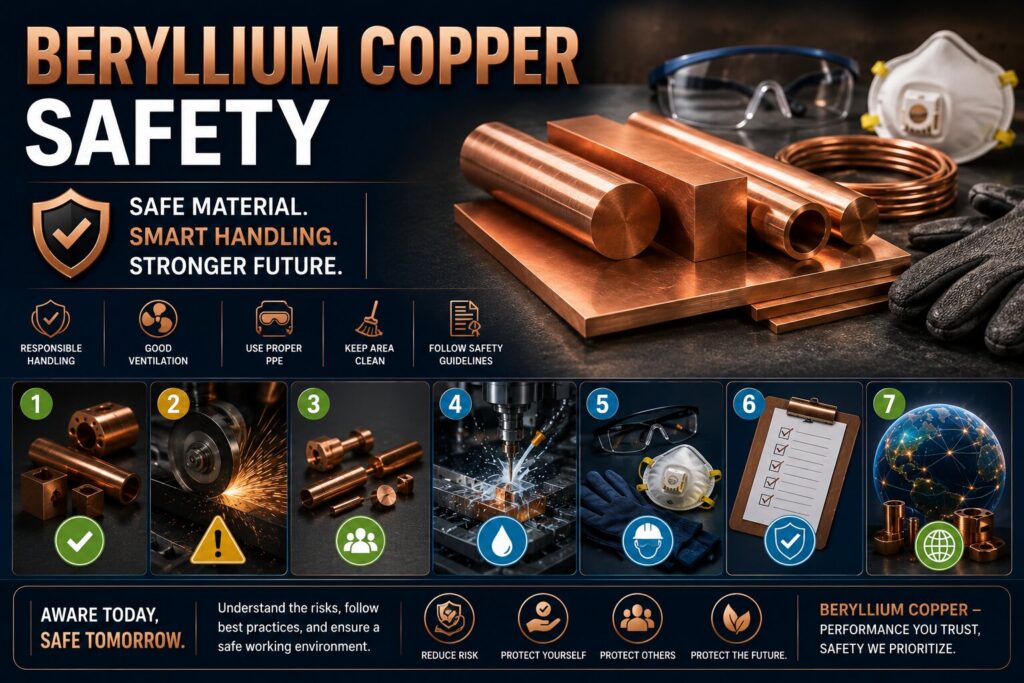
- Grinding
- Sanding
- Machining
- Cutting
- Welding
- Brazing
- Polishing
These processes can release fine airborne particles that should not be inhaled.
The risk comes from airborne dust and fumes, not from handling solid finished components.
7 Reassuring Facts About Working with Beryllium Copper at Home
1. Finished Parts Are Generally Safe
Using completed BeCu components for electrical, mechanical, or hobby applications does not normally create exposure concerns when they are used as intended. Following recommended Beryllium Copper Safety practices, many industries use finished BeCu parts every day without issue.
2. Dust Generation Is the Main Concern
Operations that create fine particles require proper controls to maintain Beryllium Copper Safety during machining, grinding, or welding. The alloy itself is not dangerous simply sitting on a workbench; the primary concern is preventing exposure to airborne dust or fumes generated during these manufacturing processes.
3. Small Quantities Can Be Managed Safely
Many home users work with limited quantities of Beryllium Copper. Following Beryllium Copper Safety practices, such as using proper ventilation, effective dust collection, and good housekeeping, can significantly reduce the potential for exposure during machining or other dust-generating operations.
4. Wet Machining Reduces Dust
Coolants and lubricants help suppress airborne particles during machining operations, supporting better Beryllium Copper Safety by minimizing dust generation. Industrial manufacturers frequently use wet processing methods to improve workplace safety and reduce potential airborne exposure.
5. Personal Protective Equipment Helps
Recommended PPE may include
- Safety glasses
- Dust masks or respirators
- Protective gloves
- Protective clothing
The exact level of protection depends on the operation being performed.
6. Modern Safety Standards Provide Clear Guidance
Manufacturers and regulatory organizations have established procedures for handling BeCu safely. Following recognized Beryllium Copper Safety guidelines helps minimize risk during fabrication while supporting a safe and compliant working environment.
7. Millions of Components Operate Safely Worldwide
Beryllium Copper remains a preferred material in industries requiring:
- High strength
- Excellent conductivity
- Fatigue resistance
- Non-sparking performance
- Long service life
Its continued use demonstrates that proper handling practices effectively manage safety concerns.
Key Properties of UNS C17200
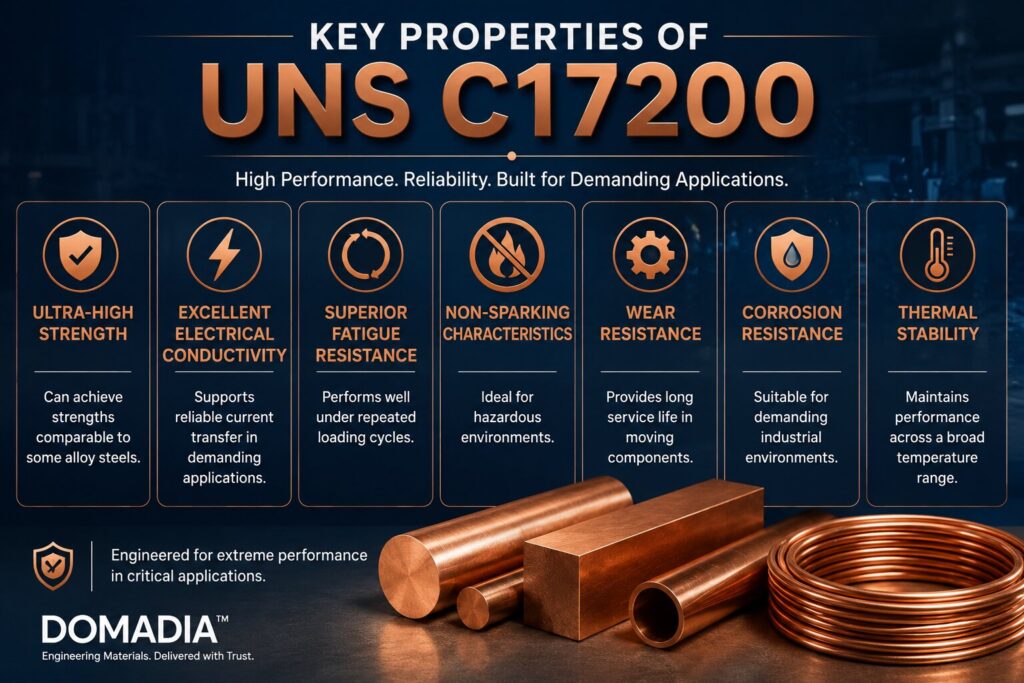
Ultra-High Strength
Beryllium Copper Safety does not compromise the alloy’s exceptional performance, as it can achieve strengths comparable to some alloy steels while maintaining excellent electrical conductivity and wear resistance.
Excellent Electrical Conductivity
Supports reliable current transfer in demanding applications.
Superior Fatigue Resistance
Performs well under repeated loading cycles.
Non-Sparking Characteristics
Ideal for hazardous environments.
Wear Resistance
Provides long service life in moving components.
Corrosion Resistance
Suitable for demanding industrial environments.
Thermal Stability
Maintains performance across a broad temperature range.
Technical Specifications
| Property | Typical Value |
| UNS Number | C17200 |
| Density | 8.25 g/cm³ |
| Tensile Strength | Up to 1400 MPa |
| Electrical Conductivity | 22–28% IACS |
| Hardness | Up to 44 HRC |
| Melting Range | 865–980°C |
| Modulus of Elasticity | 128 GPa |
Values may vary depending on heat treatment condition.
Applicable Standards
UNS C17200 is commonly manufactured according to:
- ASTM B196
- ASTM B197
- ASTM B194
- ASTM B441
- AMS 4533
- AMS 4534
- AMS 4535
- EN Equivalent Specifications
These standards ensure consistency in composition, mechanical properties, and performance.
Common Applications

Aerospace Connectors
High reliability under vibration and temperature fluctuations.
Electrical Contacts
Excellent conductivity combined with spring performance.
Semiconductor Equipment
Supports precision manufacturing systems.
Resistance Welding Electrodes
Handles demanding thermal cycles.
Oil & Gas Tools
Non-sparking properties improve operational safety.
Defense Electronics
Supports mission-critical performance.
Telecommunications Systems
Provides long-term electrical reliability.
Medical Equipment
Used in specialized precision components.
Shapes Available
DOMADIA™ supplies Beryllium Copper in multiple forms, including:
- Rods
- Bars
- Sheets
- Plates
- Foils
- Strips
- Wires
- Tubes
- Rings
- Custom Machined Components
Why Choose DOMADIA™?
DOMADIA™ supports industries requiring high-performance Beryllium Copper materials with:
- Verified material quality
- Precision manufacturing support
- Multiple stock forms
- Technical application assistance
- Global supply capabilities
- Custom cutting options
- Reliable documentation and traceability
Our team helps customers select the right grade and form for demanding engineering applications.
Conclusion
When discussing Beryllium Copper Safety, it is important to separate myths from facts.
Finished UNS C17200 components are generally safe to handle and use. The primary Beryllium Copper Safety consideration involves machining, grinding, welding, or other processes that generate airborne dust or fumes. By following established safety practices, using appropriate protective equipment, and maintaining good ventilation, Beryllium Copper can be worked with responsibly and effectively.
Its unique combination of strength, conductivity, wear resistance, and durability continues to make it one of the most valuable engineering alloys available today. Following recommended Beryllium Copper Safety guidelines allows manufacturers to benefit from its outstanding performance while maintaining a safe working environment.
Work with Beryllium Copper Safely and Confidently
DOMADIA™– Delivering Trusted Beryllium Copper Solutions with Quality, Expertise, and Reliability for Every Critical Application.
Contact DOMADIA™ today for expert guidance, competitive pricing, and tailored material solutions for your next project.
Talk to: Er.Pankaj Domadia | Kairav Domadia | Aadil Domadia | Pragati Sanap | Pooja N N
#MagneticShielding #CustomShieldDesign #MuMetal #EMIShielding #EngineeringDesign #IndustrialShielding #DOMADIA #ElectronicsProtection #MagneticFieldControl #AdvancedMaterials
Directly whatsapp us for an Enquiry: https://wa.link/kairav
We’ve supplied to Mumbai, Pune, Indore, Jaipur, and Surat—serving industries across Maharashtra, Madhya Pradesh, Rajasthan, Gujarat, and Goa, with exports to Germany, USA, Japan, South Korea, and Italy.