Blogs
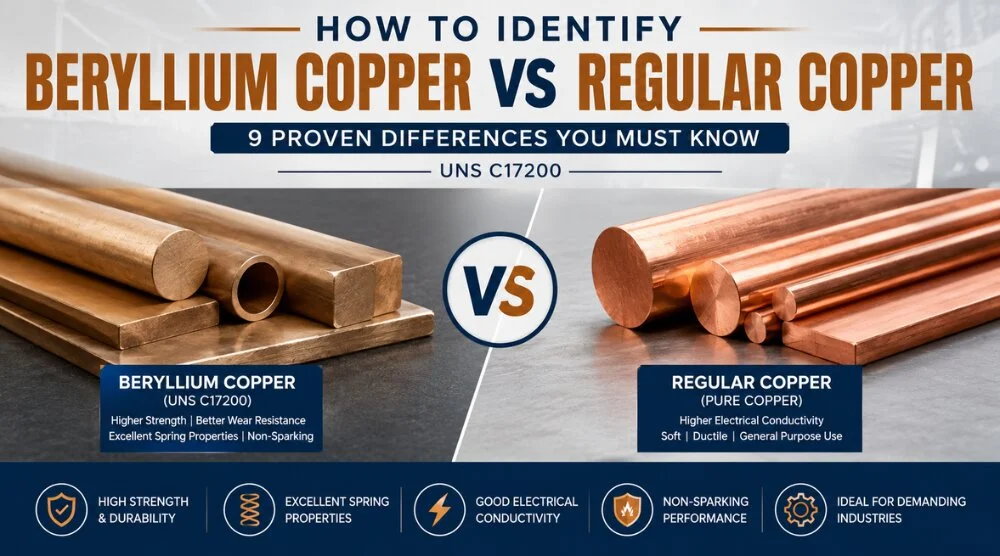
Beryllium Copper Identification: 9 Powerful Tests for UNS C17200
Beryllium Copper Identification can become surprisingly difficult when an unmarked bar, sheet, rod, strip, or machined component arrives on the production floor.
The material may look like ordinary copper. Its surface may display a familiar reddish-brown or golden-copper tone. Yet its performance can be completely different. That is why accurate Beryllium Copper Identification is essential before an unknown material enters machining, forming, or assembly.
One manufacturing company discovered this after producing a batch of electrical spring contacts from material assumed to be Beryllium Copper. The components looked correct and fitted the assembly perfectly. However, they began losing their spring force during testing.
The problem was not the component design. The material was regular copper.
That simple identification mistake resulted in rejected parts, repeated machining, delayed delivery, and avoidable downtime.
This is why engineers, purchase teams, quality inspectors, maintenance departments, and manufacturers must understand Beryllium Copper Identification and know how to distinguish Beryllium Copper from regular copper before the material enters production.
Beryllium Copper Identification Starts with Performance
Regular copper is valued mainly for its exceptional electrical and thermal conductivity. It is soft, ductile, easy to shape, and widely used in electrical wiring, busbars, earthing systems, plumbing components, and heat-transfer equipment.
Beryllium Copper, particularly UNS C17200, is selected when an application requires a more demanding combination of:
- High strength
- Excellent spring properties
- Good electrical conductivity
- Fatigue resistance
- Wear resistance
- Corrosion resistance
- Non-sparking performance
- Dimensional stability
The mindset shift is simple: do not identify the material by color alone. Identify it by its documentation, physical behaviour, mechanical properties, conductivity, and chemical composition.
What Is Beryllium Copper UNS C17200?
Beryllium Copper UNS C17200 is a precipitation-hardenable copper alloy containing approximately 1.8% to 2.0% beryllium. Understanding this composition is an important part of accurate Beryllium Copper Identification, especially when verifying materials for demanding engineering applications.
In its solution-treated condition, the alloy can be formed and machined. After age-hardening treatment, it develops significantly higher strength and hardness while retaining useful electrical and thermal conductivity.
This combination makes C17200 one of the most widely used high-strength copper alloys for critical industrial components.
What Is Regular Copper?
Regular copper generally refers to commercially pure copper grades such as electrolytic tough pitch copper, often designated UNS C11000.
It contains approximately 99.9% copper and offers exceptionally high electrical conductivity. However, it does not provide the strength, spring retention, wear resistance, or fatigue performance associated with heat-treated Beryllium Copper.
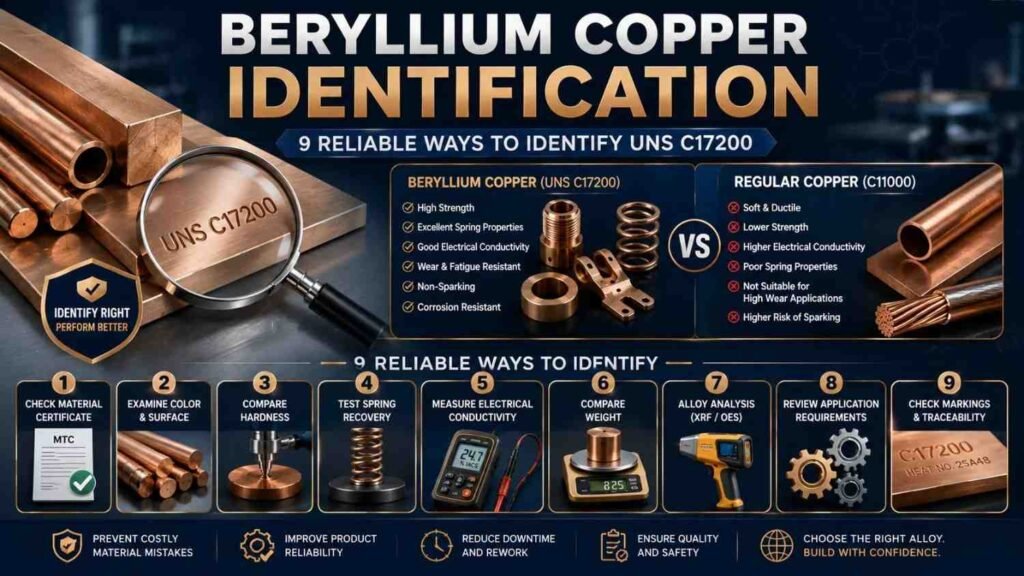
9 Reliable Ways to Identify Beryllium Copper vs Regular Copper
1. Verify the Material Test Certificate
The safest and most reliable starting point is the Material Test Certificate, commonly called an MTC or mill certificate.
The certificate should state:
- UNS designation
- Chemical composition
- Heat or batch number
- Mechanical properties
- Temper condition
- Applicable ASTM or international standard
- Material dimensions
For high-strength Beryllium Copper, look for the designation UNS C17200.
Never accept appearance alone as proof of alloy identity. A traceable certificate connects the physical material to a verified manufacturing batch.
DOMADIA™ supports customers with clearly specified Beryllium Copper materials and relevant documentation based on order requirements.
2. Examine the Colour and Surface Tone
Regular copper usually has a brighter reddish-orange appearance when freshly polished.
Beryllium Copper may appear:
- Golden brown
- Darker copper
- Slightly bronze
- Less intensely red than pure copper
Heat treatment, oxidation, machining, polishing, surface coatings, and storage conditions can all affect colour. Therefore, visual inspection should only be used as an initial clue.
Colour is useful for comparison, but it is not a conclusive identification test.
3. Compare Hardness
Hardness is one of the clearest practical differences.
Regular copper is comparatively soft. It can be scratched, dented, bent, or marked more easily.
Age-hardened C17200 is significantly harder and more resistant to surface indentation. Depending on the temper and heat-treatment condition, it can achieve hardness levels approaching those of some steels.
Portable hardness testing methods may include:
- Rockwell hardness testing
- Vickers hardness testing
- Brinell hardness testing
- Portable rebound testing
The correct method depends on the material shape, thickness, surface finish, and applicable specification.
4. Test Spring Recovery
Beryllium Copper is widely recognised for its excellent elastic and spring properties.
A thin strip of regular copper may bend easily but retain part of the deformation. A correctly processed Beryllium Copper strip can return much more effectively toward its original shape after controlled deflection.
This characteristic is especially important in:
- Electrical contacts
- Relay springs
- Connectors
- Switch components
- Retaining clips
- Precision diaphragms
However, avoid uncontrolled bending of certified material because excessive deformation can damage the sample or invalidate it for production.
5. Measure Electrical Conductivity
Regular copper generally offers significantly higher electrical conductivity than high-strength Beryllium Copper.
Typical comparison:
| Material | Typical Electrical Conductivity |
| Regular copper such as C11000 | Approximately 100% IACS |
| High-strength C17200 | Commonly around 22–28% IACS |
| Conductivity-focused Beryllium Copper grades | May be higher depending on grade |
A portable conductivity meter can help distinguish highly conductive pure copper from high-strength alloyed copper.
Conductivity testing is particularly useful because it is fast, non-destructive, and suitable for quality-control environments.
Results should still be interpreted together with temper, temperature, surface condition, and specification requirements.
6. Compare Weight Carefully
Beryllium Copper and regular copper have similar densities, so weight alone is not an effective identification method.
Typical density values are approximately:
- Beryllium Copper C17200: 8.25 g/cm³
- Pure copper: 8.89 g/cm³
A sample of equal dimensions may show a measurable difference, but machining tolerances, internal cavities, scale, coatings, and measurement errors can affect the result.
Density testing can support identification, but it should not replace chemical analysis or certification.
7. Use XRF or OES Alloy Analysis
When positive material identification is required, instrumental analysis is the strongest solution.
Common methods include:
X-Ray Fluorescence
XRF is widely used for fast alloy screening. However, detecting light elements such as beryllium can be difficult for many standard handheld XRF instruments.
An XRF result may identify copper and heavier alloying elements but may not reliably quantify beryllium.
Optical Emission Spectroscopy
OES can provide more detailed alloy chemistry when the equipment and calibration are appropriate.
Laboratory Chemical Analysis
Specialised laboratory testing can confirm the beryllium content and overall composition with greater confidence.
For critical aerospace, defence, electrical, oil and gas, or precision-engineering applications, professional alloy verification is preferable to informal workshop testing.
8. Review the Component’s Intended Application
The intended use can provide an important clue.
A component is more likely to be Beryllium Copper when it is designed for:
- Repeated spring movement
- High mechanical loading
- Non-sparking tools
- Precision electrical contacts
- Aerospace connectors
- Oil and gas safety equipment
- Mould tooling
- Wear-resistant bushings
- High-cycle fatigue applications
- Non-magnetic precision instruments
Regular copper is more likely when the primary requirement is:
- Maximum electrical conductivity
- Power transmission
- Earthing
- Heat transfer
- Plumbing
- General fabrication
- Electrical busbars
- Cable manufacturing
Application history is not proof, but it helps guide the testing process.
9. Check Markings, Purchase Records, and Traceability
Material markings may include:
- C17200
- CuBe2
- Alloy 25
- Heat number
- Batch number
- Temper code
- Manufacturer identification
- ASTM specification
Purchase orders, inward inspection reports, supplier invoices, packing lists, and inventory records can also help establish the material’s identity.
If markings have been removed during cutting or machining, maintain internal traceability by transferring the heat number to each cut piece or production batch.
Avoid Unsafe Identification Methods
Some informal identification methods involve grinding, heating, aggressive filing, or creating dust. These methods should not be used casually on materials suspected of containing beryllium.
Beryllium-containing dust, fumes, or airborne particles can present serious occupational health risks if proper controls are not followed.
Do not grind, weld, melt, sand, or aggressively machine unidentified material simply to determine what it is.
Use safe alternatives such as:
- Certificate verification
- Conductivity testing
- Hardness testing
- Professional laboratory analysis
- Controlled positive material identification
Any processing of Beryllium Copper should follow applicable workplace safety procedures, ventilation requirements, exposure controls, and local regulations.
Chemical Composition
Beryllium Copper UNS C17200
Typical chemical composition includes:
| Element | Typical Requirement |
| Copper | Balance |
| Beryllium | 1.80–2.00% |
| Cobalt and Nickel | Controlled addition |
| Cobalt, Nickel and Iron | Limited by specification |
| Lead | Restricted |
| Other elements | Controlled according to standard |
Regular Copper UNS C11000
| Element | Typical Requirement |
| Copper, including silver | Approximately 99.90% minimum |
| Oxygen | Controlled |
| Other elements | Very low residual levels |
Exact composition requirements should always be confirmed against the applicable material standard and purchase specification.
Properties of Beryllium Copper
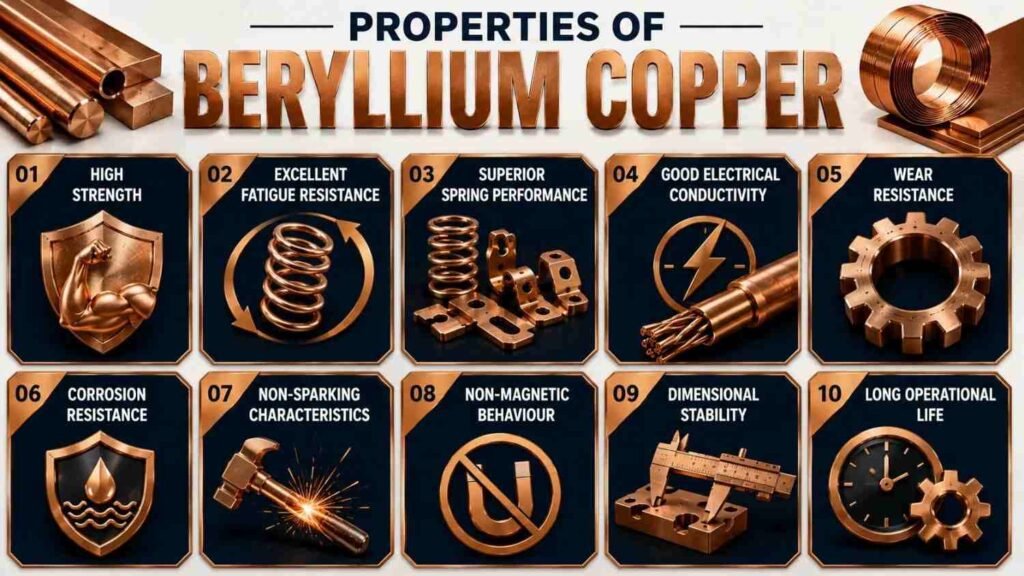
High Strength
Age-hardened C17200 can achieve very high tensile strength, making it suitable for demanding mechanical components.
Excellent Fatigue Resistance
The alloy performs reliably under repeated loading, vibration, and cyclic movement, making Beryllium Copper Identification important when selecting materials for high-fatigue applications.
Superior Spring Performance
It maintains spring force more effectively than regular copper in properly designed components, making accurate Beryllium Copper Identification important for applications requiring consistent spring performance.
Good Electrical Conductivity
Although lower than pure copper, its conductivity is sufficient for many high-performance electrical contacts and connectors.
Wear Resistance
Its hardness helps resist friction, abrasion, and repeated mechanical contact, making accurate Beryllium Copper Identification important when selecting materials for wear-resistant components.
Corrosion Resistance
Beryllium Copper performs well in many industrial, marine, and atmospheric environments, making accurate Beryllium Copper Identification important when selecting materials for corrosion-resistant applications.
Non-Sparking Characteristics
It is used for specialised tools and components in environments where accidental sparks may create a hazard, making accurate Beryllium Copper Identification important for safety-critical material selection.
Non-Magnetic Behaviour
The alloy is suitable for instruments and equipment where magnetic interference must be minimised, making accurate Beryllium Copper Identification important for selecting materials used in magnetically sensitive applications.
Dimensional Stability
Heat-treated components can maintain precise dimensions under demanding operating conditions, making accurate Beryllium Copper Identification important for applications requiring dimensional stability.
Long Operational Life
Its strength, fatigue performance, and wear resistance can reduce component replacement frequency, making accurate Beryllium Copper Identification important for achieving reliable performance and longer service life.
Technical Specifications
Typical values for high-strength UNS C17200 depend on temper, product form, thickness, and heat treatment.
| Technical Property | Typical Value or Range |
| UNS designation | C17200 |
| Common name | Alloy 25 |
| European-style designation | CuBe2 |
| Density | Approximately 8.25 g/cm³ |
| Tensile strength | Approximately 1,100–1,400 MPa in hardened conditions |
| Hardness | Approximately 36–45 HRC, depending on condition |
| Electrical conductivity | Commonly around 22–28% IACS |
| Thermal conductivity | Approximately 100–130 W/m·K, depending on condition |
| Elastic modulus | Approximately 125–135 GPa |
| Melting range | Approximately 865–980°C |
These figures are indicative and should not replace certified product-specific data.
Standards for Beryllium Copper
Depending on the shape and application, C17200 may be supplied according to standards such as:
- ASTM B194 for plate, sheet, strip, and rolled bar
- ASTM B196 for rod and bar
- ASTM B197 for wire
- ASTM B643 for seamless tube
- AMS specifications for aerospace applications
- DIN and EN material requirements
- Customer-specific technical specifications
- ISO-based quality management requirements
The correct standard must match the requested product form, temper, dimensions, testing requirements, and intended application.
Applications of Beryllium Copper

Electrical Connectors
The alloy combines conductivity with dependable contact force and spring retention, making accurate Beryllium Copper Identification essential for components requiring consistent electrical and mechanical performance.
Aerospace Components
It is used in precision parts requiring strength, fatigue resistance, and dimensional reliability, making accurate Beryllium Copper Identification important for selecting the correct material for demanding precision applications.
Oil and Gas Tools
Non-sparking tools help reduce ignition risks in controlled hazardous environments, making correct Beryllium Copper Identification important when selecting materials for safety-critical applications.
Injection Mould Components
Its thermal conductivity and strength support efficient heat removal and long tool life, making accurate Beryllium Copper Identification important when selecting materials for thermally demanding tooling applications.
Relay Springs
C17200 maintains consistent mechanical performance during repeated switching cycles, making accurate Beryllium Copper Identification important for reliable electrical switching applications.
Semiconductor Equipment
Precision components benefit from dimensional stability, wear resistance, and non-magnetic behaviour, making these properties valuable considerations during Beryllium Copper Identification for demanding engineering applications.
Welding Equipment
Selected copper-alloy components provide a balance of conductivity, strength, and thermal performance.
Defence Systems
The material is used in specialised connectors, instruments, springs, and critical mechanical assemblies, making accurate Beryllium Copper Identification important for ensuring reliable material selection in high-performance applications.
Marine Components
Corrosion resistance makes it suitable for selected marine and offshore applications, while proper Beryllium Copper Identification helps ensure the correct alloy is chosen for these demanding environments.
Industrial Machinery
Bushings, wear plates, bearings, and moving components benefit from its hardness and long service life.
Shapes Available
DOMADIA™ can support Beryllium Copper requirements in a variety of shapes, subject to grade, temper, size, specification, and availability:
- Round bars
- Square bars
- Flat bars
- Plates
- Sheets
- Strips
- Foils
- Rods
- Wires
- Tubes
- Coils
- Springs
- Machined components
- Custom-cut sizes
Beryllium Copper Identification Checklist
Before accepting or processing suspected C17200 material, follow this practical checklist:
- Confirm the UNS designation on the purchase order.
- Match the heat number with the Material Test Certificate.
- Inspect permanent or transferred material markings.
- Review the temper and heat-treatment condition.
- Perform non-destructive conductivity testing.
- Compare the result with the expected specification.
- Conduct hardness testing when appropriate.
- Use laboratory analysis for critical applications.
- Maintain traceability after cutting and machining.
This process is more dependable than relying on appearance, weight, or workshop assumptions.
Why DOMADIA™?
Correct alloy selection begins with accurate specifications and dependable sourcing.
DOMADIA™ supports customers seeking Beryllium Copper for demanding industrial applications by offering:
- Clearly specified alloy grades
- Multiple product shapes
- Custom dimensions
- International sourcing capabilities
- Application-focused material support
- Documentation based on order requirements
- Supply solutions for small and bulk quantities
- Delivery support across India and international markets
Whether the requirement involves electrical contacts, aerospace components, non-sparking tools, mould inserts, precision springs, semiconductor equipment, or industrial wear parts, DOMADIA™ helps customers source the right material for the application.
Conclusion
Beryllium Copper Identification should never depend on colour alone. Regular copper and UNS C17200 can appear similar, especially after oxidation, polishing, heat treatment, or machining, but their mechanical and electrical behaviour differs considerably. This is why accurate Beryllium Copper Identification requires more than a simple visual inspection.
The most reliable Beryllium Copper Identification process combines documentation, heat-number traceability, conductivity measurement, hardness testing, application review, and professional chemical analysis.
Regular copper remains the preferred choice when maximum conductivity, ductility, and affordability are the main priorities. Beryllium Copper becomes the stronger choice when the component must provide high strength, reliable spring action, fatigue resistance, wear resistance, non-sparking performance, and extended operational life.
Accurate Beryllium Copper Identification prevents material mix-ups, protects product quality, reduces avoidable downtime, and helps manufacturers achieve more reliable long-term performance. DOMADIA™ provides carefully specified Beryllium Copper solutions for industries where material quality cannot be left to guesswork.
Choose Certified Beryllium Copper with Confidence
DOMADIA™ supplies high-quality Beryllium Copper UNS C17200 in bars, sheets, plates, strips, rods, wires, tubes, foils, and custom sizes for demanding industrial applications.
Choose the right alloy before production begins—contact DOMADIA™for dependable UNS C17200 solutions.
Talk to: Er.Pankaj Domadia | Kairav Domadia | Aadil Domadia | Pragati Sanap | Pooja N N
#FaradayFabric #EMIShielding #RFShielding #WiFiShielding #CellSignalBlocking #ConductiveFabric #IndustrialMaterials #Electronics #EMC #DOMADIA
Directly whatsapp us for an Enquiry: https://wa.link/kairav
From Ahmedabad, Vadodara, Rajkot, Bhavnagar, and Jamnagar, we serve Gujarat’s industrial belt and nearby Maharashtra, Rajasthan, MP, and Daman, with global supply to Canada, Mexico, Brazil, Chile, and Argentina.