Blogs
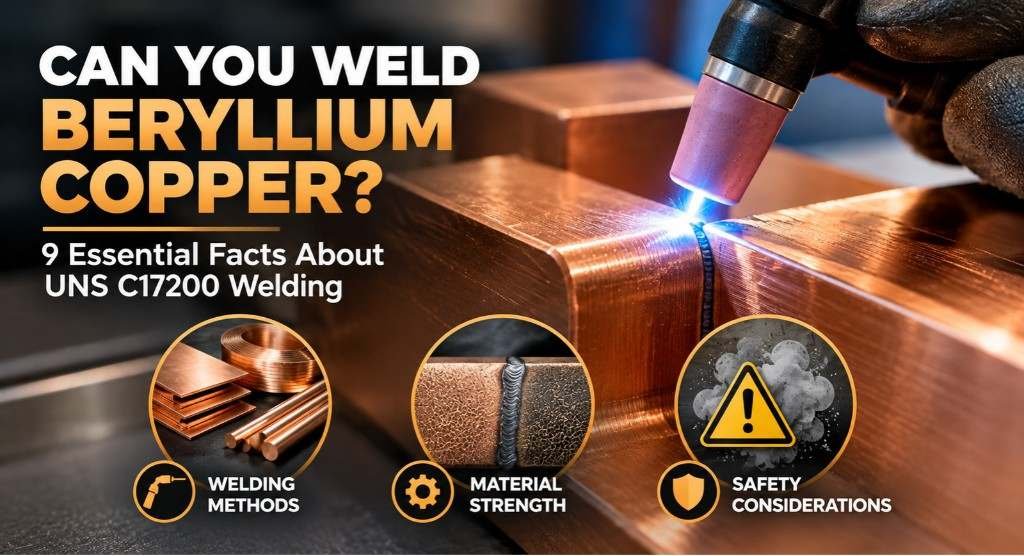
Can You Weld Beryllium Copper? 9 Essential Facts About UNS C17200 Welding
Beryllium Copper Welding is possible, but successfully joining this high-performance copper alloy requires considerably more attention than welding ordinary copper or carbon steel.
A small weld can become a major engineering problem when the wrong process, filler material, heat input, or safety precautions are used.
Consider a precision electrical component manufactured from UNS C17200 beryllium copper. The component requires excellent conductivity, mechanical strength, fatigue resistance, and dimensional accuracy.
Everything performs well until a welded joint develops cracking, distortion, or reduced hardness.
The problem may not be the alloy itself. It could be the welding procedure.
This raises an important question:
Can you weld beryllium copper without compromising its properties?
The answer is yes, under controlled conditions, but the welding method must account for the alloy’s metallurgy, heat-treatment condition, and potentially serious beryllium exposure hazards.
Understanding Beryllium Copper Welding is essential for engineers working with precision electrical components, aerospace assemblies, industrial connectors, and other demanding applications where joint reliability directly affects performance.
Unlike conventional copper joining, Beryllium Copper Welding requires careful control of heat input, appropriate joining techniques, and suitable exposure controls to reduce the risk of metallurgical defects and hazardous airborne beryllium.
In this technical guide, DOMADIA™ explains nine essential facts about welding beryllium copper, including its chemical composition, welding methods, technical properties, applicable standards, applications, limitations, and material-selection considerations.
1. What Is Beryllium Copper and Why Is Welding Challenging?
Beryllium copper is a precipitation-hardenable copper alloy known for combining several desirable engineering characteristics.
These include high mechanical strength, good electrical conductivity, excellent fatigue resistance, corrosion resistance, and useful spring performance.
Unlike ordinary copper, beryllium copper can develop substantially higher strength through controlled heat treatment.
This makes it valuable in applications where electrical and mechanical performance must coexist.
However, the same characteristics that make the alloy useful can complicate welding.
During welding, localized heating may alter the carefully developed microstructure of the material.
Depending on the welding process and material condition, the heat-affected zone may experience:
- Reduced hardness
- Loss of precipitation-hardened strength
- Distortion
- Residual stresses
- Cracking susceptibility
- Changes in electrical or mechanical performance
Furthermore, welding can generate hazardous airborne beryllium-containing particles and fumes.
Therefore, welding beryllium copper requires both metallurgical control and a properly engineered occupational safety system.
2. Chemical Composition of Beryllium Copper UNS C17200
UNS C17200 is one of the most widely recognized high-strength copper-beryllium grades.
Its nominal chemistry is designed to support precipitation hardening while maintaining useful electrical conductivity.
Chemical composition table
| Element | Composition |
| Copper (Cu) | Balance |
| Beryllium (Be) | 1.80–2.00% |
| Cobalt + Nickel (Co + Ni) | Minimum 0.20% |
| Co + Ni + Iron (Fe) | Maximum 0.60% |
Typical UNS C17200 composition limits by mass. Verify the applicable product standard and certified mill test report for the purchased material.
Why does beryllium matter?
Beryllium enables copper alloys to respond strongly to precipitation hardening.
After appropriate solution treatment and aging, the alloy can achieve mechanical strengths far above those of conventional commercially pure copper.
However, the precipitation-hardened structure is sensitive to additional thermal exposure.
A welding operation can locally change the alloy’s hardness and strength, even when the joint appears visually acceptable.
For this reason, DOMADIA™ recommends that engineers identify the material’s exact grade and temper before evaluating a joining procedure.
3. Can You Weld Beryllium Copper Using TIG Welding?
Tungsten Inert Gas welding, also called Gas Tungsten Arc Welding (GTAW), provides precise control over the welding arc.
This makes it a possible joining process for selected copper-beryllium applications.
However, TIG welding is not automatically the preferred or approved method for every UNS C17200 component.
Advantages of TIG welding
- Precise arc positioning
- Controlled heat input
- Suitability for certain small components
- Potential for localized fusion joining
- Good control of the weld pool with appropriate procedure development
Challenges of TIG welding
Copper alloys conduct heat rapidly.
Consequently, heat can move away from the weld region, making fusion and penetration control difficult.
At the same time, excessive heat input can affect the alloy’s heat-treated properties.
Additional concerns include weld-metal cracking, filler compatibility, distortion, and airborne beryllium exposure.
Important: TIG welding of beryllium copper should only be undertaken under a qualified procedure with effective engineering controls, exposure assessment, and appropriate industrial hygiene oversight. General welding ventilation or ordinary welding PPE alone should not be assumed sufficient.
4. Is Resistance Welding Better for Beryllium Copper?
Resistance welding is frequently considered when joining small conductive components.
Unlike arc welding, resistance welding produces localized heating through electrical resistance at the joining interface.
Depending on the application, resistance spot welding or related resistance-joining processes may offer advantages over conventional fusion welding.
Why resistance welding may be useful
Localized heating: The process can concentrate energy near the intended joint rather than heating a large surrounding region.
Short joining cycles: Controlled resistance welding can use relatively brief current pulses.
Repeatability: Automated systems can control electrode force, current, and timing.
Reduced thermal exposure: Some resistance-welding configurations may produce a smaller heat-affected region than arc welding.
Nevertheless, high copper-alloy conductivity makes resistance welding challenging because current can pass through the material without producing sufficient heat at the interface.
Electrode selection, surface condition, contact resistance, joint design, and material thickness all influence the result.
Resistance welding may be a better option for some thin components, but it still requires procedure qualification and beryllium exposure assessment.
5. How Does Welding Affect the Properties of UNS C17200?
One of the most important considerations in Beryllium Copper Welding is the effect of temperature on precipitation-hardened material.
UNS C17200 derives much of its strength from controlled thermal processing.
When a hardened component is exposed to welding temperatures, its original mechanical properties may not remain uniform across the joint.
Typical technical properties of UNS C17200
| Property | Typical value or range |
| Density | Approximately 8.26 g/cm³ |
| Electrical conductivity | Approximately 22–30% IACS, depending on condition |
| Thermal conductivity | Approximately 105 W/m·K |
| Ultimate tensile strength | Can exceed 1,380 MPa in selected high-strength tempers |
| Hardness | Can approach 40–45 HRC in suitable hardened conditions |
| Melting range | Approximately 866–982°C |
| Magnetic behavior | Generally nonmagnetic in common applications |
| Heat-treatment response | Precipitation hardenable |
Representative material properties, not guaranteed welded-joint properties. Values depend on product form, temper, thickness, processing history, and test conditions.
What happens inside the heat-affected zone?
The heat-affected zone may undergo several metallurgical changes.
Overaging: Excessive thermal exposure can coarsen strengthening precipitates and reduce hardness.
Local softening: Material close to the weld may lose some of its original strength.
Residual stress: Uneven heating and cooling can introduce stresses that affect dimensional stability.
Microstructural variation: The weld metal, heat-affected zone, and unaffected base material may develop different properties.
This means a weld can look acceptable while failing to meet the original mechanical requirements.
Therefore, hardness testing, mechanical evaluation, metallographic inspection, and other qualification tests may be necessary for critical components.
6. What Are the Biggest Safety Risks When Welding Beryllium Copper?
This is arguably the most important section of the entire discussion.
Beryllium-containing welding fumes and airborne particles can create serious occupational health hazards.
Inhalation exposure can cause beryllium sensitization and chronic beryllium disease, a potentially disabling lung condition. Beryllium is also a recognized human carcinogen.
These hazards require strict control even when the alloy contains only a relatively small percentage of beryllium.
Essential welding safety considerations
Exposure assessment: Evaluate the process for potential airborne beryllium exposure before work begins.
Engineered ventilation: Use properly designed local exhaust ventilation and containment where required.
Qualified procedures: Ensure the welding operation is assessed and approved by competent welding and industrial hygiene personnel.
Respiratory protection: Use an appropriate respiratory protection program where the exposure assessment requires it.
Contamination control: Prevent the spread of beryllium-containing dust, residue, and contaminated clothing.
Safe housekeeping: Follow approved cleaning and waste-management procedures rather than using methods that disperse particles.
Health surveillance: Meet applicable worker training, exposure monitoring, and medical surveillance requirements.
OSHA’s beryllium standard, 29 CFR 1910.1024, establishes an eight-hour permissible exposure limit of 0.2 µg/m³ and a short-term exposure limit of 2.0 µg/m³ over 15 minutes for covered general-industry operations.
These are regulatory exposure limits, not guarantees of zero risk.
The applicable Indian occupational safety requirements and site-specific procedures must also be assessed.
DOMADIA™ strongly recommends that no welding, cutting, grinding, or other fume-generating processing of beryllium copper be undertaken without competent safety review and appropriate exposure controls.
7. Which Welding and Joining Methods Can Be Used?
Not every component needs a conventional fusion weld.
Depending on its function, dimensions, operating temperature, and service requirements, an alternative joining process may be more appropriate.
| Joining method | Potential advantage | Main consideration |
| TIG/GTAW welding | Precise localized fusion | Heat-affected properties, cracking, hazardous fumes |
| Resistance welding | Short, localized heating | High conductivity, electrode and interface control |
| Laser welding | Concentrated energy and precision | Process sensitivity, cracking, fume containment |
| Brazing | Joining below the base metal’s melting temperature | Filler selection, joint clearance, service temperature |
| Soldering | Lower-temperature electrical assembly | Joint strength, temperature limits, flux compatibility |
| Mechanical fastening | Avoids fusion heating | Geometry, contact pressure, fatigue and assembly design |
What about brazing?
Brazing may be attractive in Beryllium Copper Welding applications where the component requires a strong joint without melting the copper-beryllium base metal.
However, brazing temperatures can still affect the material’s precipitation-hardened condition.
Filler compatibility, thermal exposure, service temperature, and post-joining properties must therefore be carefully evaluated.
What about soldering?
Soldering is commonly considered in Beryllium Copper Welding applications involving electrical connections where service temperatures and mechanical loads are compatible with the soldered joint.
Its lower joining temperature may reduce the extent of thermal damage compared with fusion welding.
However, soldering cannot automatically replace welding in high-load mechanical applications.
Engineering recommendation
For successful Beryllium Copper Welding, select the joining process according to the finished component’s performance requirements, not merely the convenience of the joining equipment.
For high-strength spring components, avoiding welding entirely may sometimes be the better design decision.
8. What Standards Apply to Beryllium Copper Welding?
Engineers should distinguish between standards governing the base material, welding qualification, joining processes, and occupational safety.

There is no single universal standard that makes every beryllium copper weld acceptable.
Relevant material and welding standards
| Standard | Relevance |
| ASTM B194/B194M | Copper-beryllium alloy plate, sheet, strip, and rolled bar |
| ASTM B196/B196M | Copper-beryllium alloy rod and bar |
| ASTM B197/B197M | Copper-beryllium alloy wire |
| AWS B2.1/B2.1M | Welding procedure and performance qualification framework |
| AWS C1.1M/C1.1 | Recommended practices for resistance welding |
| ISO 15614 series | Welding procedure qualification, where the relevant part covers the application |
| OSHA 29 CFR 1910.1024 | Beryllium exposure controls in covered US general-industry workplaces |
Standard applicability depends on product form, process, contract requirements, and jurisdiction. Check current editions and their scope before specifying compliance.
For critical industrial components, the procurement and manufacturing documentation should clearly identify:
- UNS alloy designation
- Material condition or temper
- Applicable material specification
- Joint geometry
- Approved joining procedure
- Required inspection and testing
- Finished-joint mechanical properties
- Applicable occupational safety controls
DOMADIA™ can assist customers with base-material grade and form selection, while welding qualification and process safety must be established by the responsible fabricator and engineering team.
9. When Should You Weld Beryllium Copper—and When Should You Avoid It?
A successful engineering decision begins by asking whether welding is necessary.
Applications where joining may be considered

Electrical contacts and connectors
Beryllium Copper Welding may be required in specialized electrical assemblies where copper-beryllium components must maintain mechanical strength, electrical conductivity, and reliable contact performance.
Precision spring assemblies
Some assemblies use copper-beryllium spring elements, where Beryllium Copper Welding requires particular attention to potential softening, fatigue performance, and the long-term mechanical reliability of the finished component.
Aerospace and instrumentation
Beryllium Copper Welding may be required in selected sensing and electrical assemblies where specialized joining methods, strict process qualification, and material traceability are essential for ensuring reliable performance.
Electronic switching components
Beryllium Copper Welding may be required for specialized contacts, relay components, and conductive spring systems where maintaining reliable mechanical strength, electrical conductivity, and long-term operational performance is essential.
When should welding be avoided?
Beryllium Copper Welding may be unsuitable when the finished component must retain exceptionally high spring strength, fatigue resistance, dimensional precision, or a narrowly specified heat-treated condition that cannot be restored or verified after joining.
It should also be avoided when effective beryllium exposure controls cannot be established.
In these situations, engineers should consider alternatives to Beryllium Copper Welding, including mechanical joining, alternative assembly designs, soldering, brazing, or selecting a different alloy to maintain the required performance and safety standards.
Shapes and Forms of Beryllium Copper Available
Beryllium Copper Welding performance depends on the material’s shape, thickness, and temper. UNS C17200 is available in various forms for industrial applications.

| Material Form | Applications |
| Sheets & Plates | Electrical components, precision tooling |
| Strips & Coils | Connectors, spring contacts |
| Rods & Bars | Machined parts, industrial components |
| Wires | Springs, electrical contacts |
| Foils | Precision electronics, miniature components |
Why Choose DOMADIA™ for Beryllium Copper UNS C17200?
Selecting a copper-beryllium alloy is not simply about buying copper with a higher strength rating.
The correct material must meet the operating demands of the finished component.
For welding-related applications, engineers must also consider how joining affects the alloy’s original properties.
How DOMADIA™ supports material selection
1. Grade-specific enquiries
DOMADIA™ helps customers identify appropriate beryllium copper grades, including UNS C17200, based on their technical requirements, ensuring suitable material selection for Beryllium Copper Welding applications.
2. Industrial material forms
For Beryllium Copper Welding applications, customers can enquire with DOMADIA™ about sheets, strips, plates, rods, bars, wires, and other precision forms to meet their specific industrial and engineering requirements.
3. Application-focused specifications
For successful Beryllium Copper Welding applications, DOMADIA™ encourages procurement teams to evaluate mechanical strength, electrical conductivity, temper, material dimensions, and service conditions rather than selecting materials based on price alone.
4. Technical documentation requirements
For Beryllium Copper Welding applications, customers can discuss material specifications, applicable industry standards, and required test documentation with DOMADIA™ during procurement, subject to availability and agreed supply arrangements.
5. Long-term engineering value
Selecting the correct material and manufacturing process for Beryllium Copper Welding can help reduce avoidable component failures, replacement frequency, and costly equipment downtime.
Properly engineered joints and longer-lasting components may also reduce material waste, repeated manufacturing, and recycling requirements, although the actual environmental benefits depend on the component’s complete lifecycle.
Frequently Asked Questions About Beryllium Copper Welding
Can you TIG weld beryllium copper?Yes, TIG welding may be technically feasible for selected copper-beryllium components. However, the procedure requires qualification, control of heat-affected properties, and specialized precautions against airborne beryllium exposure.
Can beryllium copper be welded to steel?
Does welding reduce the strength of beryllium copper?
Is beryllium copper welding dangerous?
Can beryllium copper be brazed instead of welded?
Is UNS C17200 suitable for resistance welding?
Conclusion: Can You Weld Beryllium Copper Successfully?
Beryllium Copper Welding is technically possible, but it requires careful process control and strict safety precautions. UNS C17200 offers excellent mechanical strength, electrical conductivity, corrosion resistance, and fatigue performance, making it suitable for demanding industrial applications.
However, Beryllium Copper Welding can affect the alloy’s heat-treated properties, reduce local strength, and introduce distortion or occupational exposure hazards. TIG, resistance welding, laser welding, brazing, and soldering may be considered depending on application requirements.
Successful Beryllium Copper Welding depends on selecting the right joining method while preserving component performance and safety. DOMADIA™ helps engineers and procurement professionals choose suitable UNS C17200 grades and material forms for reliable, long-term performance.
Looking for High-Performance Beryllium Copper UNS C17200?
DOMADIA™ supports enquiries for high-quality UNS C17200 Beryllium Copper in various shapes and sizes, subject to availability.
Contact DOMADIA™ today to discuss your Beryllium Copper Welding applications, material specifications, dimensions, temper, and quantity.
Talk to: Er.Pankaj Domadia | Kairav Domadia | Aadil Domadia | Pragati Sanap | Pooja N N
#BerylliumCopper #UNSC17200 #CopperAlloys #WeldingTechnology #TIGWelding #ResistanceWelding #MaterialEngineering #IndustrialMaterials #DOMADIA
Directly whatsapp us for an Enquiry: https://wa.link/kairav
Our materials have reached Nagpur, Aurangabad, Nashik, Kolhapur, and Solapur—strengthening Maharashtra, Goa, Karnataka, MP, and Gujarat industries, with exports to South Africa, Kenya, Egypt, Morocco, and Nigeria.