Blogs
Rare Earth Elements Rare: Why the Name Is More Misleading Than You Think
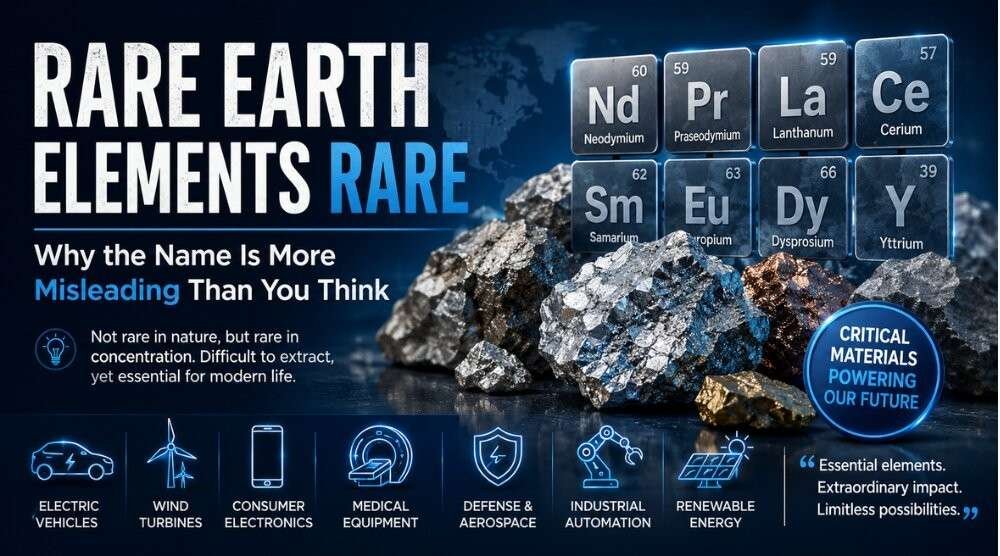
The phrase Rare Earth Elements Rare often causes confusion. Most people assume these materials hardly exist in nature. Surprisingly, that is far from the truth.
Rare earth elements are actually found throughout the Earth’s crust, and several of them are more abundant than precious metals like silver and gold. They earned the word “rare” because they were originally discovered in uncommon mineral deposits and are extremely difficult to extract economically from the ores in which they occur.
Today, these elements have become the backbone of modern technology. From electric vehicles and wind turbines to smartphones, satellites, defense systems, and medical equipment, rare earth elements enable innovations that would be nearly impossible with conventional materials.
Understanding why Rare Earth Elements Rare became such a widely accepted term helps explain both their history and their strategic importance in today’s industrial world.
What Are Rare Earth Elements?
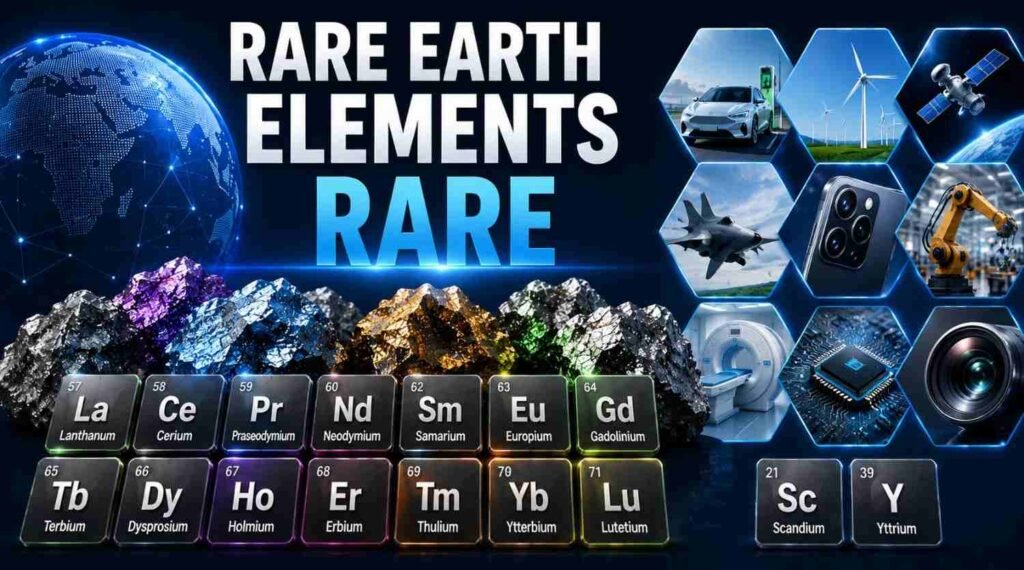
Rare earth elements are a family of 17 metallic elements, including:
- 15 Lanthanides
- Scandium (Sc)
- Yttrium (Y)
Although chemically similar, each element possesses unique magnetic, electrical, optical, and catalytic properties that make it valuable for specialized industrial applications.
Rare Earth Elements Rare: Why Were They Given This Name?
When these elements were first identified during the late eighteenth century, scientists found them only in a few unusual mineral samples.
At that time:
- Mining technology was limited.
- The minerals appeared uncommon.
- Separation techniques were extremely difficult.
- Individual elements could not easily be isolated.
The term “earth” referred to mineral oxides, while “rare” described the difficulty of finding concentrated deposits—not the actual abundance of the elements.
Today, geologists know that many rare earth elements are relatively common, but commercially viable deposits remain difficult and expensive to develop.
Rare Earth Elements Rare: Are They Actually Rare?
The answer is No.
Several rare earth elements are surprisingly abundant.
Examples include:
- Cerium is more abundant than copper.
- Lanthanum occurs more frequently than silver.
- Neodymium is more common than lead.
- Yttrium exists in numerous mineral deposits worldwide.
The real challenge is that these elements are spread across enormous volumes of rock rather than concentrated in rich ore bodies.
Consequently, mining, separation, and refining require sophisticated technologies and significant investment.
Why Is Producing Rare Earth Elements So Difficult?
Even though the elements themselves are not exceptionally scarce, producing them is highly complex.
Major reasons include:
- Low concentration in most ore deposits
- Nearly identical chemical behavior
- Complex multi-stage separation processes
- Expensive refining equipment
- Strict environmental regulations
- High capital investment
- Long project development timelines
These challenges make rare earth materials strategically valuable despite their natural abundance.
Chemical Composition
Rare earth elements consist of the following groups:
| Category | Elements |
| Light Rare Earth Elements (LREE) | Lanthanum, Cerium, Praseodymium, Neodymium, Samarium |
| Heavy Rare Earth Elements (HREE) | Europium, Gadolinium, Terbium, Dysprosium, Holmium, Erbium, Thulium, Ytterbium, Lutetium |
| Associated Elements | Scandium, Yttrium |
These materials are available as metals, oxides, powders, alloys, magnets, and specialized compounds.
Properties of Rare Earth Elements
Rare earth elements possess unique characteristics that make them indispensable across numerous industries.
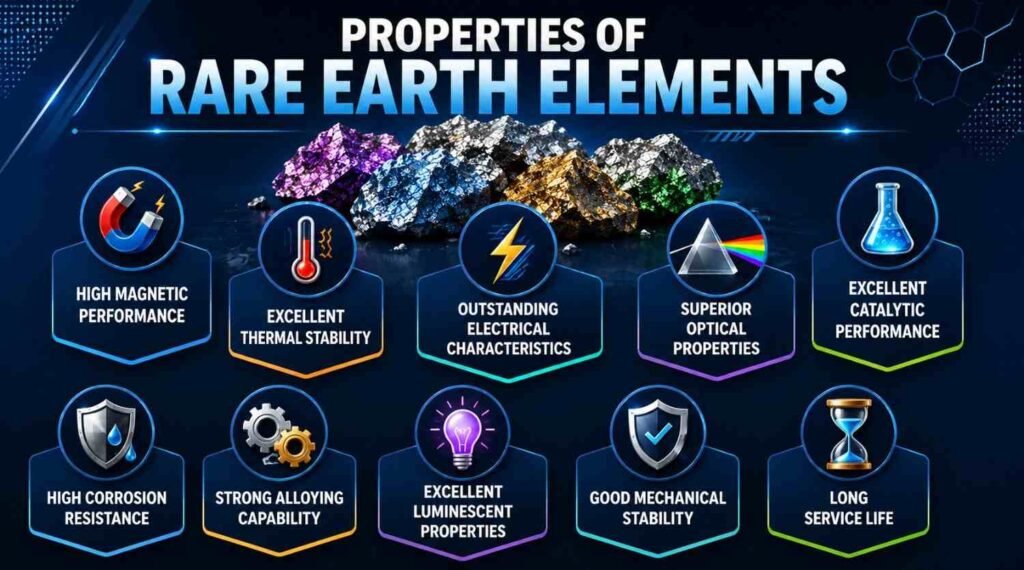
High Magnetic Performance
Rare Earth Elements Rare materials are ideal for manufacturing powerful permanent magnets used in electric vehicles, wind turbines, robotics, and advanced industrial motors.
Excellent Thermal Stability
Rare Earth Elements Rare maintain reliable performance under elevated temperatures, making them suitable for aerospace, defense, and high-temperature industrial applications.
Outstanding Electrical Characteristics
The unique electrical properties of Rare Earth Elements Rare improve efficiency, precision, and reliability in advanced electrical systems and electronic devices.
Superior Optical Properties
Rare Earth Elements Rare are widely used in lasers, LEDs, fiber optics, and precision optical equipment because of their exceptional luminescent and optical performance.
Excellent Catalytic Performance
Improve chemical processing efficiency.
High Corrosion Resistance
Provide dependable long-term durability.
Strong Alloying Capability
Enhance strength and performance of specialty alloys.
Excellent Luminescent Properties
Used in display technologies and lighting systems.
Good Mechanical Stability
Perform reliably under demanding industrial conditions.
Long Service Life
Support durable, high-performance engineering applications.
Technical Specifications
| Property | Typical Range |
| Atomic Numbers | 21, 39, 57–71 |
| Density | 2.99–9.84 g/cm³ |
| Melting Point | 798°C–1663°C |
| Purity | Up to 99.999% |
| Forms Available | Metals, Oxides, Powders, Magnets, Alloys |
| Electrical Conductivity | Moderate |
| Magnetic Characteristics | Excellent (selected elements) |
| Thermal Stability | High |
International Standards
DOMADIA™ supplies rare earth materials that can conform to internationally recognized standards, including:
- ASTM Standards
- ISO Certified Quality Systems
- REACH Compliance
- RoHS Compliance
- Customer-Specific Industrial Specifications
- Military Material Standards (where required)
Shapes Available
DOMADIA™ supplies rare earth materials in multiple industrial forms:
- Ingots
- Rods
- Bars
- Plates
- Sheets
- Foils
- Wires
- Powders
- Oxides
- Pellets
- Granules
- Magnets
- Sputtering Targets
- Custom Machined Components
Applications of Rare Earth Elements
Rare earth elements have become indispensable across numerous industries because of their exceptional magnetic, optical, electrical, and thermal properties. Rare Earth Elements Rare may sound contradictory, but these materials power many of the technologies used every day. Below are some of the most important applications where Rare Earth Elements Rare materials play a critical role.
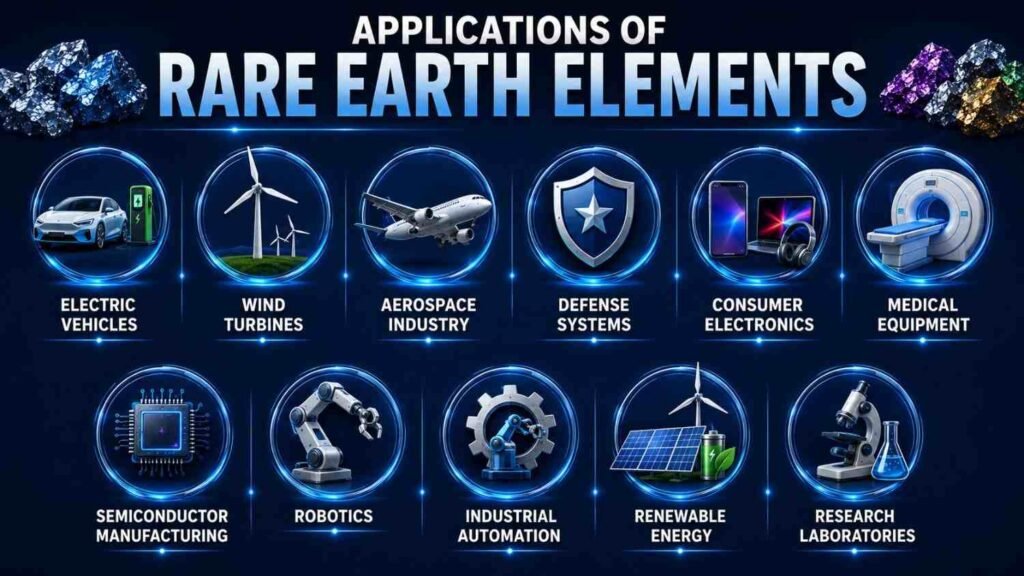
Electric Vehicles
Permanent magnets made from rare earth elements improve motor efficiency, reduce energy loss, and help electric vehicles achieve greater driving range. Rare Earth Elements Rare materials are key to high-performance EV motors.
Wind Turbines
Modern wind turbines rely on powerful rare earth magnets to generate electricity efficiently and reduce maintenance requirements. The unique properties of Rare Earth Elements Rare materials support reliable renewable energy production.
Aerospace Industry
Aircraft engines, satellites, navigation systems, and advanced aerospace components use rare earth elements because they provide excellent performance under extreme temperatures and demanding operating conditions.
Defense Systems
Radar systems, missile guidance, secure communication equipment, sonar systems, and advanced military electronics depend on Rare Earth Elements Rare materials for precision, reliability, and high-performance magnetic properties.
Consumer Electronics
Smartphones, laptops, speakers, headphones, cameras, and display technologies all contain rare earth elements that enhance sound quality, display brightness, compact motor performance, and battery efficiency.
Medical Equipment
MRI scanners, CT imaging systems, diagnostic instruments, and advanced medical devices utilize Rare Earth Elements Rare materials to improve imaging accuracy, performance, and long-term reliability.
Semiconductor Manufacturing
Rare earth elements are used in polishing compounds, specialty alloys, and high-purity manufacturing processes that support advanced semiconductor and microchip production.
Robotics
Industrial robots and automation systems use rare earth magnets to deliver higher precision, faster response, and improved energy efficiency. Rare Earth Elements Rare materials enable compact yet powerful robotic motors.
Industrial Automation
Factories worldwide rely on rare earth elements in servo motors, precision sensors, actuators, and control systems to increase productivity, improve efficiency, and reduce energy consumption.
Renewable Energy
Beyond wind power, Rare Earth Elements Rare materials contribute to energy storage systems, advanced power electronics, and next-generation clean-energy technologies that support global sustainability goals.
Research Laboratories
Scientific instruments, particle accelerators, spectroscopy equipment, lasers, and advanced analytical systems depend on Rare Earth Elements Rare materials for highly accurate measurement, testing, and research applications.
Why Rare Earth Elements Matter More Than Ever
Global demand for rare earth materials continues to increase as industries transition toward electrification, renewable energy, automation, and advanced manufacturing.
Electric vehicles, artificial intelligence hardware, defense electronics, robotics, and next-generation communication technologies all depend heavily on these critical materials. As governments strengthen supply chains and industries seek reliable sourcing, rare earth elements have become strategic resources for the future of global manufacturing.
Why Choose DOMADIA™?
When sourcing specialty materials, experience and reliability matter.
DOMADIA™ provides:
- Premium-quality rare earth materials
- Reliable global sourcing network
- Consistent material quality
- Wide inventory availability
- Custom sizes and specifications
- Competitive pricing
- Technical material selection support
- Worldwide industrial supply
- Fast and dependable delivery
Whether your project requires metals, oxides, powders, magnets, or custom-engineered products, DOMADIA™ delivers material solutions that meet demanding industrial requirements.
Conclusion
Although the phrase Rare Earth Elements Rare has been used for more than two centuries, it no longer reflects geological reality. These elements are not truly scarce—they are simply difficult to mine, separate, and refine economically. Understanding why Rare Earth Elements Rare is considered a misleading term helps explain their growing strategic importance. Their exceptional magnetic, electrical, optical, and thermal properties make them indispensable for electric vehicles, renewable energy, aerospace, electronics, medical devices, and defense systems.
As global demand for advanced materials continues to grow, choosing a trusted supplier becomes essential. DOMADIA™ supplies high-quality rare earth materials that meet international standards while helping manufacturers achieve consistent performance, dependable quality, and long-term reliability. Whether your requirement involves magnets, oxides, alloys, or custom forms, DOMADIA™ provides dependable solutions for industries that rely on Rare Earth Elements Rare to power next-generation technologies.
Power the Future with Premium Rare Earth Materials
DOMADIA™ supplies premium Rare Earth Elements that meet international standards, ensuring reliable performance for aerospace, electronics, renewable energy, defense, automotive, and industrial applications.
Contact DOMADIA™ today to discuss your requirements and receive the right rare earth material solution for your industry.
Talk to: Er.Pankaj Domadia | Kairav Domadia | Aadil Domadia | Pragati Sanap | Pooja N N
#RareEarthElements #CriticalMinerals #RareEarthMetals #IndustrialMaterials #Manufacturing #Engineering #DOMADIA #Technology #Innovation #SpecialtyMetals
Directly whatsapp us for an Enquiry: https://wa.link/kairav
From Ahmedabad, Vadodara, Rajkot, Bhavnagar, and Jamnagar, we serve Gujarat’s industrial belt and nearby Maharashtra, Rajasthan, MP, and Daman, with global supply to Canada, Mexico, Brazil, Chile, and Argentina.