Blogs
What Materials Are Similar to Mu Metal? 9 Powerful Alternatives for Magnetic Shielding
What Materials Are Similar to Mu Metal?
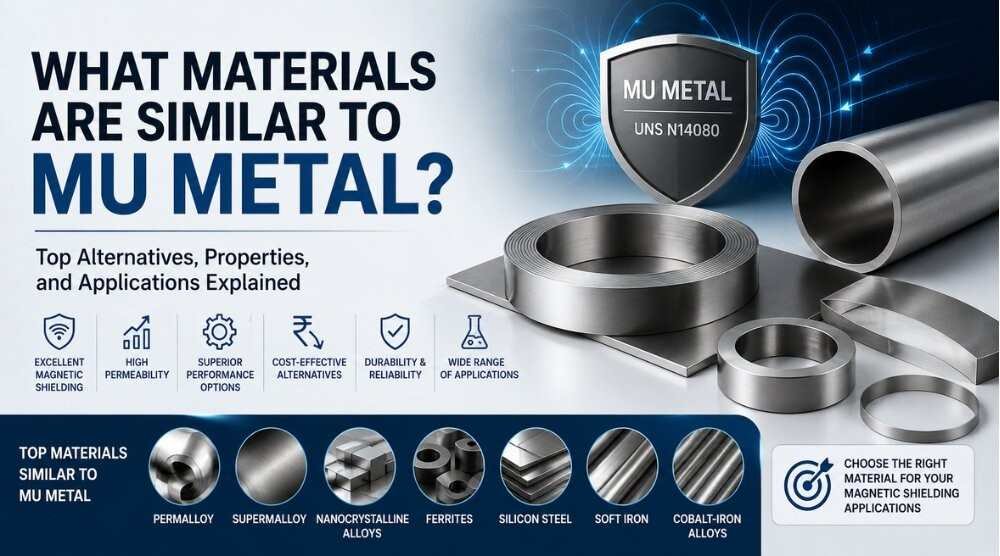
Mu Metal Alternatives are often considered when engineers require excellent magnetic shielding but need different mechanical properties, higher magnetic saturation, improved durability, or lower costs.
Mu Metal (UNS N14080) is renowned for its extremely high magnetic permeability, making it one of the world’s most effective passive magnetic shielding materials. However, it is not the only solution. Depending on the application, several Mu Metal Alternatives offer comparable—or in some cases superior—performance under specific operating conditions, including higher saturation, better mechanical strength, or improved frequency response.
At DOMADIA™, we help industries evaluate Mu Metal Alternatives based on actual performance requirements rather than simply selecting the most widely recognized alloy. This approach ensures the right balance of shielding efficiency, reliability, manufacturability, and long-term value for every application.
Understanding Mu Metal
Mu Metal is a nickel-iron soft magnetic alloy specifically designed for shielding low-frequency magnetic fields. While it remains the industry benchmark, evaluating Mu Metal Alternatives helps engineers choose the most suitable material for specific shielding and performance requirements.
Its exceptional magnetic permeability allows magnetic flux to travel through the material instead of passing into sensitive equipment. Although several Mu Metal Alternatives offer advantages for certain applications, Mu Metal continues to be one of the most effective solutions for shielding weak magnetic fields.
This makes Mu Metal—and, in many cases, carefully selected Mu Metal Alternatives—ideal for applications such as:
- Scientific instruments
- Medical imaging equipment
- Aerospace electronics
- Laboratory devices
- Audio equipment
- Defence electronics
- Precision sensors
Why Consider Alternatives?
Although Mu Metal performs exceptionally well, it may not always be the best engineering solution.
Reasons include:
- Higher material cost
- Limited mechanical strength
- Sensitivity to mechanical deformation
- Heat treatment requirements
- Different magnetic field strengths
- Application-specific performance requirements
Fortunately, several materials provide similar magnetic properties.
9 Materials Similar to Mu Metal
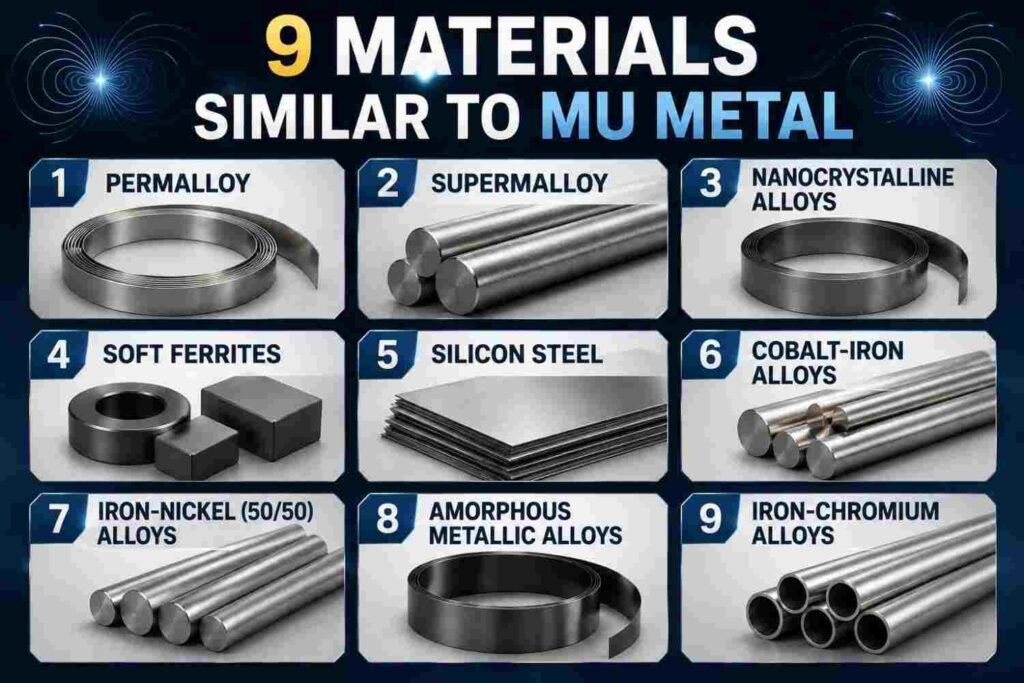
1. Permalloy
Permalloy is perhaps the closest material to Mu Metal.
It is also a nickel-iron alloy with extremely high magnetic permeability.
Advantages
- Excellent shielding efficiency
- Good soft magnetic characteristics
- Suitable for transformers
- Low coercivity
Typical Applications
- Precision transformers
- Current sensors
- Scientific instruments
- Magnetic cores
2. Supermalloy
Supermalloy contains higher nickel content than Mu Metal along with molybdenum additions.
It offers even higher magnetic permeability under certain operating conditions.
Advantages
- Extremely high permeability
- Very low coercive force
- Excellent low-field performance
Applications
- Magnetic sensors
- Fluxgate magnetometers
- Research equipment
- High-performance shielding
3. Sendust
Sendust is an iron-silicon-aluminum alloy.
Although not identical to Mu Metal, it provides outstanding soft magnetic characteristics and excellent wear resistance.
Advantages
- Low core losses
- Good saturation
- Better wear resistance
- Stable magnetic properties
Applications
- Inductors
- Power electronics
- Magnetic cores
4. Silicon Steel
Silicon steel is widely used in electrical engineering.
It has lower permeability than Mu Metal but performs extremely well in alternating magnetic fields.
Advantages
- High magnetic efficiency
- Cost-effective
- Easily available
- Excellent transformer material
Applications
- Transformers
- Electric motors
- Generators
5. Ferrites
Ferrite materials are ceramic magnetic compounds.
They provide excellent electromagnetic interference suppression, particularly at higher frequencies.
Advantages
- High electrical resistance
- Good EMI suppression
- Lightweight
- Corrosion resistant
Applications
- EMI filters
- RF suppression
- Electronic circuits
6. Amorphous Metal Alloys
Amorphous metals possess a non-crystalline structure that minimizes magnetic losses.
Advantages
- Extremely low core loss
- High efficiency
- Excellent magnetic properties
Applications
- High-efficiency transformers
- Power systems
- Renewable energy equipment
7. Nanocrystalline Alloys
Nanocrystalline alloys are among the newest soft magnetic materials.
They combine excellent permeability with outstanding thermal stability.
Advantages
- Very low losses
- High permeability
- Excellent frequency response
- Stable performance
Applications
- EV charging systems
- Renewable energy
- Industrial power electronics
8. Soft Iron
Pure soft iron has been used for magnetic circuits for decades.
Although its permeability is lower than Mu Metal, it provides high magnetic saturation.
Advantages
- Strong magnetic performance
- Good machinability
- Cost-effective
Applications
- Electromagnets
- Magnetic yokes
- Industrial equipment
9. Cobalt-Iron Alloys
Cobalt-iron alloys provide exceptionally high magnetic saturation.
While they are not replacements for ultra-sensitive shielding, they excel in high-flux applications.
Advantages
- High saturation
- Excellent strength
- Good temperature stability
Applications
- Aerospace motors
- Military equipment
- High-performance generators
Chemical Composition of Mu Metal (Typical)
| Element | Approximate Content |
| Nickel (Ni) | 77–80% |
| Iron (Fe) | Balance |
| Copper (Cu) | 4–5% |
| Molybdenum (Mo) | 2–5% |
| Manganese (Mn) | Small amount |
The exact composition varies depending on manufacturer and application.
Properties of Mu Metal
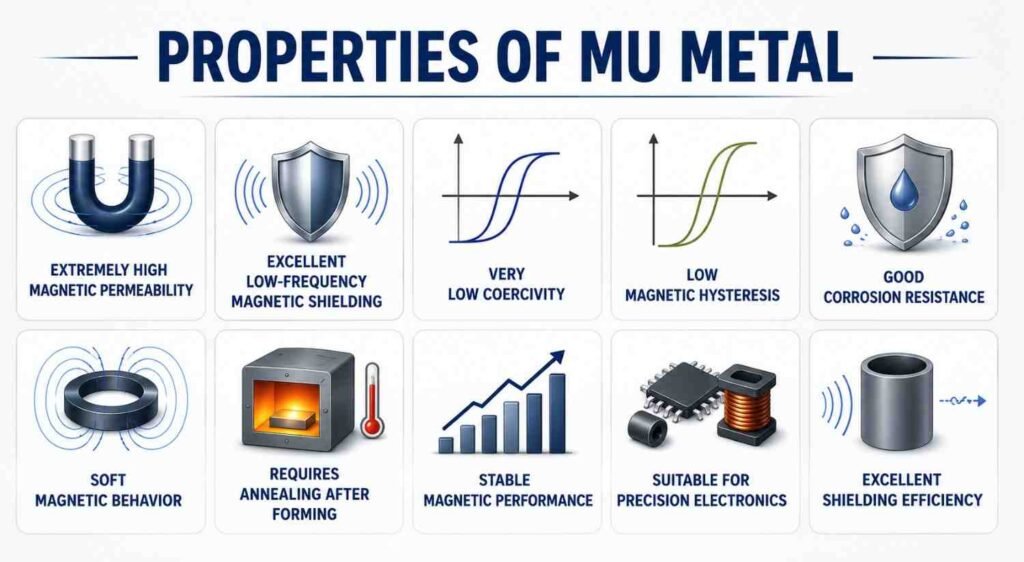
- Extremely high magnetic permeability
- Excellent low-frequency magnetic shielding
- Very low coercivity
- Low magnetic hysteresis
- Good corrosion resistance
- Soft magnetic behavior
- Requires annealing after forming
- Stable magnetic performance
- Suitable for precision electronics
- Excellent shielding efficiency
Technical Specifications
| Property | Typical Value |
| UNS Number | N14080 |
| Material Type | Nickel-Iron Alloy |
| Density | ~8.7 g/cm³ |
| Relative Permeability | Up to 100,000+ |
| Magnetic Characteristics | Soft Magnetic |
| Heat Treatment | Hydrogen Annealed |
| Formability | Excellent |
| Weldability | Moderate |
Standards
Mu Metal materials are commonly produced in accordance with:
- UNS N14080
- ASTM specifications (where applicable)
- MIL specifications for defence applications
- Customer-specific engineering standards
- International quality management standards
Shapes Available
DOMADIA™ supplies Mu Metal in various engineered forms including:
- Sheets
- Foils
- Strips
- Plates
- Rings
- Cylinders
- Tubes
- Custom fabricated shields
- Precision stamped components
- CNC machined parts
Applications of Mu Metal Alternatives

Medical Equipment
Mu Metal Alternatives are used to protect MRI systems, imaging devices, and diagnostic electronics from unwanted magnetic interference, ensuring accurate and reliable performance.
Aerospace
Advanced Mu Metal Alternatives shield avionics, navigation systems, and flight electronics from stray magnetic fields in demanding aerospace environments.
Scientific Instruments
Precision laboratories rely on Mu Metal Alternatives to improve measurement accuracy by minimizing external magnetic disturbances during sensitive experiments.
Defence Electronics
High-performance Mu Metal Alternatives support communication systems, surveillance equipment, and mission-critical defence electronics where dependable magnetic shielding is essential.
Audio Equipment
Many Mu Metal Alternatives help reduce transformer hum and electromagnetic interference, delivering cleaner audio performance in professional sound systems.
Electric Vehicles
Engineers use Mu Metal Alternatives in sensors, electric motors, and battery management systems to enhance electromagnetic compatibility and operational reliability.
Semiconductor Manufacturing
Sensitive semiconductor fabrication equipment benefits from Mu Metal Alternatives, which help protect precision manufacturing processes from magnetic disturbances.
Industrial Automation
Magnetic shielding solutions improve the reliability of sensors, controllers, and automated production systems operating in electrically noisy environments.
Power Electronics
Transformers, inductors, and magnetic assemblies achieve improved efficiency and stable performance when designed with suitable Mu Metal Alternatives.
Research Laboratories
Research facilities use Mu Metal Alternatives to create controlled magnetic environments for high-precision testing, calibration, and advanced scientific investigations.Top of Form
Bottom of Form
How to Choose the Right Alternative
Selecting the right material depends on several engineering factors:
- Required magnetic permeability
- Operating frequency
- Magnetic field strength
- Mechanical durability
- Cost constraints
- Thermal conditions
- Fabrication requirements
- Shield geometry
The best material is not always the one with the highest permeability—it is the one that delivers the right balance of shielding performance, manufacturability, and lifecycle value for your specific application.
Why DOMADIA™
Choosing magnetic shielding materials requires more than comparing datasheets. It demands application knowledge, material expertise, and dependable supply.
DOMADIA™ offers:
- Premium-quality magnetic shielding materials
- Custom manufacturing solutions
- Precision machining capabilities
- Multiple material grades
- Technical application support
- Consistent quality assurance
- Reliable global supply chain
- Fast delivery for industrial projects
Conclusion
Selecting the right Mu Metal Alternatives depends on the level of magnetic shielding, mechanical requirements, operating environment, and long-term reliability your application demands. While Mu Metal (UNS N14080) remains the benchmark for shielding extremely weak magnetic fields, several Mu Metal Alternatives—including Permalloy, Supermalloy, nanocrystalline alloys, ferrites, and silicon steel—offer unique advantages for specific engineering challenges.
By understanding the strengths of these materials, engineers can improve equipment performance, reduce maintenance, and optimize overall system efficiency. At DOMADIA™, we help customers identify the most suitable Mu Metal Alternatives and supply high-quality magnetic shielding materials for demanding industrial, aerospace, medical, defence, and research applications.
Choose the Right Magnetic Shielding Material with DOMADIA™
DOMADIA™ supplies premium magnetic shielding materials in sheets, foils, strips, tubes, rings, and custom components for aerospace, medical, defence, electronics, and industrial applications.
Contact DOMADIA™ today for expert guidance and high-quality magnetic shielding materials tailored to your application.
Talk to: Er.Pankaj Domadia | Kairav Domadia | Aadil Domadia | Pragati Sanap | Pooja N N
#MuMetal #MagneticShielding #EMIShielding #SoftMagneticMaterials #Permalloy #Supermalloy #Engineering #IndustrialMaterials #DOMADIA #PrecisionEngineerin
Directly whatsapp us for an Enquiry: https://wa.link/kairav
Our deliveries span Solan, Baddi, Nalagarh, Paonta Sahib, and Una across Himachal Pradesh, Punjab, Haryana, Uttarakhand, and J&K, exporting to USA, Canada, Greenland, Iceland, and Bermuda.