Blogs
Faraday Fabric vs Aluminum Mesh: 9 Powerful Differences You Should Know
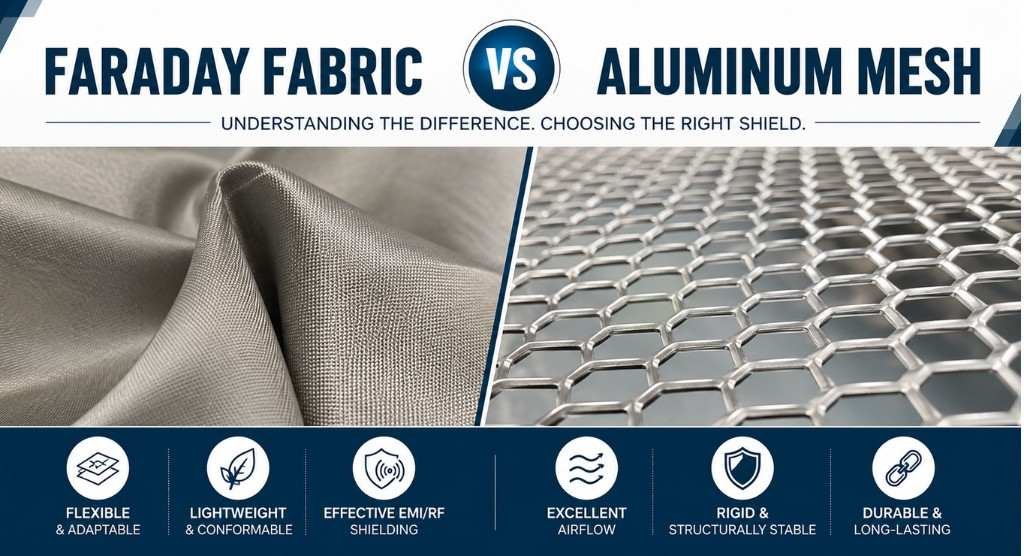
Faraday Fabric vs Aluminum mesh may look like a straightforward material comparison, but the right choice can significantly influence EMI/RF shielding performance, installation, weight, durability, flexibility, and even the overall design of an enclosure.
Consider a practical situation.
An electronics manufacturer needs to reduce unwanted radio-frequency interference around a sensitive testing area. One engineer proposes covering the area with conductive shielding fabric. Another recommends installing aluminum mesh.
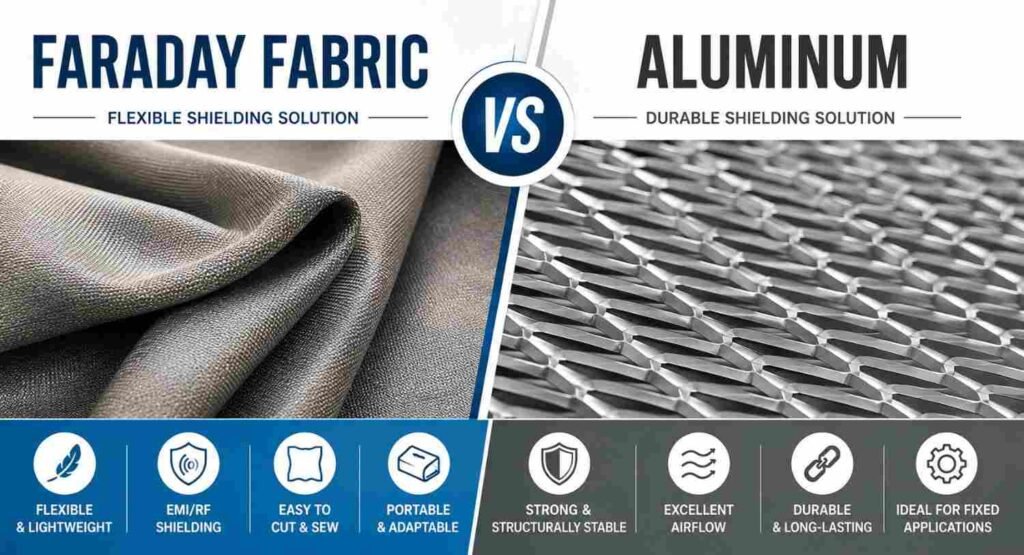
Both solutions use electrically conductive materials. Both can contribute to electromagnetic shielding. Yet they behave very differently once fabrication, seams, openings, grounding, corrosion, mechanical movement, and operating frequency enter the discussion.
That is where the Faraday Fabric vs Aluminum comparison becomes more interesting for engineers selecting an effective shielding solution.
Faraday fabric is generally chosen when lightweight, flexible and adaptable shielding is required. Aluminum mesh becomes attractive when engineers need a more rigid, open and structurally supported conductive barrier.
Neither material automatically wins every application.
When evaluating Faraday Fabric vs Aluminum, the better question is:
Which shielding material fits the actual electromagnetic and mechanical requirements of your project?
What Is Faraday Fabric?
Faraday fabric is an electrically conductive textile designed to help attenuate electromagnetic or radio-frequency energy. In a Faraday Fabric vs Aluminum comparison, this textile construction is one of the key characteristics that separates conductive fabric from conventional metal mesh.
Instead of behaving like ordinary cloth, conductive fibers, metallic coatings, plated yarns or woven conductive materials create an electrically conductive surface. This construction gives Faraday Fabric vs Aluminum an important point of differentiation, particularly where flexibility and adaptability are essential.
Depending on the construction, Faraday shielding fabrics may incorporate materials such as:
- Copper
- Nickel
- Silver
- Stainless steel
- Metallized synthetic fibers
- Conductive metal combinations
The exact composition varies substantially between products.
This distinction is important because Faraday fabric is not one specific metal or alloy. It is a category of conductive shielding materials.
Its flexibility allows it to be folded, wrapped, sewn or incorporated into suitable enclosures, curtains, covers and shielding assemblies.
What Is Aluminum Mesh?
Aluminum mesh is produced from aluminum or an aluminum alloy formed into a perforated, woven, expanded or otherwise open mesh structure.
Depending on the product, it may be supplied as:
- Woven wire mesh
- Expanded aluminum mesh
- Perforated aluminum sheet
- Fine screening mesh
- Custom fabricated mesh components
Aluminum combines relatively low density with electrical conductivity and corrosion resistance, making it useful for many industrial screening and enclosure applications.
Unlike flexible shielding textile, however, aluminum mesh generally behaves as a more structurally defined metallic barrier.
The openings in the mesh become a major engineering consideration.
Why?
Because electromagnetic shielding performance is influenced not simply by the presence of metal but also by opening dimensions, frequency, conductivity, continuity, seams and overall enclosure design.
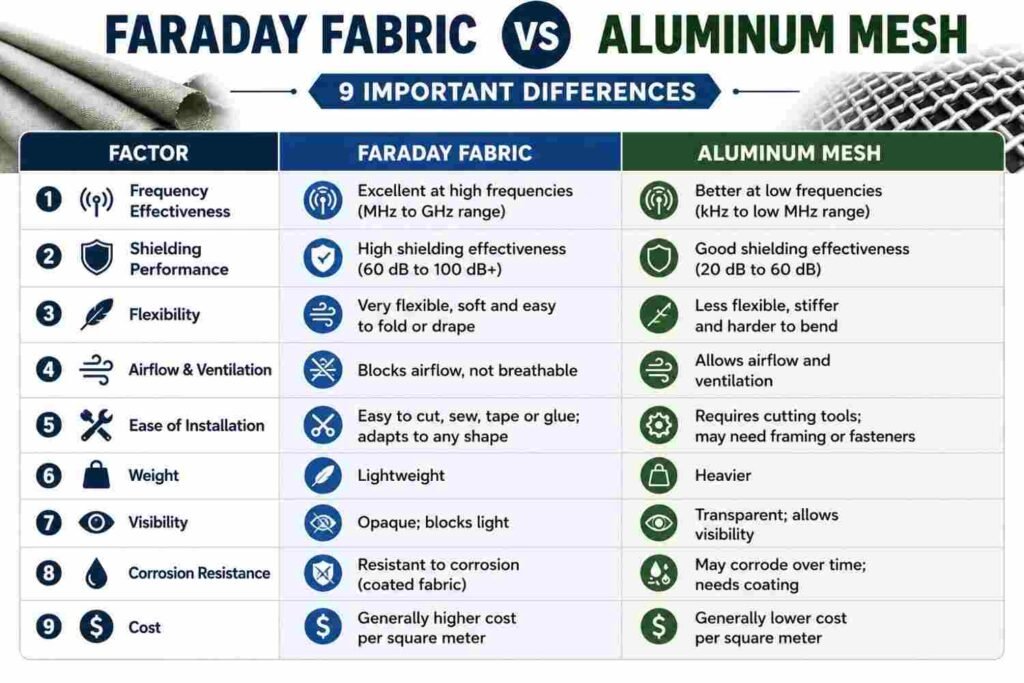
Faraday Fabric vs Aluminum Mesh: 9 Important Differences
1. Flexibility
This is perhaps the most obvious difference when evaluating Faraday Fabric vs Aluminum for EMI/RF shielding applications.
Faraday fabric can offer textile-like flexibility, depending on its construction. It can therefore conform around irregular surfaces and be incorporated into flexible shielding systems.
Aluminum mesh is comparatively rigid or semi-rigid, although its exact mechanical behaviour depends heavily on thickness and mesh construction. This mechanical distinction is an important factor in any Faraday Fabric vs Aluminum comparison.
Faraday Fabric
Better suited to:
- Flexible covers
- Curtains
- Pouches
- Equipment wraps
- Temporary shielding
- Irregular geometries
- Lightweight enclosures
Aluminum Mesh
Better suited to:
- Fixed panels
- Ventilation openings
- Windows
- Structural screens
- Permanent enclosures
- Framed barriers
When the shield must move with the application, conductive fabric can have a significant practical advantage. Therefore, Faraday Fabric vs Aluminum selection should consider not only shielding performance but also how the material must behave mechanically in the finished system..
2. EMI/RF Shielding Performance
It is tempting to compare these materials by asking:
“Which one blocks more signals?”
That question is incomplete.
Shielding effectiveness depends on several variables, including:
- Frequency
- Electrical conductivity
- Material thickness
- Mesh opening size
- Fabric construction
- Surface continuity
- Seams and joints
- Grounding or bonding design
- Apertures
- Installation quality
- Environmental conditions
A conductive fabric with good surface continuity can provide useful shielding across suitable frequencies.
An aluminum mesh can also provide effective electromagnetic screening, but the openings in the mesh become particularly important.
As a general electromagnetic principle, apertures become increasingly significant when their dimensions are large relative to the wavelength being controlled.
Therefore, two products labelled simply as “Faraday fabric” and “aluminum mesh” cannot responsibly be assigned a universal shielding winner without reviewing their actual specifications and test data.
3. Weight
Weight is an important factor in Faraday Fabric vs Aluminum selection, especially for large or portable shielding systems.
Faraday fabric can provide an exceptionally lightweight solution, while aluminum mesh combines low metal density with greater structural support. This makes Faraday Fabric vs Aluminum worth comparing for:
- Portable electronics
- Lightweight covers
- Aerospace assemblies
- Laboratory equipment
- Shielding curtains
Ultimately, Faraday Fabric vs Aluminum selection depends on whether lightweight flexibility or defined physical structure matters more.
4. Airflow and Ventilation
Here aluminum mesh can have a major advantage.
Its open structure allows air to pass through while providing a conductive barrier.
This makes appropriately engineered conductive mesh useful around:
- Ventilation openings
- Electronic cabinets
- Equipment housings
- Air intake areas
- Cooling systems
- Shielded rooms
- Industrial enclosures
A conventional conductive fabric may restrict airflow more than an open mesh.
However, specialized conductive textiles can also be engineered with different weave structures.
The correct selection therefore depends on the required balance between shielding and airflow.
5. Installation and Fabrication
Flexible shielding fabric can be relatively easy to incorporate into non-rigid structures.
It may be cut, folded or sewn according to the specific material and manufacturer recommendations.
This can make it practical for prototypes and custom shielding arrangements.
Aluminum mesh usually requires a more conventional mechanical installation process involving:
- Frames
- Fasteners
- Conductive joints
- Clamps
- Panels
- Mechanical supports
This does not necessarily make aluminum mesh more difficult to use.
For a permanent architectural or industrial installation, its structural nature may actually make the final system easier to control.
6. Durability
Here the comparison becomes application-specific.
Aluminum mesh can provide good mechanical durability when correctly selected and protected from inappropriate environmental or galvanic conditions.
Conductive fabrics vary considerably.
Repeated:
- Folding
- Abrasion
- Stretching
- Washing
- Chemical exposure
- Mechanical rubbing
may alter the electrical or shielding characteristics of some textile constructions over time.
Therefore, engineers should not select conductive fabric solely from its initial shielding effectiveness.
Long-term mechanical behaviour matters too.
A shielding material that performs exceptionally during laboratory testing but deteriorates rapidly under actual operating conditions may become an expensive solution.
7. Corrosion and Environmental Behaviour
Aluminum naturally develops a thin oxide layer when exposed to air. This oxide contributes to corrosion resistance, but it can also influence electrical contact at joints and interfaces.
Faraday fabric behaves differently because its corrosion performance depends on the conductive material used.
For example, nickel-, copper-, silver- and stainless-steel-based textile constructions can behave differently in humid, marine, chemical or outdoor environments.
Designers should therefore consider:
- Humidity
- Salt exposure
- Temperature
- Chemical contact
- Galvanic compatibility
- Condensation
- Outdoor exposure
- Contact with dissimilar metals
This is particularly important at seams, connectors and grounding points.
8. Cost
The cheaper material is not necessarily the cheaper shielding system. This is an important consideration when evaluating Faraday Fabric vs Aluminum for industrial shielding applications.
An aluminum mesh may have a competitive raw-material cost, while specialized conductive fabric can command a premium because of its metallization, textile manufacturing and shielding characteristics. Therefore, a Faraday Fabric vs Aluminum cost comparison should extend beyond the initial material price.
But purchase price tells only part of the story.
Consider:
Total Installed Cost = Material + Fabrication + Support + Installation + Maintenance + Replacement
A flexible conductive fabric could reduce fabrication complexity in an irregular enclosure.
Conversely, aluminum mesh may offer better value in a permanent framed ventilation opening.
Ultimately, the best engineering choice in a Faraday Fabric vs Aluminum comparison considers lifecycle cost, not simply price per square metre.
9. Application Suitability
The two materials often solve different versions of the same shielding challenge.
Faraday Fabric Is Commonly Considered For
- EMI/RF shielding curtains
- Shielding enclosures
- Equipment covers
- Electronic device protection
- Laboratory shielding
- Flexible partitions
- Portable shielding systems
- Conductive pouches
- Prototype shielding
Aluminum Mesh Is Commonly Considered For
- Shielded ventilation openings
- Equipment cabinets
- Architectural shielding
- Fixed screening systems
- Electronic enclosures
- Airflow-dependent shielding
- Window screening
- Industrial barriers
This is why Faraday Fabric vs Aluminum should be treated as an engineering selection question rather than a simple material contest.
Chemical Composition
Faraday Fabric Composition
There is no single chemical composition for Faraday fabric.
A conductive shielding textile may contain a polymer substrate combined with conductive materials such as nickel, copper, silver or other metals.
For example, one product could use metallized synthetic fibers, while another may incorporate conductive metallic fibers directly into the weave.
Therefore, buyers should always request the actual:
- Base-fabric composition
- Conductive metal composition
- Coating or plating information
- Surface resistance
- Shielding-effectiveness data
for the specific grade under consideration.
UNS Number
There is no universal UNS designation for Faraday fabric because it is not one standardized metallic alloy.
Aluminum Mesh Composition
The chemistry of aluminum mesh depends on the aluminum grade used to manufacture it. This is an important consideration in a Faraday Fabric vs Aluminum comparison because aluminum mesh is not defined by one universal chemical composition.
Commercial mesh products may be produced from different aluminum grades depending on strength, formability, corrosion resistance, conductivity and manufacturing requirements.
Consequently, the relevant UNS or alloy designation must be identified from the specific mesh grade, rather than assuming every aluminum mesh has the same chemistry.
For procurement, the alloy designation should therefore be stated explicitly whenever material chemistry is important, especially when conducting a technical Faraday Fabric vs Aluminum evaluation.
Key Properties Comparison
| Property | Faraday Fabric | Aluminum Mesh |
| Flexibility | Excellent in many textile constructions | Low to moderate depending on construction |
| Weight | Generally very lightweight | Lightweight for a structural metal |
| Electrical Conductivity | Depends on conductive material | Good, grade-dependent |
| Airflow | Construction-dependent | Typically excellent |
| Conformability | Excellent | Limited |
| Structural Rigidity | Low | Moderate to high |
| Corrosion Resistance | Material-dependent | Generally good, environment-dependent |
| Portability | Excellent | Moderate |
| Aperture Control | Weave-dependent | Defined by mesh geometry |
| Installation | Excellent for flexible systems | Excellent for framed/fixed systems |
Technical Specifications to Check Before Buying
Comparing materials by name alone is risky.
A professional technical evaluation should consider the actual product specifications.
For Faraday Fabric
Ask for:
- Shielding effectiveness in dB
- Tested frequency range
- Surface resistance
- Fabric thickness
- Weight per unit area
- Conductive material
- Base textile
- Width
- Temperature capability
- Abrasion resistance
- Flexibility
- Fabric construction
- Grounding recommendations
For Aluminum Mesh
Check:
- Aluminum alloy/grade
- Mesh opening
- Wire diameter or strand dimensions
- Open-area percentage
- Sheet or roll thickness
- Width and length
- Electrical conductivity
- Surface finish
- Corrosion resistance
- Temperature requirements
- Mechanical strength
- Fabrication condition
These specifications allow engineers to compare actual products instead of making decisions based on broad material categories.
Standards and Testing
EMI/RF shielding should ideally be evaluated using recognized test methods appropriate to the product and final application. When conducting a Faraday Fabric vs Aluminum comparison, understanding how each material’s shielding performance was tested is essential for making a meaningful evaluation.
Depending on the material, industry and intended use, manufacturers or laboratories may reference methods associated with electromagnetic shielding effectiveness, enclosure performance, material conductivity or related EMC requirements. Therefore, Faraday Fabric vs Aluminum performance data should always be reviewed alongside the applicable testing conditions.
However, there is an important distinction:
A material test is not automatically an enclosure test.
A shielding fabric showing strong laboratory attenuation does not guarantee that a completed room, bag or enclosure will achieve identical performance.
Seams, doors, cable penetrations, ventilation openings and electrical discontinuities can become leakage paths.
Always verify which standard, frequency range, sample configuration and test method were used when reviewing a supplier’s shielding data. This makes any Faraday Fabric vs Aluminum comparison more technically relevant to the actual application.
Shapes and Forms Available
Faraday Fabric
Conductive shielding materials can be supplied in forms such as:
- Rolls
- Sheets
- Cut pieces
- Tapes
- Pouches
- Curtains
- Custom covers
- Laminated constructions
Availability depends on the specific material.
Aluminum Mesh
Aluminum screening materials may be available as:
- Rolls
- Sheets
- Woven mesh
- Expanded mesh
- Perforated sheets
- Cut panels
- Framed mesh
- Custom fabricated components
Custom dimensions can be particularly valuable when integrating shielding into existing equipment.
Faraday Fabric vs Aluminum Mesh: Which Should You Choose?
A simple selection framework can make the decision easier.
Choose Faraday Fabric When:
Your design prioritizes flexibility, portability, low weight, folding or conformity around complex geometries.
Consider Aluminum Mesh When:
You require airflow, physical structure, a fixed barrier or integration into a rigid enclosure. In a Faraday Fabric vs Aluminum comparison, aluminum mesh can be particularly suitable when ventilation and structural stability are important.
For projects requiring a durable, open conductive barrier, evaluating Faraday Fabric vs Aluminum can help determine whether aluminum mesh better matches the mechanical and shielding requirements.
Evaluate Both When:
The project involves a complex EMI/RF environment where mechanical, electrical, thermal and environmental requirements interact. In a Faraday Fabric vs Aluminum comparison, these combined operating conditions can significantly influence which shielding solution is more appropriate.
In that situation, shielding effectiveness data for the actual material and frequency range should guide the final decision. A technically sound Faraday Fabric vs Aluminum evaluation should therefore consider real application requirements rather than relying on material type alone.
Can Faraday Fabric and Aluminum Mesh Be Used Together?
Potentially, yes.
A sophisticated shielding system does not always need to choose one material exclusively.
For example, a rigid enclosure could use metallic panels or mesh around ventilation areas while incorporating flexible conductive material around:
- Doors
- Movable interfaces
- Cable areas
- Irregular openings
- Temporary access points
This changes the mindset from:
“Which material is better?”
to:
“Where does each material perform best?”
That is often the more productive engineering question.
Why DOMADIA™?
EMI/RF shielding projects rarely succeed through material selection alone.
DOMADIA™ supports industrial buyers, engineers and manufacturers looking for specialized materials for electromagnetic, radio-frequency and magnetic shielding requirements.
Working with DOMADIA™ can help customers evaluate requirements based on factors such as:
- Required shielding performance
- Operating frequency
- Flexibility
- Conductivity
- Material construction
- Environmental exposure
- Available dimensions
- Application requirements
- Prototype and industrial requirements
Instead of treating every shielding problem as identical, DOMADIA™ focuses on matching material characteristics with the actual application.
Whether your project requires conductive fabric, specialized shielding materials or other advanced industrial materials, selecting specifications around the operating environment can reduce costly trial-and-error decisions.
Conclusion
Faraday Fabric vs Aluminum mesh is not a contest with one universal winner. Instead, the right choice depends on the specific electromagnetic, mechanical and environmental demands of the application.
Faraday fabric offers an attractive combination of flexibility, low weight and adaptability, making it particularly useful where a conventional rigid metal shield would be inconvenient.
Aluminum mesh offers different strengths: defined openings, structural stability, good conductivity and excellent airflow potential. These differences make a Faraday Fabric vs Aluminum evaluation especially important when airflow, flexibility and structural requirements must be balanced.
For flexible covers and irregular surfaces, conductive fabric may be the practical choice.
For permanent ventilation screens and structurally supported barriers, aluminum mesh may make more sense.
And in advanced shielding systems, both may have a role.
The critical principle is simple:
Do not select an EMI/RF shielding material by appearance or metal name alone. Select it according to frequency, shielding-effectiveness data, electrical continuity, environment and final enclosure design.
Ultimately, a Faraday Fabric vs Aluminum comparison should focus on actual application requirements and verified performance rather than assuming one material is inherently superior.
For specialized EMI/RF shielding material requirements, DOMADIA™ can help industrial buyers identify material forms and specifications suited to demanding applications.
Find the Right Shielding Material for Your Application
DOMADIA™ helps you choose the right shielding solution based on frequency, performance, flexibility, airflow, and installation needs.
Connect with DOMADIA™today for specialized EMI/RF shielding materials and application-focused material solutions.
Talk to: Er.Pankaj Domadia | Kairav Domadia | Aadil Domadia | Pragati Sanap | Pooja N N
#FaradayFabric #AluminumMesh #EMIShielding #RFShielding #ElectromagneticShielding #ConductiveFabric #EMC #ShieldingMaterials #IndustrialMaterials #DOMADIA
Directly whatsapp us for an Enquiry: https://wa.link/kairav
From Jamnagar, Dwarka, Porbandar, Junagadh, and Amreli, we serve Gujarat, Maharashtra, Rajasthan, MP, and Diu, exporting to Italy, Spain, Portugal, Malta, and San Marino.