Blogs
Tungsten Copper Alloy: 9 Powerful Benefits for Demanding Applications
Tungsten Copper Alloy: When One Metal Is Simply Not Enough
Tungsten Copper Alloy solves an engineering problem that sounds contradictory: what if a component needs the heat resistance and dimensional stability associated with tungsten, but also needs the electrical and thermal conductivity associated with copper?
A manufacturer designing an electrical contact, EDM electrode, heat-management component, or other high-performance part cannot always choose one property at the expense of another.
Pure copper offers outstanding conductivity but lacks tungsten’s extreme high-temperature capability and erosion resistance. Tungsten delivers exceptional refractory performance, but its conductivity is substantially lower than copper’s.
Bring the two materials together in the right proportion, however, and the engineering possibilities become much more interesting.
Copper-tungsten materials are commonly manufactured through powder-metallurgy techniques rather than conventional melting into a homogeneous alloy. ASTM B702 specifically covers copper-tungsten electrical contact components produced by powder-metallurgical procedures.
That distinction matters: although the industry frequently calls it “tungsten copper alloy,” technically it is better described as a tungsten-copper composite or pseudo-alloy.
At DOMADIA™, we support customers looking for specialized tungsten-copper materials selected according to composition, dimensions, application and technical requirements.
What Is Tungsten Copper Alloy?
Tungsten Copper Alloy, commonly abbreviated as WCu or CuW, is a composite material primarily consisting of:
- Tungsten (W) – provides refractory performance, hardness, wear resistance and dimensional stability.
- Copper (Cu) – contributes electrical conductivity, thermal conductivity and improved machinability compared with pure tungsten.
Tungsten and copper have very different physical characteristics and do not behave like a conventional mutually soluble alloy system.
Consequently, tungsten-copper materials are typically produced through powder-metallurgical routes. A porous tungsten structure can be produced and subsequently infiltrated with copper, or other powder-processing routes may be employed depending on the required material and manufacturer.
The result is a material that can provide a useful balance between the characteristics of its two principal constituents.
Chemical Composition of Tungsten Copper
Unlike alloys identified by one fixed chemistry, tungsten-copper materials are available in multiple W/Cu ratios.
Common commercial compositions include:
| Typical Grade | Tungsten | Copper |
| W50Cu50 | ~50% | ~50% |
| W60Cu40 | ~60% | ~40% |
| W70Cu30 | ~70% | ~30% |
| W75Cu25 | ~75% | ~25% |
| W80Cu20 | ~80% | ~20% |
| W85Cu15 | ~85% | ~15% |
| W90Cu10 | ~90% | ~10% |
Values above describe nominal composition families. Exact chemistry, impurities and tolerances should always be confirmed against the manufacturer’s specification or purchase requirement.
This gives engineers considerable flexibility.
More tungsten generally favors refractory behavior, hardness, density, erosion resistance and lower thermal expansion.
More copper generally favors electrical and thermal conductivity.
Therefore, there is no universally “best” tungsten-copper composition. The right grade depends on what the component actually has to accomplish.
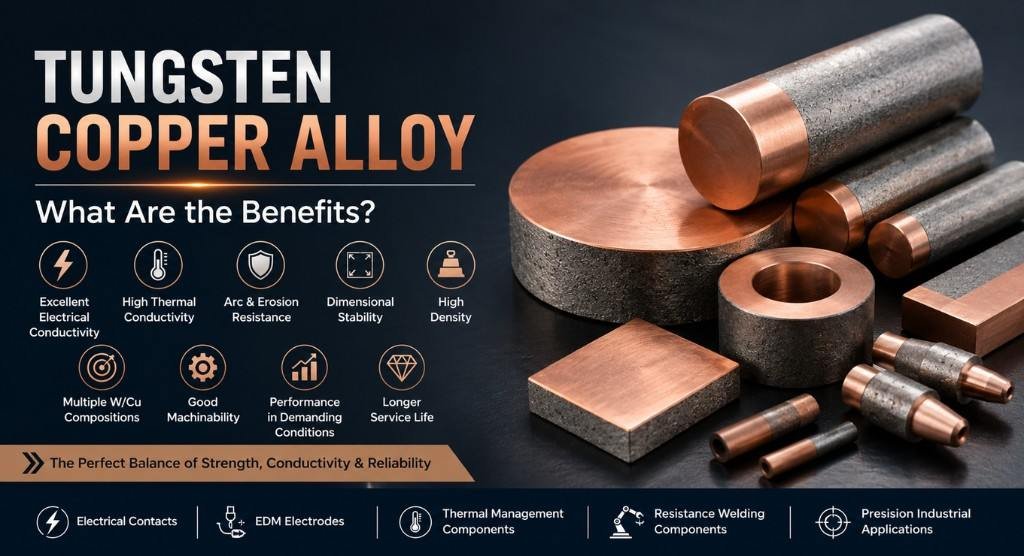
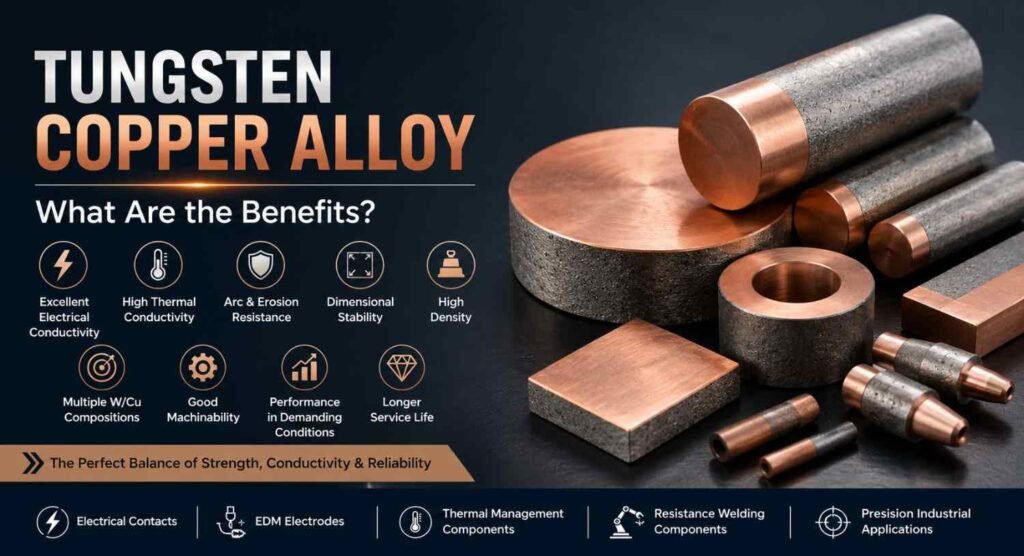
9 Powerful Benefits of Tungsten Copper Alloy
1. Excellent Electrical Conductivity
One of the biggest advantages of adding copper to a tungsten-based material is improved electrical conductivity compared with pure tungsten.
This is particularly valuable for components that must carry electrical current while simultaneously resisting heat, wear or electrical-arc-related damage.
This combination helps explain the established use of copper-tungsten materials in electrical contact components. ASTM B702 is specifically dedicated to copper-tungsten electrical contact material.
2. Strong Thermal Conductivity
Managing heat is increasingly important as electronic and electrical systems become more powerful and compact.
Copper provides excellent thermal conductivity, while tungsten contributes dimensional stability and refractory characteristics.
Depending on composition and manufacturing quality, tungsten-copper materials can therefore be attractive for specialized thermal-management applications where heat must be moved while controlling dimensional changes.
3. Excellent High-Temperature Capability
Here tungsten earns its place.
Tungsten has the highest melting point among pure metals, while copper melts at a much lower temperature.
A tungsten-copper composite does not simply inherit tungsten’s melting point as its operating temperature—the copper phase must also be considered. Nevertheless, the refractory tungsten skeleton can provide valuable resistance to thermal and electrical stresses.
This makes material selection particularly interesting for electrical contacts and other components exposed to intense localized heating.
4. Good Resistance to Arc Erosion
Electrical switching can be brutal on contact materials.
Every arc can expose the contact surface to localized heating and material erosion. Repeated switching cycles can gradually change the contact geometry and ultimately affect performance.
Tungsten’s refractory nature, combined with copper’s electrical and thermal conductivity, makes copper-tungsten an established material family for demanding electrical contact applications.
ASTM’s current B702-93(2024) specification covers copper-tungsten electrical contact components and compositions normally specified by contact users.
5. Low Thermal Expansion Compared with Copper
Thermal expansion can create serious problems in precision systems, which is why Tungsten Copper Alloy is often considered when dimensional stability and thermal performance are important.
A component repeatedly exposed to temperature changes may expand and contract. When different materials in an assembly expand at significantly different rates, mechanical stresses can develop.
Increasing tungsten content generally reduces the coefficient of thermal expansion relative to pure copper. This allows engineers to select a Tungsten Copper Alloy composition that provides a suitable balance of thermal conductivity and controlled thermal expansion.
That characteristic can be valuable in electronic packaging and thermal-management designs where dimensional stability is important.
6. High Density
Need significant mass in a relatively compact volume? Tungsten Copper Alloy can provide substantial density, particularly in compositions containing higher percentages of tungsten.
Higher-tungsten WCu compositions provide substantial density, making them suitable for specialized engineering requirements where weight and compact dimensions are important.
This characteristic means Tungsten Copper Alloy can be beneficial in specialized applications where compact mass, stability, or balancing characteristics matter alongside thermal or electrical properties.
The exact density varies significantly with tungsten percentage and manufacturing condition, so engineers should work from grade-specific technical data rather than assuming one universal value.
7. Good Wear and Erosion Resistance
Copper is highly conductive, but applications involving electrical arcs, localized thermal loading and repeated contact demand more than conductivity alone.
Tungsten strengthens the material system’s ability to withstand demanding service conditions.
This is one reason WCu is used where engineers need a balance of:
- Conductivity
- Thermal management
- Hardness
- Erosion resistance
- Dimensional stability
That balance can translate into longer component service life when the grade is correctly matched to the application.
8. Useful Machinability for Precision Components
Pure tungsten can be challenging to process. Tungsten Copper Alloy can offer improved processing characteristics compared with pure tungsten because of the presence of copper, although machining difficulty varies considerably with tungsten content, microstructure, and the manufacturing route.
WCu components can be produced or finished into precision geometries for specialized electrical, thermal, and industrial applications. This makes Tungsten Copper Alloy useful when components require both specialized material properties and precise dimensions.
Manufacturing techniques may include appropriate combinations of grinding, turning, milling, EDM, and other precision processes.
The exact machining method should always be selected according to the specific grade, geometry, tolerances, and component requirements.
9. Multiple Compositions Allow Application-Specific Performance
Perhaps the most underrated benefit of Tungsten Copper Alloy is its tunability.
Engineers do not have to treat tungsten copper as a single fixed material. Different W/Cu ratios can be selected depending on the performance priorities of the application.
Need greater conductivity?
A composition with more copper may be appropriate.
Need greater density, refractory performance, or lower thermal expansion?
A higher tungsten content may make more sense.
This flexibility allows engineers to select a Tungsten Copper Alloy composition that balances competing technical requirements rather than compromising the entire design around one material property.
Key Properties of Tungsten Copper Alloy
The actual properties depend heavily on composition, porosity, processing and manufacturer, but WCu materials are generally selected for combinations of the following:
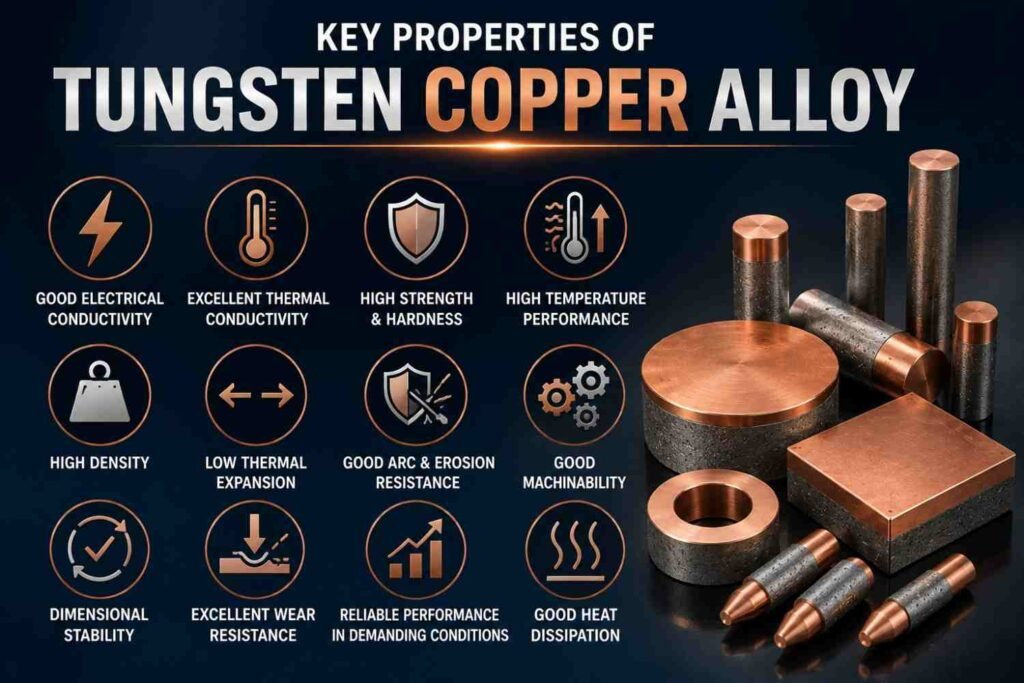
| Property | General Characteristic |
| Electrical conductivity | Moderate to high, composition-dependent |
| Thermal conductivity | Good, composition-dependent |
| Density | High |
| Thermal expansion | Lower than pure copper as W content increases |
| Hardness | Generally increases with tungsten content |
| Arc-erosion resistance | Good for suitable electrical-contact grades |
| Wear resistance | Good |
| High-temperature behavior | Enhanced by refractory tungsten phase |
| Dimensional stability | Good |
| Machinability | Grade and process dependent |
The key word is balance.
WCu is rarely selected because it beats every other material in one isolated property. Its value comes from delivering several useful characteristics simultaneously.
Technical Specifications
Because tungsten-copper is a composition family, technical specifications should be defined against the particular grade being purchased.
A proper technical enquiry should ideally specify:
Composition:
For example, W70Cu30, W75Cu25 or W80Cu20.
Dimensions:
Thickness, diameter, width, length and dimensional tolerances.
Density:
Specified according to the selected composition and manufacturing route.
Electrical Conductivity:
Where electrical performance is critical, specify the required conductivity or resistivity.
Thermal Conductivity:
Important for thermal-management applications.
Hardness:
Particularly relevant for wear-sensitive or contact components.
Surface Finish:
Specify when precision interfaces or electrical-contact surfaces are required.
Dimensional Tolerance:
Critical for machined parts and electronic packaging components.
Testing / Certification:
Specify the applicable standard, inspection requirement and material certification at the purchasing stage.
This prevents a common procurement mistake: ordering “tungsten copper” without defining what tungsten copper actually means for the application.
Tungsten Copper Alloy Standards
One particularly relevant recognized standard is:
ASTM B702-93(2024)
ASTM B702 – Standard Specification for Copper-Tungsten Electrical Contact Material
ASTM states that this specification covers copper-tungsten electrical contact components manufactured through powder-metallurgical procedures and compositions within the copper-tungsten system normally specified by users of contacts.
The standard also indicates that chemical composition limits are agreed between the manufacturer and user and that qualification tests for physical properties should be performed on production parts where practical or applicable.
This reinforces an important purchasing principle:
Do not select WCu based on the material name alone.
The grade, composition, properties, dimensions, manufacturing condition and intended application should all form part of the technical discussion.
Is There a UNS Number for Tungsten Copper Alloy?
This deserves special attention.
Unlike many conventional copper alloys, tungsten-copper does not have one universal UNS designation covering every WCu composition.
That is because tungsten-copper is a material family with multiple W/Cu ratios rather than one fixed conventional alloy chemistry.
For example, W70Cu30 and W80Cu20 clearly do not have identical composition or properties.
Therefore, for broad tungsten-copper procurement, it is more technically meaningful to specify:
WCu grade + composition + applicable standard + required properties + dimensions
rather than assuming a single UNS number represents every tungsten-copper material.
Applications of Tungsten Copper Alloy
The unusual property balance allows WCu materials to serve several demanding industrial applications.
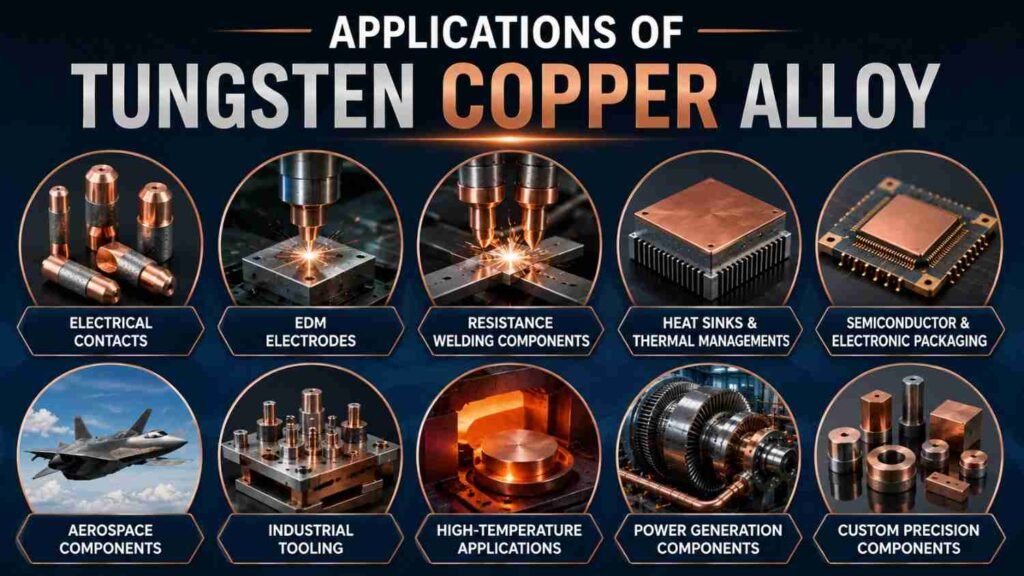
Electrical Contacts
One of the most established applications.
Copper supports current conduction, while tungsten contributes resistance to demanding thermal and arc conditions.
Typical components can include specialized:
- Electrical contacts
- Contact tips
- Switching components
- High-current contact components
EDM Electrodes
Electrical discharge machining requires electrode materials capable of conducting current while maintaining dimensional performance under repeated discharge conditions.
Tungsten Copper Alloy grades are therefore used for certain EDM electrodes, particularly when electrode wear and detail retention matter.
Resistance Welding Components
Certain Tungsten Copper Alloy compositions may be used for specialized resistance-welding electrodes and related components where electrical conductivity must coexist with resistance to localized thermal and mechanical stresses.
Heat Sinks and Thermal Management
Electronics can generate substantial heat in very small areas.
The combination of thermal conductivity and comparatively controlled thermal expansion makes selected Tungsten Copper Alloy compositions useful in specialized heat-spreading and electronic packaging applications.
Semiconductor and Electronic Packaging
Modern electronic components may require materials that help manage heat while maintaining dimensional stability.
The ability to adjust the W/Cu ratio makes Tungsten Copper Alloy useful for specialized thermal-management components where thermal expansion matching is an important design consideration.
High-Performance Industrial Components
WCu may also be considered for specialized parts requiring some combination of:
- High density
- Thermal stability
- Electrical conductivity
- Thermal conductivity
- Erosion resistance
- Dimensional stability
Selection should always be based on the actual operating environment.
Shapes Available in Tungsten Copper
Depending on composition, dimensions, manufacturer and quantity, tungsten-copper materials can be supplied or manufactured in forms such as:
- Rods
- Bars
- Plates
- Sheets
- Discs
- Blocks
- Electrodes
- Contact tips
- Rings
- Machined components
- Custom precision parts
Availability varies substantially with grade and dimension, so specialized sizes should be confirmed before finalizing component design.
Tungsten Copper vs Pure Copper vs Pure Tungsten
| Feature | Copper | Tungsten Copper | Tungsten |
| Electrical conductivity | Excellent | Good / composition-dependent | Lower |
| Thermal conductivity | Excellent | Good / composition-dependent | Good |
| Density | Moderate | High | Very high |
| Thermal expansion | Relatively high | Adjustable / lower than Cu | Low |
| Refractory behavior | Limited | Strong balance | Exceptional |
| Arc-erosion resistance | Limited in severe service | Good for suitable grades | High |
| Machining | Relatively easy | Moderate / grade-dependent | Difficult |
| Property balance | Conductivity-focused | Balanced | Refractory-focused |
This table explains the central advantage of WCu.
Copper dominates conductivity. Tungsten dominates refractory performance. Tungsten copper occupies the engineering space between them.
Why Choose DOMADIA™ for Tungsten Copper Alloy?
Specialty materials are not simply purchased by choosing a metal name from a catalogue.
Composition matters.
Dimensions matter.
Application matters.
Testing matters.
And, most importantly, consistency matters.
DOMADIA™ supports industrial customers seeking Tungsten Copper Alloy for specialized electrical, thermal, EDM and engineering requirements.
Composition Options
Requirements can be discussed around different W/Cu ratios depending on the desired balance between conductivity, density, thermal behavior and mechanical performance.
Multiple Product Forms
DOMADIA™ can support enquiries for rods, bars, plates, discs, electrodes, blocks and custom components subject to specification and availability.
Application-Based Material Selection
Instead of looking only at price per kilogram, material selection should consider service conditions, performance requirements and component life.
Technical Procurement Support
For specialized requirements, customers can specify chemistry, dimensions, tolerances, properties, testing and certification requirements at the enquiry stage.
Global Supply Capability
DOMADIA™ supports specialized material requirements for customers across India and international markets.
Choosing the Right Tungsten Copper Composition
Before sending an enquiry, answer five questions:
- What W/Cu composition does the application require?
- Is electrical conductivity or refractory performance more important?
- What thermal conditions will the component experience?
- What dimensions and tolerances are required?
- Which standard, testing and certification requirements apply?
These answers can significantly narrow the material-selection process.
A WCu grade with more copper may make sense when conductivity is the dominant requirement.
A higher-tungsten composition may be more suitable when density, dimensional stability, hardness or refractory behavior is more important.
There is no benefit in paying for a property the application does not need.
Conclusion: Why Tungsten Copper Is Such a Valuable Engineering Material
Tungsten Copper Alloy demonstrates why advanced engineering is often about finding the right balance rather than maximizing one property.
Tungsten contributes refractory characteristics, density, dimensional stability and resistance to demanding service conditions. Copper contributes valuable electrical and thermal conductivity.
Together, they create a versatile composite material suitable for applications ranging from electrical contacts and EDM electrodes to thermal-management and precision engineering components.
The biggest advantage, however, may be its flexibility. By adjusting the tungsten-to-copper ratio, engineers can select a material whose performance is much more closely aligned with the actual application.
For manufacturers, engineers and procurement teams searching for specialized tungsten-copper compositions, DOMADIA™ can support requirements based on grade, composition, dimensions, form and technical specifications.
The right question isn’t simply, “Do we need tungsten or copper?”
Sometimes, the better engineering answer is both.
Looking for the Right Tungsten Copper Alloy?
Choosing the right WCu composition can make a significant difference in conductivity, thermal performance, durability, and component reliability.
DOMADIA™supplies Tungsten Copper Alloy in multiple compositions, sizes, and product forms for specialized industrial applications.
👉 Contact DOMADIA™ todayto discuss your composition, dimensions, specifications, and application requirements.
Talk to: Er.Pankaj Domadia | Kairav Domadia | Aadil Domadia | Pragati Sanap | Pooja N N
#TungstenCopper #TungstenCopperAlloy #CopperTungsten #WCu #Tungsten #SpecialMetals #ElectricalContacts #EDM #ThermalManagement #EngineeringMaterials #AdvancedMaterials #DOMADIA
Directly whatsapp us for an Enquiry: https://wa.link/kairav
Our materials reach Chennai, Coimbatore, Hosur, Madurai, and Trichy, supporting manufacturing hubs in Tamil Nadu, Kerala, Karnataka, Andhra Pradesh, and Telangana, while shipping to France, Spain, UK, Netherlands, and Belgium.