Blogs
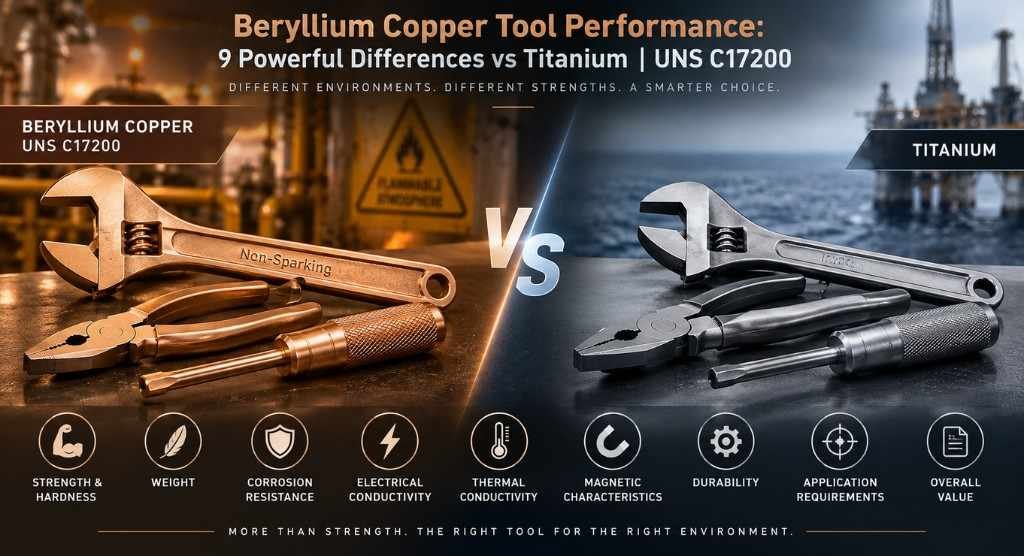
Beryllium Copper Tool Performance: 9 Powerful Differences vs Titanium | UNS C17200
Beryllium Copper Tool Performance matters when ordinary steel tools may not suit demanding or potentially hazardous environments.

Tool selection can depend on strength, hardness, corrosion resistance, conductivity, magnetic characteristics, and durability. This makes Beryllium Copper Tool Performance especially relevant when comparing UNS C17200 with titanium.
Titanium offers low weight, excellent strength-to-weight ratio, and corrosion resistance, while UNS C17200 combines high strength and hardness with useful electrical and thermal conductivity.
There is no universal winner. Beryllium Copper Tool Performance versus titanium ultimately depends on the application.
Here are 9 powerful differences to consider.
What Is UNS C17200 Beryllium Copper?
UNS C17200 is a high-strength copper-beryllium alloy containing approximately 1.80–2.00% beryllium, with copper forming the balance subject to specified limits for other elements. Its composition plays an important role in achieving reliable Beryllium Copper Tool Performance.
When appropriately heat treated, C17200 can deliver an unusual combination of mechanical strength, hardness, corrosion resistance, conductivity, and formability. Copper Development Association data reports approximately 22% IACS electrical conductivity in the precipitation-hardened condition and a density of about 8.26 g/cm³.
This combination supports Beryllium Copper Tool Performance in demanding mechanical, electrical, marine, spring, connector, and specialized tool-related applications.
Beryllium Copper Tool Performance: 9 Differences vs Titanium

1. Non-Sparking Tool Applications
One of the main reasons engineers consider beryllium copper for specialized tooling is not simply strength.
It is the alloy’s established use in special-purpose tool applications.
Copper Development Association data specifically lists MIL-C-21657, covering copper-beryllium alloy with low magnetic effect for special-purpose tools and equipment, among the specifications associated with C17200.
This makes beryllium copper relevant where conventional ferrous tooling may not suit the application’s safety or magnetic requirements.
However, calling any tool simply “non-sparking” should never replace a proper workplace risk assessment. Tool suitability depends on the exact hazardous environment, tool design, certification, maintenance condition, and applicable safety requirements.
Practical takeaway: Choose a tool because its complete specification is appropriate for the hazard—not merely because of the alloy name.
2. Titanium Has a Major Weight Advantage
Here titanium immediately changes the conversation. When evaluating Beryllium Copper Tool Performance, weight is one area where titanium has a clear advantage.
Titanium is substantially lighter than copper-beryllium alloys. C17200 has a density of approximately 8.26 g/cm³, according to Copper Development Association data.
For hand tools carried for long periods, frequently transported maintenance kits, or applications where every gram matters, material density can significantly affect usability. A lighter tool can potentially reduce carrying load and improve convenience, depending on its geometry and design.
Therefore, if the primary engineering objective is minimum weight combined with high mechanical strength, titanium deserves serious consideration.
However, Beryllium Copper Tool Performance is not defined by winning the weight contest. Its advantage lies in its distinctive combination of strength, hardness, conductivity, corrosion resistance, and specialized functional properties.
3. C17200 Offers Exceptional Strength for a Copper Alloy
Calling beryllium copper “just another copper alloy” dramatically understates its mechanical capability.
Copper Development Association marine engineering guidance notes that age-hardened copper-beryllium can attain the highest strength and hardness among commercial copper-based alloys. Depending on condition, reported tensile strength can reach approximately 1,400 N/mm², while hardness can reach roughly 420 HV.
Specific properties depend strongly on temper, product form, dimensions, and heat treatment.
This is important for tooling because a tool may experience:
- Impact
- Repeated loading
- Bending forces
- Surface contact
- Wear
- Mechanical shock
- Cyclic stress
The material therefore needs more than one attractive property.
For many demanding applications, Beryllium Copper Tool Performance comes from the combination of strength, hardness, conductivity, and corrosion behaviour rather than a single maximum value.
4. Electrical Conductivity Creates a Major Material Difference
This is where comparing beryllium copper and titanium only by strength becomes misleading. Beryllium Copper Tool Performance also benefits from the useful electrical conductivity retained by UNS C17200.
The Copper Development Association reports approximately 22% IACS electrical conductivity for C17200 in the precipitation-hardened condition. This is significant because the alloy can simultaneously provide high mechanical strength, making Beryllium Copper Tool Performance relevant where both mechanical and electrical properties matter.
Titanium is generally selected for different engineering advantages and does not provide copper-alloy-like electrical conductivity.
Therefore, where conductivity is required alongside mechanical strength, Beryllium Copper Tool Performance can offer a distinctive combination for demanding applications.
5. Thermal Conductivity Also Favors a Different Design Philosophy
Tools and components do not operate only mechanically.
Heat can matter.
C17200 has reported room-temperature thermal conductivity around 107–130 W/m·K in Copper Development Association data.
This gives engineers another property to consider when thermal transfer matters.
Titanium’s appeal, by contrast, often lies in applications where low density, corrosion resistance, and high strength-to-weight ratio dominate.
This illustrates an important purchasing lesson:
Two tools can look similar while behaving very differently because of their underlying material properties.
Material selection should therefore begin with the operating environment, not the catalogue photograph.
6. Both Materials Can Offer Strong Corrosion Performance
Corrosion is rarely a simple yes-or-no property. Temperature, moisture, chemicals, salt exposure, surface condition, galvanic contact, and service duration can all influence Beryllium Copper Tool Performance.
Copper-beryllium alloys can provide strong corrosion resistance in demanding environments. This makes Beryllium Copper Tool Performance relevant for applications involving subsea connectors, drill components, actuators, locking rings, valve gates, and other marine-related components.
Titanium is also widely valued for excellent corrosion resistance in many aggressive environments. Therefore, the better question is not simply, “Which metal is corrosion resistant?” Instead, engineers should ask which material is compatible with the exact chemicals, temperature, mechanical loading, and service conditions involved.
Evaluating these factors helps determine whether Beryllium Copper Tool Performance or titanium characteristics better match the application.
7. Magnetic Behaviour Can Influence Specialized Tool Selection
Magnetic characteristics can become important around specialized instruments, measurement systems, and environments where magnetic interaction must be controlled. In these situations, Beryllium Copper Tool Performance may extend beyond strength and hardness.
The presence of MIL-C-21657 among specifications associated with C17200 is notable because it covers copper-beryllium alloy with low magnetic effect for special-purpose tools and equipment. This can make Beryllium Copper Tool Performance relevant in specialized low-magnetic applications.
However, not every C17200 product automatically satisfies every low-magnetic requirement. Material condition, manufacturing process, finished product, certification, and applicable standards must still be verified.
For critical applications, procurement teams should request appropriate documentation to confirm Beryllium Copper Tool Performance rather than relying on a generic material description.
8. Tool Life Can Matter More Than Purchase Price
Here is where procurement economics becomes more interesting.
Suppose Tool A costs less but requires frequent replacement.
Tool B costs more initially but provides longer useful service under the actual operating conditions.
The correct comparison is not:
Purchase Price A vs Purchase Price B
It should consider:
Initial Cost + Replacement Cost + Labour + Downtime + Inventory + Production Disruption + Disposal
A specialized tool that performs reliably for longer may potentially reduce total ownership cost even when its initial price is higher.
However, service life depends on actual tool geometry, hardness, heat treatment, loading, maintenance, misuse, and operating conditions. It should therefore be evaluated from application data rather than assumed from alloy type alone.
At DOMADIA™, this lifecycle perspective is important when customers evaluate specialty materials.
The cheapest material per kilogram is not necessarily the cheapest material in service.
9. The Better Tool Depends on the Job
This is the most important difference of all.
There is no engineering rule saying:
Beryllium copper is always better than titanium.
And there is no useful rule saying:
Titanium is always more advanced because it is lighter.
Material selection is application-specific.
Consider UNS C17200 when requirements may include:
- High strength for a copper alloy
- High hardness after suitable heat treatment
- Useful electrical conductivity
- Useful thermal conductivity
- Corrosion resistance
- Specialized low-magnetic applications
- Special-purpose tooling requirements
- A combination of mechanical and functional properties
Consider titanium when priorities may include:
- Low component weight
- Excellent strength-to-weight ratio
- Strong corrosion resistance
- Weight-sensitive equipment
- Applications where copper-alloy conductivity is unnecessary
The correct decision starts with the application specification.
Chemical Composition of UNS C17200
The registered C17200 composition published by the Copper Development Association specifies 1.80–2.00% Be, copper as the remainder, and limits/requirements for other named elements. The CDA data also notes Cu plus the sum of named elements at 99.5% minimum, along with requirements involving nickel, cobalt, and iron.
| Element / Requirement | UNS C17200 |
| Copper (Cu) | Remainder |
| Beryllium (Be) | 1.80–2.00% |
| Aluminium (Al) | 0.20% max |
| Silicon (Si) | 0.20% max |
| Ni + Co | 0.20% min |
| Ni + Fe + Co | 0.60% max |
| Cu + named elements | 99.5% min |
Actual certified chemistry should always be confirmed through the material test certificate for the supplied batch.
Key Properties of UNS C17200
The usefulness of Beryllium Copper Tool Performance comes from combining several properties that can be difficult to obtain simultaneously in conventional materials. Depending on temper, heat treatment, product form, and processing, UNS C17200 can offer the following characteristics:

High Tensile Strength
Properly heat-treated C17200 can achieve high mechanical strength, helping components withstand demanding tensile and mechanical loads.
High Hardness
Age hardening can significantly increase hardness, supporting Beryllium Copper Tool Performance where resistance to deformation and surface wear is important.
Good Fatigue Characteristics
C17200 can perform effectively under repeated or cyclic loading, making it useful for springs, tools, and mechanically stressed components.
Useful Electrical Conductivity
Unlike many high-strength engineering alloys, C17200 retains useful electrical conductivity, contributing to Beryllium Copper Tool Performance in applications where both strength and conductivity matter.Useful Thermal Conductivity: The alloy can transfer heat more effectively than many conventional high-strength materials, which can be valuable in thermally demanding applications.
Corrosion Resistance
C17200 offers useful corrosion resistance in many industrial and marine environments when appropriately specified for the service conditions.Good Cold-Working Capability: The alloy can be cold worked in suitable conditions to manufacture precision shapes, components, and intermediate product forms.
Excellent Hot-Forming Capability
Suitable hot-forming characteristics allow C17200 to be processed into complex forms before final heat treatment and finishing.Age-Hardening Response: Controlled precipitation hardening can substantially improve strength and hardness, making heat treatment an important factor in achieving the required Beryllium Copper Tool Performance.
Specialized Low-Magnetic Applications
Appropriately specified copper-beryllium materials can be considered for specialized applications where low magnetic effects are important, subject to the relevant product standard and certification.
Copper Development Association data gives C17200 a density of approximately 8.26 g/cm³, electrical conductivity around 22% IACS in the precipitation-hardened condition, and modulus of elasticity in tension around 18,500 ksi.
Together, these characteristics explain why Beryllium Copper Tool Performance is evaluated across specialized tooling, electrical, mechanical, marine, aerospace, and precision-engineering applications.
However, actual Beryllium Copper Tool Performance depends on temper, dimensions, heat treatment, manufacturing process, and final tool design. These figures should therefore be treated as material-reference data rather than guaranteed values for every finished product.
Technical Specifications of UNS C17200
Several technical parameters help engineers understand why C17200 behaves differently from ordinary copper alloys.
| Property | Reference Value |
| Density | Approx. 8.26 g/cm³ |
| Electrical Conductivity | Approx. 22% IACS* |
| Thermal Conductivity | Approx. 107–130 W/m·K |
| Solidus | Approx. 866°C |
| Liquidus | Approx. 982°C |
| Modulus of Elasticity | Approx. 127.6 GPa |
| Beryllium Content | 1.80–2.00% |
Reported for precipitation-hardened material. Properties vary with temper, product form, processing, and heat treatment.
Standards for UNS C17200
C17200 is covered by different specifications depending on product form and intended application.
Commonly referenced standards include:
- ASTM B194 – copper-beryllium plate, sheet, strip, and rolled bar
- ASTM B196/B196M – copper-beryllium rod and bar
- ASTM B197/B197M – copper-beryllium wire
- ASTM B643 – copper-beryllium seamless tube
- ASTM B570 – copper-beryllium forgings and extrusions
- AMS 4530 – sheet, strip, and plate in specified condition
- AMS 4532 – sheet and strip
- AMS 4533 / AMS 4534 / AMS 4650 / AMS 4651 – specified bar, rod, forging, and heat-treatment conditions
- MIL-C-21657 – copper-beryllium alloy with low magnetic effect for special-purpose tools and equipment
The Copper Development Association lists these specifications against applicable C17200 product forms.
Always confirm the current revision and exact specification required by the drawing, customer, industry, or application before ordering.
Shapes Available in UNS C17200
UNS C17200 can be supplied or manufactured in multiple forms depending on specification, temper, dimensions, and availability.
Typical forms include:
- Sheet
- Strip
- Plate
- Foil
- Round bar
- Rod
- Wire
- Tube
- Forgings
- Extrusions
- Custom-machined components
- Specialty tool blanks
CDA specification data confirms standard coverage for forms including sheet, strip, plate, rod, bar, wire, seamless tube, forgings, and extrusions.
For DOMADIA™ customers, the correct form should be selected according to final machining requirements, heat-treatment condition, dimensions, tolerance, and application.
Applications of UNS C17200
Although this comparison focuses on tools, C17200 is much broader than a tooling alloy. Its combination of strength, hardness, conductivity, and durability allows Beryllium Copper Tool Performance characteristics to extend across many demanding applications.

Specialized Tools
Specialized tools requiring controlled mechanical or low-magnetic characteristics may use appropriately specified copper-beryllium alloys. In these applications, Beryllium Copper Tool Performance can depend on material condition, tool design, certification, and operating environment.
Springs and Spring Components
High strength and elastic behaviour make C17200 useful for demanding springs and spring components. These mechanical characteristics also contribute to Beryllium Copper Tool Performance where repeated loading and durability are important.
Electrical Contacts and Connectors
C17200 combines mechanical strength with useful electrical conductivity, making it suitable for electrical contacts, connectors, and electromechanical components. This combination is another important aspect of Beryllium Copper Tool Performance.
Aerospace Components
Aerospace applications requiring compact components with carefully controlled mechanical and electrical properties may consider copper-beryllium grades such as UNS C17200.
Marine Components
Copper Development Association literature identifies applications including subsea connectors, drill components, actuators, locking rings, lifting nuts, and valve gates. Corrosion resistance and mechanical properties can therefore influence Beryllium Copper Tool Performance in demanding marine-related environments.
Precision Components
Bushings, diaphragms, spring elements, wear components, and other precision parts can benefit from carefully specified C17200 material where strength, dimensional performance, and durability are required.
Industrial Equipment
Components exposed to repeated mechanical loading, corrosion, electrical requirements, or combinations of these conditions may justify evaluation of C17200. Understanding the complete operating environment helps engineers determine whether Beryllium Copper Tool Performance matches the requirements of the industrial application.
Beryllium Copper vs Titanium Tools: Quick Comparison
| Factor | UNS C17200 Beryllium Copper | Titanium |
| Weight | Heavier | Significantly lighter |
| Strength | Very high for copper alloy | High strength-to-weight ratio |
| Electrical Conductivity | Meaningful conductivity | Relatively low |
| Thermal Conductivity | Higher | Lower |
| Corrosion Resistance | Strong in many environments | Excellent in many environments |
| Specialized Tooling | Established applications | Application-dependent |
| Low-Magnetic Applications | Relevant when appropriately specified | Grade/application-dependent |
| Hardness | Can become very high after appropriate treatment | Depends strongly on alloy/condition |
| Best Selection Basis | Functional combination of properties | Low weight + mechanical/corrosion performance |
The table should be used as an initial engineering comparison rather than as a substitute for application-specific material selection.
Environmental Perspective: Longer Service Life Can Reduce Material Turnover
Sustainability should not be reduced to one statement such as “Material A is greener than Material B.”
The complete lifecycle matters.
Every prematurely replaced tool can involve additional raw material, manufacturing, packaging, transportation, inventory handling, and eventually recycling or disposal.
Therefore, if a properly selected specialty tool remains functional longer in its intended application, fewer replacements may reduce material turnover over the equipment lifecycle.
That is why DOMADIA™ encourages customers to consider service life alongside initial price.
Selecting durable materials for appropriate applications can support a broader industrial objective:
use the right material, obtain the required service life, and avoid unnecessary replacement.
Actual environmental performance should still be evaluated through application-specific lifecycle data rather than assumed solely from alloy type.
Important Safety Note for Beryllium Copper
Finished beryllium-copper products should be handled according to applicable workplace and supplier safety requirements.
Particular care is required during operations that may generate airborne dust, fumes, or fine particles, such as certain grinding, machining, sanding, welding, or other material-removal processes.
Suitable engineering controls, exposure assessment, personal protective equipment, housekeeping, and regulatory procedures should be established by qualified safety personnel.
A finished tool and a process generating respirable material are not the same exposure scenario.
Why DOMADIA™ for UNS C17200?
Choosing a specialty alloy is only the beginning.
The next challenge is obtaining the correct grade, form, temper, dimensions, standard, and documentation for the intended application.
DOMADIA™ supports industrial buyers, engineers, manufacturers, maintenance teams, R&D departments, and specialized equipment manufacturers looking for high-performance materials.
Customers can approach DOMADIA™ for requirements involving:
- UNS C17200 beryllium copper
- Sheets and strips
- Plates
- Rods and bars
- Wires
- Foils
- Tubes
- Custom dimensions
- Application-oriented material sourcing
- Technical specification discussions
- Industrial and export requirements
Instead of selecting material based only on price, DOMADIA™ encourages customers to consider the complete requirement: mechanical properties, conductivity, corrosion environment, form, temper, standard, dimensions, lifecycle, and final operating conditions.
Conclusion: Is Beryllium Copper Better Than Titanium Tools?
Beryllium Copper Tool Performance should not be judged by strength alone.
UNS C17200 combines high mechanical strength and hardness potential with useful electrical conductivity, thermal conductivity, corrosion resistance, and suitability for specialized applications. Titanium brings a different advantage set, particularly low density, corrosion resistance, and exceptional strength relative to weight.
So which tool material should you choose?
Start with the environment.
Then evaluate the hazard requirements, weight, mechanical loading, conductivity, corrosion exposure, magnetic requirements, expected service life, applicable standards, and total lifecycle cost.
For applications where the distinctive combination of copper-alloy strength, conductivity, hardness, and specialized functional characteristics matters, UNS C17200 can be a highly valuable engineering choice.
For applications dominated by weight reduction and strength-to-weight performance, titanium may be the more suitable material.
At DOMADIA™, material selection begins with one question:
What does the application actually require?
Looking for UNS C17200 Beryllium Copper for Demanding Applications?
When strength, hardness, conductivity, corrosion resistance, and specialized performance matter, choosing the right material specification is critical.
DOMADIA™ supplies UNS C17200 Beryllium Copper in various forms and specifications for industrial, electrical, precision engineering, specialized tooling, and other demanding applications.
Have a requirement? Share your required grade, form, temper, dimensions, quantity, standard, and application with DOMADIA™.
Talk to: Er.Pankaj Domadia | Kairav Domadia | Aadil Domadia | Pragati Sanap | Pooja N N
#BerylliumCopper #UNSC17200 #BerylliumCopperTools #TitaniumTools #CopperBeryllium #SpecialAlloys #IndustrialMaterials #EngineeringMaterials #MaterialSelection #DOMADIA
Directly whatsapp us for an Enquiry: https://wa.link/kairav
From Bikaner, Sri Ganganagar, Hanumangarh, Churu, and Jhunjhunu, we serve Rajasthan, Haryana, Punjab, UP, and Delhi, exporting to Kazakhstan, Uzbekistan, Turkmenistan, Kyrgyzstan, and Tajikistan.