Blogs
Automotive High Temperature Cable: 9 Powerful Facts About Choosing UNS C11000 Copper Cable
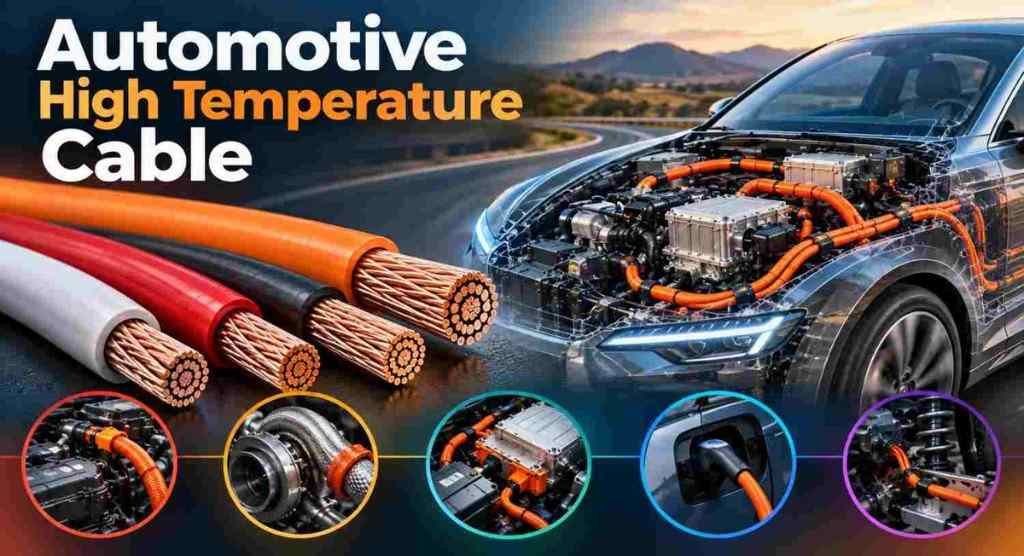
Automotive High Temperature Cable selection can become a surprisingly expensive engineering decision when a cable that looks perfectly suitable on paper is routed beside an exhaust component, turbocharger, high-current connection, motor, inverter, battery system, or other severe thermal zone.
Consider a vehicle operating normally during a long drive. Under the hood, temperatures rise, conductors carry current, the engine vibrates, fluids are present, and wiring repeatedly flexes with vehicle movement. A standard cable may continue conducting electricity—but its insulation can gradually harden, crack, abrade, or lose its protective properties.
That changes the question from:
“Which cable can handle the highest temperature?”
to:
“Which cable can survive the complete automotive environment?”
For many demanding automotive applications, ETFE, PTFE, PFA, silicone, cross-linked automotive insulation, and specialized high-temperature constructions can all be appropriate. Choosing the right Automotive High Temperature Cable depends on the actual temperature, voltage, conductor size, flexibility, chemical exposure, abrasion, installation location, and applicable automotive standard.
This guide from DOMADIA™ explains how to make that choice.
1. What Makes an Automotive High Temperature Cable Different?
An Automotive High Temperature Cable has to do much more than tolerate heat.
Automotive wiring can experience several stresses simultaneously:
- Elevated continuous temperatures
- Short-duration temperature peaks
- Engine and road vibration
- Tight routing spaces
- Repeated flexing
- Oil and automotive fluid exposure
- Moisture
- Abrasion
- Mechanical compression
- Electrical loading
- Rapid heating and cooling
- Long operating periods
This is why temperature rating alone should never determine cable selection.
For example, a material capable of tolerating a very high temperature may not necessarily provide the flexibility, abrasion resistance, diameter, fluid resistance, or installation characteristics required for a particular vehicle harness.
The entire cable construction matters.
2. Which High Temperature Cable Is Best for Automotive Applications?
There is no single insulation material that wins every automotive application.
However, a useful selection approach looks like this:
| Cable / Insulation Type | Typical Strength | Suitable Automotive Situations |
| ETFE | Thin, tough, abrasion-resistant, heat-resistant | Compact harnesses, sensors, engine compartments |
| PTFE | Excellent temperature and chemical resistance | Severe thermal and chemical environments |
| PFA | High-temperature fluoropolymer performance | Very demanding high-temperature wiring |
| Silicone | Excellent flexibility and heat performance | Flexible leads, engine-area connections |
| Cross-linked automotive insulation | Practical balance of durability, size and temperature | General automotive harnesses |
| Fluoroelastomer constructions | Heat and fluid resistance | High-temperature power applications |
| Fiberglass/ceramic constructions | Extreme-temperature capability | Specialized zones near intense heat sources |
The correct answer therefore depends on where the cable will be installed.
TE Connectivity, for example, describes automotive battery and power cables intended for high-temperature routing and notes solutions operating in the 150°C to 200°C range, while also emphasizing resistance to abrasion, cut-through, vehicle fluids and extreme temperatures.
A Practical Rule
For compact automotive wiring where abrasion resistance, low weight, thin insulation and elevated-temperature capability matter, ETFE can be an excellent candidate.
For more severe temperatures or aggressive chemical exposure, PTFE or PFA may become more appropriate.
Where exceptional flexibility is important, silicone-insulated cable can offer advantages.
The specification must ultimately be based on the vehicle manufacturer’s requirements and the applicable cable standard.
3. ETFE Cable: A Strong Automotive Candidate
ETFE—ethylene tetrafluoroethylene—is a fluoropolymer insulation material used in demanding electrical applications.
One of its major advantages is that good thermal performance does not necessarily require extremely bulky insulation.
That matters inside modern vehicles.
Today’s vehicles contain increasing numbers of:
- Sensors
- Control modules
- Cameras
- Motors
- Electronic control systems
- Power electronics
- Battery systems
- Communication circuits
- Driver-assistance electronics
Space inside a wiring harness is valuable.
A thin, mechanically tough insulation system can therefore offer a significant engineering advantage.
As one real-world reference point, TE Connectivity lists a radiation-crosslinked modified ETFE wire with a -65°C to 200°C operating-temperature range, 600 V operating voltage and tin-plated copper conductor.
That does not mean every ETFE automotive cable is automatically rated to 200°C. Ratings depend on the particular cable construction, manufacturer qualification and applicable specification.
4. PTFE Cable for Severe Automotive Heat
PTFE—polytetrafluoroethylene—is widely recognized for high-temperature capability and chemical resistance.
It can be particularly useful where wiring is exposed to demanding combinations of:
heat + chemicals + electrical insulation requirements.
Potential automotive applications can include wiring around:
- High-temperature sensors
- Engine systems
- Exhaust-related instrumentation
- Test vehicles
- Motorsport systems
- Specialized powertrain equipment
- High-temperature electronic assemblies
PTFE also has good dielectric characteristics.
However, specifying PTFE merely because it offers a high temperature rating may unnecessarily increase cost or create other design compromises.
The objective is not to purchase the most temperature-resistant cable available.
It is to select the appropriate cable for the actual operating envelope.
5. PFA for Even More Demanding Environments
PFA is another fluoropolymer used when demanding thermal, chemical and electrical properties are required.
It can provide excellent high-temperature performance while maintaining useful electrical insulation characteristics.
PFA cable may be considered for specialized automotive environments involving:
- Severe thermal exposure
- Aggressive chemicals
- Sensors
- Laboratory vehicles
- Automotive testing systems
- Motorsport
- High-performance powertrain development
- Specialized EV systems
PFA may cost more than ordinary automotive wire.
But cable cost should not be considered independently.
If a less suitable cable fails prematurely, the actual cost may include diagnosis, harness removal, vehicle downtime, component replacement and labour.
A cable costing more per metre can therefore be less expensive over the complete service life.
6. Silicone Cable: When Flexibility Matters
Silicone-insulated cable is another useful high-temperature option.
Its major advantage is flexibility.
This can make silicone attractive for areas where the wire must tolerate movement while remaining flexible across a broad temperature range.
Possible automotive uses include:
- Battery connections
- Flexible equipment leads
- Engine-compartment wiring
- Test equipment
- Motorsport
- Sensors
- Auxiliary heating systems
However, mechanical protection remains important.
A cable that performs extremely well thermally may still require additional protection where it is exposed to abrasion, sharp edges or repeated rubbing.
Sleeving, conduit, clips, routing and strain relief can be just as important as the insulation chemistry.
7. Chemical Composition of Automotive High Temperature Cable
Unlike a solid metal alloy, a cable does not have one universal chemical composition.
It is a multi-material engineered product.
A typical construction can include:
Conductor
Common conductor materials include:
- Bare copper
- Tinned copper
- Nickel-plated copper
- Silver-plated copper
- Aluminium in selected automotive applications
Where a specified copper grade such as UNS C11000 is used, it refers to the conductor material—not the complete cable.
The actual conductor grade should always be confirmed from the required specification or manufacturer documentation rather than assumed from the generic term “copper wire.”
Insulation
Depending on the application:
- ETFE
- PTFE
- PFA
- Silicone
- Cross-linked polymers
- Fluoroelastomers
- Fiberglass systems
- Ceramic/high-temperature constructions
Additional Layers
Some cable constructions may also incorporate:
- Braided shielding
- Foil shielding
- Fiberglass braid
- Protective jackets
- Metallic screens
- Mechanical reinforcement
Therefore, specifying only “high-temperature copper cable” leaves too many engineering variables unanswered.
8. Important Properties for Automotive Applications
The best Automotive High Temperature Cable should be evaluated across several properties.

Temperature Resistance
For Automotive High Temperature Cable, check both continuous operating temperature and short-duration exposure temperature, as these ratings are not interchangeable.
Electrical Conductivity
Copper provides high electrical conductivity, making it a preferred conductor for Automotive High Temperature Cable applications and vehicle wiring systems.
Flexibility
Harnesses must travel through complex vehicle geometries, so flexibility is essential for Automotive High Temperature Cable installation and reducing mechanical stress.
Abrasion Resistance
An Automotive High Temperature Cable may experience vibration for thousands of operating hours, so its insulation must withstand the mechanical stresses of vehicle installation.
Chemical Resistance
Depending on installation location, Automotive High Temperature Cable may encounter oils, fuels, coolants, cleaners, and other substances, making chemical compatibility essential for reliable performance.
Dielectric Performance
Automotive High Temperature Cable insulation must maintain reliable electrical isolation at the specified voltage while withstanding demanding environmental conditions.
Flame Performance
Applicable vehicle specifications may define flame-propagation requirements that Automotive High Temperature Cable must meet for safe and reliable operation.
Mechanical Strength
Automotive High Temperature Cable may need resistance to cut-through, crushing, scraping, bending, vibration, and tensile loads, showing why cable selection cannot be based on temperature alone.
9. Technical Specifications to Check Before Ordering
Before selecting a high-temperature automotive cable, provide your supplier with a complete operating specification.
| Parameter | Information Required |
| Conductor | Copper, tinned copper, plated copper or aluminium |
| Conductor size | mm² or AWG |
| Insulation | ETFE, PTFE, PFA, silicone, etc. |
| Continuous temperature | °C |
| Peak temperature | °C and duration |
| System voltage | V AC/DC |
| Current | A |
| Outside diameter | Maximum allowable OD |
| Flexibility | Static or dynamic |
| Fluid exposure | Oil, fuel, coolant, chemicals |
| Mechanical environment | Abrasion, vibration, bending |
| Shielding | Required/not required |
| Standard | SAE, ISO, OEM specification, etc. |
| Quantity | Metres/reels |
| Application | Exact vehicle location |
A temperature requirement such as “must withstand 200°C” is therefore only the beginning of a proper specification.
Automotive High Temperature Cable Standards
Automotive cable requirements can vary by vehicle type, voltage and region.

SAE J1128
The current SAE J1128 revision covers low-voltage primary cable intended for surface-vehicle electrical systems operating at nominal system voltages of 60 V DC / 25 V AC or less. SAE states that its tests qualify cables for normal applications with limited exposure to fluids and physical abuse.
ISO 19642 Series
For modern automotive cable specifications, the ISO 19642 series is particularly relevant.
For example, ISO 19642-5:2019 specifies dimensions and requirements for single-core copper-conductor automotive cables for systems up to 600 V AC/900 V DC and 1,000 V AC/1,500 V DC, depending on the category addressed by the standard. ISO identifies it as a successor to earlier ISO 6722-related standards.
ISO also publishes ISO 19642-6:2019 for corresponding single-core aluminium-conductor automotive cables.
Older documentation may reference ISO 6722. Engineers should be careful because ISO lists earlier ISO 6722 editions, including ISO 6722-1:2011, as withdrawn.
The applicable OEM specification can be equally important. Always verify the current standard revision and customer-specific requirements before production approval.
Applications of High Temperature Automotive Cable
High-temperature cables may be required throughout conventional, hybrid and electric vehicles.

Engine Compartment
The engine bay combines high temperatures, vibration, fluids, and limited installation space, making an Automotive High Temperature Cable essential for dependable wiring performance.
Exhaust and Emission Sensors
Sensors positioned near exhaust components can face severe heat, making an Automotive High Temperature Cable important for reliable operation in demanding thermal conditions.
Turbocharger Areas
Wiring near turbochargers faces intense heat, making an Automotive High Temperature Cable important for safe routing, thermal protection, and reliable performance.
Electric Vehicles
An Automotive High Temperature Cable helps manage the demanding electrical and thermal conditions around EV battery packs, inverters, motors, charging systems, and DC/DC converters. Higher-voltage EV architectures also require cables with suitable voltage ratings and applicable automotive standards.
Hybrid Vehicles
Hybrid powertrains combine internal-combustion heat with high-voltage electrical systems, making an Automotive High Temperature Cable important for reliable performance in demanding thermal environments.
Motorsport
Race vehicles face extreme heat, vibration, tight packaging, and weight constraints, making an Automotive High Temperature Cable essential for reliable wiring performance under demanding conditions.
Sensors
Temperature, pressure, oxygen, and other sensors may operate in high-heat areas where conventional PVC wire is unsuitable, making an Automotive High Temperature Cable a reliable choice.
Battery and Power Connections
High-current connections can generate additional heat beyond ambient temperatures, making an Automotive High Temperature Cable important for reliable electrical performance and thermal durability.
Shapes and Forms Available
DOMADIA™ can support enquiries for specialized high-temperature electrical materials and cable constructions in forms such as:
- Single-core wire
- Multi-core cable
- Flexible cable
- Shielded cable
- Unshielded cable
- Braided cable
- Sensor cable
- Power cable
- High-voltage cable
- Custom conductor sizes
- Cable supplied in coils or reels
- Application-specific constructions
Availability depends on conductor, insulation, dimensions, temperature rating, voltage rating, standard and quantity.
Where Should Different Cables Be Used?
A practical selection map can simplify the decision.
Moderately elevated automotive temperatures:
Consider qualified cross-linked automotive cable appropriate to the applicable standard.
High-temperature, compact harnesses requiring strong abrasion resistance:
Consider ETFE-based constructions.
High-temperature and chemically demanding environments:
Consider PTFE.
Severe high-temperature fluoropolymer applications:
Consider PFA where its particular properties are justified.
High-temperature areas requiring exceptional flexibility:
Consider silicone.
Extremely hot specialized zones:
Fiberglass, ceramic or other specialized constructions may be necessary, but these should not automatically be treated as substitutes for conventional automotive harness cable.
Why the Highest Temperature Rating Is Not Always Best
Suppose Cable A is rated for a higher temperature than Cable B.
Does that automatically make Cable A better?
No.
Cable B might provide:
- Better abrasion resistance
- Smaller diameter
- Easier termination
- Greater flexibility
- Lower weight
- Better harness compatibility
- Lower cost
- Better OEM qualification
If the actual operating environment never exceeds Cable B’s validated limits, choosing Cable A simply because its headline temperature number is higher may offer little practical advantage.
Good cable engineering means matching properties to conditions, not maximizing one specification.
Common Automotive Cable Selection Mistakes
One frequent mistake is designing around ambient temperature alone.
The cable can experience heat from the surrounding environment and electrical current.
Other common problems include:
- Ignoring short-term thermal peaks.
- Selecting insulation without checking automotive fluids.
- Ignoring vibration and abrasion.
- Using an unsuitable conductor size.
- Forgetting voltage requirements.
- Routing cables too close to severe heat sources.
- Ignoring bend radius.
- Assuming all PTFE, ETFE or silicone cables have identical ratings.
- Selecting by price per metre instead of lifecycle performance.
A ₹100 saving on cable is meaningless if accessing and replacing that cable later requires hours of vehicle disassembly.
Why DOMADIA™ for Automotive High Temperature Cable?
At DOMADIA™, the goal is not simply to identify a cable with the biggest temperature number on a datasheet.
The objective is to help match the material and construction to the actual application.
When sending an enquiry, provide:
Application + operating temperature + peak temperature + conductor size + current + voltage + insulation preference + applicable standard + dimensions + quantity.
This information helps narrow the selection significantly.
DOMADIA™ can support enquiries involving high-temperature cables and specialized materials for automotive, EV, industrial, electrical, sensor, heating and high-temperature engineering applications.
Conclusion: What’s the Best High Temperature Cable for Automotive Applications?
The best Automotive High Temperature Cable is the cable that survives the complete operating environment—not simply the one carrying the highest temperature rating.
ETFE is particularly attractive where thin insulation, mechanical toughness, and elevated-temperature capability are important.
PTFE can be an excellent choice for demanding heat and chemical exposure, while PFA can address particularly severe fluoropolymer applications.
Silicone offers valuable flexibility for high-temperature connections. Cross-linked automotive cable constructions remain practical for many less extreme areas of a vehicle.
Selecting the right Automotive High Temperature Cable requires engineers to evaluate temperature, voltage, current, conductor, flexibility, vibration, abrasion, fluid exposure, installation geometry, and the applicable SAE, ISO, or OEM specification.
This complete evaluation helps ensure that an Automotive High Temperature Cable performs reliably under the actual thermal, electrical, mechanical, and environmental conditions of the vehicle.
That is the mindset shift that prevents a simple wire from becoming an expensive failure point.
For specialized automotive and high-temperature cable requirements, contact DOMADIA™ with your operating conditions and technical specification t
Choose the Right Automotive High Temperature Cable with DOMADIA™
High heat, vibration, chemicals, and tight routing can quickly expose weaknesses in the wrong cable.
DOMADIA™ can help you identify suitable high-temperature cable options based on your temperature range, conductor size, voltage, insulation type, application, and required standards.
Contact DOMADIA™ today to discuss your automotive, EV, hybrid, sensor, or engine-compartment cable requirements.
Talk to: Er.Pankaj Domadia | Kairav Domadia | Aadil Domadia | Pragati Sanap | Pooja N N
#AutomotiveHighTemperatureCable #HighTemperatureCable #AutomotiveCable #ETFECable #PTFECable #PFACable #SiliconeCable #AutomotiveWiring #EVCables #ElectricVehicles #AutomotiveEngineering #DOMADIA
Directly whatsapp us for an Enquiry: https://wa.link/kairav
We’ve delivered to Gwalior, Morena, Shivpuri, Datia, and Bhind—supporting MP, Rajasthan, UP, Haryana, and Chhattisgarh, with exports to Peru, Chile, Argentina, Uruguay, and Paraguay.