Blogs
Rare Earths and Green Energy: 9 Powerful Connections | UNS N10001
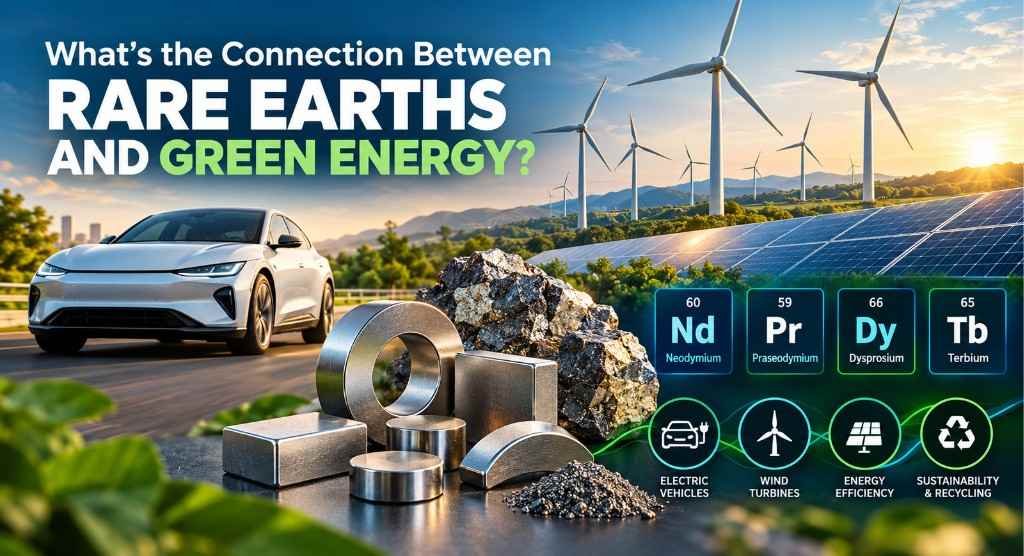
Rare Earths and Green Energy are becoming increasingly connected as the world accelerates towards electric vehicles, renewable electricity, energy-efficient technologies, and lower-carbon industrial systems.
But here is an interesting contradiction:
Some of the technologies designed to reduce environmental damage depend on minerals whose extraction and processing can create significant environmental challenges.
An electric vehicle may operate without tailpipe emissions, but its motor could contain powerful magnets made from rare earth elements. A wind turbine may generate electricity without burning fossil fuels, yet its generator may rely on neodymium, praseodymium, and dysprosium.
This growing relationship between Rare Earths and Green Energy highlights how advanced materials contribute to cleaner technologies while raising important questions about responsible sourcing, resource efficiency, and environmental sustainability.
Does this mean green energy is not genuinely green?
Not necessarily.
It means the energy transition is more complicated—and more technologically fascinating—than simply replacing fossil fuels with renewable energy.
For engineers, manufacturers, researchers, and procurement specialists, understanding rare earth elements is becoming essential.
In this guide, DOMADIA™ explores nine powerful connections between Rare Earths and Green Energy, including their chemical composition, properties, applications, technical specifications, international standards, environmental impact, and future opportunities.
1. What Are Rare Earth Elements, and Why Do They Matter?
Rare earth elements are a group of 17 metallic elements consisting of the 15 lanthanides, scandium and yttrium.
Despite their name, many rare earth elements are relatively abundant in the Earth’s crust. The challenge is that economically recoverable deposits can be difficult to develop, and separating chemically similar elements requires sophisticated processing.
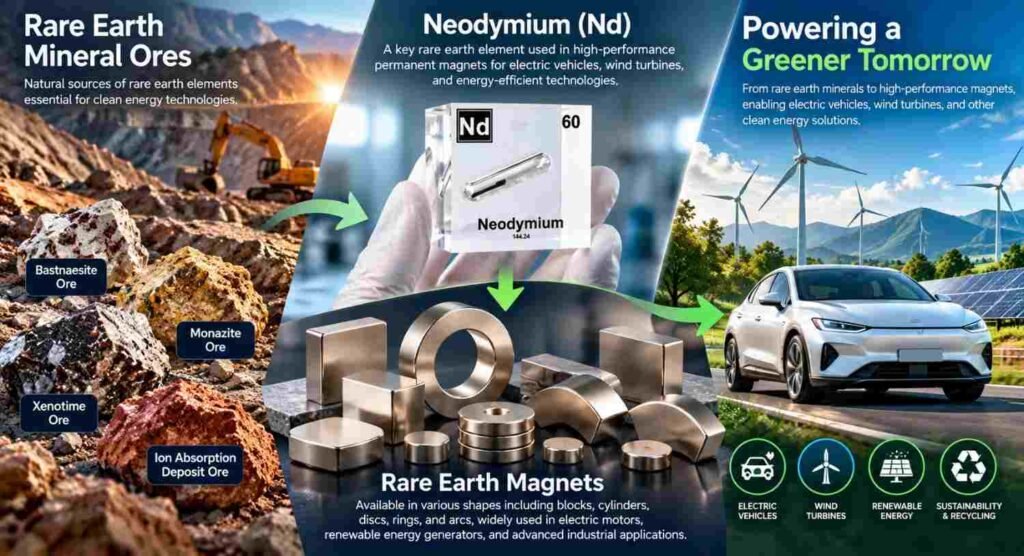
Important rare earth elements used in clean energy
| Element | Symbol | Main relevance |
| Neodymium | Nd | High-performance permanent magnets |
| Praseodymium | Pr | NdPr permanent magnets |
| Dysprosium | Dy | High-temperature magnet coercivity |
| Terbium | Tb | Enhanced magnet coercivity |
| Lanthanum | La | Nickel-metal hydride batteries and catalysts |
| Cerium | Ce | Catalysts, polishing and industrial processes |
| Yttrium | Y | Advanced ceramics, phosphors and specialized materials |
| Samarium | Sm | SmCo permanent magnets |
Not every renewable-energy technology requires rare earth elements.
For example, conventional crystalline-silicon solar panels generally do not depend on rare earth materials in their photovoltaic cells. Similarly, many electric vehicles use lithium-ion batteries that do not contain rare earth elements as essential active materials.
However, selected electric motors, generators, industrial equipment and specialized energy technologies can depend heavily on rare earth performance.
2. Rare Earths and Green Energy: The Connection Through Permanent Magnets
One of the strongest connections between rare earth materials and renewable energy is the development of powerful permanent magnets.
These magnets can generate strong magnetic fields without requiring continuous electrical power to maintain their magnetization.
Two important families are:
- Neodymium-Iron-Boron (NdFeB) magnets
- Samarium-Cobalt (SmCo) magnets
Chemical composition of rare earth magnets
| Magnet material | Typical composition | Main advantage |
| NdFeB | Nd₂Fe₁₄B-based phase | High magnetic energy product |
| NdPrFeB | Nd/Pr–Fe–B-based alloy | Strong magnetic performance |
| Dy-modified NdFeB | NdFeB with dysprosium additions or diffusion treatment | Improved coercivity at elevated temperatures |
| Tb-modified NdFeB | NdFeB with terbium additions or diffusion treatment | Enhanced coercivity |
| SmCo₅ | Samarium-cobalt intermetallic | Good thermal stability |
| Sm₂Co₁₇ | Samarium-cobalt-based alloy | High-temperature magnetic performance |
Actual commercial magnet compositions vary with grade, processing method, additives and manufacturing specifications.
The importance of these materials becomes clear when examining how motors and generators operate.
A powerful magnet can enable compact electromagnetic designs, potentially reducing equipment size and improving power density.
That is especially valuable in electric transportation and renewable-energy systems.
3. Electric Vehicles: How Rare Earth Magnets Support Efficient Motors
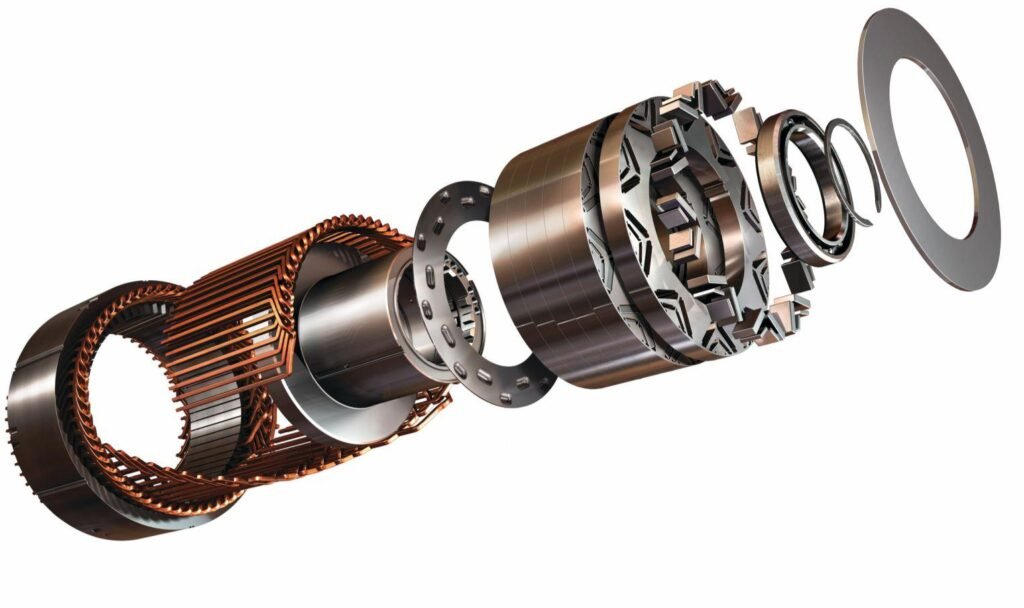
Electric vehicles are among the most visible examples of the relationship between rare earth materials and green technology.
Many electric vehicles use permanent magnet synchronous motors (PMSMs).
These motors may contain neodymium-based magnets because they provide strong magnetic fields in compact spaces.
Why are rare earth magnets useful in electric vehicles?
Rare Earths and Green Energy are closely connected through high-performance permanent magnets that enable compact electric motors with high power density, excellent efficiency, and reduced motor size. These advantages make rare earth magnets valuable for modern electric vehicle technologies.
The growing relationship between Rare Earths and Green Energy also supports precise torque and speed control in permanent magnet synchronous motors. Specialized magnet grades offer improved thermal performance and help maintain magnetic strength under elevated operating temperatures.
However, not all electric vehicles require rare earth magnets. Induction motors and electrically excited synchronous motors provide alternatives. The role of Rare Earths and Green Energy ultimately depends on motor efficiency, cost, performance, temperature requirements, and supply-chain considerations.
4. Wind Turbines: Turning Magnetic Strength Into Renewable Electricity

Wind energy represents another important application.
Certain wind turbine designs use permanent magnet generators to convert mechanical rotation into electricity.
As the turbine blades rotate, the generator converts rotational energy into electrical energy through electromagnetic induction.
Why use rare earth permanent magnets?
Rare Earths and Green Energy are closely connected through permanent magnet generators, which offer high efficiency, compact designs, and reduced dependence on rotor excitation systems. These generators are particularly suitable for selected direct-drive wind turbine applications, supporting reliable electricity generation and efficient renewable-energy performance.
The importance of Rare Earths and Green Energy becomes even greater in offshore wind turbines, where maintenance and equipment replacement can be expensive. Permanent magnet generators can reduce certain maintenance requirements through appropriate system design, potentially improving operational reliability and lowering long-term servicing costs.
However, the relationship between Rare Earths and Green Energy does not mean every wind turbine requires rare earth magnets. Alternative technologies, including doubly fed induction generators and electrically excited systems, remain practical options. The ideal generator depends on efficiency, cost, maintenance requirements, and operating conditions.
5. Technical Properties That Make Rare Earth Magnets Valuable
Rare earth magnets are useful because of their distinctive magnetic characteristics.
| Property | Typical NdFeB magnet range* | Engineering importance |
| Maximum energy product (BHmax) | Approximately 200–440 kJ/m³ | Magnetic energy density |
| Remanence (Br) | Approximately 1.0–1.48 T | Magnetic flux capability |
| Intrinsic coercivity (Hcj) | Approximately 955–2,400+ kA/m | Resistance to demagnetization |
| Density | Approximately 7.4–7.6 g/cm³ | Component weight |
| Maximum operating temperature | Often 80–200°C, grade-dependent | Thermal suitability |
| Curie temperature | Approximately 310–400°C | Fundamental magnetic transition |
These are illustrative commercial grade ranges, not guaranteed values for every product. Operating temperature depends on magnet grade, geometry, demagnetizing field and application conditions.
What makes coercivity so important?
Rare Earths and Green Energy are closely connected through high-performance magnets used in electric motors, where heat, vibration, and opposing magnetic fields can affect performance. Insufficient coercivity may cause irreversible demagnetization, reducing motor reliability and efficiency.
The importance of Rare Earths and Green Energy becomes clearer with elements such as dysprosium and terbium, which improve the intrinsic coercivity of NdFeB magnets. However, these additions can increase costs and introduce supply-chain and magnetic-performance trade-offs.
For reliable performance, Rare Earths and Green Energy applications require careful material selection based on operating temperature, magnetic strength, durability, and environmental conditions rather than simply choosing the strongest magnet available.
6. Rare Earths in Batteries, Solar Energy and Other Green Technologies
The relationship extends beyond permanent magnets.
Nickel-metal hydride batteries
Rare Earths and Green Energy are connected through lanthanum-containing alloys used in the metal-hydride electrodes of nickel-metal hydride (NiMH) batteries. These batteries have been widely used in hybrid electric vehicles, supporting reliable energy storage and efficient vehicle operation.
The role of Rare Earths and Green Energy varies across battery technologies. While NiMH batteries use rare earth alloys, many modern battery-electric vehicles rely on lithium-ion chemistries such as LFP and NMC, whose principal active materials do not contain rare earth elements.
Solar energy technologies
The connection between Rare Earths and Green Energy extends to specialized solar-energy research, luminescent materials, optical systems, and advanced coatings that can support solar technology development. However, mainstream crystalline-silicon photovoltaic cells generally do not require rare earth elements for electricity generation.
Energy-efficient lighting
Yttrium, cerium, europium and terbium have roles in certain phosphor materials used to produce and control light.
Improved lighting efficiency can reduce electThe connection between Rare Earths and Green Energy extends to energy-efficient lighting technologies, where elements such as yttrium, cerium, europium, and terbium are used in specialized phosphor materials to produce and control light. These materials help improve lighting performance and support efficient energy utilization.
The growing importance of Rare Earths and Green Energy is also reflected in advanced lighting solutions that can reduce electricity consumption, improve illumination efficiency, and contribute to long-term energy conservation and environmental sustainability.icity consumption, indirectly supporting energy conservation.
Industrial energy efficiency
Rare earth magnets can also be used in high-efficiency motors, automation equipment and specialized industrial systems.The connection between Rare Earths and Green Energy extends to energy-efficient lighting technologies, where elements such as yttrium, cerium, europium, and terbium are used in specialized phosphor materials to produce and control light. These materials can improve lighting performance, reduce electricity consumption, and support long-term energy conservation.
Their contribution depends on the complete equipment design and actual operating conditions.
7. Rare Earth Magnet Shapes and Forms Available
For manufacturers, choosing the right magnetic material is only one part of the process.
Dimensions, magnetization direction, coating, tolerance and geometry can be equally important.
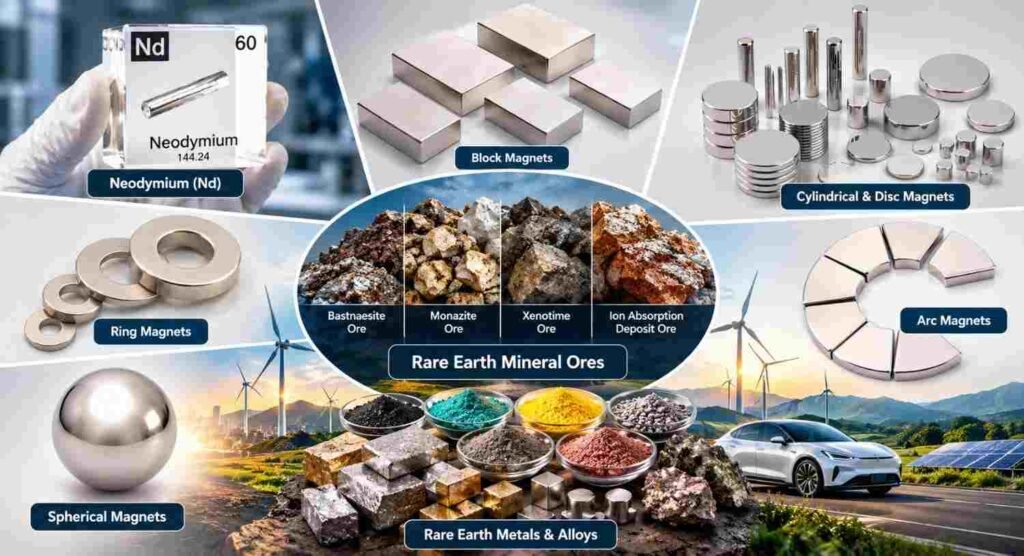
Depending on the material and manufacturing capability, custom shapes and specialized magnet configurations may also be possible.
For industrial enquiries, DOMADIA™ recommends specifying the required composition, magnet grade, dimensions, tolerance, coating, magnetization direction, operating temperature and quantity.
8. International Standards and Technical Specifications
Reliable green-energy equipment requires repeatable material performance.
Relevant standards include:
| Standard | Relevance |
| IEC 60404 series | Magnetic materials and measurement methods |
| IEC 60404-8-1 | Specifications for individual hard magnetic materials |
| ASTM A977/A977M | Test method for magnetic properties of high-coercivity permanent magnet materials |
| IEC 60034 series | Rotating electrical machines |
| ISO 14001 | Environmental management systems |
| ISO 9001 | Quality management systems |
These standards address different aspects of material characterization, equipment performance and organizational management. They are not interchangeable product certifications.
What about UNS numbers?
The Unified Numbering System identifies certain metallic materials and alloy compositions.
For example, UNS N10001 identifies a nickel-based alloy, not a universal rare earth magnet grade.
Commercial NdFeB magnets are generally specified using magnetic grade designations, chemical composition, performance requirements and applicable testing standards rather than a single universal UNS designation.
Consequently, buyers should not assume that every rare earth material has a corresponding UNS grade.
9. The Environmental Challenge: Can Rare Earths Make Green Energy Greener?
This is perhaps the most important question.
Rare earth elements can help enable efficient technologies, but their production also has environmental consequences.
Mining, mineral processing and chemical separation can involve:
- Significant energy consumption.
- Water use and wastewater management.
- Chemical reagents and waste generation.
- Tailings and land disturbance.
- Potentially radioactive residues associated with certain mineral deposits.
The environmental impact depends on ore characteristics, processing technology, energy sources, waste treatment and regulatory practices.
The lifecycle perspective
Rare earth material lifecycle
Mining
Refining
Magnet production
Clean energy use
Recovery
Illustrative lifecycle; recovery and recycling are not yet universal.
A meaningful sustainability assessment should consider both the environmental burden of manufacturing a material and the benefits delivered during its operating life.
A longer-lasting, efficient motor may reduce electricity consumption and replacement requirements. However, those benefits must be quantified through lifecycle assessment rather than assumed.
Recycling rare earth magnets
Recycling plays an important role in Rare Earths and Green Energy by recovering valuable materials from manufacturing scrap and end-of-life products. Methods such as direct magnet recycling, hydrometallurgical processing, and pyrometallurgical techniques can help reduce dependence on newly mined resources. However, collection, separation, and processing also require energy and resources. At DOMADIA™, we support responsible material selection by encouraging durability, energy efficiency, optimal material utilization, and suitable recycling opportunities for long-term sustainability.
Why DOMADIA™ for Rare Earth Materials and Green Energy Applications?
Selecting rare earth materials for industrial applications requires more than identifying an element from the periodic table.
Engineers must consider magnetic performance, thermal stability, composition, dimensions, surface treatment and long-term operating conditions.
DOMADIA™ focuses on helping customers communicate their technical requirements clearly and identify suitable specialty material options.
Key considerations include:
- Material selection: Neodymium, praseodymium, samarium and other relevant rare earth materials.
- Application requirements: Electric motors, generators, electronics, research and specialized industrial systems.
- Technical specifications: Composition, grade, dimensions, coating and operating temperature.
- Quality requirements: Relevant testing methods, standards and documentation requirements.
- Lifecycle considerations: Durability, efficiency, replacement frequency and responsible material use.
Material grades, forms, availability and documentation should be confirmed for each enquiry.
Conclusion: The Future of Rare Earths and Green Energy
Rare Earths and Green Energy share an important technological relationship, with elements such as neodymium and praseodymium enabling powerful permanent magnets, while dysprosium and terbium improve high-temperature magnetic performance. Samarium supports specialized magnet technologies, and other rare earth elements contribute to selected battery, lighting, and industrial applications, making these materials valuable for advancing cleaner and more efficient technologies.
However, the connection between Rare Earths and Green Energy extends beyond magnetic performance. Responsible mining, efficient processing, material substitution, longer equipment lifetimes, and effective recycling are essential for reducing environmental impact. The future depends on selecting the right materials in appropriate quantities for specific applications. At DOMADIA™, we aim to support industries through advanced material solutions, efficient resource utilization, and long-term engineering performance because green energy requires smart materials, and smart material selection demands responsible engineering.
Power Your Green Energy Innovations with DOMADIA™
Looking for high-quality rare earth metals, permanent magnets, or specialty materials for renewable energy applications? DOMADIA™ helps you explore suitable material solutions for electric vehicles, wind turbines, and advanced industrial technologies.
Connect with DOMADIA™ today to discuss your technical requirements!
Talk to: Er.Pankaj Domadia | Kairav Domadia | Aadil Domadia | Pragati Sanap | Pooja N N
#RareEarthElements #GreenEnergy #RenewableEnergy #Neodymium #RareEarthMagnets #ElectricVehicles #WindEnergy #SustainableTechnology #SpecialtyMaterials #DOMADIA
Directly whatsapp us for an Enquiry: https://wa.link/kairav
Our materials reach Chennai, Coimbatore, Hosur, Madurai, and Trichy, supporting manufacturing hubs in Tamil Nadu, Kerala, Karnataka, Andhra Pradesh, and Telangana, while shipping to France, Spain, UK, Netherlands, and Belgium.