Blogs
Mu Metal vs Copper Shielding: 9 Powerful Differences That Help You Choose the Right Material
Mu Metal vs Copper Shielding: Which Material Is the Better Choice?
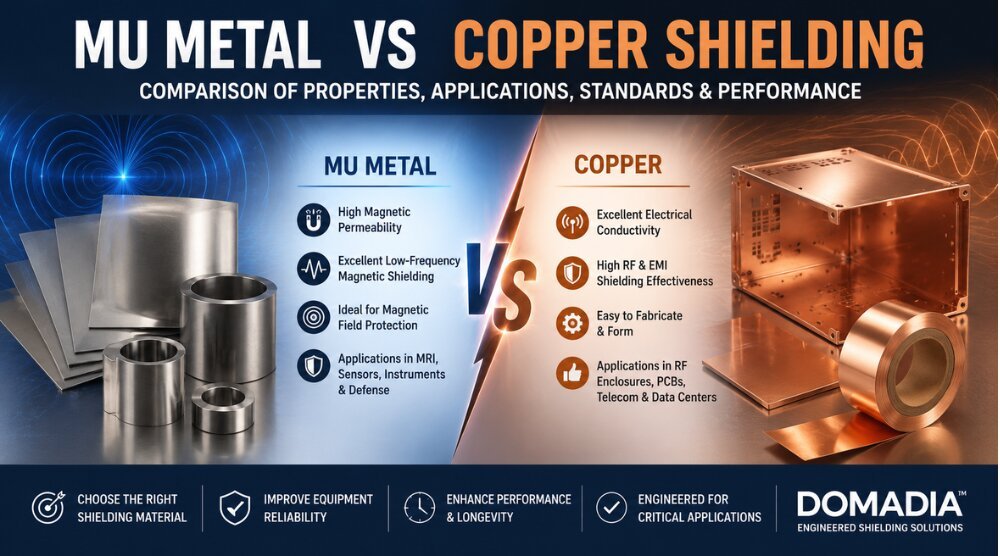
Mu Metal vs Copper Shielding is one of the most common comparisons engineers face while designing electronic systems, scientific instruments, medical devices, communication equipment, and industrial automation. Although both materials are used for shielding, they solve entirely different engineering problems, making Mu Metal vs Copper Shielding an essential consideration during material selection.
Many people mistakenly assume that any conductive metal can block every type of electromagnetic interference. In reality, the effectiveness of shielding depends on whether the interference is magnetic or electromagnetic. This is where understanding Mu Metal vs Copper Shielding becomes critical, as each material is engineered to address different types of interference.
Understanding the strengths and limitations of each material helps engineers avoid costly design mistakes, improve equipment reliability, and maximize long-term performance. By evaluating Mu Metal vs Copper Shielding based on the application, engineers can select the most effective shielding solution for reliable, long-lasting protection.
Understanding the Difference
Before selecting a shielding material, it is important to understand what needs protection.
Mu Metal
Mu Metal is a high-permeability nickel-iron alloy specifically designed to redirect and absorb low-frequency magnetic fields. Instead of blocking magnetic energy, it provides an easier path for magnetic flux to travel, preventing the field from reaching sensitive equipment.
It is the preferred material wherever magnetic interference affects precision electronics.
Copper
Copper is one of the world’s best electrical conductors. It is widely used to shield against:
- Radio Frequency (RF)
- Electromagnetic Interference (EMI)
- High-frequency electrical noise
Copper reflects and absorbs electromagnetic waves exceptionally well but offers very limited protection against strong low-frequency magnetic fields.
Chemical Composition
Mu Metal (Typical)
| Element | Approx. % |
| Nickel | 77% |
| Iron | 16% |
| Copper | 5% |
| Molybdenum | 2% |
Copper
| Element | Approx. % |
| Copper | 99.9%+ |
Mu Metal vs Copper Shielding Comparison
| Property | Mu Metal | Copper |
| Magnetic Shielding | Excellent | Poor |
| RF Shielding | Moderate | Excellent |
| EMI Shielding | Good | Excellent |
| Magnetic Permeability | Extremely High | Very Low |
| Electrical Conductivity | Moderate | Excellent |
| Corrosion Resistance | Good | Excellent |
| Mechanical Strength | Moderate | Good |
| Cost | Higher | Lower |
| Annealing Required | Yes | No |
| Best Application | Magnetic Fields | EMI & RF |
Properties of Mu Metal
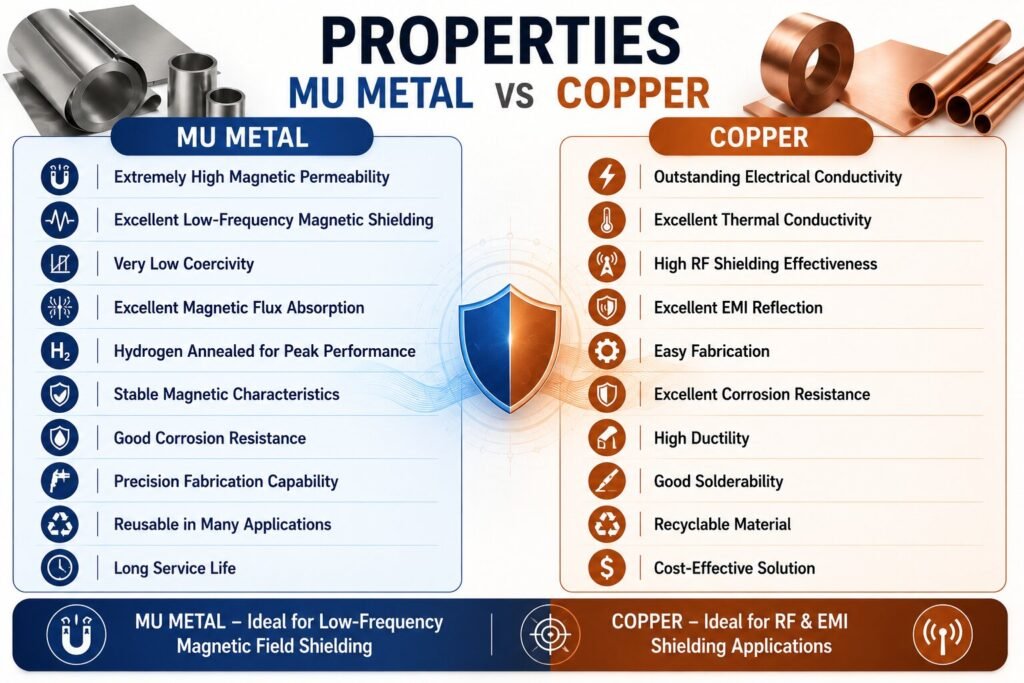
Extremely High Magnetic Permeability
Mu Metal vs Copper Shielding clearly shows that Mu Metal offers exceptionally high magnetic permeability, making it ideal for redirecting and containing low-frequency magnetic fields.
Excellent Low-Frequency Magnetic Shielding
In the Mu Metal vs Copper Shielding comparison, Mu Metal provides outstanding protection against low-frequency magnetic interference that copper cannot effectively shield.
Very Low Coercivity
In the Mu Metal vs Copper Shielding comparison, Mu Metal’s very low coercivity allows it to magnetize and demagnetize easily, providing highly efficient low-frequency magnetic shielding with minimal residual magnetism.
Excellent Magnetic Flux Absorption
Unlike conductive metals that mainly reflect EMI, Mu Metal efficiently channels and absorbs magnetic flux to protect sensitive electronic equipment.
Hydrogen Annealed for Peak Performance
The hydrogen annealing process significantly enhances the alloy’s magnetic permeability, making Mu Metal vs Copper Shielding an important consideration for precision shielding applications.
Stable Magnetic Characteristics
In the Mu Metal vs Copper Shielding comparison, Mu Metal maintains stable magnetic performance under properly controlled operating conditions, delivering consistent, long-term shielding reliability against low-frequency magnetic fields.
Good Corrosion Resistance
In the Mu Metal vs Copper Shielding comparison, Mu Metal offers useful corrosion resistance alongside its excellent magnetic shielding capabilities, making it suitable for long-term industrial applications when properly protected against environmental exposure.
Precision Fabrication Capability
Available in accurately manufactured sheets, foils, cylinders, and custom enclosures, Mu Metal vs Copper Shielding often favors Mu Metal for precision-engineered shielding solutions.
Reusable in Many Applications
In the Mu Metal vs Copper Shielding comparison, Mu Metal offers excellent reusability, as proper handling and re-annealing when necessary can help restore its magnetic properties, making it suitable for repeated use in industrial and scientific shielding applications.
Long Service Life
Its excellent magnetic stability and durability ensure a long operational life, making Mu Metal vs Copper Shielding a valuable comparison for engineers seeking dependable long-term performance.
Properties of Copper
Outstanding Electrical Conductivity
In the Mu Metal vs Copper Shielding comparison, copper stands out for its exceptional electrical conductivity, making it one of the best materials for EMI and RF shielding.
Excellent Thermal Conductivity
Copper efficiently dissipates heat from electrical systems, helping improve equipment performance and reliability in demanding applications.
High RF Shielding Effectiveness
When evaluating Mu Metal vs Copper Shielding, copper provides outstanding shielding against high-frequency radio waves and electromagnetic interference.
Excellent EMI Reflection
Copper effectively reflects electromagnetic waves, making it an ideal material for protecting electronic equipment from external EMI sources.
Easy Fabrication
Its excellent formability allows copper to be easily cut, bent, stamped, and fabricated into various shielding components and enclosures.
Excellent Corrosion Resistance
Copper offers excellent resistance to atmospheric corrosion, ensuring dependable shielding performance in a wide range of industrial environments.
High Ductility
Copper’s high ductility enables it to be drawn into thin foils, wires, and complex shapes without compromising its mechanical integrity.
Good Solderability
The material can be soldered easily, allowing secure electrical connections and simplified assembly in electronic shielding applications.
Recyclable Material
Copper is highly recyclable without significant loss of performance, making Mu Metal vs Copper Shielding an important consideration for sustainable engineering projects.
Cost-Effective Solution
Compared with specialized magnetic shielding alloys, copper provides an economical solution for RF and EMI shielding, making Mu Metal vs Copper Shielding a practical comparison when balancing performance and budget.
Technical Specifications
Mu Metal
- UNS: N14080
- Density: ~8.7 g/cm³
- Relative Permeability: Up to 100,000+
- Curie Temperature: Approx. 400°C
- Operating Condition: Annealed
- Magnetic Shielding: Excellent
Copper
- UNS: C11000 (Typical)
- Density: 8.96 g/cm³
- Electrical Conductivity: 100% IACS
- Thermal Conductivity: ~390 W/m·K
- Magnetic Permeability: Approximately 1
- RF Shielding: Excellent
International Standards
Mu Metal
- UNS N14080
- ASTM Specifications
- MIL Standards (application dependent)
- RoHS Compliant (where applicable)
Copper
- ASTM B152
- ASTM B187
- ASTM B170
- ASTM B75
- RoHS Compliant
Applications of Mu Metal
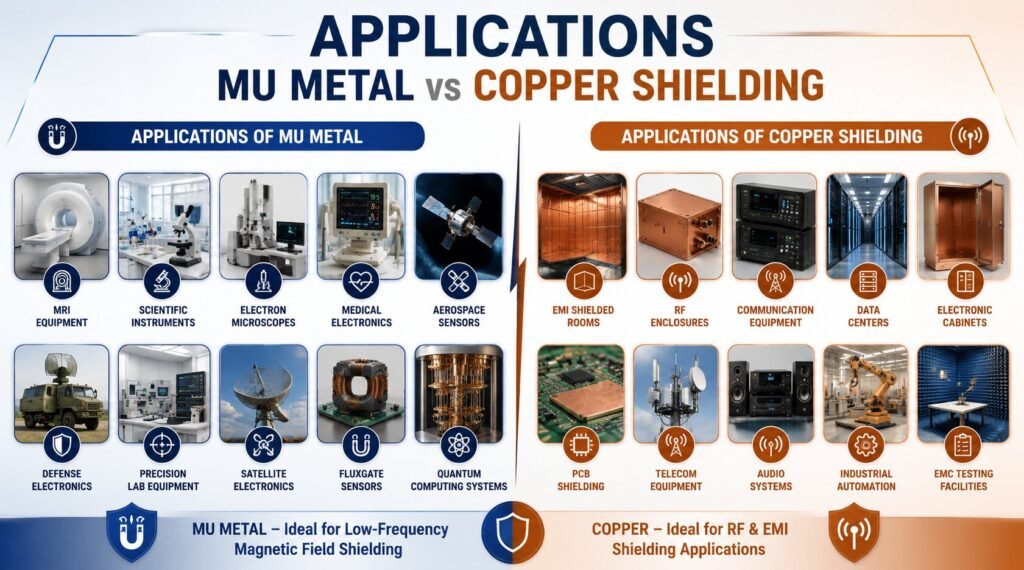
MRI Equipment
In the Mu Metal vs Copper Shielding comparison, Mu Metal is the preferred choice for MRI systems because it effectively shields sensitive components from low-frequency magnetic interference.
Scientific Instruments
Mu Metal protects highly sensitive scientific instruments from external magnetic fields, ensuring accurate measurements and reliable experimental results.
Electron Microscopes
Its exceptional magnetic shielding capability minimizes magnetic disturbances that could affect image quality and precision in electron microscopy.
Medical Electronics
Medical diagnostic and monitoring equipment rely on Mu Metal to reduce magnetic interference and maintain consistent operational accuracy.
Aerospace Sensors
The Mu Metal vs Copper Shielding comparison highlights Mu Metal’s ability to protect aerospace sensors from unwanted magnetic fields in demanding environments.
Defense Electronics
Mu Metal is widely used in defense systems to shield mission-critical electronic equipment from magnetic disturbances and improve system reliability.
Precision Laboratory Equipment
Laboratories use Mu Metal shielding to maintain stable magnetic environments for precision instruments and highly sensitive research applications.
Satellite Electronics
Mu Metal helps safeguard satellite electronics from magnetic interference, improving performance and reliability during space missions.
Fluxgate Sensors
Designed to detect extremely weak magnetic fields, fluxgate sensors benefit from Mu Metal shielding for enhanced accuracy and reduced external interference.
Quantum Computing Systems
As advanced technologies evolve, Mu Metal vs Copper Shielding clearly demonstrates that Mu Metal is the preferred material for shielding quantum computing systems from disruptive magnetic fields.
Applications of Copper Shielding
EMI Shielded Rooms
In the Mu Metal vs Copper Shielding comparison, copper is widely used in EMI shielded rooms to block electromagnetic interference and protect sensitive electronic equipment.
RF Enclosures
Copper provides excellent attenuation of radio frequency signals, making it an ideal material for RF enclosures used in testing, communication, and research facilities.
Communication Equipment
Copper shielding helps communication systems maintain stable signal transmission by reducing electromagnetic noise and unwanted RF interference.
Data Centers
Modern data centers use copper shielding to minimize EMI, ensuring reliable performance of servers, networking equipment, and critical communication infrastructure.
Electronic Cabinets
The Mu Metal vs Copper Shielding comparison shows that copper is highly effective for shielding electronic cabinets from external electromagnetic interference.
PCB Shielding
Copper is extensively used for PCB shielding to reduce signal interference, improve electromagnetic compatibility, and enhance circuit performance.
Telecom Equipment
Copper shielding protects telecom equipment from RF interference, helping maintain clear communication and uninterrupted network operation.
Audio Systems
Professional audio systems use copper shielding to reduce electromagnetic noise and unwanted signal distortion, resulting in cleaner sound quality.
Industrial Automation
In Mu Metal vs Copper Shielding, copper remains the preferred choice for protecting industrial automation systems from EMI generated by electrical equipment and control panels.
EMC Testing Facilities
Copper is widely used in EMC testing facilities to create controlled environments for accurate electromagnetic compatibility testing and regulatory compliance.
Top of Form
Bottom of Form
Shapes Available
Mu Metal
- Sheets
- Foils
- Plates
- Strips
- Coils
- Tubes
- Cylinders
- Custom Fabricated Boxes
- Shielding Enclosures
- Precision Components
Copper
- Sheets
- Foils
- Mesh
- Plates
- Strips
- Bars
- Rods
- Tubes
- Wires
- EMI Shielding Tape
When Should You Choose Mu Metal?
Choose Mu Metal if your equipment suffers from:
- Transformer magnetic fields
- Motor interference
- Permanent magnets
- Low-frequency magnetic noise
- Precision sensor disturbances
- Scientific measurement errors
Examples include:
- MRI systems
- Electron microscopes
- Medical instruments
- Defense electronics
- Laboratory equipment
When Should You Choose Copper?
Copper is the better option when protection is required against:
- Radio frequency interference
- Wireless communication signals
- Electromagnetic interference
- High-frequency electronic noise
- Static discharge
Typical applications include:
- Electronic enclosures
- RF chambers
- Control panels
- Telecom systems
- Computer equipment
Can They Be Used Together?
Yes.
Many high-performance shielding systems combine both materials.
A common multilayer construction uses:
- Inner Mu Metal layer for magnetic shielding
- Outer copper layer for EMI/RF shielding
This approach provides comprehensive protection against both magnetic and electromagnetic interference.
Why DOMADIA™
DOMADIA™ supplies premium-quality Mu Metal and copper shielding materials for industries requiring dependable electromagnetic protection.
Customers choose DOMADIA™ because of:
- High-quality industrial materials
- International standard compliance
- Precision fabrication support
- Multiple material grades
- Custom dimensions
- Fast delivery
- Technical application guidance
- Reliable industrial supply
- Competitive pricing
- Global export capability
Conclusion
Mu Metal vs Copper Shielding is not about determining which material is universally superior—it is about selecting the right solution for the specific type of interference your application faces. In the Mu Metal vs Copper Shielding comparison, Mu Metal is unmatched for shielding low-frequency magnetic fields because of its exceptionally high magnetic permeability, while copper remains the preferred choice for RF and EMI shielding due to its outstanding electrical conductivity.
For critical applications requiring protection from both magnetic and electromagnetic interference, combining the two materials often delivers the highest level of shielding performance. Understanding Mu Metal vs Copper Shielding helps engineers make informed decisions that improve equipment reliability, reduce interference, and extend service life. DOMADIA™ supports industries with high-quality shielding materials and technical expertise, helping customers choose the ideal solution for dependable performance in demanding environments.
Choose the Right Shielding Material for Maximum Performance
DOMADIA™ helps you select the ideal shielding material based on your magnetic, EMI, and RF protection requirements.
Explore our precision-engineered Mu Metal and copper shielding solutions designed for reliable performance across electronics, medical, aerospace, defense, and industrial applications.
Contact DOMADIA™ today for expert guidance and customized shielding solutions.
Talk to: Er.Pankaj Domadia | Kairav Domadia | Aadil Domadia | Pragati Sanap | Pooja N N
#MuMetal #CopperShielding #MagneticShielding #EMIShielding #RFShielding #Engineering #IndustrialMaterials #UNSN14080 #DOMADIA
Directly whatsapp us for an Enquiry: https://wa.link/kairav
From Ahmedabad, Vadodara, Rajkot, Bhavnagar, and Jamnagar, we serve Gujarat’s industrial belt and nearby Maharashtra, Rajasthan, MP, and Daman, with global supply to Canada, Mexico, Brazil, Chile, and Argentina.