Blogs
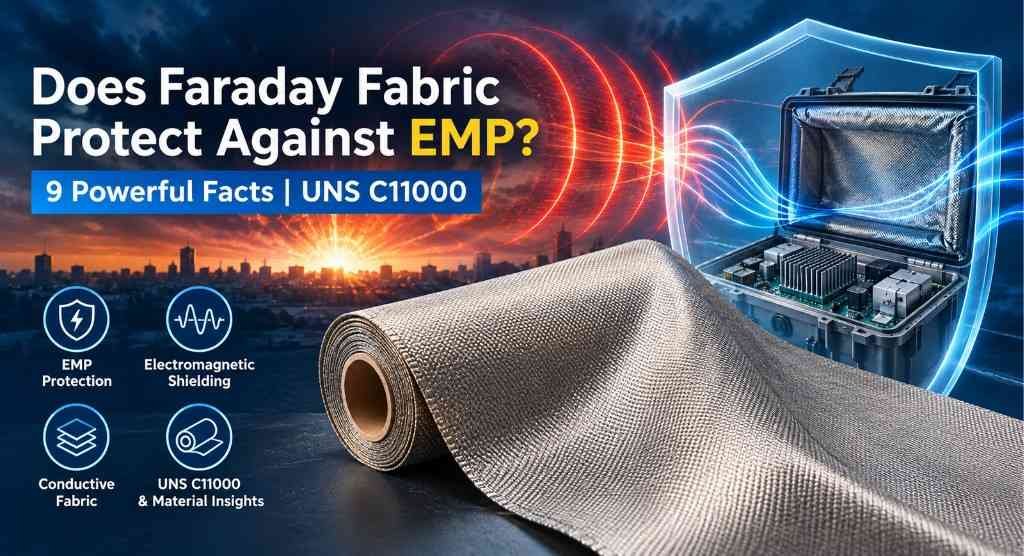
Does Faraday Fabric Protect Against EMP? 9 Powerful Facts About Electromagnetic Shielding | UNS C11000
Faraday Fabric EMP Protection is an important topic for engineers, electronics manufacturers, defense researchers, industrial equipment designers, and organizations concerned about electromagnetic pulse exposure.
A Faraday fabric may block mobile phone signals, reduce radio-frequency interference, and provide excellent shielding performance in laboratory tests.
But does that mean it can protect sensitive electronics from an electromagnetic pulse (EMP)?
Not necessarily.
An EMP can involve extremely fast electromagnetic transients, high electric fields, and energy distributed across a broad frequency spectrum. A material that performs well against everyday electromagnetic interference may not provide adequate protection against every EMP threat.
The distinction is important because protecting electronics from routine RF interference is not the same as designing an EMP-hardened enclosure.
This article explores nine essential facts about Faraday fabric, including its composition, electromagnetic shielding properties, technical specifications, relevant standards, applications, limitations, and the role of DOMADIA™ in helping engineers select suitable shielding materials.
Yes, Faraday fabric can contribute to EMP protection, but it cannot guarantee complete protection on its own. Effectiveness depends on the conductive material, shielding effectiveness across the relevant frequencies, seams, openings, grounding and bonding arrangements, cable penetrations, and the characteristics of the EMP event.
1. What Is Faraday Fabric and How Does It Work?
Faraday fabric is a flexible, electrically conductive textile designed to reduce the transmission of electromagnetic energy.
Unlike conventional fabrics, which are generally poor electrical conductors, Faraday fabrics contain conductive metals, metallic coatings, or specialized conductive fibers.
These materials interact with electromagnetic fields through reflection, absorption, and other shielding mechanisms.
How electromagnetic shielding works
When electromagnetic waves encounter a conductive textile, some incident energy is reflected, some may be absorbed or dissipated, and some may pass through the material.
The amount of attenuation depends on the material’s electrical conductivity, magnetic properties, thickness, construction, and frequency.
However, an important distinction must be understood.
A conductive textile is not automatically equivalent to a continuous, fully enclosed Faraday cage.
Even an excellent shielding material can deliver disappointing results if electromagnetic energy enters through gaps, openings, poorly bonded seams, or unprotected cables.
This is why Faraday Fabric EMP Protection must be evaluated as part of a complete shielding system.
2. Understanding EMP: Why Is It Different From Ordinary EMI?
An electromagnetic pulse is a short-duration burst of electromagnetic energy capable of producing transient voltages and currents in exposed conductors and electronic systems.
EMP can originate from several sources, including nuclear events, certain specialized electromagnetic systems, and natural electromagnetic disturbances.
For engineers, the challenge is not simply whether electromagnetic energy is present.
It is the combination of pulse characteristics, field strength, frequency content, coupling paths, and the vulnerability of the equipment.
Three important EMP-related effects
Fast electromagnetic transients
Rapidly changing electromagnetic fields can couple into circuits, cables, and electronic equipment, potentially producing damaging voltage or current spikes.
Broad-frequency electromagnetic energy
Some EMP environments contain substantial energy across a wide frequency range, making single-frequency shielding measurements insufficient.
Conducted disturbances
Long cables, power lines, and communication connections can carry induced disturbances into protected equipment, even when the enclosure itself provides effective field attenuation.
In high-altitude nuclear EMP discussions, the E1, E2, and E3 components are commonly distinguished. E1 is a fast transient, E2 is associated with intermediate-time effects, and E3 is a much slower geomagnetic-like disturbance that can affect long conductors and large infrastructure.
A flexible conductive fabric may help attenuate some radiated components. However, it should not be assumed to provide adequate protection against all three.
3. Does Faraday Fabric Protect Against EMP? 9 Powerful Facts

Fact 1: Conductive fabrics can attenuate electromagnetic energy
The principal advantage of Faraday fabric is its ability to reduce electromagnetic field transmission. Faraday Fabric EMP Protection relies on conductive materials such as silver, copper, nickel, or other metallic components to provide meaningful electromagnetic and RF shielding.
Depending on their construction, properly tested fabrics may demonstrate attenuation ranging from tens of decibels to substantially higher values across specified frequency bands. However, effective Faraday Fabric EMP Protection depends on material conductivity, fabric construction, shielding continuity, and verified performance under relevant electromagnetic conditions.
Nevertheless, shielding effectiveness must be established through reliable testing rather than assumed from the presence of a metallic coating.
Fact 2: Shielding effectiveness is measured in decibels
Shielding effectiveness (SE) is commonly expressed in decibels (dB).
For an electric-field amplitude comparison under defined measurement conditions:
\[ SE=20\log_{10}\left(\frac{E_{\mathrm{incident}}}{E_{\mathrm{transmitted}}}\right) \]
The following table illustrates how decibel values relate to idealized transmitted power ratios.
| Shielding effectiveness | Transmitted power | Power attenuation |
| 20 dB | 1% | 99% |
| 40 dB | 0.01% | 99.99% |
| 60 dB | 0.0001% | 99.9999% |
| 80 dB | 0.000001% | 99.999999% |
These values describe idealized ratios under defined conditions, not a guaranteed level of EMP protection.
A fabric with a 60 dB laboratory shielding result at one frequency may perform very differently in an assembled enclosure or under a broadband transient.
Fact 3: Frequency coverage matters more than a single impressive number
A supplier may advertise high shielding effectiveness at 1 GHz. While this information can be useful, it does not guarantee reliable Faraday Fabric EMP Protection across every frequency associated with an electromagnetic pulse.
For effective Faraday Fabric EMP Protection, engineers should request a shielding-effectiveness curve covering the relevant frequency range to evaluate material performance and ensure the selected fabric meets their application’s electromagnetic shielding requirements.
Fact 4: Openings and seams can compromise protection
Even a highly conductive fabric can lose system-level effectiveness when installed with:
- Unsealed seams
- Loose overlaps
- Unprotected zippers
- Open ventilation areas
- Poorly bonded conductive panels
- Gaps around doors or access points
For practical protection, enclosure continuity can be just as important as the shielding performance of the base fabric.
Fact 5: Grounding alone does not guarantee EMP protection
A common misconception is that grounding a conductive fabric automatically makes it EMP-proof. While grounding and bonding may be essential for electrical safety, charge management, and certain shielding arrangements, effective Faraday Fabric EMP Protection depends on more than grounding alone.
RF shielding can also function in properly constructed ungrounded enclosures. The correct approach depends on enclosure design, safety requirements, electromagnetic coupling mechanisms, and the operating environment to achieve reliable shielding performance.
Fact 6: Magnetic-field shielding can be more difficult
Conductive fabrics are often effective against radio-frequency electric fields and plane-wave electromagnetic radiation. However, Faraday Fabric EMP Protection becomes more challenging when dealing with low-frequency magnetic fields, which behave differently from high-frequency electromagnetic waves.
For demanding applications, high-permeability magnetic shielding materials, specialized conductive enclosures, or multilayer shielding systems may be required to achieve the desired protection. Therefore, effective Faraday Fabric EMP Protection requires careful material selection, frequency-specific testing, and proper enclosure design. A conventional silver-coated fabric should not be assumed to replace a professionally engineered magnetic shielding enclosure.
Fact 7: Cable penetrations are critical vulnerabilities
An enclosure can provide excellent electromagnetic shielding yet still allow damaging electrical transients to reach sensitive equipment through connected wiring. Effective Faraday Fabric EMP Protection must therefore consider potential interference entering through power cables, communication lines, antenna connections, and sensor cables.
For reliable Faraday Fabric EMP Protection, a complete shielding system may require appropriately rated surge protection devices, electromagnetic filtering, shielded connectors, and carefully controlled cable entry points. These additional protective measures help reduce conducted interference and improve the overall resilience of sensitive electronic equipment against electromagnetic disturbances.
Fact 8: Fabric durability influences long-term shielding
Repeated folding, abrasion, washing, humidity, and corrosion can gradually affect the conductivity and electromagnetic shielding performance of certain conductive textiles. Effective Faraday Fabric EMP Protection depends not only on the initial shielding effectiveness but also on the material’s ability to maintain its protective properties under demanding operating conditions.
A fabric that performs exceptionally well when new may experience reduced shielding effectiveness after prolonged industrial use. Therefore, engineers evaluating Faraday Fabric EMP Protection should consider mechanical durability, corrosion resistance, environmental exposure, and long-term conductivity alongside electromagnetic performance to ensure reliable and consistent protection.
Fact 9: Tested assemblies are more reliable than unsupported claims
Faraday Fabric EMP Protection is most reliable when supported by application-specific testing and verified shielding-effectiveness data. While a fabric sample’s test report provides valuable information about electromagnetic attenuation, testing the complete enclosure or assembled shielding system offers stronger evidence of real-world performance.
For mission-critical applications, effective Faraday Fabric EMP Protection requires comprehensive engineering validation, frequency-specific shielding tests, and evaluation of enclosure integrity to ensure sensitive electronic equipment receives the required level of protection against electromagnetic disturbances.
4. Chemical Composition of Faraday Fabric
Faraday fabric does not have one universal chemical composition. Its composition depends on the conductive coating, fiber structure, and manufacturing process.
Common constructions include silver-plated nylon, copper-nickel-coated polyester, stainless steel fiber textiles, and blended conductive fabrics.
Common conductive materials
| Material | Chemical composition | Main advantage |
| Silver (Ag) | Ag, metallic coating | Excellent electrical conductivity |
| Copper (Cu) | Cu, often UNS C11000 or other copper grades | High conductivity |
| Nickel (Ni) | Ni, metallic coating | Coating durability and corrosion resistance |
| Stainless steel | Fe-Cr-based alloy | Mechanical durability |
| Polyester | (C₁₀H₈O₄)ₙ | Flexible textile substrate |
| Nylon 6,6 | (C₁₂H₂₂N₂O₂)ₙ | Strength and flexibility |
Important: UNS C11000 identifies a copper grade that may be used as a conductive material or reference for copper properties. It does not mean that every copper-coated Faraday fabric is manufactured from UNS C11000.
The actual metallic composition and coating thickness should be confirmed using the manufacturer’s technical data.
5. Technical Specifications and Important Properties
Engineers evaluating conductive textiles should examine more than the advertised shielding percentage.
The following specifications are important for selecting materials.
| Technical parameter | What to evaluate |
| Shielding effectiveness | Measured attenuation in dB |
| Frequency range | Tested frequencies relevant to the application |
| Surface resistance | Ω/square, with test conditions |
| Fabric thickness | mm or µm |
| Fabric weight | g/m² |
| Conductive composition | Silver, copper, nickel, stainless steel, or blends |
| Mechanical flexibility | Ability to bend without significant coating damage |
| Tensile strength | Resistance to mechanical loading |
| Corrosion resistance | Performance under environmental exposure |
| Temperature resistance | Allowable operating and storage conditions |
| Seam conductivity | Electrical continuity after assembly |
| Durability | Performance after folding, abrasion, or washing |
These are specification categories rather than universal numerical ratings. Exact values vary by fabric construction and supplier.
Key material properties
High electrical conductivity: Supports the flow of induced currents and contributes to electromagnetic shielding.
Low weight: Makes conductive fabrics attractive where conventional metal enclosures would add undesirable mass.
Flexibility: Allows shielding materials to conform to irregular equipment shapes.
Adaptability: Supports customized covers, pouches, curtains, liners, and composite shielding structures.
Potential multilayer compatibility: Conductive textiles can be combined with other materials to address mechanical, environmental, or electromagnetic requirements.
6. Standards for Faraday Fabric and EMP Shielding
Standards help engineers distinguish general electromagnetic shielding claims from performance verified under defined test conditions.
| Standard | Purpose |
| ASTM D4935-18(2026) | Shielding effectiveness of planar materials |
| IEEE Std 299 | Measurement of shielding effectiveness of electromagnetic shielding enclosures |
| IEC 61000-2-9:2025 | Description of radiated high-altitude EMP environments |
| IEC 61000-4-25 | Immunity test methods for equipment and systems exposed to HEMP |
| MIL-STD-188-125-1 | HEMP protection requirements for certain critical fixed facilities |
ASTM D4935-18(2026) addresses planar material shielding measurements over approximately 30 MHz to 1.5 GHz. It does not test complete cable systems or certify a material as EMP-proof.
IEC 61000-2-9:2025 establishes reference descriptions of the HEMP radiated environment.
MIL-STD-188-125-1 addresses performance and testing requirements for protected fixed facilities, rather than providing automatic approval for individual shielding fabrics.
Engineering recommendation: Ask for both material-level shielding data and application-relevant enclosure or system test results when EMP resilience is a design requirement.
7. Applications of Faraday Fabric
Faraday fabric is useful across industries that require lightweight and adaptable electromagnetic shielding.

Industrial electronics
Conductive textile covers and shielding assemblies can help reduce electromagnetic interference (EMI) around industrial controllers, measurement devices, and sensitive electronic systems. Effective Faraday Fabric EMP Protection depends on material conductivity, proper shielding construction, and enclosure integrity to improve electromagnetic shielding performance in demanding industrial environments.
Aerospace and defense
Lightweight shielding materials can be incorporated into equipment covers, cable-management assemblies, and specialized electronic protection systems where qualified designs permit. Effective Faraday Fabric EMP Protection offers a flexible shielding approach for applications requiring reduced weight, adaptable installation, and electromagnetic interference management, provided the complete system meets the necessary performance and safety requirements.
Research laboratories
Conductive textiles can support radio-frequency (RF) experiments, electromagnetic compatibility (EMC) investigations, and specialized temporary shielding arrangements. Effective Faraday Fabric EMP Protection can help reduce electromagnetic interference in research laboratories, testing facilities, and sensitive electronic environments, provided the shielding materials and assemblies are properly designed and tested for the required frequency range and electromagnetic conditions.
Portable electronics protection
Appropriately constructed shielding pouches can help reduce electromagnetic signal penetration for small, disconnected electronic devices, depending on their tested frequency range, material conductivity, and closure design. Effective Faraday Fabric EMP Protection requires carefully engineered shielding materials and proper enclosure construction to minimize electromagnetic interference.
Potential applications include telecommunications, automotive electronics, test instrumentation, medical electronics, and specialized industrial equipment. However, reliable Faraday Fabric EMP Protection should not be assumed for every conductive textile, as high-energy EMP exposure requires application-specific testing, validated shielding effectiveness, and appropriate engineering design.
8. Faraday Fabric vs Metal Enclosures for EMP Protection
One of the most important design decisions is whether a flexible textile can replace a rigid conductive enclosure.
The answer depends on the required level of protection.
| Feature | Faraday fabric | Rigid metal enclosure |
| Flexibility | Excellent | Limited |
| Weight | Generally lightweight | Depends on material and thickness |
| Installation | Adaptable to complex shapes | Requires structural design |
| Seam management | Can be challenging | Can use engineered conductive joints |
| Mechanical durability | Depends on coating and textile | Often better against impact and wear |
| Shielding performance | Highly construction-dependent | Highly construction-dependent |
| EMP suitability | Requires assembly-level validation | Requires assembly-level validation |
A rigid metal enclosure is not automatically EMP-proof either. Doors, vents, gaskets, cables, and joints can still create vulnerabilities.
For critical applications, a hybrid construction may be appropriate, using rigid structural shielding together with conductive textiles, gaskets, filters, and other qualified protective components.
9. How to Select Faraday Fabric for EMP-Related Applications
Faraday Fabric EMP Protection requires careful material selection, reliable technical data, and a clear understanding of the electromagnetic environment. Choosing a conductive fabric based only on its advertised shielding effectiveness may lead to inadequate protection.
Instead, engineers should follow a structured evaluation process to identify the most suitable shielding solution.
8 Essential Factors for Selecting Faraday Fabric
1. Identify the EMP Threat
For effective Faraday Fabric EMP Protection, engineers must determine the electromagnetic pulse characteristics, expected exposure conditions, and required protection level to ensure the selected shielding materials and enclosure design meet the equipment’s specific electromagnetic safety and performance requirements.
2. Evaluate Frequency Coverage
For effective Faraday Fabric EMP Protection, engineers should select conductive shielding materials with documented shielding effectiveness across the relevant frequency range rather than relying on a single decibel (dB) rating. This helps ensure reliable electromagnetic attenuation, consistent shielding performance, and suitability for specific equipment protection requirements.
3. Verify Shielding Performance
For effective Faraday Fabric EMP Protection, engineers should request laboratory test reports, verified attenuation measurements, and applicable industry standard references to evaluate shielding effectiveness, confirm material performance, and ensure the selected conductive fabric meets the application’s electromagnetic protection requirements.
4. Examine Material Composition
For Faraday Fabric EMP Protection, compare silver-coated, copper-nickel-coated, and other conductive fabrics based on conductivity, coating durability, and application requirements.
5. Inspect Seams and Closures
For effective Faraday Fabric EMP Protection, ensure conductive continuity across fabric joints, overlaps, zippers, and enclosure openings.
6. Assess Environmental Durability
For Faraday Fabric EMP Protection, consider temperature, humidity, abrasion, corrosion, repeated folding, and expected service life.
7. Protect Electrical Connections
Evaluate cables, connectors, power lines, and other entry points that could introduce conducted electromagnetic disturbances and affect Faraday Fabric EMP Protection.
8. Validate the Complete Assembly
For reliable Faraday Fabric EMP Protection, test the finished shielding enclosure against the relevant electromagnetic requirements rather than depending exclusively on fabric-level measurements.
Make Material Selection a Performance-Based Decision
The most suitable Faraday fabric is not necessarily the one with the highest advertised shielding rating. It is the material that meets the application’s electrical, mechanical, environmental, and installation requirements.
At DOMADIA™, we encourage engineers and procurement teams to evaluate conductive shielding fabrics using documented technical specifications and application-specific performance criteria.
Effective EMP shielding begins with the right material—but reliable protection depends on the complete system.
Why DOMADIA™ for Faraday Fabric and EMI Shielding Materials?
Choosing conductive textiles requires an understanding of how the material will function in the intended assembly.
At DOMADIA™, we emphasize application-specific material selection rather than relying on broad shielding claims.
Our approach focuses on helping engineers and procurement professionals evaluate:
- Conductive fabric composition and material construction
- Shielding effectiveness and frequency requirements
- Flexible textile forms and installation constraints
- Compatibility with electromagnetic shielding assemblies
- Mechanical and environmental operating conditions
- Technical specifications and relevant test documentation
Available shapes and forms
Depending on material construction and availability, Faraday fabrics can be specified or converted into:
Availability, coating composition, dimensions, and minimum order quantities should be confirmed for the specific requirement.

Conclusion: Can Faraday Fabric Really Protect Against EMP?
Faraday Fabric EMP Protection is technically possible as part of an appropriately engineered shielding system, but it should never be treated as a universal guarantee.
Conductive fabrics offer several valuable advantages, including flexibility, low weight, adaptable installation, and electromagnetic attenuation.
However, genuine EMP resilience requires more than choosing a material with an impressive shielding effectiveness rating.
Engineers must consider frequency coverage, conductive continuity, seams, closures, cable penetrations, environmental durability, and complete system testing.
For critical infrastructure and sensitive electronics, protection should be demonstrated against the relevant threat environment and applicable standards.
At DOMADIA™, we believe effective electromagnetic shielding begins with accurate specifications and informed material selection.
The goal is not merely to block a signal. It is to develop a shielding solution that performs reliably when protection matters most.
Protect Your Electronics with the Right Faraday Fabric – Contact DOMADIA™ Today!
Looking for reliable Faraday Fabric EMP Protection for sensitive electronics, industrial equipment, or specialized shielding applications?
At DOMADIA™, we help engineers and manufacturers explore high-performance conductive fabrics based on shielding effectiveness, frequency requirements, material composition, and technical specifications.
Contact DOMADIA™ today with your application details, required shielding performance, dimensions, and quantity to discuss suitable electromagnetic shielding materials.
DOMADIA™ – Advanced Materials for Demanding Shielding Applications.
Our materials reach Chennai, Coimbatore, Hosur, Madurai, and Trichy, supporting manufacturing hubs in Tamil Nadu, Kerala, Karnataka, Andhra Pradesh, and Telangana, while shipping to France, Spain, UK, Netherlands, and Belgium.