Blogs
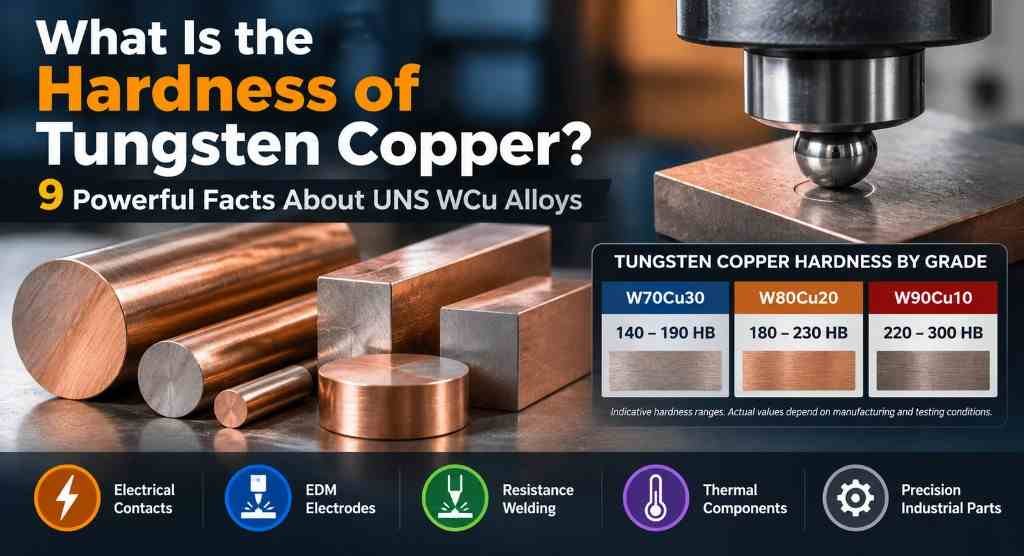
What Is the Hardness of Tungsten Copper? 9 Powerful Facts About UNS WCu Alloys
Tungsten Copper Hardness is one of the most important properties engineers evaluate when selecting materials for electrical contacts, resistance welding electrodes, EDM components, heat sinks, and high-performance industrial applications.
A component may look exceptionally strong, but will it resist indentation, deformation, and wear when subjected to repeated mechanical pressure, electrical loading, or demanding operating conditions?
That is where tungsten copper becomes particularly interesting.
Unlike pure copper, which is relatively soft, tungsten copper combines the hardness and refractory characteristics of tungsten with the excellent electrical and thermal conductivity of copper. This unique combination makes Tungsten Copper Hardness particularly valuable in applications requiring mechanical durability alongside efficient heat and electrical transfer.
However, there is one important detail: not every tungsten copper grade has the same hardness.
Its hardness depends on tungsten content, copper percentage, manufacturing process, density, microstructure, and material condition. Understanding these factors is essential because Tungsten Copper Hardness can vary significantly between grades, directly influencing wear resistance, deformation resistance, and overall component performance.
In this technical guide, DOMADIA™ explains Tungsten Copper Hardness, its chemical composition, important properties, technical specifications, industry standards, applications, and how to select the appropriate grade for demanding industrial requirements.
1. What Is Tungsten Copper Alloy?
Tungsten copper, commonly written as WCu or CuW, is a composite material made from tungsten and copper.
Unlike conventional alloys, where elements may dissolve into one another to form a solid solution, tungsten and copper have very limited mutual solubility.
Consequently, tungsten copper is typically manufactured using powder metallurgy techniques, including infiltration or sintering-based processing.
The resulting material contains two distinct phases:
- Tungsten (W): Provides hardness, high melting temperature, stiffness, and resistance to deformation.
- Copper (Cu): Contributes electrical conductivity, thermal conductivity, and heat dissipation.
This combination makes tungsten copper particularly valuable in applications where neither pure tungsten nor pure copper independently provides the desired balance of properties.
Chemical Composition of Tungsten Copper
| Common grade designation | Tungsten (W) | Copper (Cu) |
| W50Cu50 | 50% | 50% |
| W60Cu40 | 60% | 40% |
| W70Cu30 | 70% | 30% |
| W75Cu25 | 75% | 25% |
| W80Cu20 | 80% | 20% |
| W85Cu15 | 85% | 15% |
| W90Cu10 | 90% | 10% |
Values represent nominal compositions by weight. Actual tolerances depend on the manufacturer’s specification.
Generally, increasing the tungsten percentage raises hardness and density, while increasing the copper percentage improves electrical and thermal conductivity.
2. What Is the Hardness of Tungsten Copper?
The hardness of tungsten copper varies significantly with its composition and manufacturing condition.
For many commercial WCu grades, approximate hardness values fall between 100 and 300 HB, although certain grades and processing conditions may produce values outside this range.
Tungsten Copper Hardness by Grade
| Grade | Indicative Brinell hardness (HB) | Relative hardness |
| W50Cu50 | 100–140 | Moderate |
| W60Cu40 | 120–160 | Moderate |
| W70Cu30 | 140–190 | High |
| W75Cu25 | 160–210 | High |
| W80Cu20 | 180–230 | Very high |
| W85Cu15 | 200–250 | Very high |
| W90Cu10 | 220–300 | Extremely high |
These are broad illustrative ranges, not guaranteed grade specifications. Actual hardness must be verified against the supplier’s test certificate, measurement method, and applicable standard.
How tungsten content influences hardness
The hardness of tungsten copper generally increases as the tungsten percentage rises. Tungsten provides resistance to indentation and deformation, while copper contributes electrical and thermal conductivity.
Tungsten Copper Hardness Comparison by Grade
What Does This Mean for Industrial Applications?
50–70% Tungsten — Greater Copper Content
These grades generally provide lower hardness but greater electrical and thermal conductivity, making them useful where heat dissipation and current transfer are priorities.
75–80% Tungsten — Balanced Performance
These compositions offer a useful combination of hardness, conductivity, and deformation resistance for selected EDM electrodes and electrical contact applications.
85–90% Tungsten — Higher Hardness
Tungsten-rich grades generally provide greater resistance to indentation and deformation, making them attractive for specialized components requiring high hardness.
Key Takeaway: Higher tungsten content generally increases Tungsten Copper Hardness, but the best grade depends on the required balance of hardness, electrical conductivity, thermal performance, and operating conditions.
At DOMADIA™, we help industries identify suitable tungsten copper grades based on their application and technical requirements.
3. Why Does Tungsten Copper Hardness Change With Composition?
The relationship between composition and hardness is closely connected to the physical characteristics of tungsten and copper.
Tungsten contributes resistance to indentation
Tungsten is a dense refractory metal with a very high melting point of approximately 3,422°C.
Its rigid structure contributes resistance to indentation and mechanical deformation.
As the tungsten fraction increases, the composite generally becomes harder and stiffer.
Copper contributes conductivity and heat dissipation
Copper has excellent electrical and thermal conductivity but is comparatively soft.
Adding more copper can improve the ability of the material to carry electrical current and transfer heat.
However, a greater copper fraction generally reduces the composite’s hardness.
Microstructure also matters
Two tungsten copper products with identical nominal chemical compositions can exhibit different hardness values because of differences in:
- Tungsten particle size
- Porosity and density
- Distribution of copper
- Sintering and infiltration conditions
- Manufacturing defects
- Surface preparation and test method
Therefore, specifying only the percentage of tungsten is not sufficient when hardness is a critical engineering requirement.
4. How Is Tungsten Copper Hardness Measured?
Several testing methods can be used to evaluate tungsten copper.
Brinell hardness (HBW)
Measures indentation produced by a hard ball under a specified load. Useful for evaluating bulk hardness where sample dimensions and test conditions are appropriate.
Vickers hardness (HV)
Uses a diamond pyramid indenter. Useful for small samples, localized measurements, and microhardness testing of composite microstructures.
Rockwell hardness (HR)
Measures indentation depth under prescribed loads. Appropriate scales depend on the material hardness, thickness, and testing requirements.
Important: Brinell, Vickers, and Rockwell hardness values should not be treated as directly interchangeable. Conversions for heterogeneous tungsten copper composites may be unreliable without material-specific validation.
For critical industrial components, request the actual measured hardness, testing scale, test load, and inspection report.
5. Technical Specifications and Physical Properties
Hardness is only one part of tungsten copper’s engineering performance.
The following table provides representative property ranges for commonly used compositions.
| Property | W70Cu30 | W80Cu20 | W90Cu10 |
| Tungsten content | 70% | 80% | 90% |
| Copper content | 30% | 20% | 10% |
| Density, approximate | 13.8–14.3 g/cm³ | 15.2–15.8 g/cm³ | 16.8–17.3 g/cm³ |
| Brinell hardness, indicative | 140–190 HB | 180–230 HB | 220–300 HB |
| Electrical conductivity | Moderate–high | Moderate | Lower |
| Thermal conductivity | High | High | Composition-dependent |
| Resistance to indentation | High | Very high | Extremely high |
Indicative engineering information, not a purchasing specification. Conductivity and hardness require verification for the selected product and manufacturing route.
Important properties of tungsten copper

High Hardness:
Tungsten-rich compositions provide substantial resistance to indentation and deformation. Tungsten Copper Hardness generally increases with higher tungsten content, making these grades suitable for demanding mechanical and electrical applications.
Excellent Thermal Conductivity:
The copper phase facilitates efficient heat transfer, which is particularly important for welding electrodes and thermal-management components. This property complements Tungsten Copper Hardness by helping manage heat during demanding operations.
Electrical Conductivity:
Tungsten copper provides a useful combination of electrical conductivity and mechanical performance. Its balanced properties make it suitable for electrical contacts, electrodes, and specialized industrial components.
High Density:
The presence of tungsten makes these composites substantially denser than conventional copper alloys. Higher tungsten content generally increases both density and Tungsten Copper Hardness, depending on the manufacturing process and microstructure.
Elevated-Temperature Capability:
Tungsten’s refractory characteristics support demanding applications, although the copper phase limits usable temperature and mechanical performance. Selecting the appropriate grade requires evaluating thermal exposure alongside Tungsten Copper Hardness.
Arc Erosion Resistance:
Suitable WCu grades can provide good resistance to electrical arc erosion in properly designed switching contacts. Their combination of conductivity, thermal performance, and mechanical durability supports reliable operation under specified conditions.
Dimensional Stability:
Tungsten copper can offer useful resistance to deformation under appropriate operating conditions. Higher Tungsten Copper Hardness can contribute to maintaining component geometry where mechanical loading and dimensional accuracy are important.
Machinability:
Tungsten copper can be machined using suitable tooling and machining parameters, although tungsten-rich grades can be more challenging. As Tungsten Copper Hardness increases, machining operations may require optimized cutting tools, speeds, and techniques.
Wear Resistance:
Higher-hardness compositions can provide improved resistance to certain wear mechanisms, depending on the contact environment. Understanding Tungsten Copper Hardness helps engineers select suitable grades for components exposed to repeated contact, friction, and mechanical loading.
6. Which Tungsten Copper Grade Is the Hardest?
Among the common grades discussed here, W90Cu10 generally offers the highest hardness because it contains approximately 90% tungsten. This higher tungsten concentration contributes to increased Tungsten Copper Hardness, making the grade particularly suitable for applications requiring strong resistance to indentation and mechanical deformation.
However, selecting W90Cu10 solely because it is harder can create engineering compromises.
For example, a resistance welding electrode must balance hardness, electrical conductivity, thermal performance, contact geometry, and resistance to deformation.
A harder material may provide better indentation resistance but may not dissipate heat or conduct electricity as effectively as a copper-rich alternative. Therefore, engineers should evaluate Tungsten Copper Hardness alongside thermal conductivity, electrical efficiency, operating temperature, and application-specific requirements to achieve the best overall performance.
7. Industrial Applications of Tungsten Copper
Tungsten copper is widely considered for industrial components that must withstand a combination of electrical, thermal, and mechanical stresses.

Resistance welding electrodes
Tungsten copper can be used in specialized welding electrodes where Tungsten Copper Hardness, resistance to deformation, electrical conductivity, and thermal performance must be carefully balanced to ensure reliable operation and long-lasting performance.
EDM electrodes
Selected WCu compositions are used in electrical discharge machining (EDM), where Tungsten Copper Hardness, electrode wear resistance, dimensional accuracy, and electrical performance are important for achieving precise machining results and consistent electrode performance.
Electrical contacts and switchgear
Tungsten copper is suitable for certain high-load electrical contact systems where Tungsten Copper Hardness, arc erosion resistance, and mechanical durability are essential for maintaining reliable electrical performance, minimizing contact wear, and extending component service life under demanding operating conditions.
Heat sinks and electronic packaging
Selected tungsten copper grades provide useful thermal conductivity and controlled thermal expansion characteristics for specialized electronic assemblies. Tungsten Copper Hardness further contributes to mechanical durability and dimensional stability in components exposed to demanding operating conditions.
Other applications include electrical discharge components, plasma-related equipment, specialized tooling, power-distribution systems, and certain aerospace and defense components. However, Tungsten Copper Hardness should always be evaluated alongside electrical conductivity, thermal performance, wear resistance, and actual operating conditions to ensure appropriate material selection and reliable long-term performance.
8. Standards and Specifications for Tungsten Copper
When sourcing tungsten copper, standards help define material quality, testing requirements, and performance expectations.
| Standard | Relevance |
| ASTM B702 | Specification for copper-tungsten electrical contact materials |
| ASTM E10 | Brinell hardness testing of metallic materials |
| ASTM E92 | Vickers and Knoop hardness testing of metallic materials |
| ASTM E18 | Rockwell hardness testing of metallic materials |
| ASTM B193 | Electrical resistivity testing of electrical conductor materials |
| ISO 6506 | Brinell hardness testing |
| ISO 6507 | Vickers hardness testing |
The correct standard depends on the product’s intended use and the agreed procurement specification.
What about UNS numbers?
Tungsten copper products are frequently identified by their nominal W/Cu composition or by electrical-contact material classifications.
W80Cu20 is a composition designation, not itself a UNS number. A universal UNS designation should not be assumed for every tungsten copper grade.
For electrical-contact applications, ASTM B702 material classifications may be more relevant. Procurement documents should use the verified grade, applicable specification, and any confirmed UNS designation rather than assigning one without supporting documentation.
9. Does Higher Tungsten Copper Hardness Mean Longer Service Life?
Not necessarily, but hardness can be an important contributor to service life.
Consider an industrial electrical contact subjected to repeated operating cycles.
Each cycle may involve mechanical pressure, heating, electrical current, and potentially arcing.
If the selected material deforms excessively, contact geometry can change, which may contribute to higher resistance, uneven heating, and reduced operational reliability.
A suitable tungsten copper grade may help resist deformation and certain wear mechanisms.
However, actual component life also depends on contact force, current, temperature, arc energy, surface condition, and operating frequency.
Initial cost vs lifecycle cost
Tungsten copper can cost more initially than conventional copper materials because of its tungsten content and specialized manufacturing processes.
Nevertheless, a longer-lasting component may reduce replacement frequency, maintenance costs, and unplanned downtime.
Environmental benefits of longer service life
A component that lasts longer can also reduce material consumption and waste.
Where tungsten copper demonstrably extends component life, fewer replacements may mean less manufacturing demand, transportation, scrap handling, and recycling activity.
However, tungsten production and composite manufacturing also have environmental impacts. A full lifecycle assessment is needed before claiming an overall environmental advantage.
At DOMADIA™, the objective is to support responsible material selection that balances durability, efficiency, and resource use.
Why Choose DOMADIA™ for Tungsten Copper?
Selecting the correct tungsten copper grade requires more than checking a hardness value.
Engineers must evaluate the relationship between composition, hardness, conductivity, thermal performance, dimensional accuracy, and operating conditions.
DOMADIA™ supports industrial buyers and engineering teams seeking specialized tungsten copper materials for demanding applications.
Key procurement considerations include:
- Material selection: Identifying suitable WCu compositions according to application requirements.
- Technical specifications: Clarifying hardness, density, conductivity, and dimensional tolerances.
- Product forms: Discussing suitable stock forms and custom component requirements.
- Industrial applications: Supporting requirements involving electrodes, contacts, thermal components, and precision parts.
- Quality documentation: Establishing applicable test reports, material certificates, and inspection requirements before ordering.
Shapes and Forms Available
Tungsten copper can be manufactured or supplied in several forms, depending on the grade, production process, dimensions, and supplier capability.
Availability should be confirmed for the required grade and dimensions.

Frequently Asked Questions
1. Is tungsten copper harder than pure copper?
Yes. Most commercial tungsten copper composites are significantly harder than annealed pure copper because of the tungsten phase.
2. What is the hardness of W80Cu20?
W80Cu20 may exhibit an indicative Brinell hardness of approximately 180–230 HB, depending on its density, microstructure, and manufacturing process. Confirm the actual value from a material certificate.
3. Is W90Cu10 harder than W70Cu30?
Generally, yes. W90Cu10 contains more tungsten and usually provides higher hardness, although the actual values depend on processing and testing.
4.Does tungsten copper hardness increase with temperature?
No. Hardness and mechanical strength generally decrease as temperature rises. Tungsten copper’s elevated-temperature performance must be assessed for the complete composite, not simply from tungsten’s melting point.
5.Can tungsten copper be heat-treated to increase hardness?
Conventional tungsten copper composites do not respond to precipitation hardening in the same manner as age-hardenable copper alloys. Their properties are primarily controlled through composition, densification, and microstructure.
6. Which tungsten copper grade is best for electrical contacts?
The correct grade depends on current, voltage, contact pressure, switching frequency, arc conditions, and thermal requirements. Hardness alone cannot determine the best choice.
Conclusion: Choosing the Right Tungsten Copper Hardness
Tungsten Copper Hardness is a critical property for engineers working with electrical contacts, welding electrodes, EDM equipment, and high-performance industrial components.
Typical commercial compositions may exhibit hardness values ranging approximately from 100 to 300 HB, with tungsten-rich grades generally offering higher resistance to indentation and deformation.
However, maximum hardness should never be the only selection criterion.
Electrical conductivity, thermal conductivity, wear resistance, operating temperature, density, component geometry, and expected service life must all be considered.
The correct material is not necessarily the hardest grade—it is the grade that provides the most suitable balance of properties for the intended application.
For specialized tungsten copper requirements, DOMADIA™ can assist with material selection discussions based on the required grade, composition, form, dimensions, and technical specifications.
Contact DOMADIA™ for Tungsten Copper Requirements
Share your required WCu grade, hardness range, dimensions, quantity, application, and applicable standard with DOMADIA™.
Contact DOMADIA™ today with your required grade, hardness, dimensions, quantity, and technical specifications to discuss the right tungsten copper solution for your application.
Talk to: Er.Pankaj Domadia | Kairav Domadia | Aadil Domadia | Pragati Sanap | Pooja N N
#TungstenCopper #TungstenCopperHardness #W80Cu20 #W90Cu10 #CopperTungsten #IndustrialMaterials #MaterialScience #ElectricalContacts #EDMElectrodes #ResistanceWelding #DOMADIA
Directly whatsapp us for an Enquiry: https://wa.link/kairav
Our materials have reached Nagpur, Aurangabad, Nashik, Kolhapur, and Solapur—strengthening Maharashtra, Goa, Karnataka, MP, and Gujarat industries, with exports to South Africa, Kenya, Egypt, Morocco, and Nigeria.