Blogs
Rare Earths vs Critical Minerals: 9 Powerful Differences You Must Know
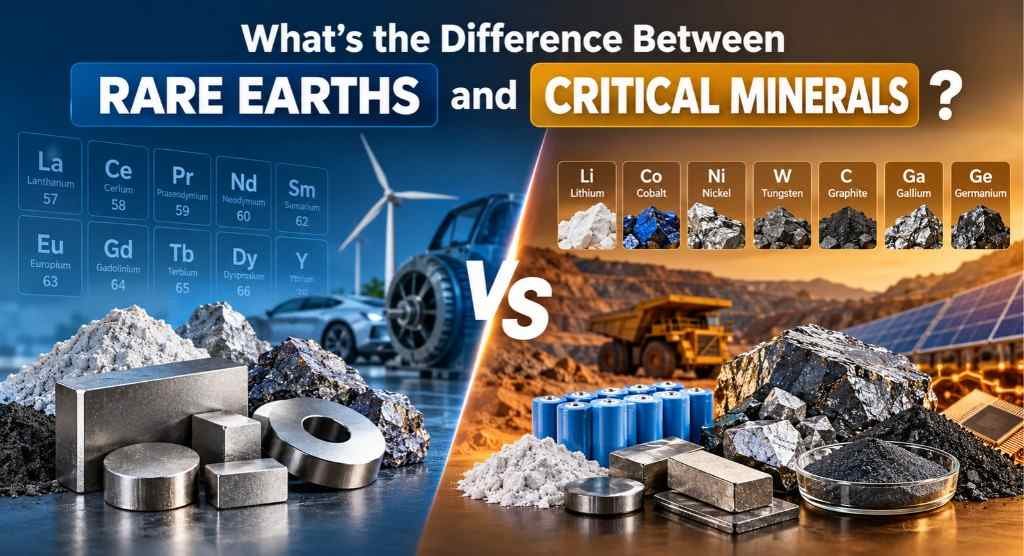
Rare Earths vs Critical Minerals is an increasingly important topic in modern manufacturing, clean energy, electronics, aerospace, and defence.
A small shortage of specialised materials can delay electric vehicle production, semiconductor manufacturing, or critical defence projects.
Understanding Rare Earths vs Critical Minerals helps industries avoid such supply-chain disruptions.
Rare earths are a scientifically defined group of 17 chemical elements, while critical minerals are strategically important materials facing potential supply risks.
Although some rare earths are classified as critical minerals, not all critical minerals are rare earth elements.
In this detailed DOMADIA™ guide, we explore 9 powerful differences in Rare Earths vs Critical Minerals, covering chemical composition, properties, applications, international standards, available forms, and their growing importance in global industries.
1. What Are Rare Earth Elements?
Rare earth elements (REEs) are a group of 17 metallic chemical elements comprising the 15 lanthanides, together with scandium and yttrium.
Despite their name, many rare earth elements are not particularly rare in Earth’s crust.
The real challenge is that economically recoverable deposits can be limited, while separating and refining individual rare earth elements requires sophisticated processing.
The 17 Rare Earth Elements and Their Chemical Symbols
| Element | Symbol | Atomic Number | Major Applications |
| Scandium | Sc | 21 | Aluminium alloys, solid oxide fuel cells |
| Yttrium | Y | 39 | Ceramics, phosphors, lasers |
| Lanthanum | La | 57 | Optical glass, catalysts, batteries |
| Cerium | Ce | 58 | Glass polishing, automotive catalysts |
| Praseodymium | Pr | 59 | Permanent magnets, specialty glass |
| Neodymium | Nd | 60 | Powerful permanent magnets |
| Promethium | Pm | 61 | Specialised radioactive applications |
| Samarium | Sm | 62 | High-temperature magnets |
| Europium | Eu | 63 | Display phosphors, security features |
| Gadolinium | Gd | 64 | MRI contrast agents, magnetic materials |
| Terbium | Tb | 65 | Magnet additives, phosphors |
| Dysprosium | Dy | 66 | High-temperature magnet performance |
| Holmium | Ho | 67 | Lasers, specialised magnetic systems |
| Erbium | Er | 68 | Fibre-optic amplifiers, lasers |
| Thulium | Tm | 69 | Medical and industrial lasers |
| Ytterbium | Yb | 70 | Fibre lasers, specialty materials |
| Lutetium | Lu | 71 | Scintillators, medical imaging |
Why Are Rare Earths Important?
Consider an electric vehicle traction motor.
Its permanent magnets may contain neodymium and praseodymium, with dysprosium or terbium incorporated into certain high-temperature magnet designs.
These elements help manufacturers achieve high magnetic performance in compact motor assemblies.
The result can be greater power density and efficient operation, depending on the motor design.
Rare earth elements are therefore important not simply because they are unusual metals, but because their magnetic, optical, electronic, and chemical properties are difficult to replicate in certain applications.
2. What Are Critical Minerals?
Critical minerals are minerals or mineral-derived materials that governments identify as strategically or economically important and potentially vulnerable to supply disruption.
Unlike rare earth elements, critical minerals do not form one fixed chemical family.
They may include elements from completely different parts of the periodic table.
Examples include:
- Lithium for rechargeable batteries
- Cobalt for selected battery chemistries and high-performance alloys
- Nickel for batteries and industrial alloys
- Graphite for battery anodes and industrial applications
- Tungsten for cutting tools and high-temperature components
- Gallium for semiconductor applications
- Germanium for infrared optics and electronics
- Rare earth elements for magnets, electronics, and defence technologies
Importantly, there is no single universal critical-minerals list.
The United States, European Union, India, Australia, and other jurisdictions assess criticality according to their economic needs, strategic priorities, and supply vulnerabilities.
A material considered critical in one country may not receive the same designation elsewhere.
This is the first major distinction engineers and procurement teams should understand.
3. Rare Earths vs Critical Minerals: 9 Powerful Differences

Difference 1: Scientific Classification vs Strategic Classification
Rare earth elements belong to a defined group of chemical elements.
Critical minerals are identified through economic, industrial, and supply-chain assessments.
For example, neodymium is a rare earth element because of its chemical classification.
Lithium is not a rare earth element, but it is considered critical by many jurisdictions because of its importance to battery technology and energy systems.
Key takeaway: Rare earth is a chemical identity. Critical mineral is a strategic designation.
Difference 2: Fixed Group vs Changing Lists
In Rare Earths vs Critical Minerals, classification differs based on scientific definitions and changing industrial priorities.
Rare earths comprise a fixed group of 17 chemical elements, while critical mineral lists can change with technological advancements, geopolitical developments, and supply-chain risks.
Growing demand for electric vehicles, renewable energy, and battery storage can increase the strategic importance of certain minerals.
Understanding Rare Earths vs Critical Minerals helps manufacturers monitor changing material priorities and develop reliable long-term sourcing strategies.
Difference 3: Magnetic Applications vs Broader Industrial Applications
In Rare Earths vs Critical Minerals, industrial applications vary depending on material properties and performance requirements.
Rare earth elements such as neodymium are essential for high-performance permanent magnets used in electric motors, wind turbines, and industrial automation.
Critical minerals like lithium support rechargeable batteries for electric vehicles and energy storage, while tungsten is widely used in wear-resistant tools, electrodes, and high-temperature equipment.
Understanding Rare Earths vs Critical Minerals helps manufacturers select suitable materials for advanced technologies and demanding industrial applications.
Difference 4: Abundance vs Supply Availability
One common misconception in Rare Earths vs Critical Minerals is that rare earths are difficult to obtain because they are extremely scarce.
In reality, availability depends on ore concentration, extraction costs, refining complexity, environmental regulations, and processing capacity.
Critical minerals face similar challenges, particularly when production is concentrated in a few countries.
Understanding Rare Earths vs Critical Minerals helps manufacturers recognise that reliable access to refined materials matters more than geological abundance alone.
Difference 5: Processing Complexity
In Rare Earths vs Critical Minerals, processing complexity plays a major role in material availability and supply-chain stability.
Rare earth elements require complex separation and refining because of their similar chemical properties. Meanwhile, critical minerals such as lithium, tungsten, and graphite involve specialised extraction, purification, and processing methods.
Understanding Rare Earths vs Critical Minerals helps manufacturers recognise that supply risks extend beyond mining to refining, processing, and final material production.
Difference 6: Price and Market Behaviour
In Rare Earths vs Critical Minerals, pricing depends on material purity, demand, availability, processing costs, and supply-chain conditions.
Rare earth elements such as neodymium and praseodymium have different pricing trends from cerium and lanthanum. Similarly, critical minerals like lithium, cobalt, nickel, and tungsten follow distinct market dynamics.
Understanding Rare Earths vs Critical Minerals helps manufacturers recognise that higher prices do not necessarily indicate greater criticality. Supply risks, economic importance, and availability of alternatives are equally important.
Difference 7: Substitution Possibilities
In Rare Earths vs Critical Minerals, material substitution depends on performance, cost, efficiency, and application requirements.
Some electric motors can replace rare-earth magnets with induction or electrically excited designs, while certain battery technologies reduce dependence on cobalt and nickel.
However, alternatives may involve compromises in efficiency, weight, reliability, or lifecycle costs.
Understanding Rare Earths vs Critical Minerals helps manufacturers select suitable alternatives without compromising safety, performance, or long-term reliability.
Difference 8: Environmental Considerations
In Rare Earths vs Critical Minerals, environmental impacts depend on mining methods, processing techniques, and resource management.
Both material groups can involve land disturbance, water consumption, chemical waste, and emissions. Certain rare earth ores may also contain naturally occurring radioactive materials requiring careful handling.
Understanding Rare Earths vs Critical Minerals highlights the importance of responsible sourcing, cleaner processing, recycling, and sustainable material use.
At DOMADIA™, we recognise the importance of material efficiency and responsible sourcing in supporting more sustainable industrial development.
Difference 9: Industrial and National Strategic Importance
Rare earth elements are important for specific advanced technologies, particularly permanent magnets and selected electronic, optical, and defence systems.
Critical minerals represent a broader category of materials important to economic and national security.
This distinction affects government policy, procurement strategy, stockpiling, investment, and supply-chain diversification.
A manufacturer that understands both categories can better anticipate sourcing risks and identify suitable alternatives before shortages interrupt production.
4. Chemical Composition of Rare Earth and Critical Mineral Materials
Rare earth elements are individual chemical elements, but industrial products often use them in compounds or alloys.
Critical minerals may similarly be traded as ores, oxides, salts, refined metals, powders, or engineered materials.
Representative Industrial Compositions
| Material | Chemical Formula or Composition | Industrial Significance |
| Neodymium oxide | Nd₂O₃ | Precursor for neodymium-based materials |
| Dysprosium oxide | Dy₂O₃ | Precursor for specialised magnet materials |
| Cerium oxide | CeO₂ | Polishing and catalytic applications |
| Neodymium iron boron | Nd₂Fe₁₄B (principal magnetic phase) | High-performance permanent magnets |
| Samarium cobalt | SmCo₅ or Sm₂Co₁₇ families | High-temperature permanent magnets |
| Lithium carbonate | Li₂CO₃ | Lithium chemical and battery-material production |
| Lithium iron phosphate | LiFePO₄ | Rechargeable battery cathodes |
| Tungsten carbide | WC | Cutting tools and wear-resistant components |
| Gallium nitride | GaN | Power and RF semiconductor devices |
| Germanium dioxide | GeO₂ | Optical and chemical applications |
These formulas represent compounds or principal phases, not necessarily the full commercial composition of finished products.
For example, commercial NdFeB magnets may contain additional elements and coatings selected for magnetic performance, corrosion protection, and operating temperature.
Do Rare Earth Elements Have UNS Numbers?
Not every advanced material is classified using the Unified Numbering System (UNS).
UNS designations are widely used for metallic alloys and certain commercial metal grades.
Rare earth oxides, individual rare earth elements, and many engineered magnet materials are more commonly identified by chemical symbols, purity specifications, magnet grades, and applicable technical standards.
Examples of non-rare-earth industrial metals with UNS designations include:
| Material | UNS Designation | Typical Industrial Use |
| Nickel 200 | N02200 | Chemical processing, electrical components |
| Nickel 201 | N02201 | High-temperature and chemical processing applications |
| Copper ETP | C11000 | Electrical conductors and components |
| Commercially pure titanium Grade 2 | R50400 | Corrosion-resistant industrial equipment |
These are examples of UNS-designated materials, not a claim that every listed alloy is officially designated a critical mineral.
5. Important Technical Properties
The engineering value of rare earths and critical minerals depends on the particular material and its final application.
Representative physical properties of selected elements
| Element | Density (g/cm³) | Melting Point (°C) |
| Neodymium | 7.01 | 1,016 |
| Dysprosium | 8.55 | 1,412 |
| Cerium | 6.77 | 795 |
| Lithium | 0.534 | 180.5 |
| Cobalt | 8.90 | 1,495 |
| Nickel | 8.91 | 1,455 |
| Tungsten | 19.25 | 3,422 |
Approximate values for pure elements near ambient conditions. Commercial alloys, oxides, and engineered products have different properties.
Key Performance Characteristics
In Rare Earths vs Critical Minerals, technical properties determine material selection for advanced industrial applications.
Magnetic Performance: Neodymium, praseodymium, samarium, dysprosium, and terbium support high-performance permanent magnets.
Thermal Resistance: Tungsten withstands extreme temperatures, while samarium-cobalt magnets perform well in certain high-temperature environments.
Electrical Behaviour: Copper, nickel, and gallium-based materials support electrical and semiconductor applications.
Mechanical Strength: Tungsten carbide and advanced alloys provide exceptional hardness, wear resistance, and durability.
Optical Properties: Erbium, yttrium, and europium support lasers, phosphors, and optical technologies.
Electrochemical Performance: Lithium, nickel, cobalt, manganese, and graphite are important in various battery technologies.
Understanding Rare Earths vs Critical Minerals helps engineers evaluate these properties for reliable material selection.
At DOMADIA™, we recognise that selecting the right material requires understanding Rare Earths vs Critical Minerals, their technical capabilities, and specific industrial requirements.
6. Rare Earth Magnets: Technical Specifications
Permanent magnets are one of the most commercially important uses of rare earth elements.
Two major magnet families are neodymium iron boron (NdFeB) and samarium cobalt (SmCo).
| Specification | NdFeB Magnets | SmCo Magnets |
| Main chemistry | Nd-Fe-B based | Sm-Co based |
| Maximum energy product | Commonly ~25–55 MGOe | Commonly ~15–35 MGOe |
| Temperature capability | Grade-dependent; often ~80–200°C | Certain grades ~250–350°C |
| Corrosion behaviour | Often requires protective coating | Generally better resistance than uncoated NdFeB |
| Relative cost | Often more economical | Often more expensive |
| Typical applications | Motors, generators, robotics | Aerospace, high-temperature sensors, specialised motors |
These are broad commercial ranges, not guaranteed specifications. Actual values depend on magnet grade, geometry, magnetic circuit, operating temperature, and manufacturer data.
What Engineers Should Check
Before selecting a rare earth magnet, evaluate remanence (Br), intrinsic coercivity (Hcj), maximum energy product (BHmax), operating temperature, irreversible demagnetisation risk, corrosion protection, dimensional tolerances, and magnetic orientation.
For high-temperature environments, selecting a magnet based only on room-temperature pull force can lead to unexpected performance loss.
7. Major Industrial Applications

Electric Vehicles and Automotive
In Rare Earths vs Critical Minerals, rare earth magnets power many electric vehicle motors, while lithium, graphite, nickel, and cobalt support various battery technologies. Material selection depends on EV design, battery chemistry, efficiency, and performance requirements.
Renewable Energy
In Rare Earths vs Critical Minerals, rare-earth permanent magnets support certain wind turbine generators, while other critical minerals are essential for battery storage, power electronics, and renewable energy technologies.
Electronics and Semiconductors
In Rare Earths vs Critical Minerals, gallium, germanium, and selected rare earth elements play important roles in semiconductors, optical systems, displays, lasers, and advanced telecommunications technologies.
Aerospace and Defence
In Rare Earths vs Critical Minerals, samarium-cobalt magnets, specialised rare earth materials, tungsten, titanium, and advanced nickel alloys support demanding aerospace and defence applications requiring high strength, thermal stability, durability, and reliable performance.
Industrial Automation
Permanent magnets, wear-resistant tooling, precision sensors, and high-performance metallic materials support modern automated manufacturing.
8. International Standards and Material Specifications
Material identification alone is not sufficient for industrial procurement.
Engineers should specify applicable standards, grade, purity, dimensional tolerances, and test requirements.
| Standard / Framework | Relevance |
| IEC 60404 series | Magnetic materials and measurement methods |
| IEC 60404-8-1 | Specifications for certain hard magnetic materials |
| ASTM A977/A977M | Magnetic properties of high-coercivity permanent magnet materials |
| ISO 21928-2 | Permanent magnets: measurement methods for magnetic properties |
| ASTM B777 | Tungsten-base high-density metal specifications |
| ISO 9001 | Quality management systems |
| ISO 14001 | Environmental management systems |
| OECD Due Diligence Guidance | Responsible mineral supply-chain due diligence |
| REACH Regulation | EU chemical registration and applicable substance obligations |
Not every standard applies to every material. For example, magnet standards should not automatically be applied to lithium compounds or tungsten carbide powders.
A good procurement specification should identify the actual product and intended use before selecting the relevant standard.
9. Shapes and Forms Available for Industrial Applications
Rare earth and critical mineral products can be supplied in many forms depending on their chemistry and manufacturing route.
Oxides and Powders
Used for chemical processing, ceramics, magnets, and specialised material production.
Ingots and Metal Pieces
Used as raw materials for alloying, melting, and further processing.
Magnets and Custom Shapes
Blocks, discs, rings, cylinders, arcs, and application-specific geometries.
Rods, Sheets, Foils and Wires
Available for suitable metals and alloys, subject to material grade and manufacturing capability.
For procurement, the final form is often as important as the element itself.
A high-purity rare earth oxide cannot automatically replace a finished magnet, just as tungsten powder cannot be substituted directly for a precision-machined tungsten component.
The product form, manufacturing process, and final performance requirements must all align.
10. Why Rare Earths and Critical Minerals Matter for India
India’s growing electric vehicle, electronics, renewable energy, aerospace, and defence industries are increasing the importance of reliable strategic-material supply chains.
In July 2023, India’s Ministry of Mines published a list of 30 critical minerals, including rare earth elements, lithium, cobalt, nickel, graphite, tungsten, titanium, and gallium.
The distinction between rare earths and critical minerals is particularly important for Indian manufacturers because both material groups support different stages of industrial development.
India’s Strategic Opportunities
Domestic exploration: Identifying economically viable deposits can help diversify future mineral supplies.
Refining and processing: Building processing capabilities is important because mineral deposits alone do not guarantee availability of high-purity industrial materials.
Advanced manufacturing: Converting refined materials into magnets, battery components, alloys, and engineered products can create additional industrial value.
Recycling: Recovering valuable elements from industrial scrap and end-of-life products can supplement primary supplies.
International partnerships: Diversified sourcing relationships can help reduce dependence on individual suppliers or processing regions.
In October 2026, reports also indicated that India was developing a strategic critical-mineral stockpiling policy to reduce exposure to supply disruptions. Final policy details remained under consideration.
For Indian manufacturers, the message is clear: strategic material planning is becoming an essential part of industrial competitiveness.
11. Environmental Sustainability and Recycling
The environmental discussion surrounding rare earths and critical minerals should consider the complete material lifecycle.
Mining and refining are important, but so are product durability, manufacturing efficiency, repairability, reuse, and end-of-life recovery.
How Recycling Can Help
- Recover valuable elements from used motors, electronics, batteries, and industrial equipment.
- Reduce dependence on newly extracted material where recovery is technically and economically feasible.
- Lower waste generation through improved material segregation.
- Encourage manufacturers to design components for disassembly and recovery.
- Support circular material supply chains.
However, recycling is not automatically environmentally superior in every situation. Energy consumption, chemical processing, recovery yield, transport, and the quality of recovered materials must also be evaluated.
DOMADIA™ and Responsible Material Selection
At DOMADIA™, the value of responsible material selection lies in helping industrial buyers consider durability, application suitability, and long-term performance.
A component that lasts longer and requires fewer replacements can potentially reduce material consumption, maintenance activities, and scrap generation.
This is particularly relevant for high-performance magnets, specialty alloys, and precision industrial components.
The goal should be to select materials that perform reliably throughout their intended service life—not simply to minimise the initial purchase price.
12. Why DOMADIA™ for Rare Earth and Critical Mineral Requirements?

Selecting advanced industrial materials involves much more than identifying a chemical element.
Engineers must consider grade, purity, processing condition, product form, technical performance, and supplier documentation.
DOMADIA™ focuses on helping customers evaluate specialised material requirements for demanding industrial applications.
Application-Oriented Material Selection
In Rare Earths vs Critical Minerals, selecting the right material starts with understanding the application. Whether choosing rare earth magnets, tungsten, nickel alloys, copper alloys, or other specialised materials, performance, reliability, and technical requirements should guide every decision.
Technical Specification Support
In Rare Earths vs Critical Minerals, industrial buyers should clearly specify material grade, purity, dimensions, tolerances, operating conditions, and applicable standards to avoid specification mismatches, procurement delays, and unnecessary costs.
Specialised Material Requirements
In Rare Earths vs Critical Minerals, advanced industrial applications may require customised dimensions, specialised material forms, and specific technical properties. Manufacturers should confirm material availability and production feasibility before finalising their requirements.
Long-Term Performance Focus
In Rare Earths vs Critical Minerals, DOMADIA™ encourages customers to consider material performance, initial cost, replacement frequency, maintenance needs, and long-term lifecycle value to ensure reliable and cost-effective industrial solutions.
Conclusion: Understanding the Difference for Smarte Industrial Decisions
The Rare Earths vs Critical Minerals distinction goes beyond terminology and plays an important role in modern industrial development.
Rare earths comprise 17 scientifically defined elements known for their magnetic, optical, and electronic properties, while critical minerals represent a broader category of strategically important materials vulnerable to supply disruptions.
Both support electric vehicles, renewable energy, electronics, aerospace, defence, and advanced manufacturing.
Understanding Rare Earths vs Critical Minerals helps engineers and procurement professionals evaluate chemical composition, technical properties, material availability, supply risks, and lifecycle performance.
As global technologies evolve, reliable sourcing and informed material selection will become increasingly essential.
At DOMADIA™, we support application-focused material selection, helping customers identify suitable industrial materials. Our expertise in Rare Earths vs Critical Minerals supports informed sourcing decisions for demanding engineering requirements.
Find the Right Rare Earths & Critical Minerals with DOMADIA™
Power Your Innovations with High-Performance Industrial Materials!
From rare earth magnets to critical minerals and specialised alloys,DOMADIA™ helps industries explore material solutions for demanding applications in aerospace, defence, electronics, electric vehicles, and advanced manufacturing.
Contact DOMADIA™ with your required grade, purity, dimensions, quantity, and technical specifications.
Talk to: Er.Pankaj Domadia | Kairav Domadia | Aadil Domadia | Pragati Sanap | Pooja N N
#RareEarthElements #CriticalMinerals #RareEarthMagnets #StrategicMinerals #AdvancedMaterials #SupplyChain #CleanEnergy #DOMADIA
Directly whatsapp us for an Enquiry: https://wa.link/kairav
Our materials reach Chennai, Coimbatore, Hosur, Madurai, and Trichy, supporting manufacturing hubs in Tamil Nadu, Kerala, Karnataka, Andhra Pradesh, and Telangana, while shipping to France, Spain, UK, Netherlands, and Belgium.