Blogs
Double-Layer Mu Metal vs Single Layer: 9 Powerful Benefits of UNS N14080 Shielding
Double Layer Mu Metal shielding can provide significantly better protection against unwanted magnetic fields than a single layer when properly engineered. Consider a sensitive magnetic sensor working perfectly during testing but producing unstable readings near transformers or electric motors. Even after installing a single-layer shield, magnetic interference may remain.
This raises an important question: Can Double Layer Mu Metal deliver better shielding than a thicker single layer? In many low-frequency applications, two properly spaced high-permeability barriers can improve magnetic attenuation. However, Double Layer Mu Metal performance depends on material quality, shield geometry, air-gap spacing, and magnetic annealing.
In this comprehensive guide, DOMADIA™ explores the benefits of Double Layer Mu Metal, including UNS N14080 properties, chemical composition, technical specifications, applications, engineering standards, and cost considerations to help engineers select the right magnetic shielding solution.
What Is Mu Metal and Why Is UNS N14080 Important?
Mu Metal is a high-nickel, iron-based soft magnetic alloy engineered to provide extremely high magnetic permeability under suitable processing and operating conditions.
The alloy is commonly associated with approximately 80% nickel, with iron making up much of the balance and smaller additions of elements such as molybdenum.
One widely recognised high-permeability nickel-iron alloy designation is UNS N14080.
Its principal function is to provide a low-reluctance path for magnetic flux.
Instead of completely stopping a magnetic field, a properly designed Mu Metal enclosure redirects a portion of the external magnetic flux through the shield material, reducing the field within the protected region.
This makes Mu Metal particularly valuable for protecting equipment that is sensitive to static and low-frequency magnetic interference.
Why high permeability matters
Magnetic permeability describes how readily a material responds to an applied magnetic field.
A high-permeability alloy can carry magnetic flux more readily than air under appropriate conditions.
When a Mu Metal enclosure surrounds sensitive equipment, magnetic flux tends to follow the high-permeability shield, helping reduce magnetic field penetration into the protected space.
However, permeability is not constant.
It depends on several factors, including:
- Magnetic field strength
- Material composition
- Heat-treatment condition
- Mechanical stress
- Operating temperature
- Magnetic history
- Frequency of the applied field
Consequently, simply purchasing a high-permeability alloy does not guarantee maximum shielding performance.
The final performance depends on the complete shield design and the condition of the finished component.
Chemical Composition of Mu Metal UNS N14080
The chemical composition of a magnetic shielding alloy directly influences its permeability, saturation behaviour, mechanical characteristics, and response to heat treatment.
The following values describe a representative 80% nickel-iron-molybdenum shielding alloy. They are illustrative rather than universal certification limits for every UNS N14080 product.
| Element | Typical composition |
| Nickel (Ni) | Approximately 79–81% |
| Molybdenum (Mo) | Approximately 4–5% |
| Iron (Fe) | Balance |
| Manganese (Mn) | Small controlled addition |
| Silicon (Si) | Small controlled addition |
| Carbon (C) | Controlled low level |
| Other elements | Controlled according to material specification |
The precise composition must be confirmed against the applicable purchase specification and supplier’s material test certificate.
Role of the major elements
Nickel: Nickel is fundamental to the alloy’s soft magnetic behaviour and helps support the high permeability associated with properly processed nickel-iron alloys.
Iron: Iron contributes to the alloy’s ferromagnetic characteristics and magnetic flux-carrying capability.
Molybdenum: Molybdenum helps modify the magnetic characteristics of certain high-nickel alloy systems and supports the desired soft magnetic performance.
Minor additions: Elements such as manganese and silicon may be controlled during alloy production to support processing and material quality.
At DOMADIA™, material selection should begin with the required alloy designation, chemical composition, product form, and magnetic performance rather than relying on a commercial alloy name alone.
Single-Layer vs Double-Layer Mu Metal: What Is the Actual Difference?
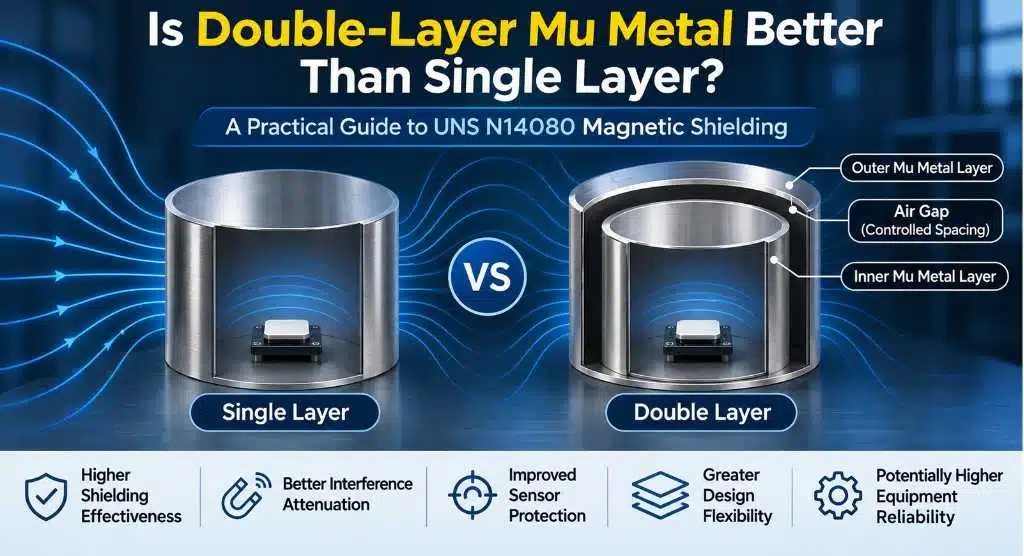
A single-layer magnetic shield uses one continuous enclosure or barrier made from high-permeability material.
A double-layer magnetic shield uses two separate high-permeability barriers, generally with an air gap or nonmagnetic spacer between them.
The difference may sound simple, but it can have a substantial effect on magnetic shielding performance.
Single-layer Mu Metal shielding
A single-layer design is commonly used when the magnetic interference is relatively moderate and the required shielding factor can be achieved without additional complexity.
Its advantages include:
- Simpler fabrication
- Lower component count
- Reduced assembly complexity
- Potentially lower manufacturing cost
- Compact overall dimensions
However, a single shield may be insufficient for particularly sensitive instruments or challenging low-frequency magnetic environments.
Double-layer Mu Metal shielding
A double-layer construction introduces an additional magnetic shielding barrier.
The outer shield reduces the field reaching the inner shield, while the inner shield provides further attenuation around the protected component.
Proper separation between the two shields can improve the overall shielding factor.
The performance improvement depends on the geometry, magnetic properties, field direction, spacing, and potential saturation of both layers.
The main engineering advantage is not merely having twice the material. It is having two magnetic shielding stages that can work together.
9 Powerful Benefits of Double-Layer Mu Metal Shielding

Benefit 1: Higher Magnetic Shielding Effectiveness
One of the biggest advantages of Double Layer Mu Metal is its potential to provide a higher shielding factor. Two properly spaced high-permeability layers can reduce unwanted magnetic interference more effectively than a single layer, depending on the design.
Benefit 2: Better Performance Against Low-Frequency Magnetic Fields
Double Layer Mu Metal can improve shielding against low-frequency magnetic interference from transformers, electric motors, and industrial equipment. At 50 Hz or 60 Hz, properly engineered multilayer shielding can provide greater attenuation than a single shield.
Benefit 3: Improved Protection for Sensitive Sensors
Sensitive instruments require stable magnetic environments for accurate measurements. Double Layer Mu Metal helps reduce external magnetic interference around magnetometers, precision sensors, laboratory instruments, and scientific measurement equipment.
Benefit 4: More Efficient Use of Material
Two properly separated Mu Metal layers can sometimes provide better shielding than one thicker layer using a similar total material thickness. This makes multilayer construction an effective option when magnetic performance and material efficiency are carefully balanced.
Benefit 5: Greater Flexibility in Shield Design
Double Layer Mu Metal provides engineers with greater design flexibility through adjustable layer thickness, air-gap spacing, and enclosure geometry. These factors help optimise shielding performance for specific industrial and scientific applications.
Benefit 6: Potentially Better Magnetic Field Uniformity
Properly designed Double Layer Mu Metal shielding can help reduce magnetic field variations inside sensitive equipment. This is particularly valuable for precision instruments requiring a stable magnetic environment and consistent measurement accuracy.
Benefit 7: Reduced Exposure of the Inner Shield to External Fields
In multilayer shielding, the outer Mu Metal layer reduces the magnetic field reaching the inner layer. This allows the inner shield to operate under more favourable magnetic conditions, although both layers must still be evaluated for magnetic saturation.
Benefit 8: Better Performance Optimisation for Critical Equipment
Double Layer Mu Metal can provide enhanced magnetic protection for specialised magnetometers, scientific research instruments, and precision measurement systems. Its multilayer construction offers additional opportunities to achieve demanding shielding requirements.
Benefit 9: Potentially Lower Lifecycle Cost
Although Double Layer Mu Metal generally requires a higher initial investment, effective shielding may reduce measurement disturbances, recalibration, maintenance, and equipment downtime. Improved operational reliability can justify the additional cost in demanding applications.
Key Takeaway: The best magnetic shielding solution is not necessarily the cheapest or thickest. It is the design that delivers reliable attenuation, long-term performance, and cost efficiency for the intended application.
Double-Layer Mu Metal vs Single Layer: Detailed Comparison
| Parameter | Single layer | Double layer |
| Shielding effectiveness | Suitable for less demanding requirements | Potentially higher |
| Construction | One shielding barrier | Two separate barriers |
| Magnetic attenuation | One stage | Two interacting stages |
| Material requirement | Generally lower | Generally higher |
| Space requirement | More compact | Requires additional space |
| Fabrication | Simpler | More complex |
| Heat-treatment considerations | Important | Important for both layers |
| Assembly requirements | Fewer components | Requires controlled spacing and alignment |
| Initial cost | Generally lower | Generally higher |
| Design flexibility | Limited | Greater |
| Typical applications | General magnetic shielding | Sensitive instrumentation and demanding magnetic environments |
The comparison highlights an important principle: double-layer shielding is not universally superior in every engineering situation.
A properly designed single-layer shield may already meet the required attenuation with lower cost and complexity.
The additional layer becomes valuable when it produces a meaningful improvement in performance.
Why Does the Air Gap Between Mu Metal Layers Matter?
One of the most important factors in Double Layer Mu Metal shielding is the air gap between the two layers. Proper separation allows each shield to redirect magnetic flux, potentially improving overall shielding effectiveness. When the layers are pressed too closely together, some advantages of multilayer construction may be reduced.
What Happens When the Gap Is Too Small?
A very small air gap in Double Layer Mu Metal shielding can limit the benefits of independently functioning magnetic barriers. Depending on the geometry and magnetic contact, the arrangement may behave more like a single thicker shield, reducing the potential improvement in attenuation.
What Happens When the Gap Is Increased?
Increasing the separation between layers can improve Double Layer Mu Metal shielding performance in certain configurations. However, excessive spacing increases enclosure dimensions and may create installation challenges. Therefore, engineers must balance magnetic shielding effectiveness with available space.
Is There an Ideal Air Gap?
There is no universal air-gap measurement suitable for every Double Layer Mu Metal application. The ideal spacing depends on shield diameter, thickness, geometry, magnetic field strength, and required attenuation. At DOMADIA™, we emphasise selecting the right material specifications and shield geometry to support reliable magnetic shielding performance.
Technical Specifications and Magnetic Properties of UNS N14080
The following values represent general characteristics associated with high-nickel, high-permeability Mu Metal-type alloys.
They should not be interpreted as guaranteed certified properties for every product condition.
| Property | Representative value or characteristic |
| UNS designation | N14080 |
| Alloy family | High-nickel iron-molybdenum soft magnetic alloy |
| Nickel content | Approximately 80% |
| Density | Approximately 8.7 g/cm³ |
| Magnetic permeability | Very high after appropriate magnetic annealing |
| Saturation flux density | Approximately 0.7–0.8 T, depending on alloy and condition |
| Electrical resistivity | Approximately 55–65 µΩ·cm |
| Curie temperature | Approximately 400–460°C, depending on composition |
| Magnetic behaviour | Soft ferromagnetic |
| Corrosion resistance | Moderate; environment dependent |
| Typical supply forms | Sheet, strip, foil, and fabricated components, subject to availability |
Why permeability values require careful interpretation
Magnetic permeability is often quoted as a single number.
However, engineers must distinguish between initial permeability, maximum permeability, and differential permeability.
These values describe different parts of the magnetic response.
A permeability value obtained under one test condition cannot necessarily predict the performance of a finished enclosure exposed to a different magnetic field.
Therefore, for critical shielding applications, the purchase specification should identify the required magnetic test method and acceptance criteria.
Why Magnetic Annealing Is Critical for Both Layers
Mu Metal is highly sensitive to mechanical stress caused by bending, stamping, cutting, welding, and forming. These processes can reduce magnetic permeability and affect shielding performance. Therefore, proper magnetic annealing is essential to maintain the effectiveness of Double Layer Mu Metal shielding.
What Is Magnetic Annealing?
Magnetic annealing is a controlled heat-treatment process that helps restore or improve the soft magnetic properties of Mu Metal. It typically involves heating the alloy in a controlled atmosphere, followed by a specified cooling cycle. For Double Layer Mu Metal, proper annealing helps both shielding layers achieve the required magnetic performance.
Why Does This Matter in Multilayer Shielding?
In Double Layer Mu Metal shielding, both inner and outer layers must maintain high magnetic permeability. If either layer experiences mechanical stress or deformation after annealing, its shielding effectiveness may decrease. Proper heat treatment and careful handling help ensure reliable magnetic attenuation.
Important: Annealing temperatures and cooling procedures depend on the specific Mu Metal grade, component geometry, and manufacturer recommendations. A validated heat-treatment process is essential for achieving consistent magnetic shielding performance.
Applications of Single-Layer and Double-Layer Mu Metal Shielding

1. Precision Magnetometers
Sensitive magnetometers may require Double Layer Mu Metal shielding to reduce environmental magnetic interference and improve measurement accuracy and stability.
2. Medical and Scientific Instrumentation
Specialised medical and scientific sensors may benefit from Double Layer Mu Metal shielding to reduce magnetic interference. However, MRI systems require application-specific magnetic field engineering, as Mu Metal is not a universal solution for MRI field containment.
3. Aerospace and Defence Electronics
Double Layer Mu Metal shielding can help protect sensitive aerospace and defence sensors and measurement components from low-frequency magnetic interference, improving measurement stability and reliability.
4. Precision Electronic Instruments
Sensitive measurement systems may benefit from Double Layer Mu Metal shielding to reduce unwanted magnetic interference from nearby equipment, improving measurement accuracy, stability, and reliability.
5. Industrial Automation
Sensors operating near transformers, motors, and current-carrying conductors may benefit from Double Layer Mu Metal shielding to reduce low-frequency magnetic interference and improve measurement stability and reliability.
6. Research Laboratories
Advanced magnetic measurements and specialised physics experiments may use Double Layer Mu Metal shielding with nested high-permeability enclosures to achieve low residual magnetic fields and improve measurement accuracy.
Standards Applicable to Mu Metal UNS N14080
Material standards help establish consistent requirements for chemical composition, product quality, dimensional tolerances, and magnetic testing.
The following standards and classifications may be relevant, depending on the application and exact material specification.
| Standard or designation | Relevance |
| UNS N14080 | Alloy identification |
| ASTM A753 | Wrought nickel-iron soft magnetic alloys |
| ASTM A596/A596M | DC magnetic properties using ring and permeameter methods |
| ASTM A773/A773M | DC magnetic properties using ring and permeameter procedures with electronic instrumentation |
| IEC 60404 series | Magnetic materials and applicable magnetic measurement methods |
The exact applicability and edition of each standard should be confirmed before procurement.
Important purchasing considerations
A material certificate showing the correct chemical composition does not necessarily demonstrate that a fabricated shield will achieve the required attenuation.
For demanding applications, the specification should also address the material condition, magnetic properties, final heat treatment, dimensions, and finished-assembly testing.
Where a particular shielding factor is mandatory, it should be stated as an acceptance requirement under defined test conditions.
Shapes and Forms of Mu Metal Available Through DOMADIA™
Mu Metal is used in several product forms, depending on the application and fabrication requirements.
DOMADIA™ can be contacted regarding the required UNS N14080 grade, dimensions, thickness, material condition, and product form, subject to sourcing and availability.
Mu Metal Sheets
Flat sheets are suitable for producing magnetic shielding panels, covers, enclosures, and fabricated components.
Mu Metal Foils
Thin foils are useful where space limitations, lightweight construction, or precision fabrication are important.
Mu Metal Strips
Strip material can be used in formed components, shielding elements, and other specialised applications.
Mu Metal Coils
Coiled material may be appropriate for continuous processing, stamping, and volume manufacturing applications.
Fabricated Mu Metal Components
Depending on manufacturing capabilities and project requirements, Mu Metal can be formed into cylindrical enclosures, shielding cans, and other application-specific geometries.
For multilayer applications, engineers should specify the dimensions and tolerances of both the inner and outer shields, including their intended separation.
Is Double-Layer Mu Metal Always Better Than a Thicker Single Layer?
Not necessarily.
This is one of the most important engineering distinctions in magnetic shielding design.
A thicker single-layer shield may offer advantages in applications where simplicity, compact dimensions, or mechanical robustness are important.
A double-layer shield may provide greater attenuation in certain configurations, particularly where nested magnetic barriers can be appropriately spaced.
However, a thicker single shield may be preferable when the available space is limited or when the field strength makes saturation an important concern.
In some cases, the optimum design may involve a combination of high-permeability and higher-saturation materials.
Therefore, the correct comparison should consider:
- Required shielding factor
- External magnetic field strength
- Frequency and field orientation
- Shield geometry
- Available installation space
- Material thickness
- Magnetic saturation
- Manufacturing and annealing requirements
- Total project cost
More layers do not automatically mean better engineering. The goal is to achieve the specified shielding performance with an appropriate design.
Environmental and Lifecycle Considerations
The environmental impact of Double Layer Mu Metal shielding depends on material consumption, manufacturing processes, energy usage, and equipment lifespan. Although multilayer shielding requires additional material and heat treatment, its improved magnetic protection may help reduce equipment failures and unnecessary replacements.
Double Layer Mu Metal can offer lifecycle benefits when its enhanced shielding performance reduces maintenance, downtime, and replacement frequency. High-nickel alloys also have recycling potential, supporting more efficient material recovery and resource conservation.
However, Double Layer Mu Metal is not automatically more sustainable than single-layer shielding. Its environmental benefits depend on actual performance, service life, and manufacturing requirements.
At DOMADIA™, we promote responsible material selection and long-term reliability. Choosing Double Layer Mu Metal for suitable applications can support resource efficiency, reduce avoidable material waste, and contribute to more sustainable industrial practices.
Why DOMADIA™ for Mu Metal UNS N14080?
Selecting Mu Metal is not simply a matter of choosing an alloy with a high nickel percentage.
Engineers must consider magnetic properties, material condition, dimensions, fabrication requirements, and the intended shielding environment.
DOMADIA™ supports industrial material sourcing discussions for specialised alloy requirements, including high-permeability magnetic shielding materials.
Material-focused selection
DOMADIA™ can assist procurement teams in identifying the required alloy designation, material form, thickness, and applicable specifications for Double Layer Mu Metal shielding applications.
Application-oriented requirements
Whether the requirement involves magnetic shielding foil, sheet, strip, or material for fabricated enclosures, the enquiry can be aligned with the intended application.
Technical specification support
Customers can share drawings, material standards, dimensions, magnetic property requirements, and required documentation for review.
Industrial procurement approach
DOMADIA™ focuses on helping customers source specialised materials according to technical and commercial requirements, subject to availability and supplier confirmation.
Single-layer and multilayer project requirements
For projects involving nested magnetic shields, customers can specify both inner and outer enclosure requirements, including thickness, dimensions, and final material condition.
Conclusion: Is Double-Layer Mu Metal Worth the Investment?

Double Layer Mu Metal provides enhanced magnetic shielding when a single layer cannot achieve the required attenuation. Its two separated high-permeability barriers help protect sensitive sensors, precision instruments, and electronic equipment from magnetic interference.
The effectiveness of Double Layer Mu Metal depends on UNS N14080 material properties, magnetic permeability, shield geometry, air-gap spacing, and proper annealing. Engineers must evaluate these factors to ensure reliable shielding performance.
While single-layer shielding is economical, Double Layer Mu Metal can offer superior protection for demanding applications. At DOMADIA™, we support specialised Mu Metal UNS N14080 material requirements, technical specifications, and sourcing solutions.
Upgrade Your Magnetic Shielding Performance with DOMADIA™
Single-layer or double-layer Mu Metal—which is right for your application? Discover high-performance UNS N14080 Mu Metal solutions with DOMADIA™. From precision magnetic shielding foils and sheets to specialised industrial requirements, we help you select the right material for effective shielding, reliability, and long-term performance.
Contact DOMADIA™ Today to discuss your magnetic shielding requirements and explore the right solution for your project.
Talk to: Er.Pankaj Domadia | Kairav Domadia | Aadil Domadia | Pragati Sanap | Pooja N N
#MuMetal #DoubleLayerMuMetal #UNSN14080 #MagneticShielding #MagneticShieldingMaterials #HighPermeabilityAlloys #NickelIronAlloy #MuMetalShielding #IndustrialMaterials #PrecisionEngineering #ElectromagneticShielding #AdvancedMaterials #DOMADIA
Directly whatsapp us for an Enquiry: https://wa.link/kairav
We’ve supplied to Mumbai, Pune, Indore, Jaipur, and Surat—serving industries across Maharashtra, Madhya Pradesh, Rajasthan, Gujarat, and Goa, with exports to Germany, USA, Japan, South Korea, and Italy.