Blogs

Copper Tungsten Composite: 9 Powerful Differences From Pure Metals | UNS C74400
What Makes Tungsten Copper Different From Pure Metals?
Copper Tungsten Composite materials exist because engineers do not always have the luxury of choosing a metal based on one property. In demanding electrical and thermal environments, the right material often needs to balance several performance requirements at the same time.
A component may need to conduct electricity efficiently while resisting electrical arcing. An electrode may need to transfer heat while maintaining its shape. A contact may need good conductivity but also greater resistance to wear than pure copper can provide under severe operating conditions. This is precisely where a Copper Tungsten Composite can provide an engineered combination of properties that neither pure metal delivers alone.
This creates an interesting engineering problem.
Pure copper is highly conductive. Tungsten offers exceptional refractory characteristics. But what happens when the application needs properties from both?
That is where tungsten copper becomes valuable.
Rather than behaving exactly like either constituent metal, tungsten-copper materials combine a tungsten-rich structure with copper to provide an engineered balance of electrical conductivity, thermal conductivity, density, hardness, wear resistance and high-temperature performance. This balance makes Copper Tungsten Composite materials particularly relevant for demanding electrical contacts, electrodes, heat-management components and other specialized industrial applications.
Here are 9 important differences that explain why tungsten copper occupies a unique position between pure copper and pure tungsten.
1. Copper Tungsten Composite Is Not a Conventional Alloy

This is the first major distinction.
People often refer to the material as tungsten copper alloy, but technically it is better understood as a composite produced primarily through powder-metallurgical processing.
Why?
Tungsten and copper have very different physical characteristics and limited mutual solubility. They are therefore not simply melted together like many conventional alloys.
A typical manufacturing route can involve creating a porous tungsten structure and introducing copper into that structure through infiltration. Other powder-metallurgical routes may also be used depending on the required material.
The result is a microstructure in which both constituents continue contributing their characteristic advantages.
Tungsten contributes:
- High-temperature capability
- High density
- Hardness
- Wear resistance
- Resistance to arc erosion
- Dimensional stability
Copper contributes:
- High electrical conductivity
- High thermal conductivity
- Heat dissipation
- Electrical-current carrying capability
This dual-material behaviour is one of the main reasons W-Cu is so different from a pure metal.
2. Chemical Composition Can Be Engineered
There is no single tungsten-copper composition suitable for every application.
Commercial materials are available with different ratios of tungsten and copper.
Typical nominal compositions can include:
| Grade | Tungsten | Copper | General Character |
| W50Cu50 | ~50% | ~50% | Greater copper contribution |
| W60Cu40 | ~60% | ~40% | Conductivity-focused balance |
| W70Cu30 | ~70% | ~30% | Balanced engineering performance |
| W75Cu25 | ~75% | ~25% | Tungsten-rich performance |
| W80Cu20 | ~80% | ~20% | Higher refractory contribution |
| W90Cu10 | ~90% | ~10% | Strong tungsten-dominant characteristics |
These percentages are representative nominal compositions. Actual chemistry and permissible limits should be verified against the required grade, applicable specification and material certification.
And this leads to an important point:
Changing the W/Cu ratio changes the material’s performance.
Increasing copper generally moves the material toward improved electrical and thermal conductivity.
Increasing tungsten generally moves it toward greater density, hardness, wear resistance and refractory characteristics.
The best composition therefore depends on the application rather than on a simple rule that “more tungsten is better.”
3. It Is More Than Conductivity vs Strength
Pure copper is an extraordinary conductor.
That is precisely why copper remains so important for electrical conductors, busbars, electrical connections and heat-transfer applications.
But suppose an electrical contact repeatedly experiences:
high current + heat + mechanical pressure + electrical arcing.
Conductivity is now only one part of the problem.
Pure copper may conduct extremely well, but demanding operating conditions can create requirements for greater wear resistance, dimensional stability and resistance to arc erosion.
Tungsten copper addresses that trade-off.
It gives up some of pure copper’s conductivity in exchange for characteristics contributed by tungsten.
This changes the material-selection question from:
“Which metal has the highest conductivity?”
to:
“Which material delivers the right combination of conductivity and durability for this operating environment?”
That mindset shift is essential when specifying high-performance materials.
4. It Behaves Differently From Pure Tungsten Too
At the other end of the spectrum is tungsten.
Tungsten is known for its extremely high melting point, density and high-temperature capabilities.
Those properties make it valuable in environments that would be extremely demanding for conventional metals.
But tungsten does not offer copper’s exceptional electrical and thermal conductivity.
The copper phase in a Copper Tungsten Composite therefore serves an important purpose.
It creates conductive pathways that improve the material’s ability to carry electrical current and transfer heat compared with pure tungsten.
This creates three very different material choices:
Pure Copper → Maximum conductivity-oriented performance
Tungsten Copper → Engineered balance of properties
Pure Tungsten → Refractory-performance-oriented material
None is automatically superior.
The application determines which combination is useful.
5. Properties of Tungsten Copper

Electrical Conductivity
The copper phase gives Copper Tungsten Composite materials useful electrical conductivity, making them suitable for applications where conductivity must be balanced with wear resistance and high-temperature performance.
However, tungsten copper should not be expected to conduct electricity as efficiently as high-conductivity pure copper. The exact value depends heavily on composition, density, manufacturing quality and grade.
This is why the electrical conductivity of a Copper Tungsten Composite should be specified rather than assumed, particularly when selecting material for demanding electrical contacts, electrodes and related components.
Thermal Conductivity
Copper also contributes significantly to heat transfer, giving Copper Tungsten Composite materials useful thermal conductivity alongside the high-temperature characteristics provided by tungsten.
This can be extremely useful when heat must be removed efficiently from a localized electrical or thermal interface.
High Density
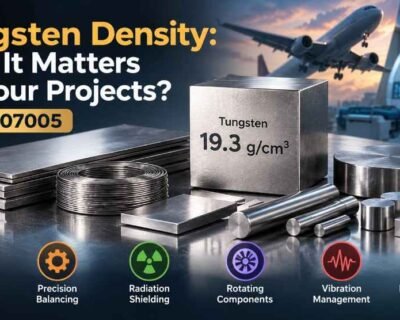
Tungsten has a density of approximately 19.3 g/cm³, compared with roughly 8.96 g/cm³ for copper.
As tungsten content increases, Copper Tungsten Composite materials can therefore become substantially denser than pure copper, making composition an important consideration where component weight and mass are critical design factors.
Wear Resistance
Tungsten contributes hardness and resistance to mechanical wear, helping Copper Tungsten Composite materials perform effectively in demanding environments.
This becomes particularly valuable for components exposed to repeated contact, pressure or erosion, where improved wear resistance can help maintain dimensional stability and extend component service life.
Arc-Erosion Resistance
Electrical contacts and electrodes can experience extreme localized heating during electrical arcing.
Tungsten-rich Copper Tungsten Composite materials can provide better resistance to these severe conditions than pure copper in suitably engineered applications, particularly where arc erosion resistance and dimensional stability are important.
Thermal Expansion
Tungsten has a significantly lower coefficient of thermal expansion than copper.
Selected Copper Tungsten Composite compositions can therefore be useful when engineers need to balance thermal conductivity with controlled dimensional change, particularly in applications where thermal stability and precise component dimensions are important.
High-Temperature Performance
The tungsten phase helps Copper Tungsten Composite materials retain useful characteristics under demanding conditions where ordinary copper components may become increasingly challenging to use, particularly when elevated temperatures, wear and dimensional stability must be considered together.
6. Technical Specifications Engineers Should Check
Buying tungsten copper by asking only for “WCu material” is risky.
Two products carrying the same general description can have very different compositions and performance.
A useful technical specification should include:
| Specification | Details to Confirm |
| Material Type | Copper-Tungsten / Tungsten-Copper |
| Composition | W70Cu30, W75Cu25, W80Cu20, etc. |
| Tungsten Content | Required weight percentage |
| Copper Content | Required weight percentage |
| Density | Required or minimum value |
| Conductivity | % IACS where applicable |
| Hardness | Required scale and value |
| Dimensions | Diameter, thickness, width and length |
| Tolerances | Application-specific |
| Surface Condition | Ground, machined, polished, etc. |
| Standard | ASTM, RWMA or customer specification |
| Certification | Material/test certificate if required |
| Application | EDM, welding, contact, thermal management, etc. |
This information is particularly important because two W-Cu compositions may look similar while delivering significantly different electrical, thermal and mechanical behaviour.
At DOMADIA™, providing the composition, dimensions, form, tolerances, standard, quantity and end application helps define the material requirement more precisely.
7. Standards and UNS C74400
Standards require careful attention when dealing with tungsten copper.
The generic term “tungsten copper” does not identify one universal grade or one universal UNS number.
Different compositions and classifications are available.
For electrical-contact applications, one important standard is:
ASTM B702
ASTM B702 – Standard Specification for Copper-Tungsten Electrical Contact Material covers powder-metallurgically produced copper-tungsten electrical contact components.
RWMA Classifications
Copper-tungsten materials are also encountered under Resistance Welding Manufacturers Alliance (RWMA) classifications, particularly Classes 10, 11 and 12 for specialized resistance-welding applications.
UNS C74400
UNS C74400 is associated with a particular tungsten-copper classification and should not automatically be applied to every W-Cu composition.
This distinction matters.
For example, specifying only:
“Tungsten Copper – UNS C74400”
without verifying the required chemistry and properties can potentially create confusion if the actual application requires a different tungsten/copper ratio.
A better specification includes:
W/Cu composition + relevant UNS/RWMA designation + standard + required physical properties + dimensions.
8. Shapes Available
Tungsten-copper materials can be supplied or manufactured into a variety of forms depending on composition, manufacturing method and final application.
Common forms include:
- Rods
- Bars
- Plates
- Blocks
- Sheets
- Discs
- Rings
- Contact tips
- Electrode blanks
- Inserts
- Electrode faces
- Machined components
- Custom engineered shapes
For resistance welding and EDM applications, customers may require material as blanks for further machining or as finished components manufactured to specified dimensions.
DOMADIA™ can evaluate requirements based on the required W/Cu composition, dimensions, tolerance, quantity and final application.
9. Applications Where Tungsten Copper Makes a Difference
The real value of tungsten copper becomes clearer when we look at where it is used.

Electrical Contacts
Electrical switching components may experience repeated current loads and electrical arcing. Copper Tungsten Composite materials are particularly valuable where these demanding electrical conditions require more than conductivity alone.
Pure copper offers excellent conductivity, but Copper Tungsten Composite materials can provide a useful balance of electrical conductivity and arc-erosion resistance for demanding contact applications.
Resistance Welding Electrodes
Resistance welding creates a difficult combination of:
electrical current + heat + mechanical pressure + repeated cycles.
Copper Tungsten Composite materials may be used for electrode faces, inserts and other resistance-welding components where conventional copper electrode materials may not provide sufficient performance for the particular operating conditions.
EDM Electrodes
Electrical Discharge Machining (EDM) depends on controlled electrical discharges between the electrode and workpiece.
Copper Tungsten Composite materials can be useful for specialized EDM electrodes where electrical conductivity, dimensional accuracy and resistance to electrode wear are important for maintaining consistent machining performance
High-Voltage Switchgear
Circuit breakers, switching devices and high-voltage electrical systems can expose contact materials to severe electrical arcs.
The combination of copper and tungsten makes Copper Tungsten Composite materials relevant to specialized contact systems where electrical conductivity, arc-erosion resistance and reliable performance under demanding switching conditions are important.
Thermal Management
Selected Copper Tungsten Composite compositions can be used for heat sinks, heat spreaders and other electronic thermal-management components.
The combination of useful thermal conductivity and relatively controlled thermal expansion can be particularly valuable in specialized electronic packaging where efficient heat dissipation and dimensional stability are important.
Aerospace Applications
Copper Tungsten Composite materials may be considered for specialized aerospace systems where thermal behaviour, density, dimensional stability or other extreme operating requirements justify their use, particularly when conventional metals cannot provide the required combination of properties.
Specialized Industrial Components
Custom Copper Tungsten Composite components may also be used where conventional pure metals cannot provide the required balance of:
conductivity + wear resistance + heat management + dimensional stability.
Why Use Tungsten Copper Instead of Pure Copper?
Here is where initial price can become misleading.
Suppose pure copper is cheaper.
It would be tempting to choose it immediately.
But suppose the component operates in an environment where pure copper experiences accelerated wear, deformation or arc erosion.
The lower purchase price can quickly lose its advantage.
Engineers should therefore consider:
Initial material cost
- Machining cost
- Expected service life
- Replacement frequency
- Maintenance labour
- Equipment downtime
- Production losses
=
Real lifecycle cost
A higher-performance tungsten-copper component can potentially become more economical if it significantly reduces replacement frequency or downtime in the intended application.
That doesn’t mean tungsten copper should replace pure copper everywhere.
It means price per kilogram is not the same thing as cost of ownership.
Why Use Tungsten Copper Instead of Pure Tungsten?
Pure tungsten sits at the opposite extreme. Its refractory performance is exceptional, but some applications also require greater electrical or thermal conductivity. This is where Copper Tungsten Composite materials provide a different engineering approach.
Copper helps address this limitation by contributing useful electrical and thermal conductivity to the tungsten-rich structure. As a result, a Copper Tungsten Composite can offer a carefully engineered balance between refractory characteristics and conductivity.
The result is not a replacement for tungsten in every high-temperature application. Instead, it creates another engineering option for situations where refractory characteristics must coexist with useful electrical or thermal performance.
That balance is the central advantage of Copper Tungsten Composite materials, particularly when neither pure copper nor pure tungsten can independently satisfy the complete performance requirement.
Environmental Effect: Service Life Matters Too
Environmental responsibility in engineering should look beyond whether a material is recyclable.
Replacement frequency matters.
Every time an industrial component reaches the end of its service life, another component may need to be manufactured, machined, transported and installed. The old component then enters a recovery, recycling or disposal process.
If a correctly specified Copper Tungsten Composite component provides a longer service life than a lower-performance alternative in a severe application, it can potentially reduce the number of replacement cycles over the equipment’s operating life.
Fewer replacements can mean:
less repeated manufacturing → fewer shipments → less maintenance → fewer discarded components → fewer recycling cycles.
From a lifecycle perspective, this can make Copper Tungsten Composite materials particularly valuable where wear, electrical arcing, heat or repeated operating cycles cause conventional materials to require more frequent replacement.
This potential benefit is application-dependent and should always be evaluated using actual operating conditions, service-life expectations and lifecycle data.
At DOMADIA™, Copper Tungsten Composite material selection is therefore considered from both a performance and lifecycle perspective—not simply by comparing the initial purchase price. The objective is to identify a material that can deliver the required performance while potentially reducing replacement frequency, maintenance requirements and unnecessary material consumption over the component’s worki
Why DOMADIA™?
A tungsten-copper requirement should begin with engineering specifications rather than simply a material name.
DOMADIA™ supports industrial customers looking for specialized tungsten-copper materials by helping define requirements around:
- Tungsten/copper composition
- Grade
- UNS or RWMA classification where applicable
- Required form
- Dimensions
- Tolerances
- Electrical conductivity
- Density
- Hardness
- Applicable standard
- Surface condition
- Quantity
- End application
Whether the requirement is for electrical contacts, EDM electrodes, resistance-welding components, thermal-management parts, W70Cu30, W75Cu25, W80Cu20 or custom tungsten-copper components, correct specification is essential.
Need Tungsten Copper for a Demanding Application?
Share your required W/Cu composition, dimensions, form, quantity, applicable standard and end application with DOMADIA™.
Choosing the correct material at the beginning can help prevent costly replacements, premature wear and unnecessary downtime later.
Conclusion
Copper Tungsten Composite materials are different from pure metals because they are designed around compromise—in the best engineering sense of the word.
Pure copper provides outstanding electrical and thermal conductivity, but certain demanding applications need greater resistance to heat, wear and electrical arcing. Pure tungsten provides extraordinary refractory characteristics, but it cannot provide copper’s level of electrical and thermal conductivity.
Copper Tungsten Composite materials occupy the useful engineering space between them.
By adjusting the W/Cu ratio, engineers can select a material that balances conductivity, thermal performance, density, hardness, wear resistance, arc resistance and dimensional behaviour according to the actual operating environment.
So the question should not simply be:
“Is tungsten copper better than pure copper or pure tungsten?”
The more useful question is:
“Which material will provide the right performance—and the right service life—for this specific component?”
When conductivity alone isn’t enough and refractory performance alone isn’t enough, Copper Tungsten Composite materials can provide the engineered middle ground demanded by specialized electrical, thermal and industrial applications.
At DOMADIA™, material selection starts with the application. By considering composition, operating temperature, electrical requirements, wear conditions, component geometry and expected service life, engineers and procurement teams can identify the tungsten-copper grade and form suited to their technical requirements.
Need the Right Tungsten Copper Material?
Get the right balance of conductivity, heat resistance, wear resistance, and durability for your application. DOMADIA™ supplies tungsten-copper materials for electrical contacts, EDM electrodes, resistance welding, thermal management, and specialized industrial components.
Contact DOMADIA™ todaywith your required composition, dimensions, quantity, standard, and application.
Talk to: Er.Pankaj Domadia | Kairav Domadia | Aadil Domadia | Pragati Sanap | Pooja N N
#CopperTungsten #TungstenCopper #WCu #UNSC74400 #SpecialMetals #ElectricalContacts #EDM #ResistanceWelding #EngineeringMaterials #DOMADIA
Directly whatsapp us for an Enquiry: https://wa.link/kairav
From Hyderabad, Secunderabad, Warangal, Karimnagar, and Nizamabad, we serve Telangana, Andhra Pradesh, Karnataka, Maharashtra, and Chhattisgarh, with global reach to Turkey, Greece, Poland, Hungary, and Czech Republic.