Blogs
BeCu vs Copper Alloys: 7 Powerful Reasons Engineers Choose It for Critical Applications
A major electrical equipment manufacturer faced recurring failures in its switchgear connectors. The components initially appeared robust, conductive, and cost-effective. However, after thousands of operating cycles, contact wear increased, spring force dropped, and system reliability suffered.
The engineering team investigated multiple material options including phosphor bronze, brass, copper chromium zirconium, and beryllium copper. The result was surprising. While Beryllium Copper (BeCu) carried a higher initial material cost, it delivered significantly longer service life, superior mechanical performance, and reduced maintenance requirements.
This real-world challenge highlights why material selection goes far beyond conductivity alone.
In this comprehensive BeCu vs Copper Alloys comparison, we explore the differences in properties, applications, standards, lifecycle performance, and why BeCu often becomes the preferred choice for demanding engineering environments.
Understanding BeCu vs Copper Alloys is essential for engineers seeking the optimal balance between conductivity, strength, durability, and long-term operational reliability. The comparison often reveals that although BeCu may require a higher upfront investment, its extended service life and reduced maintenance costs can provide substantial value over the entire product lifecycle.
Understanding Beryllium Copper (BeCu)
Beryllium Copper is a precipitation-hardened copper alloy known for combining:
- High strength
- Good electrical conductivity
- Excellent fatigue resistance
- Superior wear resistance
- Non-sparking characteristics
- Corrosion resistance
Unlike many conventional copper alloys that require a trade-off between conductivity and strength, BeCu offers an exceptional balance of both.
Chemical Composition Comparison
Beryllium Copper (C17200)
| Element | Composition (%) |
| Copper (Cu) | Balance |
| Beryllium (Be) | 1.8 – 2.0 |
| Cobalt + Nickel | 0.2 – 0.6 |
Phosphor Bronze (C51000)
| Element | Composition (%) |
| Copper | Balance |
| Tin | 4.2 – 5.8 |
| Phosphorus | 0.03 – 0.35 |
Brass (C26000)
| Element | Composition (%) |
| Copper | 68 – 71 |
| Zinc | Balance |
Copper Chromium Zirconium (CuCrZr)
| Element | Composition (%) |
| Copper | Balance |
| Chromium | 0.5 – 1.2 |
| Zirconium | 0.03 – 0.3 |
1. Strength Comparison
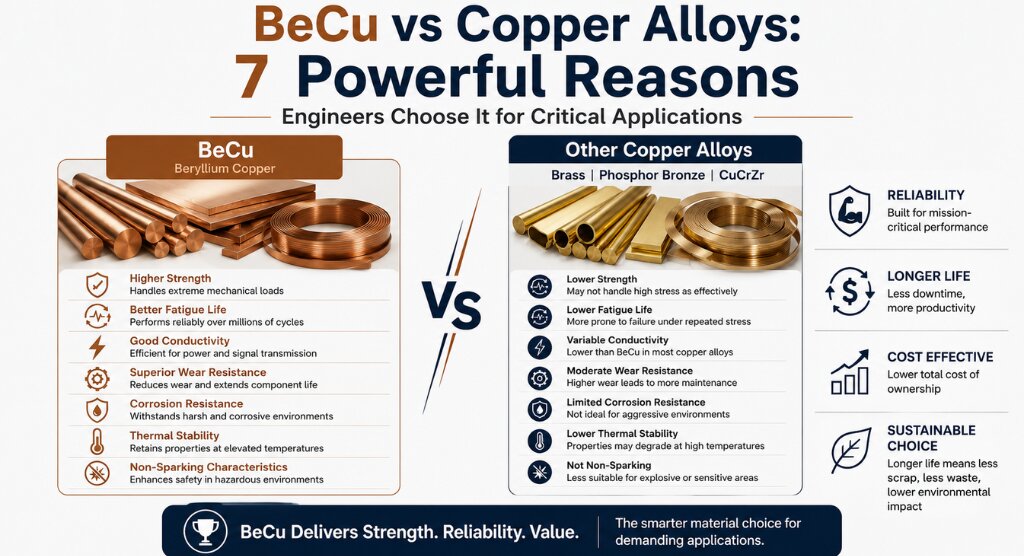
One of the most significant differences between BeCu and other copper alloys is mechanical strength.
| Material | Tensile Strength (MPa) |
| Brass | 300 – 550 |
| Phosphor Bronze | 500 – 700 |
| CuCrZr | 450 – 700 |
| BeCu C17200 | 1100 – 1400 |
Winner: BeCu
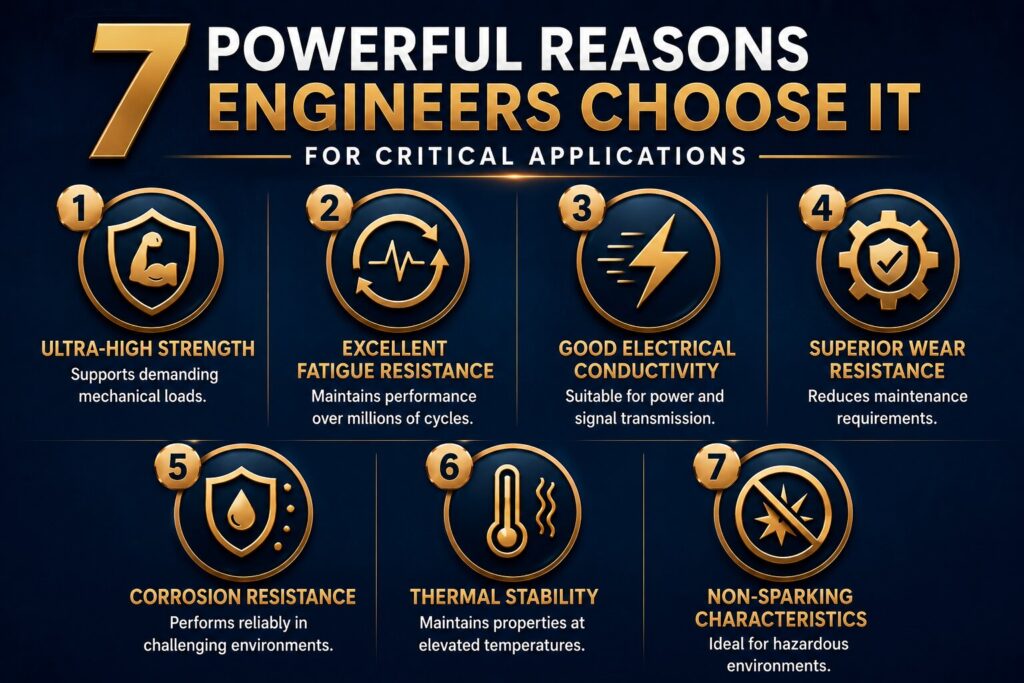
BeCu can achieve nearly double the strength of many traditional copper alloys while maintaining useful conductivity.
2. Electrical Conductivity Comparison
Electrical performance remains critical in connectors, switches, and power systems.
| Material | Conductivity (% IACS) |
| Pure Copper | 100 |
| CuCrZr | 80 – 90 |
| Brass | 28 |
| Phosphor Bronze | 15 |
| BeCu | 20 – 60 |
Winner: CuCrZr for conductivity
Winner: BeCu for conductivity-strength balance
When both mechanical durability and conductivity are required, BeCu frequently becomes the preferred solution.
3. Fatigue Resistance Comparison
Many components experience millions of operating cycles.
Examples include:
- Electrical contacts
- Springs
- Relays
- Aerospace connectors
- Precision instruments
BeCu exhibits exceptional fatigue resistance, maintaining performance under repeated loading conditions.
Winner: BeCu
Its fatigue life significantly exceeds brass and phosphor bronze in demanding cyclic applications.
4. Wear Resistance Comparison
Mechanical wear directly impacts lifecycle costs.
Brass
- Moderate wear resistance
- Suitable for general applications
Phosphor Bronze
- Better wear characteristics
- Common in springs and bearings
CuCrZr
- Good durability
- Suitable for welding systems
BeCu
- Outstanding wear resistance
- Excellent galling resistance
- Long service life
Winner: BeCu
The longer operational lifespan often offsets the higher initial material cost.
5. Corrosion Resistance Comparison
Industrial environments frequently expose materials to:
- Humidity
- Chemicals
- Salt-laden atmospheres
- Industrial pollutants
Performance Ranking
- BeCu
- Phosphor Bronze
- CuCrZr
- Brass
BeCu offers excellent resistance to environmental degradation while retaining mechanical properties.
6. Thermal Performance Comparison
Many applications operate at elevated temperatures.
| Material | Thermal Stability |
| Brass | Moderate |
| Phosphor Bronze | Good |
| CuCrZr | Excellent |
| BeCu | Excellent |
BeCu maintains mechanical strength across a wide operating temperature range.
This makes it highly suitable for:
- Aerospace systems
- Defense electronics
- High-performance connectors
- Industrial automation
7. Lifecycle Cost Comparison
This is where engineers often experience a major mindset shift.
Initial Purchase Price
BeCu typically costs more than:
- Brass
- Phosphor Bronze
- CuCrZr
However, purchase price alone rarely reflects true ownership cost.
Hidden Costs of Lower-Performance Materials
- Premature replacement
- Production downtime
- Maintenance labor
- Equipment shutdowns
- Inventory management costs
When lifecycle performance is evaluated, BeCu frequently delivers a lower total cost of ownership despite its higher acquisition cost.
Environmental Impact Comparison
Material selection also plays a significant role in sustainability. In the BeCu vs Copper Alloys discussion, environmental impact is becoming an increasingly important factor alongside performance and cost considerations.
When components wear out faster, they typically require more frequent replacements, increased manufacturing activity, additional transportation, and higher recycling frequency. These factors collectively increase resource consumption and contribute to a larger environmental footprint over time. A longer-lasting material can help reduce these impacts while improving overall operational efficiency.
The BeCu vs Copper Alloys comparison often highlights the advantage of BeCu’s extended service life. BeCu components frequently remain in operation significantly longer than many alternative copper alloys, reducing the need for replacement parts and minimizing material waste. This longer lifecycle helps lower overall material consumption and decreases the frequency of recycling processes throughout the product’s operational life.
For many manufacturers, selecting durable materials is becoming an important part of their environmental responsibility strategy. By choosing materials that offer greater longevity and reliability, organizations can support both performance goals and sustainability initiatives while reducing the long-term environmental impact of their operations.
Key Properties of Beryllium Copper
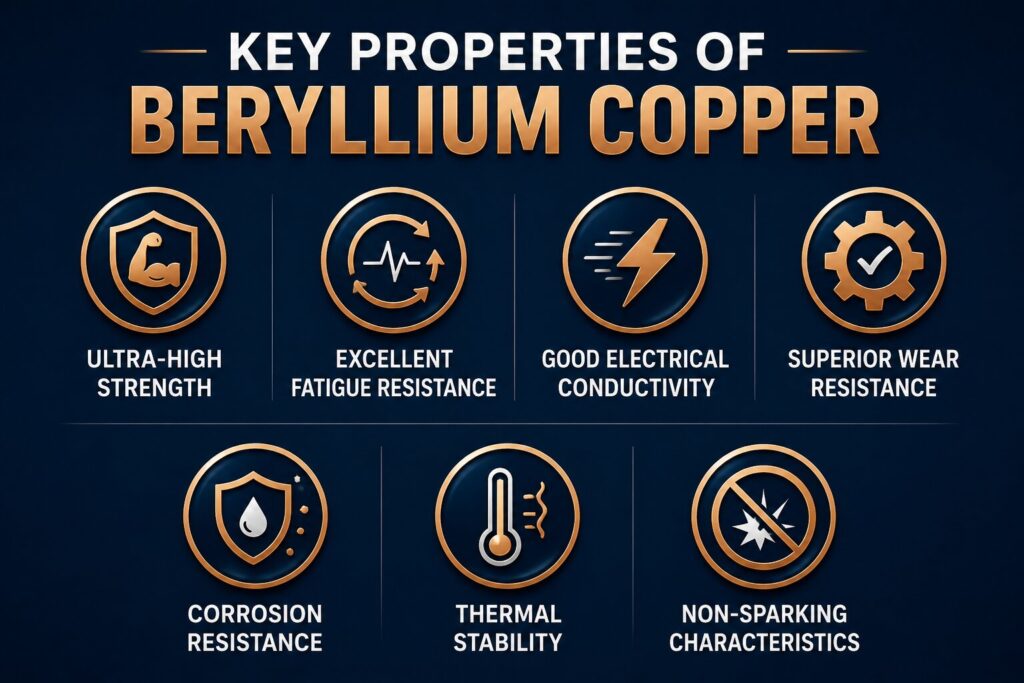
Ultra-High Strength
In BeCu vs Copper Alloys applications, BeCu supports demanding mechanical loads while maintaining excellent durability and dimensional stability.
Excellent Fatigue Resistance
In BeCu vs Copper Alloys applications, BeCu maintains performance over millions of cycles, ensuring long-term reliability in repetitive-motion components.
Good Electrical Conductivity
In BeCu vs Copper Alloys applications, BeCu provides excellent conductivity, making it suitable for power and signal transmission while maintaining superior mechanical strength.
Superior Wear Resistance
In BeCu vs Copper Alloys applications, BeCu offers superior wear resistance, reducing maintenance requirements and extending component service life.
Corrosion Resistance
In BeCu vs Copper Alloys applications, BeCu performs reliably in challenging environments by offering excellent resistance to corrosion and environmental degradation.
Thermal Stability
In BeCu vs Copper Alloys applications, BeCu maintains its properties at elevated temperatures, ensuring reliable performance in demanding operating environments.
Non-Sparking Characteristics
In BeCu vs Copper Alloys applications, BeCu is ideal for hazardous environments where non-sparking performance enhances operational safety.
Technical Specifications of BeCu C17200
| Property | Value |
| Density | 8.25 g/cm³ |
| Tensile Strength | Up to 1400 MPa |
| Yield Strength | Up to 1200 MPa |
| Hardness | 36–44 HRC |
| Conductivity | 20–60% IACS |
| Melting Point | Approx. 865–980°C |
| Elastic Modulus | 131 GPa |
Standards
Common standards for Beryllium Copper include:
- ASTM B196
- ASTM B197
- ASTM B194
- ASTM B441
- UNS C17200
- UNS C17300
- AMS 4533
- AMS 4534
- AMS 4535
Shapes Available
DOMADIA™ supplies BeCu materials in various forms including:
- Rods
- Bars
- Sheets
- Plates
- Foils
- Strips
- Wires
- Tubes
- Precision Machined Components
- Custom Profiles
Applications of BeCu
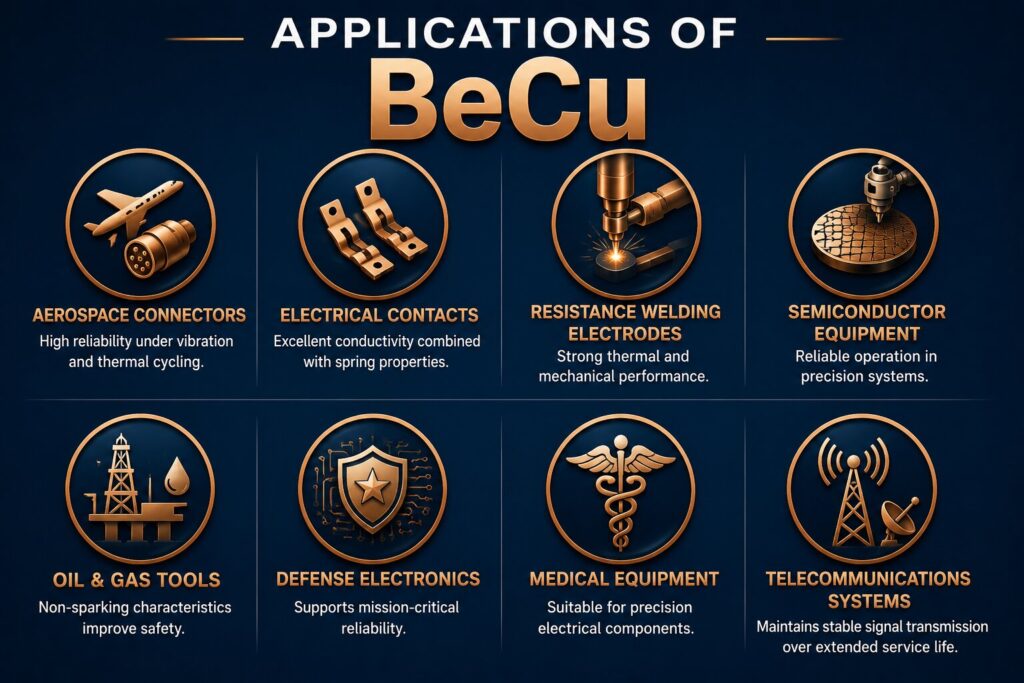
Aerospace Connectors
In BeCu vs Copper Alloys applications, BeCu provides high reliability under vibration and thermal cycling, making it ideal for aerospace connectors.
Electrical Contacts
Excellent conductivity combined with spring properties.
Resistance Welding Electrodes
In BeCu vs Copper Alloys applications, BeCu delivers strong thermal and mechanical performance, making it an excellent choice for resistance welding electrodes.
Semiconductor Equipment
In BeCu vs Copper Alloys applications, BeCu supports reliable operation in precision systems where accuracy, durability, and consistent performance are critical.
Oil & Gas Tools
Non-sparking characteristics improve safety.
Defense Electronics
Supports mission-critical reliability.
Medical Equipment
Suitable for precision electrical components.
Telecommunications Systems
Maintains stable signal transmission over extended service life.
Why DOMADIA™
DOMADIA™ supplies premium-performance engineering materials for demanding industrial applications.
What Sets DOMADIA™ Apart?
✔ Extensive BeCu inventory
✔ Certified material quality
✔ International standards compliance
✔ Precision processing capabilities
✔ Technical material selection support
✔ Fast delivery schedules
✔ Custom sizes and machining solutions
✔ Support for aerospace, electronics, defense, semiconductor, and industrial sectors
Whether your application prioritizes conductivity, wear resistance, fatigue performance, or lifecycle reliability, DOMADIA™ helps engineers identify the optimal material solution.
Conclusion
Selecting the right alloy requires evaluating far more than conductivity alone. In the BeCu vs Copper Alloys comparison, Beryllium Copper consistently stands out when strength, fatigue resistance, wear performance, and long-term reliability become critical.
While materials such as brass, phosphor bronze, and CuCrZr each offer unique advantages, BeCu vs Copper Alloys evaluations often reveal that BeCu delivers the best balance of electrical performance and mechanical durability. For mission-critical applications, the reduction in downtime, replacement costs, and maintenance can make BeCu one of the most cost-effective solutions over the full lifecycle of a product.
As industries continue demanding higher performance and longer service life, BeCu vs Copper Alloys remains a key consideration for engineers seeking dependable materials. BeCu continues to be one of the most valuable advanced copper alloys available for high-reliability applications today.
Need the Right Copper Alloy for Your Application?
DOMADIA™ supplies high-performance Beryllium Copper and specialty copper alloys engineered for demanding industrial applications.
Connect with DOMADIA™ today for expert guidance on selecting the ideal copper alloy for maximum performance, reliability, and lifecycle value.
Talk to: Er.Pankaj Domadia | Kairav Domadia | Aadil Domadia | Pragati Sanap | Pooja N N
#BerylliumCopper #BeCu #CopperAlloys #EngineeringMaterials #ElectricalConnectors #AerospaceMaterials #IndustrialEngineering #DOMADIA
Directly whatsapp us for an Enquiry: https://wa.link/kairav
From Ahmedabad, Vadodara, Rajkot, Bhavnagar, and Jamnagar, we serve Gujarat’s industrial belt and nearby Maharashtra, Rajasthan, MP, and Daman, with global supply to Canada, Mexico, Brazil, Chile, and Argentina.