Blogs
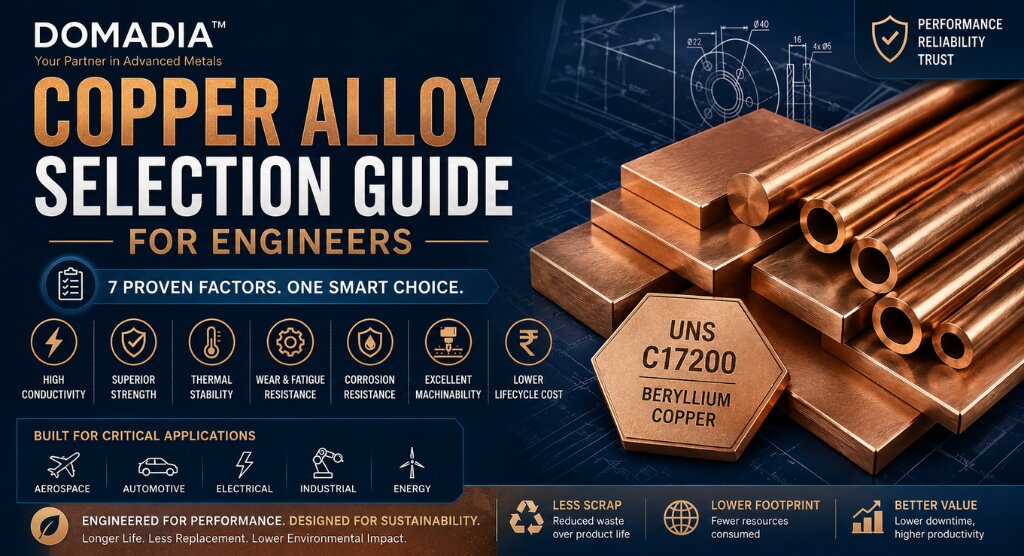
Copper Alloy Selection Guide for Engineers: 7 Proven Factors Using UNS C17200 and Beyond
Modern engineering projects demand materials that can deliver electrical conductivity, mechanical strength, corrosion resistance, and long-term reliability simultaneously. Selecting the wrong material can lead to premature failures, increased maintenance costs, production downtime, and reduced operational efficiency.
This is where Copper Alloy Selection becomes critical. A well-planned Copper Alloy Selection process helps engineers balance performance requirements, manufacturing considerations, and lifecycle costs to achieve optimal results.
Copper alloys are among the most versatile engineering materials available today. They are widely used in electrical systems, aerospace components, automotive connectors, industrial machinery, telecommunications equipment, defense systems, marine applications, and renewable energy technologies.
However, not all copper alloys perform the same way. Engineers must evaluate multiple factors before selecting the most suitable alloy for their application. Effective Copper Alloy Selection requires a thorough understanding of material properties, environmental conditions, operating temperatures, and application-specific demands.
This guide explores the key considerations, chemical compositions, standards, properties, applications, and technical specifications that help engineers make smarter material decisions.
Why Copper Alloys Matter in Engineering
Pure copper offers excellent electrical and thermal conductivity, but its mechanical strength is relatively limited for demanding applications.
By adding controlled amounts of alloying elements such as:
- Beryllium
- Nickel
- Chromium
- Zirconium
- Tin
- Zinc
- Silicon
manufacturers can significantly improve:
- Strength
- Wear resistance
- Fatigue performance
- Corrosion resistance
- Temperature stability
- Spring properties
The result is a family of advanced engineering materials capable of meeting highly specialized requirements.
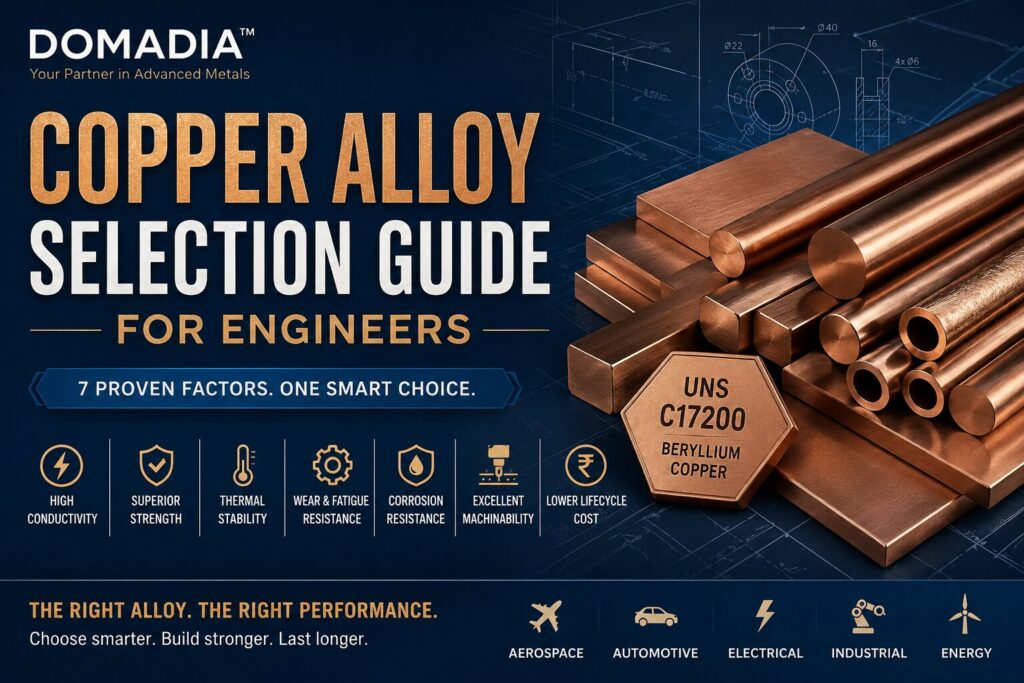
7 Critical Factors for Copper Alloy Selection
1. Electrical Conductivity Requirements
Many applications require efficient current transmission, making Copper Alloy Selection a critical engineering decision.
Examples include:
- Electrical connectors
- Busbars
- Switchgear components
- Battery systems
- EV charging infrastructure
Engineers must evaluate conductivity ratings carefully during the Copper Alloy Selection process to ensure optimal electrical performance and energy efficiency.
Typical Conductivity Values
| Alloy Type | Conductivity (% IACS) |
|---|---|
| Pure Copper | 100 |
| Chromium Copper | 80–95 |
| Copper Zirconium | 80–90 |
| Beryllium Copper | 20–60 |
| Nickel Copper Alloys | Lower |
Higher conductivity is generally preferred where power efficiency is critical, making conductivity one of the most important factors in successful Copper Alloy Selection for electrical and power distribution applications.
2. Mechanical Strength Requirements
Applications exposed to mechanical loads require stronger alloys.
Examples include:
- Aerospace connectors
- Defense electronics
- Spring contacts
- Industrial automation systems
Beryllium copper alloys such as UNS C17200 offer exceptional strength while maintaining useful conductivity.
Typical tensile strength ranges:
- Pure Copper: 200–250 MPa
- Chromium Copper: 400–600 MPa
- Beryllium Copper: 1000–1400 MPa
The strength advantage often justifies the higher initial material cost.
3. Operating Temperature
Many engineering systems operate under elevated temperatures, making Copper Alloy Selection especially important for maintaining performance and reliability.
Examples include:
- Resistance welding electrodes
- Semiconductor manufacturing equipment
- Aerospace assemblies
- EV battery systems
Temperature resistance becomes a critical material selection factor, as excessive heat can affect conductivity, strength, and service life. During the Copper Alloy Selection process, engineers must carefully evaluate thermal stability to ensure consistent operation under demanding conditions.
Copper chromium zirconium alloys frequently provide excellent thermal stability while maintaining high conductivity. Their ability to withstand elevated temperatures makes them a preferred choice in many applications where Copper Alloy Selection must balance both thermal performance and electrical efficiency.stability while maintaining conductivity.
4. Wear and Fatigue Resistance
Repeated mechanical cycling can cause material fatigue.
Critical applications include:
- Electrical contacts
- Relay systems
- Connectors
- Springs
- Aerospace assemblies
High-performance copper alloys provide:
- Longer service life
- Reduced maintenance
- Improved reliability
Fatigue resistance is particularly important when replacement costs and downtime are significant.
5. Corrosion Resistance
Many industrial environments expose materials to:
- Moisture
- Chemicals
- Saltwater
- Industrial pollutants
These challenging conditions make Copper Alloy Selection an important consideration for ensuring long-term durability and reliable performance.
Marine systems, offshore platforms, and chemical processing equipment often require copper alloys with enhanced corrosion resistance. During the Copper Alloy Selection process, engineers must evaluate environmental exposure carefully to minimize maintenance requirements and extend component service life.
Nickel-containing copper alloys frequently perform exceptionally well in harsh environments due to their superior resistance to corrosion and degradation. Their proven performance makes them a preferred option whenever Copper Alloy Selection involves demanding marine or chemical processing applications.
6. Machinability and Fabrication
Engineers must also consider manufacturing efficiency.
Material selection impacts:
- Machining costs
- Production speed
- Tool wear
- Fabrication complexity
Some copper alloys machine easily, while others require specialized tooling and processing methods.
Selecting a material that balances performance and manufacturability often reduces total production costs.
7. Lifecycle Cost Analysis
Many organizations focus primarily on purchase price.
This can be misleading.
A lower-cost alloy may result in:
- Frequent replacements
- Increased maintenance
- Production interruptions
- Higher labor costs
A premium alloy often delivers superior value through:
- Extended service life
- Reduced downtime
- Improved reliability
- Lower replacement frequency
This lifecycle perspective is becoming increasingly important in modern engineering decision-making.
Common Copper Alloy Chemical Compositions
1. UNS C17200 Beryllium Copper
Typical Composition
| Element | Percentage |
| Copper | Balance |
| Beryllium | 1.8–2.0% |
| Cobalt/Nickel | Small additions |
Key Benefits
- Extremely high strength
- Excellent fatigue resistance
- Good conductivity
- Outstanding spring properties
2. Copper Chromium Zirconium (CuCrZr)
Typical Composition
| Element | Percentage |
| Copper | Balance |
| Chromium | 0.5–1.2% |
| Zirconium | 0.03–0.3% |
Key Benefits
- High conductivity
- Excellent thermal stability
- Superior electrode performance
3. Phosphor Bronze
Typical Composition
| Element | Percentage |
| Copper | Balance |
| Tin | 4–10% |
| Phosphorus | Small addition |
Key Benefits
- Good wear resistance
- Corrosion resistance
- Spring characteristics
4. Nickel Copper Alloys
Typical Composition
| Element | Percentage |
| Copper | Balance |
| Nickel | Variable |
Key Benefits
- Marine durability
- Corrosion resistance
- Long-term stability
Important Industry Standards
Engineers should always verify compliance with applicable specifications.
Common standards include:
ASTM Standards
- ASTM B196
- ASTM B197
- ASTM B224
- ASTM B441
UNS Designations
- UNS C17200
- UNS C17510
- UNS C18150
- UNS C51000
SAE Standards
Widely used for aerospace and transportation applications.
AMS Specifications
Important for aerospace-grade materials requiring strict performance control.
ISO Standards
Support international quality and manufacturing consistency.
Key Properties Engineers Should Evaluate
When comparing alloys, consider:
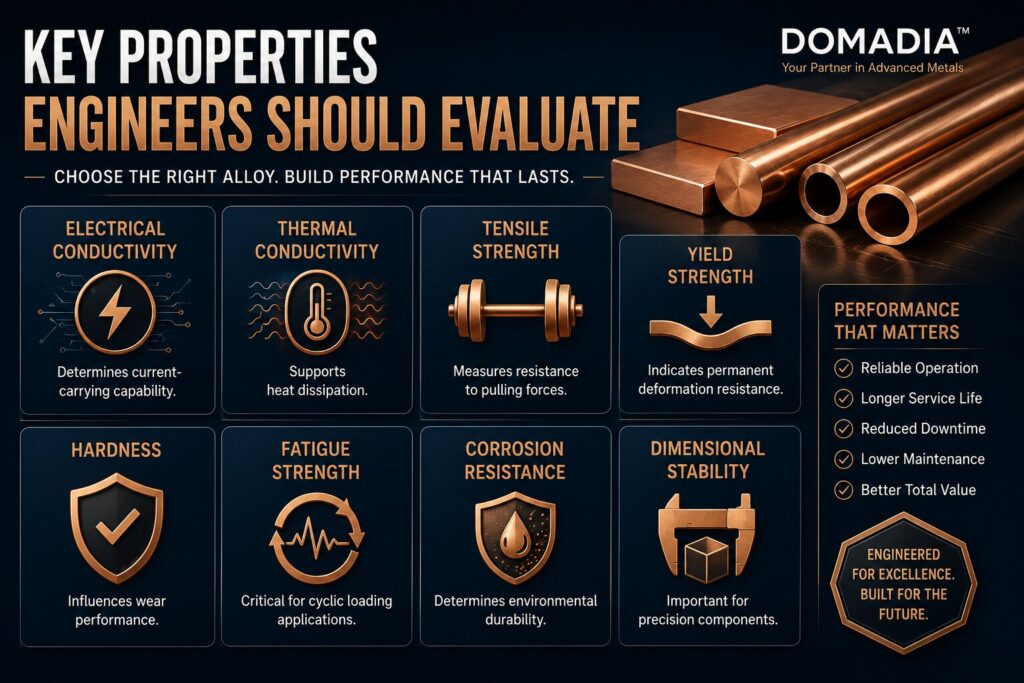
Electrical Conductivity
Determines current-carrying capability.
Thermal Conductivity
Supports heat dissipation.
Tensile Strength
Measures resistance to pulling forces.
Yield Strength
Indicates permanent deformation resistance.
Hardness
Influences wear performance.
Fatigue Strength
Critical for cyclic loading applications.
Corrosion Resistance
Determines environmental durability.
Dimensional Stability
Important for precision components.
Technical Specifications Overview
| Property | Typical Range |
| Density | 8.2–8.9 g/cm³ |
| Conductivity | 20–100% IACS |
| Tensile Strength | 200–1400 MPa |
| Hardness | 60–450 HB |
| Thermal Conductivity | 100–400 W/mK |
| Operating Temperature | Up to 500°C+ (alloy dependent) |
Actual values vary according to alloy type, heat treatment condition, and manufacturing process.
Shapes Available
DOMADIA™ supplies copper alloys in various engineered forms to meet diverse manufacturing requirements.
Available shapes include:
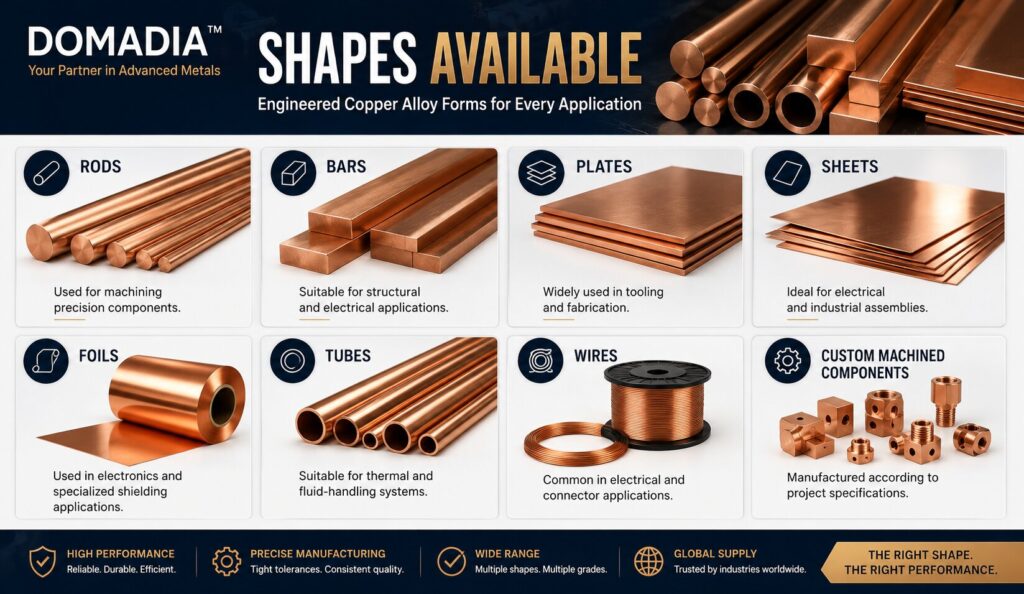
Rods
Used for machining precision components.
Bars
Suitable for structural and electrical applications.
Plates
Widely used in tooling and fabrication.
Sheets
Ideal for electrical and industrial assemblies.
Foils
Used in electronics and specialized shielding applications.
Tubes
Suitable for thermal and fluid-handling systems.
Wires
Common in electrical and connector applications.
Custom Machined Components
Manufactured according to project specifications.
Emerging Trends in Copper Alloy Engineering
The demand for advanced copper alloys continues growing due to:
- Electric vehicle expansion
- Renewable energy systems
- Aerospace modernization
- Semiconductor manufacturing growth
- Industrial automation
Industry analysts continue reporting strong growth in advanced materials markets as manufacturers seek higher performance and greater operational efficiency.
Future developments are expected to focus on:
- Improved conductivity-strength combinations
- Enhanced sustainability
- Longer service life
- Advanced manufacturing techniques
- Lightweight engineering solutions
Why DOMADIA™
DOMADIA™ supports engineers, manufacturers, and OEMs with high-performance copper alloy solutions designed for demanding industrial environments.
Extensive Material Portfolio
Wide range of copper alloy grades for diverse applications.
Quality Assurance
Materials supplied according to recognized international standards.
Technical Expertise
Support for alloy selection and application requirements.
Custom Supply Solutions
Available in multiple forms and dimensions.
Reliable Delivery Network
Serving industries across aerospace, automotive, electronics, energy, defense, and industrial manufacturing sectors.
Long-Term Value
Focus on performance, durability, and lifecycle cost optimization.
Conclusion
Copper Alloy Selection directly influences product performance, reliability, maintenance costs, and operational efficiency. Engineers must evaluate conductivity, strength, temperature resistance, corrosion performance, manufacturability, and lifecycle costs before making a final decision.
Whether selecting UNS C17200 beryllium copper for high-strength electrical contacts or choosing copper chromium zirconium for thermal applications, the right material can significantly improve long-term results.
As industries continue demanding higher efficiency, greater durability, and improved sustainability, intelligent Copper Alloy Selection will remain one of the most important engineering decisions. DOMADIA™ continues helping manufacturers identify and source advanced copper alloy solutions engineered for modern industrial challenges.
Optimize Performance with the Right Copper Alloy
The wrong material can increase downtime, maintenance costs, and product failures. The right copper alloy can improve reliability, efficiency, and long-term value.
Partner with DOMADIA™ for premium copper alloy solutions engineered for conductivity, strength, corrosion resistance, and long-term performance.
Contact DOMADIA™ now to discuss your application requirements and receive a customized material recommendation.
Talk to: Er.Pankaj Domadia | Kairav Domadia | Aadil Domadia | Pragati Sanap | Pooja N N
#CopperAlloy #UNSC17200 #BerylliumCopper #EngineeringMaterials #IndustrialManufacturing #ElectricalEngineering #CopperAlloys #DOMADIA #AdvancedMaterials #MetalIndustry
Directly whatsapp us for an Enquiry: https://wa.link/kairav
Our materials reach Chennai, Coimbatore, Hosur, Madurai, and Trichy, supporting manufacturing hubs in Tamil Nadu, Kerala, Karnataka, Andhra Pradesh, and Telangana, while shipping to France, Spain, UK, Netherlands, and Belgium.