Blogs

How to Work with Beryllium Copper If You Have Allergies: 9 Essential Safety Tips | UNS C17200
Beryllium Copper Allergy Safety is essential for engineers, machinists, and industrial workers handling UNS C17200.
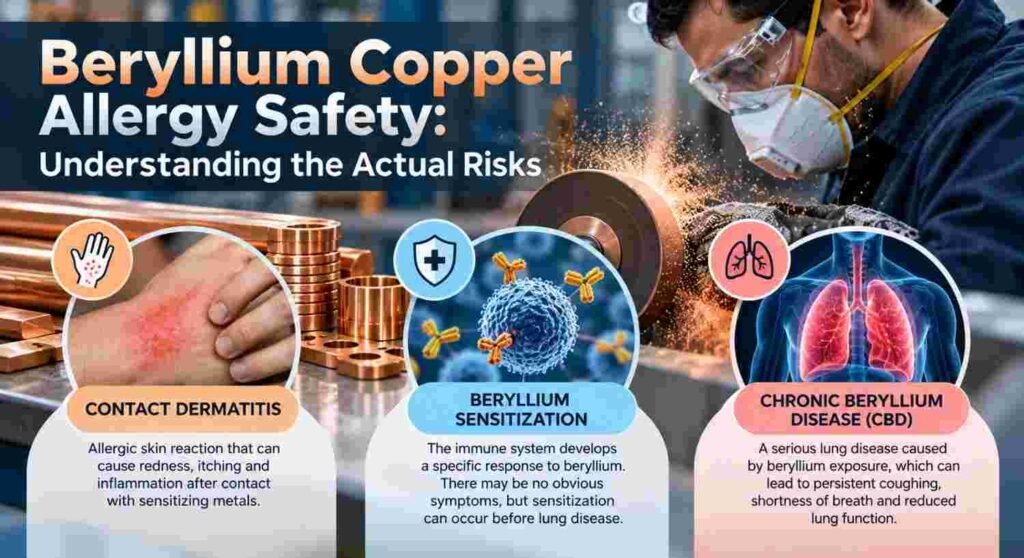
Although beryllium copper offers excellent strength, conductivity, and wear resistance, machining or grinding can release hazardous airborne particles.
Understanding Beryllium Copper Allergy Safety helps workers distinguish common metal allergies from serious beryllium-related health risks.
Proper ventilation, protective equipment, workplace hygiene, and occupational health assessments are important precautions.
In this guide, DOMADIA™ explains nine essential Beryllium Copper Allergy Safety tips for safer handling and responsible industrial use.
What Is Beryllium Copper UNS C17200?
Beryllium copper is a precipitation-hardening copper alloy containing a relatively small proportion of beryllium.
Unlike pure copper, which is primarily selected for its excellent electrical and thermal conductivity, beryllium copper is engineered to provide high strength while retaining useful conductivity.
This combination makes it valuable for precision components that must withstand repeated mechanical loading without sacrificing electrical performance.
UNS C17200, also known as Alloy 25, is among the most widely used high-strength copper-beryllium grades.
Chemical Composition of UNS C17200
| Element | Typical composition |
| Copper (Cu) | Balance |
| Beryllium (Be) | 1.80–2.00% |
| Cobalt (Co) + Nickel (Ni) | Minimum 0.20% |
| Cobalt + Nickel + Iron (Fe) | Maximum 0.60% |
| Other specified elements | Subject to applicable material specification |
Note: The composition shown is representative of UNS C17200. Always verify the applicable standard, material certificate, and supplier documentation before procurement.
The presence of nickel or cobalt is also relevant when evaluating workers with documented contact allergies to those metals. However, the presence of an element in an alloy does not establish that ordinary contact will cause an allergic reaction.
Beryllium Copper Allergy Safety: Understanding the Actual Risks
Not all metal-related health reactions are the same.
A worker may develop an itchy rash after wearing a metal watch. Another may experience respiratory symptoms following years of exposure to industrial dust.
Although both situations involve metals, their underlying causes, severity, and preventive measures may be very different.
1. Contact dermatitis
Allergic contact dermatitis is a delayed immune reaction that can cause itching, redness, inflammation, and skin irritation after contact with sensitizing substances.
Understanding Beryllium Copper Allergy Safety is important for workers with existing metal sensitivities, particularly to nickel or cobalt. Surface chemistry, contamination, wear, and individual sensitivity can influence skin-related risks.
A dermatologist may recommend patch testing when allergic contact dermatitis is suspected.
2. Beryllium sensitization
Beryllium sensitization occurs when the immune system develops a specific response to beryllium. Understanding Beryllium Copper Allergy Safety is important because sensitized individuals may have no obvious symptoms, yet sensitization can precede chronic beryllium disease.
Qualified clinicians may use specialized testing, such as the beryllium lymphocyte proliferation test (BeLPT), to investigate sensitization. A conventional skin allergy patch test cannot replace a BeLPT.
3. Chronic beryllium disease
Chronic beryllium disease (CBD) is an immune-mediated lung condition caused by beryllium exposure, making Beryllium Copper Allergy Safety an important workplace consideration.
CBD can cause lung inflammation and granuloma formation, leading to persistent coughing, shortness of breath, fatigue, and reduced exercise tolerance. Symptoms may develop years after exposure, even at relatively low exposure levels.
Understanding Beryllium Copper Allergy Safety also means recognizing that beryllium sensitization differs from common metal allergies, such as nickel allergy.
Workers with confirmed sensitization or CBD should avoid further beryllium exposure under occupational health guidance. Following appropriate Beryllium Copper Allergy Safety measures helps reduce exposure risks and protect long-term respiratory health.
9 Essential Safety Tips for Working with Beryllium Copper If You Have Allergies
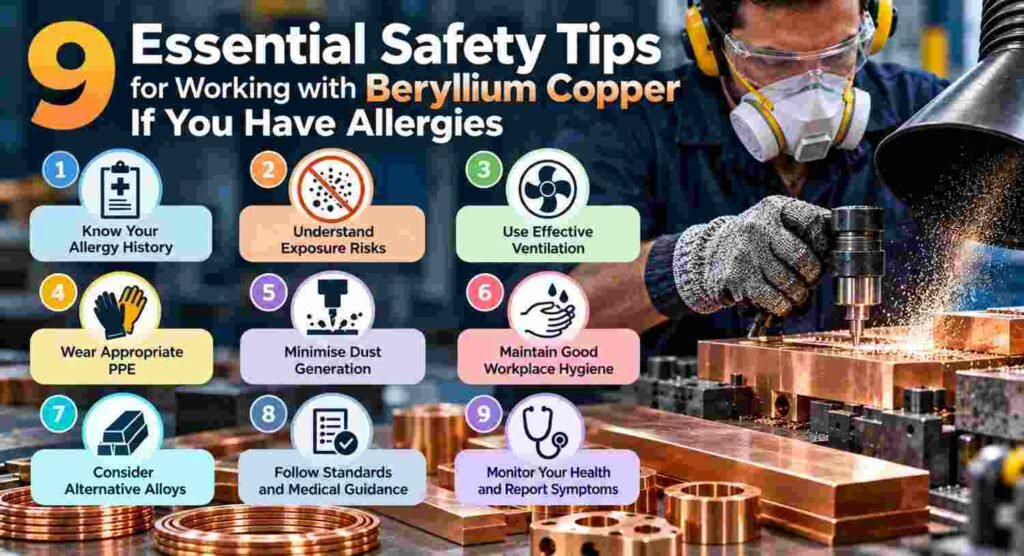
1. Identify the Exact Allergy Before Handling the Material
The first mistake is assuming that every metal allergy means the same thing.
A person allergic to nickel may not be allergic to copper. Similarly, a person who develops irritation from a metal bracelet is not automatically sensitized to beryllium.
Before beginning work, identify whether the concern involves:
- Diagnosed nickel or cobalt contact allergy
- Suspected allergic contact dermatitis
- Confirmed beryllium sensitization
- Chronic beryllium disease
- Respiratory symptoms associated with workplace exposure
Workers should discuss relevant medical findings with an occupational health professional and their employer’s health and safety team.
Practical action: Do not rely on a self-diagnosis or a general statement such as “I am allergic to metals.” Establish which substances and exposure routes are medically relevant.
2. Understand the Difference Between Solid Handling and Dust-Producing Operations
A finished beryllium copper component and a cloud of airborne machining dust present very different exposure situations.
Intact solid copper-beryllium products generally present substantially lower inhalation exposure potential during ordinary handling than processes that generate airborne particulate.
However, this does not mean every solid component is automatically safe for every person or every operation.
Exposure potential increases when the alloy is subjected to processes such as:
- Grinding
- Sanding
- Dry machining
- Abrasive polishing
- Cutting that generates fine particles
- Certain welding or thermal operations
Fine airborne particles are particularly concerning because they can enter the respiratory system.
For workers with allergies, Beryllium Copper Allergy Safety therefore begins with understanding the task, not merely identifying the material.
3. Use Effective Local Exhaust Ventilation
When an industrial process can generate airborne beryllium-containing particles, properly designed engineering controls are essential.
Local exhaust ventilation can capture contaminated air near the point where dust or fume is generated.
A suitable system should be selected and validated by qualified industrial hygiene professionals.
Important considerations include extraction position, airflow, filtration, equipment maintenance, and exposure monitoring.
An ordinary room fan is not a substitute for an engineered extraction system. In some circumstances, uncontrolled airflow can spread contamination.
Where appropriate, enclosed machining systems and properly designed wet processes can further reduce airborne dust generation.
4. Wear Task-Appropriate Personal Protective Equipment
Personal protective equipment provides an additional protective layer but should not replace effective engineering controls.
Depending on the risk assessment, protective equipment may include:
- Suitable chemical- or particulate-resistant gloves
- Protective clothing
- Safety glasses or face protection
- Appropriate protective footwear
- Respiratory protection when required by the exposure assessment
For respiratory protection, use a properly selected and fit-tested respirator within an established respiratory protection program. The appropriate filter and equipment depend on the exposure and applicable regulations.
Workers with contact allergies should also consider the composition of gloves, coatings, and other PPE materials.
For example, someone with an allergy to certain rubber accelerators may require alternative glove formulations.
A glove is useful only when it protects against the actual hazard and does not introduce another relevant allergen.
5. Avoid Dry Grinding and Uncontrolled Dust Generation
Dry abrasive operations can generate fine airborne metal particles, making Beryllium Copper Allergy Safety essential during machining, grinding, and polishing.
Engineering teams should consider enclosed machining, local exhaust ventilation, and properly engineered wet machining to reduce particle exposure. Effective Beryllium Copper Allergy Safety also requires appropriate management of contaminated coolant, sludge, and collected particles.
Avoid compressed-air blowdowns, dry sweeping, and ordinary household vacuum cleaners in contaminated areas. Instead, use approved HEPA-filtered equipment or other validated cleaning methods.
Following proper Beryllium Copper Allergy Safety procedures helps minimize airborne contamination and supports a safer industrial workplace.
6. Maintain Strict Workplace Hygiene
Good workplace hygiene is essential for Beryllium Copper Allergy Safety, helping prevent contamination from spreading into clean areas.
Workers should avoid eating, drinking, smoking, or applying cosmetics in areas where beryllium particles may be present. Following proper Beryllium Copper Allergy Safety procedures includes handwashing, changing contaminated clothing, and completing required decontamination before entering clean spaces.
Contaminated work clothing should never be taken home for ordinary laundering, as particles on clothing, footwear, or equipment may create secondary exposure risks.
Maintaining effective Beryllium Copper Allergy Safety practices helps reduce contamination and supports a safer industrial working environment.
7. Consider Alternative Alloys When Medically Necessary
One of the most practical ways to manage risk is to determine whether the application genuinely requires beryllium copper.
In some applications, alternatives such as phosphor bronze, selected stainless steels, or other copper alloys may be technically suitable.
However, substitution requires careful evaluation.
| Material | Important characteristics | Potential limitations |
| Beryllium Copper C17200 | High strength, fatigue resistance, useful conductivity | Requires beryllium-specific exposure controls |
| Phosphor Bronze C51000 | Good spring properties and corrosion resistance | Generally lower maximum strength than hardened C17200 |
| Stainless Steel 316 | Good corrosion resistance and mechanical durability | Much lower electrical conductivity |
| Copper-Nickel alloys | Useful corrosion resistance in selected environments | Nickel allergy considerations and different mechanical properties |
For an individual with confirmed beryllium sensitization, avoiding further exposure is a medical priority. Substituting materials or assigning work outside beryllium exposure areas may be necessary.
At DOMADIA™, material selection should consider engineering performance, workplace exposure conditions, and the relevant health and safety requirements together.
8. Follow Recognized Exposure Standards and Medical Surveillance Requirements
Beryllium-containing materials are subject to occupational safety requirements in various jurisdictions.
In the United States, OSHA’s general industry beryllium standard, 29 CFR 1910.1024, establishes requirements covering exposure assessment, controls, respiratory protection, medical surveillance, and related measures.
Two important airborne exposure values under that standard are:
| OSHA exposure criterion | Value |
| Permissible Exposure Limit (PEL), 8-hour TWA | 0.2 µg/m³ |
| Short-Term Exposure Limit (STEL), 15 minutes | 2.0 µg/m³ |
These values refer to airborne beryllium exposure, not the percentage of beryllium in the alloy.
Compliance with occupational limits does not guarantee that sensitization or disease cannot occur.
Indian workplaces should assess the applicable national and state occupational safety, factory, hazardous-process, and industrial hygiene requirements. US OSHA values should not automatically be treated as Indian legal limits.
Medical surveillance requirements depend on the jurisdiction, exposure conditions, and individual health status.
9. Report Symptoms Early and Seek Professional Assessment
Workers should not ignore unexplained symptoms following occupational exposure.
Potential warning signs include persistent cough, unusual breathlessness, fatigue, or recurring skin inflammation.
These symptoms are not specific to beryllium exposure, and many other conditions can cause them.
However, they deserve assessment when there is a relevant exposure history.
If symptoms develop, notify the occupational health team, document the tasks and materials involved, and obtain appropriate medical evaluation.
Workers with confirmed beryllium sensitization or chronic beryllium disease should not resume exposure-prone tasks merely because symptoms have improved.
Technical Specifications and Properties of UNS C17200
The reason beryllium copper remains important in modern engineering is its distinctive balance of properties.
Representative values; actual properties depend on temper, processing, product form, and test conditions.
| Property | Typical value or characteristic |
| UNS designation | C17200 |
| Common designation | Alloy 25 |
| Density | Approximately 8.26 g/cm³ |
| Electrical conductivity | Approximately 22–30% IACS |
| Thermal conductivity | Approximately 105 W/m·K |
| Ultimate tensile strength | Up to approximately 1,380 MPa or higher in selected conditions |
| Hardness | Can approach 40–45 HRC in suitable hardened conditions |
| Heat treatment | Solution treatment and precipitation hardening |
| Magnetic behavior | Generally low magnetic response |
| Corrosion resistance | Good in many industrial environments |
These values are indicative, not guaranteed procurement specifications. Material condition and certified test results determine the properties of a particular batch.
Why These Properties Matter
High strength allows precision components to withstand demanding mechanical loads, while Beryllium Copper Allergy Safety remains an important consideration during manufacturing and handling.
Excellent fatigue resistance supports repeated deflection in springs and electrical contacts, making proper Beryllium Copper Allergy Safety precautions essential during processes that may generate airborne particles.
Electrical conductivity enables efficient current transmission without compromising mechanical integrity, while wear resistance and hardness can extend component service life.
However, these advantages do not eliminate occupational exposure risks. Following appropriate Beryllium Copper Allergy Safety practices helps protect workers while maintaining the alloy’s industrial performance.
Industrial Applications of Beryllium Copper
Beryllium copper is used in several industries where a combination of strength, conductivity, and dimensional stability is required.
| Industry | Typical applications |
| Electronics | Connector contacts, terminals, contact springs |
| Aerospace | Precision springs, electrical components, mechanical parts |
| Automotive | Electrical terminals, connectors, sensors |
| Oil and gas | Specialized non-sparking hand tools |
| Industrial machinery | Bushings, wear-resistant components, precision parts |
| Telecommunications | RF contacts, connectors, spring elements |
| Medical equipment | Selected precision mechanical and electrical components |
For medical, aerospace, and other critical applications, the final component must meet applicable qualification and regulatory requirements.
The selection of beryllium copper should consider not only performance in service but also how the material will be processed, maintained, repaired, and eventually recycled.
Standards Applicable to Beryllium Copper
Different standards govern material composition, product dimensions, mechanical properties, and occupational exposure.
| Standard | Scope |
| ASTM B194/B194M | Copper-beryllium alloy plate, sheet, strip, and rolled bar |
| ASTM B196/B196M | Copper-beryllium alloy rod and bar |
| ASTM B197/B197M | Copper-beryllium alloy wire |
| ASTM B643 | Copper-beryllium alloy seamless tube |
| UNS C17200 | Alloy designation |
| OSHA 29 CFR 1910.1024 | Occupational beryllium exposure requirements in US general industry |
The applicable ASTM standard should be selected according to the material form and purchase requirements. Occupational exposure standards address a separate but equally important part of workplace safety.
The OSHA standard also identifies an 8-hour action level of 0.1 µg/m³, which can trigger additional obligations under specified conditions.
Available Shapes and Forms of Beryllium Copper
DOMADIA™ can be contacted to discuss beryllium copper material requirements in forms such as:
Product availability, dimensions, temper, and certifications should be confirmed for each requirement.
For workers with known allergies, the material form is relevant because processing requirements can significantly affect the potential for dust generation and direct contact.
For workers with known allergies, the material form is relevant because processing requirements can significantly affect the potential for dust generation and direct contact.
Can Someone with a Nickel Allergy Work with Beryllium Copper?
A nickel allergy does not automatically prohibit working with beryllium copper.
However, UNS C17200 may contain nickel or cobalt within its specified alloying composition.
The actual exposure potential depends on the material’s surface, processing condition, contact duration, and individual medical history.
A person with a documented nickel or cobalt allergy should consult a qualified clinician about direct skin contact and the appropriate protective measures.
Beryllium-specific hazards must be assessed separately, regardless of whether the worker has a nickel allergy.
Can You Safely Touch Finished Beryllium Copper Components?
Ordinary contact with a clean, intact, finished component generally creates a different risk profile from inhaling airborne particles generated during machining.
Nevertheless, a clean solid component should not be treated as completely risk-free in every circumstance.
Surface contamination, residual machining particles, skin condition, and individual sensitization status may influence the assessment.
For a worker with confirmed beryllium sensitization, any proposed exposure should be reviewed by an occupational health specialist.
Why DOMADIA™ for Beryllium Copper UNS C17200?
Selecting a specialized alloy involves more than comparing price and tensile strength. Beryllium Copper Allergy Safety should also be considered alongside material certification, dimensions, processing conditions, and application requirements.
At DOMADIA™, we help industrial customers identify materials that meet their technical needs while encouraging responsible handling practices.
Material-Focused Selection
Discuss UNS C17200 requirements and alternative copper alloys where appropriate. Beryllium Copper Allergy Safety considerations can also influence material selection for specific working environments.
Multiple Industrial Forms
Enquire about rods, bars, sheets, strips, wires, and other available forms. Proper handling and processing precautions remain essential for Beryllium Copper Allergy Safety, particularly during operations that generate airborne particles.
Technical Specification Support
Share your requirements for chemical composition, mechanical properties, temper, dimensions, and applicable ASTM standards to ensure suitable material selection.
Responsible Material Handling
DOMADIA™ encourages customers to follow relevant safety data sheets, occupational exposure controls, and qualified professional guidance. Effective Beryllium Copper Allergy Safety practices help reduce workplace exposure risks.
Long-Term Performance Considerations
Properly selected high-performance alloys can offer excellent durability, potentially reducing replacement frequency, downtime, and material waste. Environmental benefits depend on the complete product lifecycle.
At DOMADIA™, we believe Beryllium Copper Allergy Safety and technical performance should work together to support responsible industrial material selection.
Conclusion: A Safer Approach to Working with Beryllium Copper
Beryllium Copper Allergy Safety is not simply about wearing gloves or avoiding direct skin contact. It requires understanding ordinary contact allergies, beryllium sensitization, and the serious health risks associated with airborne beryllium exposure.
UNS C17200 offers exceptional strength, conductivity, fatigue resistance, and corrosion resistance, making it valuable in electronics, aerospace, automotive, and precision manufacturing. However, Beryllium Copper Allergy Safety must remain a priority when handling or processing this alloy.
Effective Beryllium Copper Allergy Safety practices include proper material identification, exposure assessment, engineering controls, workplace hygiene, suitable protective equipment, and occupational medical guidance.
Workers with confirmed beryllium sensitization or chronic beryllium disease should avoid further exposure. Following appropriate Beryllium Copper Allergy Safety precautions helps industries protect employees while benefiting from the alloy’s excellent performance.
At DOMADIA™, we believe responsible material selection includes safe handling, proper processing, and worker protection.
Choose the right alloy. Control the exposure. Protect the people who work with it.
Need Beryllium Copper UNS C17200 for a precision engineering application?
Visit DOMADIA™ to explore specialized industrial materials and discuss your technical requirements.
Contact DOMADIA™ with your required alloy grade, dimensions, form, temper, quantity, and applicable standard.
Talk to: Er.Pankaj Domadia | Kairav Domadia | Aadil Domadia | Pragati Sanap | Pooja N N
#BerylliumCopper #UNSC17200 #BerylliumCopperSafety #MetalAllergies #IndustrialSafety #WorkplaceSafety #CopperAlloys #MaterialScience #OccupationalHealth #DOMADIA
Directly whatsapp us for an Enquiry: https://wa.link/kairav
We’ve supplied to Mumbai, Pune, Indore, Jaipur, and Surat—serving industries across Maharashtra, Madhya Pradesh, Rajasthan, Gujarat, and Goa, with exports to Germany, USA, Japan, South Korea, and Italy.