Blogs
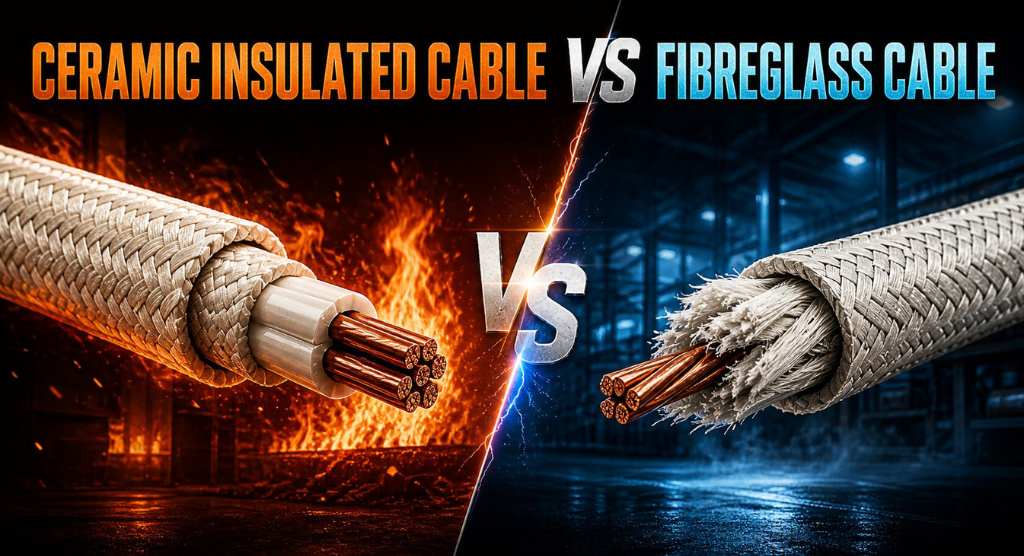
Ceramic Insulated Cable vs Fibreglass Cable: 7 Powerful Differences That Matter
Ceramic Insulated Cable vs Fibreglass Cable: Which One Truly Performs Under Fire?
Comparison for Extreme Applications
When industries operate in high-temperature or fire-critical environments, cable failure is not just a technical issue—it’s a safety risk and financial loss. This is where Ceramic Insulated Cable and Fibreglass Cable enter the conversation.
Both are designed for heat resistance, but their performance under real-world stress varies significantly. Choosing the wrong cable can lead to downtime, system failure, and even hazardous situations. At DOMADIA™, the focus is not just on supplying cables—but ensuring the right material is selected for long-term reliability.
What is Ceramic Insulated Cable?
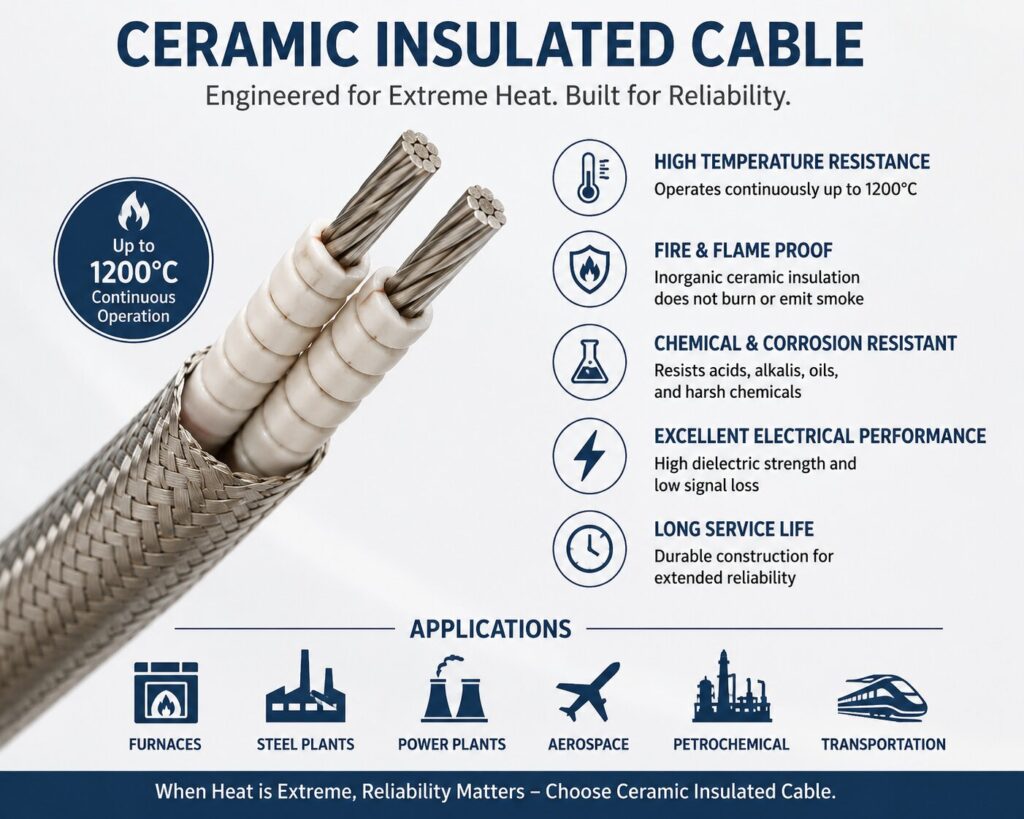
Ceramic Insulated Cable is engineered with advanced ceramic compounds that can withstand extremely high temperatures. Under fire conditions, the insulation transforms into a rigid ceramic layer, maintaining circuit integrity.
Unlike conventional cables, it doesn’t just resist heat—it adapts to it, making it ideal for fire survival systems.
What is Fibreglass Cable?
Fibreglass Cable uses glass fiber insulation to provide thermal resistance. It performs well in moderately high temperatures and is widely used in industrial heating and electrical insulation applications.
However, its limitation lies in extreme conditions where structural stability and fire survival become critical.
Chemical Composition
Ceramic Insulated Cable
- Ceramic compounds (silica-based materials)
- High-temperature polymers
- Fire-resistant mineral fillers
Fibreglass Cable
- Glass fibers (silica-based)
- Resin coatings (for flexibility and durability)
- Additional insulation layers (optional)
Key Properties Comparison
| Property | Ceramic Insulated Cable | Fibreglass Cable |
| Temperature Resistance | Up to 1000°C+ | Up to 500–600°C |
| Fire Survival | Maintains circuit integrity | Limited |
| Mechanical Strength | Becomes rigid under fire | Remains flexible |
| Durability | High in extreme conditions | Moderate |
| Lifespan | Longer in critical environments | Shorter in extreme heat |
Technical Specifications
Ceramic Insulated Cable
- Temperature Range: Up to 1000°C+
- Voltage Rating: Up to 1.1 kV
- Fire Resistance: IEC 60331 compliant
- Insulation Type: Ceramic-forming compound
- Conductors: Copper / Nickel-plated copper
Fibreglass Cable
- Temperature Range: Up to 600°C
- Voltage Rating: Up to 660 V
- Insulation Type: Glass fiber braid
- Flexibility: High
- Fire Resistance: Limited to insulation protection
Applications of Ceramic Insulated Cable
Fire Alarm and Emergency Systems
Ensures uninterrupted circuit integrity during fire, allowing alarms and safety systems to function when they are needed most.
Power Plants and Nuclear Facilities
Designed to withstand extreme temperatures and critical conditions, ensuring reliable power transmission without failure.
Tunnels and Underground Infrastructure
Maintains performance in confined spaces where fire safety and evacuation systems are crucial.
Steel and Metallurgical Industries
Performs efficiently in high-heat environments like furnaces and processing units, ensuring operational continuity.
Oil & Gas Hazardous Zones
Provides safe and reliable electrical connectivity in explosive and high-risk environments with superior fire resistance.
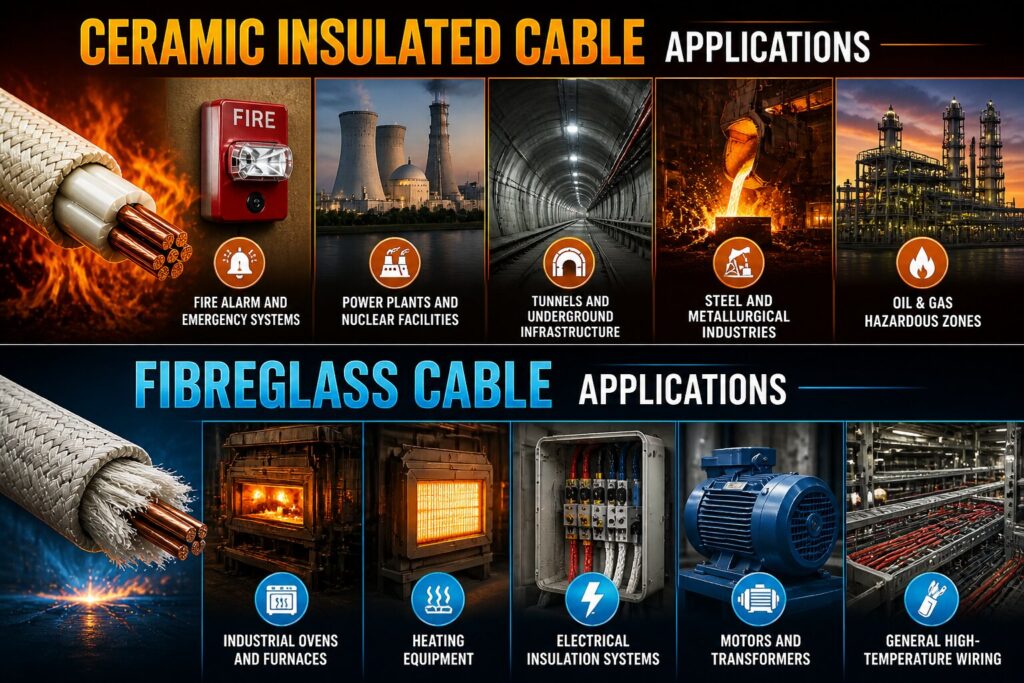
Applications of Fibreglass Cable
Industrial Ovens and Furnaces
Offers reliable insulation in moderately high-temperature equipment used for heating and processing.
Heating Equipment
Suitable for applications like heaters and thermal systems where consistent temperature resistance is required.
Electrical Insulation Systems
Used to protect wiring and components in standard industrial setups from heat exposure.
Motors and Transformers
Ensures insulation stability in electrical machines operating under elevated temperatures.
General High-Temperature Wiring
Ideal for routine industrial wiring where flexibility and moderate heat resistance are sufficient.
Standards & Compliance
Ceramic Insulated Cable
- IEC 60331 (Fire resistance)
- BS 6387 (Fire survival performance)
- UL Fire Resistance Standards
Fibreglass Cable
- IEC 60228 (Conductors)
- UL insulation standards
- General industrial compliance norms
Shapes Available
Both cables are available in:
- Single-core cables
- Multi-core cables
- Flexible braided cables
- Custom industrial configurations
However, Ceramic Insulated Cable often includes specialized fire-resistant constructions tailored for critical safety systems.
The Real Difference: Performance Under Crisis
Mindset Shift: Heat Resistance vs Fire Survival
Old thinking:
“Any high-temperature cable will perform in fire conditions.”
New thinking:
“Only cables designed for fire survival can maintain system integrity.”
This is where the difference becomes clear. Fibreglass cables resist heat—but Ceramic Insulated Cable survives fire. In industries like power plants, tunnels, or oil refineries, this distinction is critical.
Lifecycle & Cost Advantage
At first glance, Fibreglass Cable may appear more economical. But when evaluated over time:
- Frequent replacements increase operational cost
- Downtime leads to production loss
- Safety risks escalate maintenance expenses
On the other hand, Ceramic Insulated Cable:
- Extends lifecycle significantly
- Reduces replacement frequency
- Minimizes downtime and risk
From a sustainability perspective, longer-lasting cables mean less scrap and reduced environmental impact—an important factor in modern industrial decision-making.
Why DOMADIA™
Choosing the right cable is not just about specifications—it’s about performance assurance.
With DOMADIA™, you get:
- Precision-engineered high-temperature cable solutions
- Compliance with global fire safety standards
- Customization based on application needs
- Reliable supply chain and consistent quality
DOMADIA™ ensures that your systems are not just operational—but protected.
Conclusion
The choice between Fibreglass Cable and Ceramic Insulated Cable ultimately depends on the environment and risk level. For moderate heat applications, fibreglass performs adequately. But in fire-critical and extreme temperature environments, Ceramic Insulated Cable stands out as the superior solution.
It’s not just about resisting heat—it’s about surviving it.
Investing in the right cable today can prevent costly failures tomorrow. With DOMADIA™, industries gain more than a product—they gain long-term reliability and peace of mind.
Protect Critical Systems with Ceramic Insulated Cable
When safety, performance, and reliability are non-negotiable, the right cable makes all the difference. Don’t risk system failure in extreme conditions—upgrade to DOMADIA™ Ceramic Insulated Cable engineered for fire survival and long-term durability.
Get in Touch Today to find the perfect high-temperature cable solution tailored to your application.
Talk to: Er.Pankaj Domadia | Kairav Domadia | Aadil Domadia | Pragati Sanap | Pooja N N
#CeramicInsulatedCable #FibreglassCable #HighTemperatureCables #FireSafety #IndustrialEngineering #DOMADIA
Directly whatsapp us for an Enquiry: https://wa.link/kairav
From Ahmedabad, Vadodara, Rajkot, Bhavnagar, and Jamnagar, we serve Gujarat’s industrial belt and nearby Maharashtra, Rajasthan, MP, and Daman, with global supply to Canada, Mexico, Brazil, Chile, and Argentina.