Blogs
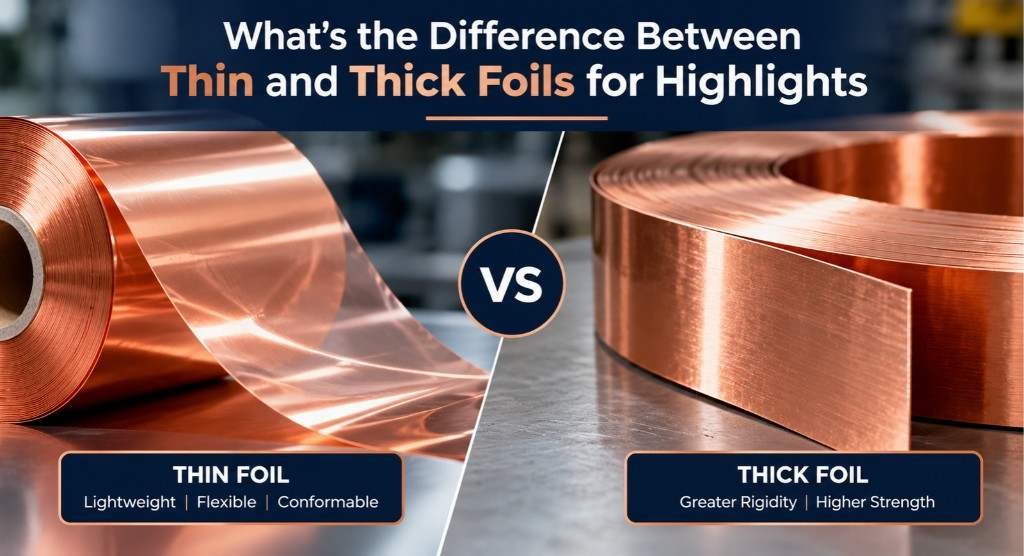
Thin vs Thick Metal Foils: 9 Powerful Differences for Better Performance | UNS C11000
Thin Metal Foils may look almost identical to thicker metal foils at first glance, but a small difference in thickness can completely change how a material performs in demanding industrial applications.
Consider an aerospace engineer designing a lightweight electronic enclosure. Thin Metal Foils measuring just 0.025 mm might be suitable for a flexible shielding layer, while a 0.50 mm metal sheet could offer greater rigidity and resistance to handling damage.
Both materials may have the same chemical composition. Both may come from the same alloy family. Yet their performance, fabrication requirements, weight, and cost can be very different.
That raises an important question:
When should engineers choose Thin Metal Foils, and when are thicker foils the better investment?
In this guide, DOMADIA™ explains nine important differences between Thin Metal Foils and thicker alternatives, along with their properties, chemical composition, industrial applications, relevant standards, available shapes, and practical material-selection considerations.
1. What Are Thin and Thick Metal Foils?
Metal foils are flat metallic materials manufactured in relatively small thicknesses. They may be produced through rolling, precision reduction, or other specialized manufacturing processes.
There is no universal thickness boundary separating thin foil from thick foil across every metal and industry. The classification depends on the alloy, manufacturing method, supplier, and applicable specification.
For practical comparison, the following illustrative ranges are useful.
| Material classification | Illustrative thickness |
| Ultra-thin foil | 0.001–0.010 mm |
| Thin foil | 0.010–0.100 mm |
| Intermediate foil | 0.100–0.200 mm |
| Thick foil / thin strip | 0.200–0.500 mm |
| Thin sheet | Above 0.500 mm |
These are descriptive ranges, not formal universal standards. Commercial naming and availability vary.
For example, a 0.10 mm copper product may be marketed as foil or strip, while another alloy supplier may classify the same thickness differently.
The important engineering parameters are the actual thickness, tolerance, temper, surface condition, and intended application, rather than the product name alone.
2. Thin vs Thick Metal Foils: 9 Powerful Differences

Difference 1: Thickness and Weight
The most obvious difference is the amount of material used.
Thin foils contain less metal per unit area, making them particularly attractive where lightweight construction is important.
For example, consider two copper foils with identical length and width.
- Foil A: 0.025 mm thick
- Foil B: 0.250 mm thick
Foil B contains ten times as much copper by volume and therefore has ten times the mass, assuming identical density.
This difference becomes important in aerospace structures, portable electronics, batteries, sensors, and precision equipment.
Highlight: Thin foils are often preferred when weight reduction and compact packaging matter more than rigidity.
Difference 2: Flexibility and Bendability
Thin Metal Foils can conform more easily to curved surfaces, small components, and irregular geometries, making them suitable for applications requiring flexibility and precise material positioning.
For the same material, width, and elastic modulus, bending stiffness scales approximately with the cube of thickness.
That means doubling the thickness can increase bending stiffness by roughly eight times.
However, flexibility does not automatically mean better fatigue resistance. The repeated bending performance of Thin Metal Foils also depends on alloy composition, temper, bend radius, surface defects, and manufacturing quality.
Thin Metal Foils are particularly useful for flexible electrical circuits, EMI/RF shielding wraps, conductive tapes, and precision assemblies where lightweight construction and adaptability are essential.
Thicker foils or strips are better suited to components that need greater dimensional stability, mechanical rigidity, and resistance to deformation.
Difference 3: Mechanical Strength and Structural Support
Thickness changes the load-carrying capacity of a metallic component, even when the material’s intrinsic tensile strength remains unchanged.
A thicker strip generally offers greater cross-sectional area and resistance to bending.
However, it is important to distinguish between:
- Material strength: Influenced by alloy composition, temper, and processing.
- Component strength: Influenced by thickness, geometry, loading, and material properties.
A thin, high-strength alloy can have a higher tensile strength than a thick, soft copper strip, even though the thicker component may carry a greater total load.
Highlight: Choose thickness according to the actual mechanical loading rather than assuming thicker metal always has superior material strength.
Difference 4: Electrical Conductivity
Electrical conductivity is primarily a material property, but foil thickness affects the resistance of a finished conductor.
For a uniform metallic strip:
\[ R=\frac{\rho L}{wt} \]
Where:
- \(R\) = electrical resistance
- \(\rho\) = electrical resistivity
- \(L\) = conductor length
- \(w\) = conductor width
- \(t\) = conductor thickness
Increasing thickness reduces electrical resistance when all other factors remain constant.
Therefore, thicker copper foils can be beneficial for high-current electrical connections and power distribution.
Thin foils are often more suitable for compact conductive layers, signal pathways, and applications where flexibility is essential.
At high frequencies, current distribution also depends on skin depth, making the relationship between thickness and RF performance more complex.
Difference 5: Thermal Performance
Both Thin Metal Foils and thick metal foils can support thermal management, but they perform different functions.
Thin Metal Foils can provide lightweight thermal interfaces, conformable heat-spreading layers, or specialized thermal barriers depending on the material and construction.
Thicker foils generally offer greater in-plane heat conduction capacity because they have more cross-sectional area.
They also provide greater thermal mass per unit area.
However, thermal performance depends on the metal’s thermal conductivity, contact resistance, geometry, surface treatment, and operating temperature.
A thin copper foil may spread heat effectively over a small area, while a thicker copper strip can be better suited to carrying larger heat loads. Therefore, selecting Thin Metal Foils or thicker alternatives requires careful consideration of thermal performance and application-specific requirements.
Difference 6: EMI and RF Shielding
Metal foils are widely used for electromagnetic interference shielding.
However, thicker does not automatically mean better shielding in every situation.
Shielding effectiveness depends on:
- Electrical conductivity
- Magnetic permeability
- Frequency
- Material thickness
- Shield geometry
- Electrical continuity
- Openings, joints, and seams
At sufficiently high frequencies, a thin conductive foil may already provide substantial shielding through its continuous conductive surface.
For low-frequency magnetic fields, material permeability and shielding geometry become especially important. Simply increasing the thickness of nonmagnetic copper may not solve the problem.
DOMADIA™ recommends selecting shielding foil according to the actual electromagnetic environment and required attenuation.
Difference 7: Manufacturing and Handling
Ultra-thin foils require careful handling during production, cutting, transportation, and installation.
They can be more susceptible to:
- Wrinkling
- Tearing
- Edge damage
- Surface scratches
- Handling deformation
Thicker foils and strips are generally easier to handle without accidental deformation.
Nevertheless, thicker materials may require greater forming forces and more robust cutting equipment.
For precision manufacturing, engineers should consider how thickness affects stamping, slitting, bending, bonding, welding, and automated feeding.
Difference 8: Cost and Material Efficiency
Thin Metal Foils use less raw metal per square metre, making them attractive for applications where material efficiency and weight reduction are important.
However, the cost per kilogram of Thin Metal Foils may be higher because producing extremely thin material can require additional rolling passes, tighter process controls, specialized handling, and greater quality assurance.
Thicker foils consume more raw material but may be easier to process.
The best comparison therefore considers total installed cost rather than price per kilogram alone.
For example, an inexpensive thin foil that repeatedly tears during assembly may ultimately cost more than a thicker, more durable alternative.
Conversely, specifying unnecessary thickness can increase material consumption and product weight without delivering meaningful benefits. Therefore, selecting Thin Metal Foils or thicker alternatives should involve balancing material costs, manufacturing efficiency, durability, and long-term performance.
Difference 9: Durability, Lifecycle, and Sustainability
A properly selected foil thickness can improve product life and reduce replacement frequency.
In applications exposed to mechanical handling, vibration, or repeated loading, an adequately thick material may offer better resistance to certain failure modes.
However, thicker foil is not always longer-lasting. Flexing conditions, corrosion, fatigue, temper, and installation geometry must also be evaluated.
Choosing the right thickness can contribute to sustainability by reducing avoidable scrap, material consumption, transportation weight, and premature replacement.
At DOMADIA™, responsible material selection means helping customers specify the performance they actually need without unnecessary overengineering.
3. Thin vs Thick Foils: Quick Technical Comparison
| Property | Thin foils | Thick foils / strips |
| Weight per unit area | Lower | Higher |
| Flexibility | Generally higher | Generally lower |
| Bending stiffness | Lower | Higher |
| Current-carrying cross-section | Smaller | Larger |
| Thermal mass | Lower | Higher |
| Handling damage resistance | Often lower | Often higher |
| Forming force | Generally lower | Generally higher |
| Raw material consumption | Lower | Higher |
| Typical applications | Shielding, sensors, flexible circuits | Contacts, shims, current paths, structural support |
These comparisons assume the same alloy and material condition. Actual performance requires application-specific evaluation.
4. Chemical Composition of Common Metal Foils
Thickness does not determine chemical composition.
A 0.025 mm copper foil and a 0.250 mm copper strip can have the same alloy designation and chemical specification.
The following materials are commonly considered for precision foil applications.
| Material | UNS designation | Representative composition |
| Oxygen-free copper | C10100 | Minimum 99.99% Cu, subject to specification |
| Electrolytic tough-pitch copper | C11000 | Minimum 99.90% Cu, subject to specification |
| Beryllium copper | C17200 | Approximately 1.8–2.0% Be, balance mainly Cu |
| Phosphor bronze | C51000 | Approximately 4.2–5.8% Sn, 0.03–0.35% P, balance Cu |
| Stainless steel 304 | S30400 | Approximately 18–20% Cr, 8–10.5% Ni, balance mainly Fe |
| Nickel 200 | N02200 | Minimum 99.0% Ni, subject to specification |
| Titanium Grade 2 | R50400 | Commercially pure titanium with controlled residual elements |
These values are representative. Procurement should always use the applicable material standard and certified chemical analysis.
Different alloys deliver different combinations of conductivity, corrosion resistance, magnetic behavior, strength, and thermal performance.
For example, copper is frequently selected for electrical conductivity, while stainless steel may be preferred where corrosion resistance and mechanical durability are more important.
5. Technical Specifications and Properties
Selecting foil thickness requires more than specifying a nominal dimension.
Illustrative weight comparison for UNS C11000 copper
Typical technical parameters to evaluate include:
| Specification | Engineering consideration |
| Thickness | Nominal dimension and allowable tolerance |
| Width | Coil, slit strip, or cut-piece dimensions |
| Temper | Annealed, cold-worked, or heat-treated condition |
| Surface finish | Cleanliness, roughness, coating, oxidation |
| Flatness | Wrinkles, waviness, and residual curvature |
| Tensile properties | Strength and elongation requirements |
| Electrical properties | Conductivity or resistivity |
| Thermal properties | Conductivity and operating temperature |
| Edge quality | Burrs, cracks, and slitting defects |
For high-precision applications, tolerance control may be just as important as nominal thickness.
A small thickness variation can affect electrical resistance, spring behavior, fit, or dimensional accuracy.
6. Industrial Applications of Thin and Thick Metal Foils

EMI/RF Shielding
Thin Metal Foils provide effective conductive shielding solutions for electronic enclosures, cable wraps, and sensitive electronic assemblies, helping reduce electromagnetic interference.
Precision Shims
Thin or thicker metallic strips are used for precise clearance, spacing, and alignment control in mechanical and industrial assemblies.
Battery Technology
Thin Metal Foils, particularly copper and aluminium, serve as current collectors in suitable battery cell designs, supporting efficient electrical conduction and compact construction.
Electrical Connections
Thicker copper strips are preferred for electrical contacts, conductive links, and power distribution systems where mechanical stability and current-carrying capacity are essential.
Aerospace and Defense
Lightweight Thin Metal Foils are used in aerospace and defense applications for EMI shielding, precision shims, thermal management systems, and specialized components.
Sensors and Instrumentation
Precision Thin Metal Foils are used in diaphragms, sensing elements, and specialized instrumentation assemblies requiring dimensional accuracy and consistent material properties.
The correct material thickness depends on the application and its specific design requirements.
For instance, an EMI shielding wrap may benefit from Thin Metal Foils made from conformable copper, whereas a conductive connector may require a thicker strip to provide the necessary mechanical stability and current-carrying capacity.
7. Standards for Metal Foils and Strips
Different foil materials fall under different product specifications.
Commonly relevant standards include:
| Standard | Typical scope |
| ASTM B152/B152M | Copper sheet, strip, plate, and rolled bar |
| ASTM B103/B103M | Phosphor bronze plate, sheet, strip, and rolled bar |
| ASTM B194 | Copper-beryllium alloy plate, sheet, strip, and rolled bar |
| ASTM A666 | Annealed or cold-worked austenitic stainless steel sheet, strip, plate, and flat bar |
| ASTM B162 | Nickel and nickel-alloy plate, sheet, and strip for specified grades |
| ASTM B265 | Titanium and titanium-alloy strip, sheet, and plate |
The applicability of a particular standard depends on the alloy, thickness, condition, and intended use.
Not every ultra-thin product falls within the thickness range of a conventional sheet or strip standard.
For specialized foils, supplementary purchase specifications may be required for surface condition, tolerances, cleanliness, pinholes, and mechanical properties.
8. Shapes and Forms Available
DOMADIA™ can be approached for specialized foil and strip requirements in forms such as:

- Precision metal foils
- Thin sheets
- Thick foils and strips
- Slit coils
- Rolled foil
- Flat cut pieces
- Precision shims
- Custom-width strips
- Application-specific cut components
Availability depends on the selected metal, thickness, temper, width, processing requirements, and order quantity.
For example, ultra-thin nickel foil may have different production constraints from copper foil of the same nominal thickness.
Therefore, engineers should confirm manufacturing feasibility before finalizing drawings and purchasing specifications.
9. How to Choose the Right Foil Thickness
The best selection begins with the functional requirement.
Before placing an order, confirm the following:
- What function must the foil perform?
- What alloy or UNS grade is required?
- What thickness and tolerance are acceptable?
- Will the component experience bending, vibration, or repeated loading?
- Are electrical, magnetic, or thermal properties critical?
- What surface condition and temper are required?
- What standard and inspection documentation are needed?
Answering these questions can prevent material waste and costly manufacturing problems.
10. Why Choose DOMADIA™ for Precision Metal Foils?
Selecting Thin Metal Foils and other specialized metal foils requires a balance of material properties, dimensional requirements, manufacturing feasibility, and cost.
DOMADIA™ supports engineers, manufacturers, and procurement teams seeking high-quality Thin Metal Foils and specialized industrial materials for demanding applications.
Key considerations when working with DOMADIA™ include:
Material selection: Discuss copper, nickel, stainless steel, titanium, and other specialized alloys according to the intended application.
Technical specification support: Communicate the required UNS grade, thickness, width, temper, tolerance, and applicable standard when selecting Thin Metal Foils for precision applications.
Application-focused sourcing: Evaluate whether Thin Metal Foils, thick foils, or precision strips are more suitable for the required function.
Specialized industrial requirements: Discuss foil needs for aerospace, electronics, electrical equipment, EMI/RF shielding, sensors, and precision manufacturing.
Supply planning: Confirm dimensions, availability, documentation, quantities, and delivery requirements before procurement to ensure that Thin Metal Foils meet project specifications.
DOMADIA™ encourages customers to select materials based on technical performance rather than relying solely on thickness or price.
Conclusion: Thin Metal Foils vs Thick Foils — Which Is Better?
The difference between thin and thick metal foils extends far beyond physical dimensions.
Thin Metal Foils are often preferred where low weight, flexibility, compact construction, and conformability are essential.
Thicker foils and strips are generally better suited to applications requiring greater bending stiffness, larger conductive cross-sections, mechanical support, or improved handling resistance.
Neither option is universally superior.
The right choice depends on alloy composition, thickness tolerance, temper, loading, operating environment, and the performance required from the finished component.
For industries where precision matters, even a small thickness difference can influence product quality, manufacturing efficiency, and long-term reliability. Therefore, selecting Thin Metal Foils requires careful consideration of application-specific requirements and technical specifications.
At DOMADIA™, the focus is on helping customers identify the appropriate specialized material for their engineering requirements. Whether you need Thin Metal Foils for lightweight shielding and precision electronics or thicker strips for demanding industrial applications, DOMADIA™ supports informed material selection for better performance and long-term reliability.
Contact DOMADIA™ for Precision Metal Foil Requirements
Need thin foils, thick foils, or custom metal strips for your next industrial project?
Contact DOMADIA™ with your required UNS grade, thickness, width, temper, standard, quantity, and application details to discuss suitable material options.
Explore specialized industrial materials at DOMADIA™.
Talk to: Er.Pankaj Domadia | Kairav Domadia | Aadil Domadia | Pragati Sanap | Pooja N N
#ThinMetalFoils #MetalFoils #CopperFoil #PrecisionEngineering #UNSC11000 #EMIShielding #IndustrialMaterials #MetalManufacturing #SpecialAlloys #DOMADIA
Directly whatsapp us for an Enquiry: https://wa.link/kairav
Our materials have reached Tiruppur, Erode, Salem, Namakkal, and Karur across Tamil Nadu, Karnataka, Kerala, Andhra Pradesh, and Telangana, with exports to Italy, Turkey, Tunisia, Morocco, and Algeria.