Blogs

Custom Magnetic Shield Design Guide: 7 Powerful Steps to Achieve Superior Magnetic Protection
A semiconductor manufacturer was facing a frustrating problem.
Despite investing in highly accurate testing equipment, measurement inconsistencies continued appearing across multiple production lines. Engineers initially suspected software errors, sensor calibration issues, and environmental factors. After weeks of investigation, the actual cause was identified—uncontrolled external magnetic fields affecting sensitive instruments.
The solution was not replacing equipment.
The solution was implementing a Custom Magnetic Shield Design engineered specifically for the operating environment.
As industries continue adopting increasingly sensitive electronic, medical, aerospace, scientific, and semiconductor technologies, controlling magnetic interference has become more critical than ever. A generic shielding solution often fails to provide the required level of protection. This is why many organizations now rely on Custom Magnetic Shield Design to achieve optimal performance, measurement accuracy, and equipment reliability.
This guide explores the key engineering principles, material selection criteria, applications, standards, and design considerations involved in developing an effective Custom Magnetic Shield Design for demanding industrial environments.
Understanding Magnetic Shielding
Magnetic shielding is the process of redirecting magnetic field lines away from sensitive equipment, components, or systems.
Unlike electromagnetic shielding, which primarily blocks high-frequency electromagnetic waves, magnetic shielding works by providing a low-reluctance path that attracts and channels magnetic flux through the shielding material rather than allowing it to penetrate protected areas.
Proper shielding helps:
- Improve measurement accuracy
- Reduce signal distortion
- Protect sensitive electronics
- Enhance equipment reliability
- Improve system stability
- Reduce operational failures
- Extend equipment lifespan
As technology becomes more precise, shielding design becomes increasingly important.
Why Custom Magnetic Shield Design Matters
Many organizations initially choose standard shielding enclosures or off-the-shelf materials.
However, magnetic fields vary significantly depending on:
- Field strength
- Frequency
- Source location
- Environmental conditions
- Equipment sensitivity
- Space limitations
- Mechanical requirements
A shield that performs effectively in one application may fail completely in another.
Custom-engineered shielding allows designers to optimize:
- Shield geometry
- Material thickness
- Layer configuration
- Shield placement
- Weight
- Cost
- Performance
The result is a solution specifically designed for the application’s unique magnetic environment.
7 Powerful Steps for Effective Magnetic Shield Design
1. Identify the Magnetic Interference Source
Every successful Custom Magnetic Shield Design begins with a thorough understanding of the source of magnetic interference. Common sources include power transformers, electric motors, generators, high-current cables, MRI equipment, industrial machinery, and power distribution systems. During the Custom Magnetic Shield Design process, engineers evaluate the magnetic field intensity, frequency characteristics, distance from sensitive equipment, and the direction of field propagation. Accurate field mapping enables engineers to select the appropriate shielding materials, optimize shield geometry, and achieve reliable protection against unwanted magnetic interference.
2. Define Shielding Performance Requirements
An effective Custom Magnetic Shield Design starts with clearly defining the required level of protection. Not every application demands the same shielding performance—some systems require moderate attenuation, while others operate in environments where extremely low magnetic field levels are essential. Design objectives may include reducing magnetic field strength by up to 90%, lowering interference below specified thresholds, protecting precision instruments from external magnetic disturbances, and meeting applicable industry or regulatory requirements. Establishing these performance goals early in the Custom Magnetic Shield Design process helps prevent unnecessary over-engineering, ensures optimal material selection, and delivers a cost-effective shielding solution.
3. Select the Right Shielding Material
Material selection is often the most important design decision.
Common Magnetic Shielding Materials
Mu Metal
Widely recognized for its exceptionally high magnetic permeability.
Ideal for:
- Sensitive electronics
- Scientific instruments
- Medical equipment
- Precision sensors
Permalloy
Provides excellent low-field shielding performance.
Frequently used in:
- Telecommunications
- Aerospace systems
- Defense electronics
Silicon Steel
Suitable for higher magnetic flux applications.
Often used in:
- Transformers
- Industrial equipment
- Power systems
Soft Iron
Offers good magnetic field redirection with excellent mechanical strength.
Used in:
- Industrial machinery
- Heavy equipment
- Structural shielding assemblies
Material selection depends on shielding effectiveness, cost, fabrication requirements, and operating conditions.
Chemical Composition of Typical Mu Metal
Mu Metal remains one of the most commonly specified materials for custom magnetic shielding.
Typical composition includes:
| Element | Percentage (%) |
| Nickel (Ni) | 75–80 |
| Iron (Fe) | Balance |
| Molybdenum (Mo) | 4–5 |
| Copper (Cu) | 1–2 |
| Other Elements | Trace |
This composition provides extremely high permeability and excellent low-frequency magnetic shielding performance.
4. Optimize Shield Geometry
Geometry plays a critical role in the effectiveness of a Custom Magnetic Shield Design, as the shape of the shield directly influences how magnetic flux is redirected. Cylindrical shields are commonly used to protect sensors, tubes, and instrument housings, while box enclosures are ideal for electronics, control systems, and communication equipment. For applications exposed to stronger magnetic fields, multi-layer shields provide significantly higher attenuation by using multiple shielding barriers. In situations with complex equipment layouts or limited installation space, custom-fabricated structures are developed to meet specific operational and dimensional requirements. A well-engineered Custom Magnetic Shield Design ensures magnetic flux follows the intended low-reluctance path through the shielding material, maximizing protection for sensitive equipment.
5. Consider Material Thickness
A successful Custom Magnetic Shield Design is not simply achieved by using the thickest possible shielding material. A common misconception is that greater thickness always provides better magnetic protection. In reality, shielding effectiveness depends on several engineering factors, including material permeability, magnetic field strength, shield geometry, and the material’s saturation limits. Excessive thickness can increase project costs, add unnecessary weight, and complicate fabrication and installation without delivering proportional performance improvements. Through careful engineering analysis, a Custom Magnetic Shield Design identifies the optimal shield thickness that balances attenuation, manufacturability, and overall system efficiency.
6. Evaluate Mechanical and Environmental Factors
A reliable Custom Magnetic Shield Design must perform consistently under the actual environmental conditions in which the equipment operates. Magnetic shielding systems are often exposed to temperature variations, mechanical vibration, corrosion, shock loading, humidity, and installation constraints that can influence long-term performance. Engineers evaluate these factors during the Custom Magnetic Shield Design process to select suitable materials, protective finishes, and structural configurations. By accounting for real-world operating conditions, the shielding system maintains stable magnetic performance, durability, and reliability throughout the service life of the equipment.
7. Validate Through Testing
Every Custom Magnetic Shield Design should undergo comprehensive testing to verify that it delivers the required level of magnetic protection. Typical evaluation methods include magnetic field measurements, shielding effectiveness assessments, environmental testing, and performance validation under actual operating conditions. These tests help identify any design refinements before installation and ensure the Custom Magnetic Shield Design meets its specified attenuation targets, reliability requirements, and overall performance objectives prior to full-scale deployment.
Key Properties of Magnetic Shielding Materials
Successful shielding materials possess several critical characteristics.
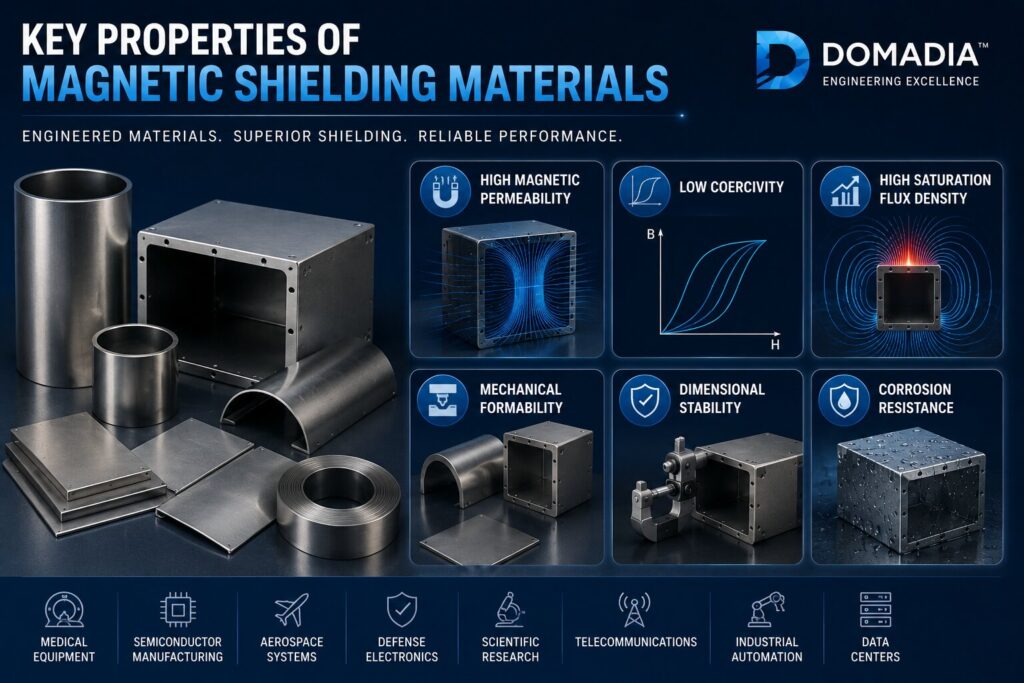
High Magnetic Permeability
Efficiently attracts and redirects magnetic fields away from protected equipment.
Low Coercivity
Allows rapid magnetization and demagnetization.
High Saturation Flux Density
Maintains effectiveness under stronger magnetic fields.
Mechanical Formability
Can be fabricated into complex enclosures and shielding structures.
Dimensional Stability
Maintains shielding effectiveness during extended service periods.
Corrosion Resistance
Supports long-term reliability in industrial environments.
Technical Specifications Considered in Shield Design
Engineers typically evaluate the following parameters:
| Property | Typical Consideration |
| Permeability | High |
| Shielding Factor | Application-specific |
| Thickness | Custom |
| Saturation Flux Density | Material dependent |
| Operating Temperature | Application dependent |
| Mechanical Strength | Design dependent |
| Corrosion Resistance | Environment dependent |
| Fabrication Method | Custom engineered |
Standards Relevant to Magnetic Shielding
Depending on the industry and application, shielding systems may be designed around various standards and guidelines.
Commonly referenced standards include:
ASTM Standards
Used for material quality and testing.
IEC Standards
Applicable to electrical and electronic systems.
IEEE Standards
Frequently referenced for electromagnetic compatibility requirements.
MIL Standards
Widely used in defense and aerospace applications.
ISO Quality Standards
Support manufacturing consistency and quality control.
Compliance requirements vary according to industry and end-use applications.
Applications of Custom Magnetic Shield Design
Custom shielding solutions are used across numerous industries.
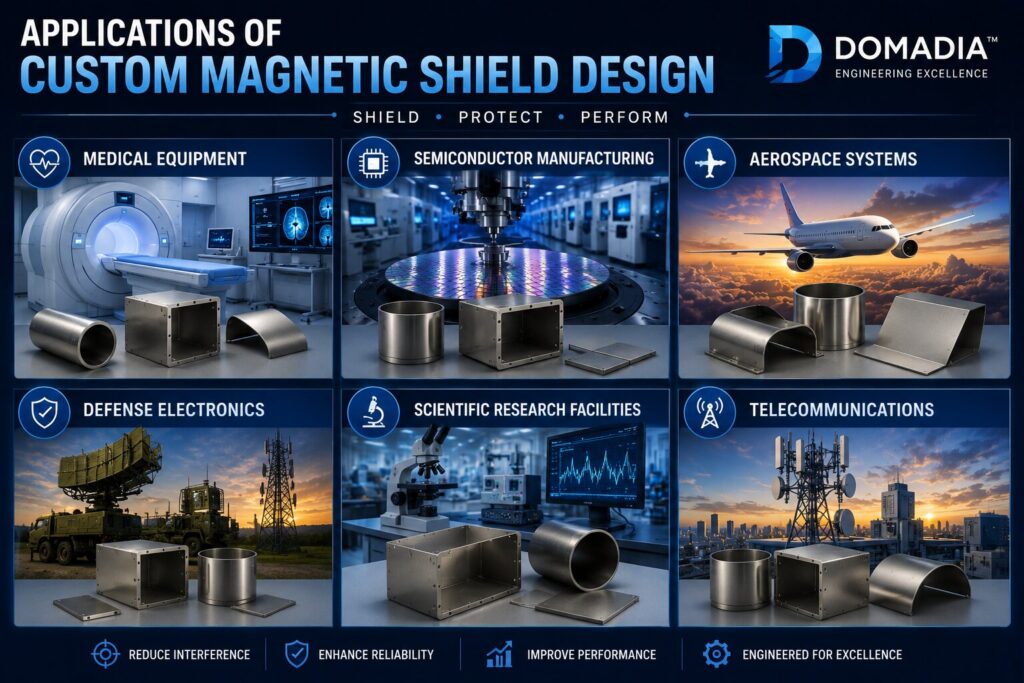
Medical Equipment
Protects MRI systems, diagnostic instruments, and laboratory equipment.
Semiconductor Manufacturing
Improves process stability and measurement accuracy.
Aerospace Systems
Protects navigation, sensing, and communication equipment.
Defense Electronics
Supports mission-critical reliability under demanding conditions.
Scientific Research Facilities
Maintains controlled magnetic environments for precision experiments.
Telecommunications
Protects sensitive communication systems from interference.
Industrial Automation
Enhances performance of sensors, controls, and monitoring systems.
Data Centers
Reduces magnetic interference affecting critical electronic infrastructure.
Shapes Available for Custom Magnetic Shields
DOMADIA™ can support various shielding configurations depending on project requirements.
Common shapes include:
- Sheets
- Foils
- Cylinders
- Tubes
- Enclosures
- Boxes
- Multi-layer assemblies
- Precision fabricated components
- Sensor housings
- Custom engineered geometries
Custom fabrication enables shielding solutions tailored to complex equipment designs.
Why DOMADIA™
When selecting a magnetic shielding partner, technical expertise is just as important as material quality.
DOMADIA™ supports industries requiring advanced shielding solutions through:
Extensive Material Knowledge
Support for high-performance magnetic shielding alloys and specialized materials.
Custom Engineering Support
Solutions designed around actual operating conditions and performance requirements.
Precision Manufacturing
Fabrication capabilities for complex geometries and demanding specifications.
Quality-Focused Approach
Materials supplied with strict quality control and traceability.
Multi-Industry Experience
Supporting aerospace, defense, medical, semiconductor, telecommunications, and industrial applications.
Technical Consultation
Helping customers optimize shielding performance while balancing cost and manufacturability.
Conclusion
Custom Magnetic Shield Design has become an essential engineering discipline as electronic systems, sensors, medical devices, and industrial equipment become increasingly sensitive to magnetic interference.
Successful shielding requires far more than simply selecting a high-permeability material. Engineers must carefully evaluate interference sources, material properties, geometry, thickness, environmental conditions, and performance requirements to develop an effective solution.
By combining advanced materials, sound engineering practices, and thorough testing, organizations can significantly improve equipment reliability, measurement accuracy, and long-term operational performance. For industries where precision matters, a properly engineered magnetic shielding solution can be the difference between inconsistent performance and dependable success.
Protect Your Critical Systems from Magnetic Interference
DOMADIA™ – Engineering Advanced Magnetic Shielding Solutions for Demanding Industries.
ContactDOMADIA™ today and discover how our custom magnetic shielding solutions can enhance the performance, accuracy, and reliability of your critical systems.
Talk to: Er.Pankaj Domadia | Kairav Domadia | Aadil Domadia | Pragati Sanap | Pooja N N
#MagneticShielding #CustomShieldDesign #MuMetal #EMIShielding #EngineeringDesign #IndustrialShielding #DOMADIA #ElectronicsProtection #MagneticFieldControl #AdvancedMaterials
Directly whatsapp us for an Enquiry: https://wa.link/kairav
We’ve supplied to Mumbai, Pune, Indore, Jaipur, and Surat—serving industries across Maharashtra, Madhya Pradesh, Rajasthan, Gujarat, and Goa, with exports to Germany, USA, Japan, South Korea, and Italy.