Blogs

9 Powerful Mu Metal Alternatives for Magnetic Shielding: Materials, Properties & Applications
Mu Metal is widely recognized for its ability to shield sensitive electronic equipment from unwanted magnetic fields. Its high magnetic permeability makes it particularly useful in precision instruments, medical devices, aerospace systems, and scientific applications.
However, Mu Metal is not the only material capable of providing effective magnetic shielding. Several Mu Metal Alternatives for Magnetic Shielding offer valuable advantages in terms of permeability, saturation flux density, mechanical strength, operating frequency, and manufacturing flexibility.
Understanding Mu Metal Alternatives for Magnetic Shielding helps engineers, manufacturers, and procurement professionals select suitable materials based on actual operating conditions. Some alternatives perform better in stronger magnetic fields, while others are more suitable for high-frequency interference, compact electronic assemblies, or cost-sensitive industrial applications.
In this guide, DOMADIA™ explores nine powerful Mu Metal Alternatives for Magnetic Shielding, highlighting their properties, industrial applications, advantages, and essential material selection considerations.
What Makes Mu Metal Effective for Magnetic Shielding?
Mu Metal is a soft magnetic nickel-iron alloy commonly associated with UNS N14080 and ASTM A753 Alloy 4.
It typically contains approximately 80% nickel, with iron and smaller amounts of other alloying elements.
Its most important characteristic is extremely high magnetic permeability when properly processed and annealed.
This allows Mu Metal to provide a low-reluctance path that redirects magnetic flux around a protected region.
Important properties of Mu Metal
Mu Metal is a high-permeability nickel-iron alloy widely used to protect sensitive equipment from unwanted magnetic interference. Understanding its properties and limitations helps engineers evaluate Mu Metal Alternatives for Magnetic Shielding for different industrial applications.
1. High Magnetic Permeability
Mu Metal offers exceptionally high magnetic permeability after suitable magnetic annealing. This allows magnetic flux to pass through the material more easily, helping protect sensitive electronic components from external magnetic fields.
2. Low Coercivity and Magnetic Hysteresis
Its low coercivity and minimal magnetic hysteresis make Mu Metal effective in applications requiring stable magnetic performance. These properties are particularly valuable in precision instruments and scientific measurement equipment.
3. Excellent Low-Frequency Magnetic Shielding
Mu Metal performs exceptionally well against weak, low-frequency magnetic fields. However, engineers may consider Mu Metal Alternatives for Magnetic Shielding when applications involve stronger magnetic fields or different operating frequencies.
4. Flexible Material Forms and Applications
Mu Metal is available in foils, sheets, strips, and fabricated shielding components. These forms support applications in medical devices, aerospace electronics, magnetic sensors, and precision measurement instruments.
5. Limitations of Mu Metal
Despite its advantages, Mu Metal is sensitive to mechanical stress. Forming, welding, and machining can reduce magnetic permeability, making final magnetic annealing important for demanding applications.
Additionally, its relatively low saturation flux density can limit shielding effectiveness in stronger magnetic fields.
6. Why Consider Alternative Magnetic Shielding Materials?
These limitations encourage manufacturers to explore Mu Metal Alternatives for Magnetic Shielding, including Permalloy, Supermalloy, Silicon Steel, and Nanocrystalline Alloys. Depending on the application, these materials may offer higher saturation capacity, improved frequency-dependent performance, or more economical shielding solutions.
9 Powerful Mu Metal Alternatives for Magnetic Shielding
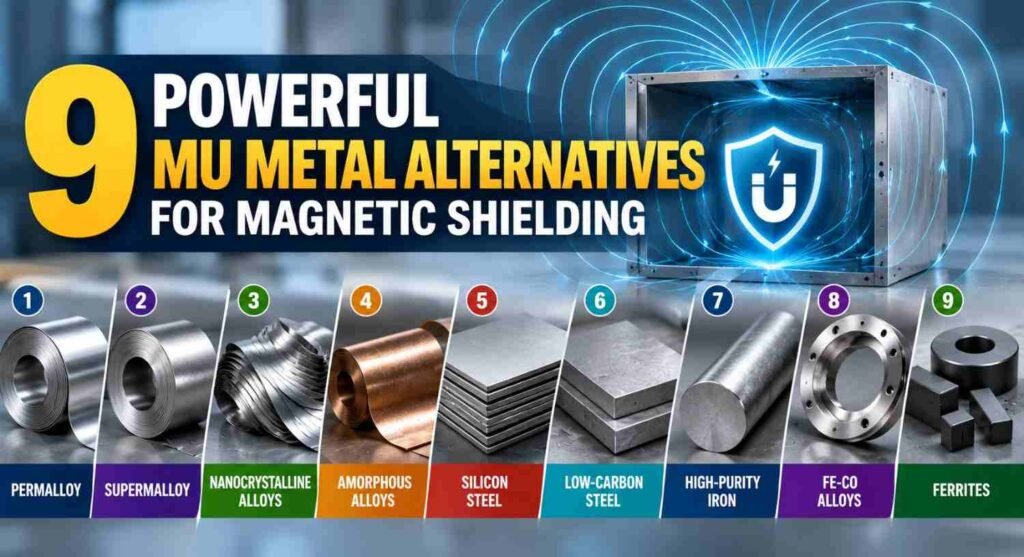
1. Permalloy – A High-Permeability Nickel-Iron Alternative
Permalloy is one of the closest Mu Metal Alternatives for Magnetic Shielding, offering excellent magnetic permeability and low coercivity. This family of soft magnetic nickel-iron alloys typically contains approximately 45–80% nickel, depending on the specific grade. High-nickel Permalloy is particularly effective in redirecting weak magnetic fields, making it suitable for sensitive electronic equipment and precision instruments.
Its high permeability and low coercive force support applications such as magnetic shielding enclosures, precision sensors, transformers, electronic measurement instruments, and laboratory equipment. However, its magnetic performance depends significantly on alloy composition and heat treatment. Since certain Permalloy grades closely resemble Mu Metal, engineers should verify the exact material specifications before selecting an alternative.
2. Supermalloy – Extremely High Magnetic Permeability
Supermalloy is another important material among Mu Metal Alternatives for Magnetic Shielding, particularly for applications requiring exceptionally high magnetic permeability. This specialised nickel-iron-molybdenum alloy typically contains approximately 79% nickel, 5% molybdenum, and the balance primarily iron. Its extremely low coercivity and magnetic hysteresis make it suitable for shielding sensitive equipment against weak magnetic fields.
Supermalloy is commonly considered for precision magnetic instruments, low-level magnetic sensors, sensitive electronic assemblies, magnetic amplifier components, and specialised low-field shielding systems. Its high initial permeability after appropriate annealing provides valuable magnetic performance. Nevertheless, mechanical stress, manufacturing processes, and heat treatment can influence its effectiveness, making careful material handling essential.
3. Nanocrystalline Magnetic Alloys – Advanced Shielding Materials
Nanocrystalline magnetic alloys are advanced Mu Metal Alternatives for Magnetic Shielding that combine high magnetic permeability with relatively high saturation flux density. These materials are manufactured through controlled crystallisation of rapidly solidified metallic ribbons and commonly contain iron, silicon, boron, niobium, and copper. Their specialised microstructure supports favourable magnetic properties across useful operating frequency ranges.
These alloys are widely used in current transformers, common-mode chokes, power electronics, EMI suppression components, and magnetic sensors. Their low magnetic losses and compact ribbon-based construction make them attractive for modern electronic applications. However, their thin-ribbon geometry and fabrication requirements must be considered when designing large magnetic shielding enclosures.
4. Amorphous Magnetic Alloys – Low-Loss Soft Magnetic Materials
Amorphous magnetic alloys, also known as metallic glasses, are valuable Mu Metal Alternatives for Magnetic Shielding in specialised applications requiring low magnetic losses. Unlike conventional crystalline metals, these materials have a non-crystalline atomic structure and are typically manufactured as thin ribbons through rapid solidification. Iron-based and cobalt-based amorphous alloys offer different combinations of magnetic permeability, electrical resistivity, and saturation flux density.
Their low hysteresis losses and relatively high electrical resistivity make them useful in high-efficiency transformers, magnetic sensors, power conversion systems, inductive components, and specialised shielding assemblies. These properties can improve magnetic performance under suitable operating conditions. However, their ribbon-based structure may require specialised fabrication techniques, particularly when producing complex shielding components.
5. Silicon Steel – A Practical Alternative for Stronger Magnetic Fields
Silicon steel, commonly called electrical steel, is one of the more economical Mu Metal Alternatives for Magnetic Shielding in applications involving stronger magnetic fields. This iron-silicon alloy is widely used in transformers, electric motors, generators, and industrial magnetic circuits. Although its weak-field permeability is generally lower than that of properly annealed Mu Metal, silicon steel offers higher saturation flux density and good magnetic flux-carrying capability.
Available in sheets and laminations, silicon steel is suitable for transformer enclosures, industrial magnetic shielding, power distribution equipment, motor assemblies, and magnetic flux management systems. Its commercial availability and relatively affordable cost make it practical for many industrial applications. Engineers often consider silicon steel when higher saturation capacity and cost efficiency are more important than extremely high initial permeability.
6. Low-Carbon Steel – Cost-Effective Magnetic Shielding
Low-carbon steel is a practical choice among Mu Metal Alternatives for Magnetic Shielding, especially for large industrial structures and cost-sensitive applications. Its iron-rich composition provides useful magnetic properties, including relatively high saturation flux density, mechanical strength, and good fabrication flexibility. Although its permeability in weak magnetic fields is generally lower than that of Mu Metal, it can handle higher magnetic flux densities before saturation.
Low-carbon steel is commonly considered for industrial equipment enclosures, magnetic field barriers, machinery installations, electrical housings, and multi-layer shielding systems. Its widespread availability and economical pricing make it attractive for large-scale manufacturing. However, magnetic performance varies with carbon content, heat treatment, and mechanical processing, so material selection should reflect the application’s specific shielding requirements.
7. Pure Iron and High-Purity Iron – High Saturation Magnetic Materials
High-purity iron is another useful option among Mu Metal Alternatives for Magnetic Shielding, particularly when high saturation flux density is essential. This soft magnetic material offers strong magnetic flux conduction and can provide low coercivity when properly processed. Its magnetic performance depends on purity, grain structure, heat treatment, and residual mechanical stress.
High-purity iron is used in magnetic pole pieces, electromagnetic equipment, scientific instruments, magnetic flux concentrators, and specialised shielding assemblies. Its ability to accommodate relatively high magnetic flux densities makes it valuable in stronger-field applications. Additionally, engineers may combine high-purity iron with high-permeability nickel-iron alloys in multi-layer shielding systems to achieve better performance across different magnetic field strengths.
8. Fe-Co Alloys – High Saturation Flux Density
Iron-cobalt alloys, commonly called Fe-Co alloys, are high-performance Mu Metal Alternatives for Magnetic Shielding when saturation resistance is a major design consideration. Certain specialised grades contain approximately 49% cobalt and are known for exceptionally high saturation flux density. These alloys provide strong magnetic flux-carrying capability, making them suitable for demanding electromagnetic systems.
Fe-Co alloys are used in aerospace electromagnetic equipment, high-performance motors, electromagnetic actuators, magnetic pole pieces, and specialised high-field shielding components. Their high saturation capability supports compact magnetic designs operating under demanding conditions. However, these materials are generally more expensive than conventional electrical steel, and their magnetic properties depend on composition, heat treatment, and fabrication methods.
9. Ferrites – Useful for High-Frequency Magnetic Applications
Ferrites are ceramic soft magnetic materials widely used in high-frequency magnetic interference control. They are important Mu Metal Alternatives for Magnetic Shielding in selected frequency-dependent applications, although their operating characteristics differ considerably from metallic nickel-iron alloys. Common types include manganese-zinc and nickel-zinc ferrites, which are manufactured using iron oxides combined with other metallic oxides.
Their high electrical resistivity helps reduce eddy-current losses, making them suitable for EMI suppression, high-frequency transformers, ferrite beads, cable cores, electronic filters, and RF-related magnetic components. Ferrites are available in different shapes, including toroids, beads, tiles, and custom components. However, their relatively low saturation flux density and frequency-dependent permeability mean they are generally unsuitable as direct replacements for Mu Metal in weak static or very-low-frequency magnetic shielding applications.
Mu Metal Alternatives for Magnetic Shielding: Comparison Table
The following comparison provides general material-selection guidance. Performance varies considerably by grade, thickness, processing, geometry, and operating conditions.
| Material | Main advantage | Important limitation | Typical suitability |
| Permalloy | High permeability | Stress-sensitive | Weak-field shielding |
| Supermalloy | Extremely high permeability | Requires careful processing | Precision low-field systems |
| Nanocrystalline alloys | High permeability and useful saturation | Ribbon fabrication constraints | Compact magnetic systems |
| Amorphous alloys | Low magnetic losses | Form and geometry limitations | Magnetic components |
| Silicon steel | Higher saturation, economical | Lower weak-field permeability | Industrial magnetic fields |
| Low-carbon steel | Affordable and strong | Variable magnetic performance | Large enclosures |
| High-purity iron | High saturation | Processing-sensitive | Flux management |
| Fe-Co alloys | Very high saturation | Higher cost | High-field applications |
| Ferrites | High-frequency loss control | Low saturation, brittle | EMI suppression |
How to Choose the Best Magnetic Shielding Material
Selecting the right Mu Metal Alternatives for Magnetic Shielding requires evaluating magnetic properties, operating conditions, material thickness, manufacturing processes, and overall cost. Understanding these factors helps engineers choose suitable materials for reliable magnetic protection.
1. Magnetic Field Strength
Magnetic field strength is an important consideration when selecting shielding materials. Weak magnetic fields often require alloys with extremely high permeability, such as Permalloy or Supermalloy. However, stronger magnetic fields may require materials with higher saturation flux density, including silicon steel or iron-cobalt alloys, to maintain effective shielding performance.
2. Operating Frequency
Operating frequency significantly influences the effectiveness of Mu Metal Alternatives for Magnetic Shielding. Static and low-frequency magnetic fields, including 50/60 Hz interference, often require high-permeability metallic alloys. In contrast, ferrites and specialised magnetic materials may be more suitable for certain high-frequency applications because of their electrical resistivity and frequency-dependent magnetic properties.
3. Magnetic Permeability
Magnetic permeability determines how easily a material supports magnetic flux. Materials with high permeability can redirect magnetic fields away from sensitive electronic components. However, initial, maximum, and differential permeability values vary depending on magnetic field strength and processing conditions. Therefore, engineers should evaluate material specifications under relevant operating conditions.
4. Saturation Flux Density
Saturation flux density is another critical factor when comparing Mu Metal Alternatives for Magnetic Shielding. Once a material approaches magnetic saturation, its ability to redirect additional magnetic flux decreases. High-saturation materials such as electrical steel, high-purity iron, and Fe-Co alloys can be useful in applications involving stronger magnetic fields.
5. Material Thickness and Shield Geometry
The effectiveness of magnetic shielding depends on material thickness, enclosure shape, openings, seams, and magnetic field direction. Thicker materials may provide greater magnetic flux-carrying capacity, while properly designed enclosures can improve shielding efficiency. For example, a closed cylindrical shield may perform differently from an open-ended enclosure manufactured using the same magnetic alloy.
6. Heat Treatment and Fabrication
Manufacturing processes such as bending, machining, welding, and forming can introduce mechanical stress that reduces magnetic permeability. High-permeability nickel-iron alloys are particularly sensitive to these changes. Consequently, appropriate heat treatment, including final magnetic annealing where required, helps restore magnetic performance and improve shielding reliability.
7. Cost and Availability
Cost and material availability play important roles when selecting Mu Metal Alternatives for Magnetic Shielding for industrial projects. Specialised nickel-rich alloys may provide excellent magnetic properties but can involve higher material and processing costs. Alternatively, silicon steel and low-carbon steel may offer more economical solutions when their magnetic performance meets the application’s technical requirements.
Can Different Magnetic Shielding Materials Be Combined?
Yes. Multi-layer magnetic shielding can provide advantages over a single material, particularly when magnetic field strength varies significantly.
For example, a design may combine:
- An outer layer of low-carbon steel to handle relatively strong magnetic fields.
- An inner layer of high-permeability nickel-iron alloy to reduce weaker residual magnetic fields.
- Appropriate spacing and geometry to improve overall performance.
However, layer order, dimensions, and spacing should be determined through magnetic analysis and testing rather than treated as a universal configuration.
Multi-layer systems are particularly relevant to scientific instruments, precision measurement systems, and sensitive electronic equipment.
Applications of Mu Metal Alternatives for Magnetic Shielding
Different magnetic materials support a broad range of industrial and scientific applications.

1. Medical and Diagnostic Equipment
Mu Metal Alternatives for Magnetic Shielding help protect sensitive diagnostic sensors and medical measurement electronics from external magnetic interference, supporting accurate readings and reliable equipment performance.
2. Aerospace and Defence Electronics
Specialised magnetic alloys can help reduce magnetic interference in navigation instruments, sensors, and precision electronic systems.
3. Industrial Automation
Mu Metal Alternatives for Magnetic Shielding are widely used to protect sensors, measurement equipment, transformers, and industrial control systems from unwanted magnetic interference.
4. Scientific Research Instruments
Mu Metal Alternatives for Magnetic Shielding are useful in sensitive scientific experiments and research instruments, helping control external magnetic interference and improve measurement accuracy.
5. Power Electronics
Mu Metal Alternatives for Magnetic Shielding, including nanocrystalline alloys, amorphous alloys, silicon steel, and ferrites, support efficient power conversion and electromagnetic interference suppression in advanced electronic systems.
6. Precision Measurement Systems
Mu Metal Alternatives for Magnetic Shielding, particularly high-permeability nickel-iron alloys, help protect magnetic sensors and precision measurement instruments from external magnetic interference, ensuring stable performance in low-field environments.
Is Mu Metal Always the Best Magnetic Shielding Material?
Not necessarily.
Mu Metal remains an important option for weak, low-frequency magnetic shielding because of its exceptionally high permeability after appropriate processing.
However, other materials may be preferable under different conditions.
For instance, silicon steel may be more practical for certain industrial applications involving stronger fields, while ferrites may be better suited to selected high-frequency interference problems.
Likewise, nanocrystalline alloys can provide advantages in compact magnetic components, and iron-cobalt alloys offer high saturation capability.
Ultimately, the best material depends on the shielding target, magnetic field strength, frequency, fabrication requirements, and project budget.
Conclusion
Choosing suitable Mu Metal Alternatives for Magnetic Shielding requires a clear understanding of magnetic permeability, saturation flux density, operating frequency, and manufacturing conditions.
Permalloy and Supermalloy are strong candidates for weak-field shielding, while nanocrystalline and amorphous alloys provide valuable options for specialised magnetic systems.
Silicon steel, low-carbon steel, high-purity iron, and iron-cobalt alloys can be useful where higher saturation capability is important. Ferrites, meanwhile, offer advantages in selected high-frequency interference applications.
No single material is ideal for every magnetic shielding requirement.
The most reliable approach is to match the material to the actual magnetic environment and validate the finished shielding design.
Looking for High-Performance Magnetic Shielding Materials?
DOMADIA™ supports industrial material sourcing requirements, including specialised magnetic shielding alloys and high-performance engineering materials.
Contact DOMADIA™ today with your required material grade, thickness, dimensions, specifications, and quantity to discuss your magnetic shielding requirements.
DOMADIA™ — Advanced Materials for Demanding Industrial Applications.
Talk to: Er.Pankaj Domadia | Kairav Domadia | Aadil Domadia | Pragati Sanap | Pooja N N
#MuMetal #MagneticShielding #MuMetalAlternatives #MagneticShieldingMaterials #Permalloy #Supermalloy #NanocrystallineAlloys #SiliconSteel #Ferrites #NickelIronAlloys #HighPermeabilityAlloys #SoftMagneticMaterials #EMIShielding #AdvancedMaterials #IndustrialMaterials #DOMADIA
Directly whatsapp us for an Enquiry: https://wa.link/kairav
DOMADIA™ has supplied industrial materials to Mumbai, Pune, Indore, Jaipur, and Surat—supporting industries across Maharashtra, Madhya Pradesh, Rajasthan, Gujarat, and Goa, with international exports to Germany, the USA, Japan, South Korea, and Italy.